• Following Us

  • Categories

  • Check out the Archives


  • Awards & Nominations

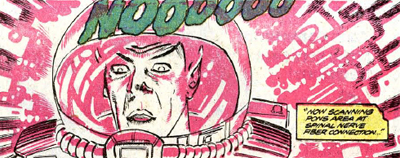
Star Trek (DC Comics, 1984) #1-6 – Errand of War! (Review)

This July, we’re taking a look at some classic Star Trek movie tie-ins. Check back daily for the latest reviews and retrospectives.

After Marvel lost the Star Trek license in 1982, there was a period where no monthly Star Trek comics were being published. One of the consequences of this was that Star Trek II: The Wrath of Khan didn’t receive an official comic book adaptation, until IDW decided to go back and fill in the blanks in 2009. Eventually, DC comics managed to secure the license for Star Trek comics, and they began publishing in 1984, the year that saw the release of Star Trek III: The Search for Spock. DC would maintain the license into the mid-nineties, making it one of the most stable licensing agreements ever reached about Star Trek comics.

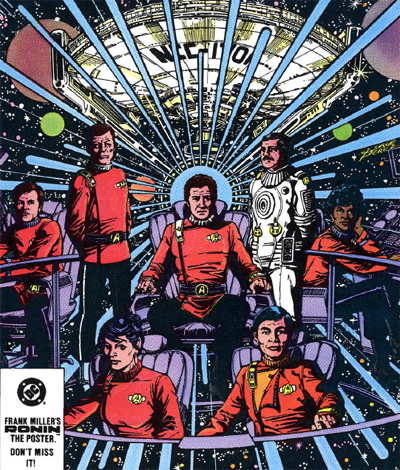
Unlike Marvel’s 1979 agreement with Paramount, DC reached an agreement that allowed them full access to the Star Trek mythology. Marvel had been restricted to using characters and concepts from Star Trek: The Motion Picture, a rather restrictive agreement. In contrast, DC had access to the whole of the Star Trek canon. Indeed, reading Mike Barr and Tom Sutton’s run on Star Trek, it seems like their opening six issues were designed to showcase the sheer breadth of continuity available to them.

At the same time, Barr’s scripts have a pulpy charm that makes them highly enjoyable, even as trying to tell an unfolding Star Trek story set between the events of The Wrath of Khan and The Search for Spock seems ill-advised.
Warp speed ahead...

Warp speed ahead…

Continue reading

Star Trek III: The Search for Spock (DC Comics, 1984) (Review)

This June, we’re taking a look at some classic Star Trek movie tie-ins. Check back daily for the latest reviews and retrospectives.

In 1984, DC secured the license to print Star Trek comics. They retained the license into the nineties, allowing the publisher to release their own comic book adaptations of each of the four remaining classic Star Trek movies. They even got to publish an adaptation of Star Trek: Generations before the rights transferred to Marvel. Mike W. Barr and Tom Sutton got to produce 64-page adaptations of Star Trek III: The Search for Spock and Star Trek IV: The Voyage Home, lending some consistency to the last two instalments in the trilogy that began with Star Trek II: The Wrath of Khan.

While its impressive visuals and relaxed pacing meant that Star Trek: The Motion Picture leant itself to a comic book adaptation, The Search for Spock is not quite as nice a fit for the medium. The movie’s plot is quite complicated, with lots of things going on at different times with different characters in different locations. One of the joys of the film is the way that it tries to turn Star Trek into an ensemble piece in Spock’s absence, with each of the main characters getting a moment in the sun during the Enterprise jailbreak. The comic simply doesn’t have the space to do this, and the result is an adaptation feels a little compressed.

At the same time, though, writer Mike W. Barr does get to showcase his love of the franchise, and his deft technical skill.

Let's see what's out there...

Let’s see what’s out there…

Continue reading

Star Trek: Khan – Ruling in Hell (Review)

This June, we’re taking a look at some classic Star Trek movie tie-ins and other interesting objects. Check back daily for the latest reviews and retrospectives.

Khan is a massively important figure in the grand mythology of Star Trek.

One need only look to Star Trek Into Darkness as proof of that assertion – a film that trades on how iconic the name “Khan” is, even to the most casual of fans. However, despite the fact that Khan has only appeared in a single episode and two feature films, each spaced apart by more than a decade, the character continues to exert a strong pull over the rest of the franchise. He is arguably more iconic and well-known than any lead character from a show produced after Star Trek: The Next Generation.

War of the supermen...

War of the supermen…

After all, Khan’s influence can be felt on just about every iteration of the franchise. On Star Trek: Deep Space Nine, he haunted the character of Julian Bashir. When the fourth season of Star Trek: Enterprise began its high-profile journey into the franchise’s continuity, Khan became something of a touchstone. The season’s first three-part episode (Borderland, Cold Station 12 and The Augments) was devoted to exploring the legacy of Khan Noonien Singh. Indeed, the show even tied Khan into the origin of the flat-foreheaded Klingons in Affliction and Divergence.

And yet, despite all this, there really is only so much material the character can support. Khan Noonien Singh is an iconic bad guy, but there’s a point where he ends up over-saturated.

The sands of time...

The sands of time…

Continue reading

Star Trek II: The Wrath of Khan (IDW, 2009) #1-3 (Review)

This June, we’re taking a look at some classic Star Trek movie tie-ins and other interesting objects. Check back daily for the latest reviews and retrospectives.

Due to bad timing, the Star Trek comic book license was between publishers when Star Trek II: The Wrath of Khan was released into cinemas in 1982. As the license transitioned between Marvel and DC, the movie adaptation got lost in the shuffle. As a result, the film was the only classic Star Trek film without a contemporary comic book adaptation. It remained that way for over a quarter of a century.

However, on the release of JJ Abrams’ rebooted Star Trek, current license holder IDW decided to release an omnibus of the classic movie adaptations as a tie-in. In doing so, they discovered a Wrath-of-Khan-sized hole in the collection, and so set about filling it with a three-issue miniseries that could be included in the omnibus for completeness’ sake.

Stationary orbit...

Stationary orbit…

Continue reading

Star Trek – Untold Voyages (Review)

This June, we’re taking a look at some classic Star Trek movie tie-ins and other interesting objects. Check back daily for the latest reviews and retrospectives.

There’s something of a continuity lacuna that exists between Star Trek: The Motion Picture and Star Trek II: The Wrath of Khan. Although the movies were released three years apart, more time appears to have passed for the characters themselves. Some of the changes are quite startling. After fighting so hard to get the Enterprise back in The Motion Picture, Kirk has retired to Earth once again at the start of The Wrath of Khan. After putting the Enterprise back in action in The Motion Picture, it has been converted into a cadet cruiser in The Wrath of Khan.

A lot of stuff has happened, and the gap is relatively under-explored by tie-in material. In contrast, the gap between The Turnabout Intruder (or The Counter-Clock Incident) and The Motion Picture is filled with all sorts of material designed to offer the show the type of closure that it never got on television. The same is true of the gap between The Cage and Where No Man Has Gone Before, with books and comics eager to offer accounts of Pike’s time in command and the transition to Captain James Tiberius Kirk.

Star Trek: Untold Voyages is a five-issue Marvel Comics series published in 1998 designed to bridge The Motion Picture and The Wrath of Khan. Although it wallows a bit in continuity and references, writer Glenn Greenberg uses the series to make some very clever and introspective points about Star Trek as a franchise – in effect, cleverly transitioning from Gene Roddenberry’s “future humans are the best” attitude toward Nicholas Meyer’s more reflective and introspective take on the characters and their world.

Shining star...

Shining star…

Continue reading

Star Trek: The Newspaper Strips – Called Home (Review)

This June, we’re taking a look at some classic Star Trek movie tie-ins and other interesting objects. Check back daily for the latest reviews and retrospectives.

It’s amazing how diverse and expansive the history of the Star Trek franchise is. Even odd little curiosities like the Gold Key Comics and The Newspaper Strips endure in one form or another – passed down over the years and lovingly maintained. There really are no truly forgotten pieces of Star Trek out there, and one of the great things about IDW’s management of the Star Trek license has been their willingness to dig into the annals of Star Trek history to produce some striking pieces of work.

(I am really hoping that their reprint programme extends at some point to include the British Star Trek comic strips, which were wonderfully dynamic pieces of work that were never properly reprinted outside the United Kingdom. However, given how thorough the reprint programme has been, it seems almost inevitable that those strips will see the light of day in some form or another.)

The Newspaper Strips were launched in 1979, débuting four days before the cinematic release of Star Trek: The Motion Picture. The strip only ran for until 1983, cancelled due to the fact that the market was crowded out with more popular science-fiction comic strips like Star Wars or Flash Gordon. Still, despite the ignominious finish for the strip, it is a fascinating piece of Star Trek history, an example of one of the many ways the franchise survived during its long hiatus from television.

tos-calledhome

Continue reading

Star Trek (Marvel Comics, 1979) #1-3 – The Motion Picture (Review)

This June, we’re taking a look at some classic Star Trek movie tie-ins and other interesting objects. Check back daily for the latest reviews and retrospectives.

What better way to announce the arrival of Star Trek at Marvel Comics than with an adaptation of Star Trek: The Motion Picture? Initially published as a giant Marvel Super-Size issue, the adaptation was subsequently split across the opening three issues of Marvel’s ill-fated Star Trek monthly.

It is worth noting that the franchise’s initial association with Marvel was relatively brief, with the Star Trek monthly series only lasting eighteen issues from 1979 through to 1982. In 1982, the Star Trek comic book franchise moved to DC Comics, where it remained until the nineties. Things became a bit more complicated at that stage, but it was a long-term relationship.

Still, in 1979, Marvel became the second company to publish monthly comics based around the Star Trek license. However, they were a substantially more impressive operation than Gold Key Comics, the previous license-holder. For example, this adaptation of The Motion Picture comes from some very talented creators, and its publication was treated as something of an event.

The light at the end of the tunnel...

The light at the end of the tunnel…

Continue reading

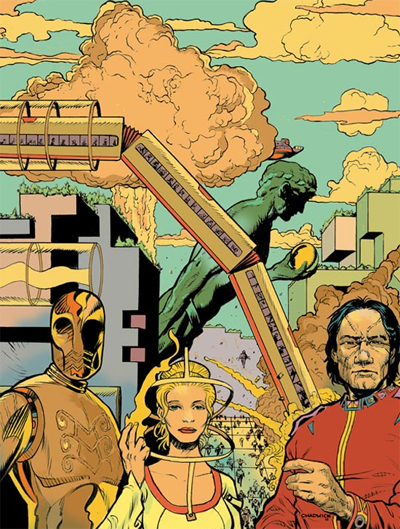
Harlan Ellison’s 7 Against Chaos (Review)

This June, we’re taking a look at some classic Star Trek movie tie-ins and other interesting objects. Check back daily for the latest reviews and retrospectives.

Star Trek: The Motion Picture went through a variety of iterations before settling on the version finally produced – a revised version of In Thy Image, the proposed pilot for the aborted Star Trek: Phase II television series. The story was devised by noted science-fiction author Alan Dean Foster, who had enjoyed a long relationship with the franchise – novelising episodes of Star Trek: The Animated Series earlier in the decade. Decades later, he would novelise the JJ Abrams films.

However, Foster was not the only noted science-fiction author who consulted on the development of what would become The Motion Picture. Theodore Sturgeon, who had contributed to the show, was among those contributing. Ray Bradbury, who Roddenberry had pursued to write for the show on several occasions but never did, also pitched. However, one of the more interesting ideas came from Harlan Ellison.

Ellison is a writer who will forever be associated with the franchise. He contributed the original teleplay for The City on the Edge of Forever, but was infamously displeased with how the episode turned out. He and Roddenberry had an acrimonious relationship after that point, with both sides prone to make cutting remarks and accusations across the aisle at one another. Roddenberry was fond to exaggerating or lying about Ellison’s original script, while Ellison was quite candid about his opinion of Roddenberry as a writer.

7againstchaos7

Continue reading

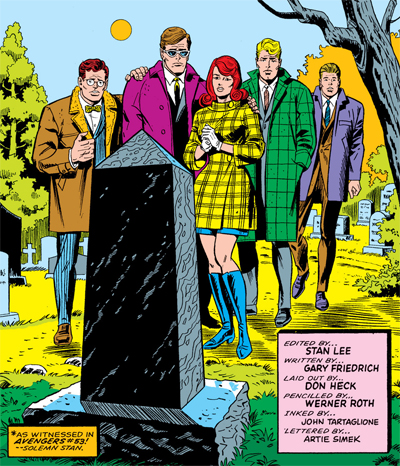
Gary Friedrich, Don Heck and Werner Roth’s X-Men – X-Men Omnibus, Vol. 2 (Review/Retrospective)

This May, to celebrate the release of X-Men: Days of Future Past, we’re taking a look at some classic and modern X-Men (and X-Men-related) comics. Check back daily for the latest review.

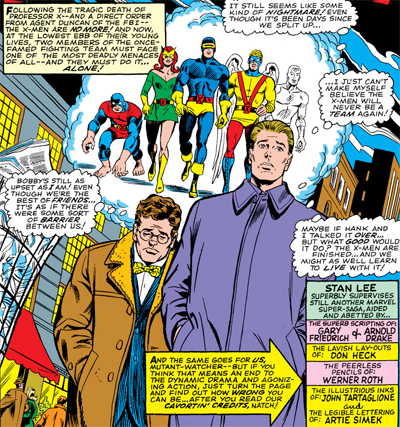
By the time that Gary Friedrich had taken over writing duties on X-Men, it was clear that the title was in trouble. To be fair, this has nothing to do with the rapid turnover of writing talent on the book. At this point in the history of Marvel, it often seemed like writers were wandering around the office waiting to fill any gap that happened to develop. Friedrich wasn’t a replacement for Roy Thomas as an attempt to herald a bold new direction for the book. Indeed, his first issue was a story pitched by Thomas.

However, at the same time, it’s quite clear that X-Men was struggling to stay afloat. The comic was seemingly re-tooling itself month-in and month-out. Professor Xavier had been killed off towards the end of Roy Thomas’ last run. The cover now trumpeted individual members of the cast and back-up stories opted to focus on characters within the team, hoping they might find an audience as solo super heroes.

The first death of the dream...

The first death of the dream…

This trend continued into Gary Friedrich’s short tenure as X-Men writer. The first issue of Gary Friedrich’s run focuses on a guest star from the golden age, while his last solo script dissolves the X-Men as a team. In the middle, there’s a crossover with The Avengers. This was a very troubled book entering its fourth year, and the fact that it could not seem to settle on a single creative team or direction contributed to that sense of listlessness.

X-Men was a book that simply wasn’t working.

These men... these X-Men!

These men… these X-Men!

Continue reading

X-Men: The End – Book Three: Men and X-Men (Review/Retrospective)

This May, to celebrate the release of X-Men: Days of Future Past, we’re taking a look at some classic and modern X-Men (and X-Men-related) comics. Check back daily for the latest review.

Chris Claremont struggles with endings. As a writer, Claremont works very well within the structure of a continuing narrative. His stories tend to resolve in such a way that story threads dangle, allowing him to pick up those threads for more stories. Claremont is very good at telling an on-going story, at keeping the wheels spinning and moving. One story leads to another, and that story leads to another. As The Dark Phoenix Saga wraps up Jean Grey’s arc, it introduces Kitty Pryde.

This isn’t really a problem on mainstream comic books. After all, Claremont wrote Uncanny X-Men for seventeen years, and it was structured as an on-going and evolving story. There are obvious “cut-off” points for certain sections of his run – The Dark Phoenix Saga and Inferno come to mind – but they never feel like they resolve everything. There are always just enough plot points carried over for the book to keep moving, to the point where saying “this run ends here” would involve chopping off significant story points.

.. in the name of love...

.. in the name of love…

Claremont’s difficulty with endings is reflected with the closure of his run on the titles in the early nineties. He left Uncanny X-Men with a minimum of ceremony. The book was handed from Chris Claremont to Fabian Nicieza in the middle of The Muir Island Saga. Claremont’s big goodbye to the title was the opening three-issue arc on adjectiveless X-Men, a story that found itself functioning as both a beginning and an end. In those three issue, it seemed like the only character arc Claremont resolved was that of Magneto.

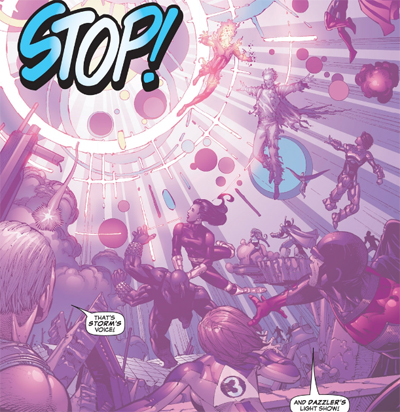
So, it isn’t a surprise that Men and X-Men is a glorious mess. It is essentially one giant and protracted fight sequence between the X-Men and Shi’ar, drawing in cameos from across the breadth of X-Men history. The fact that this should be the last story told featuring these characters feels a little arbitrary, with quite a lot of Men and X-Men feeling like Claremont is running through a laundry list of things he needs to resolve before the curtain drops.

Flight of the Phoenix...

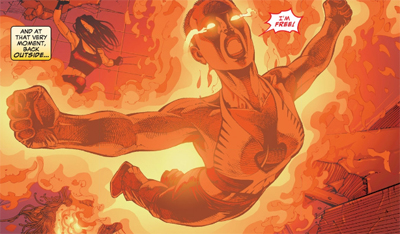
Flight of the Phoenix…

At the same time, there is something quite charming about Men and X-Men, as Claremont seems to suggest that this final gigantic superhero battle actually means very little in the grand scheme of things. Various plot points and threats resolve in whimpers rather than bangs, while Claremont suggests that this is an elaborate six-issue misdirection. We are not looking at what we should be looking at.

It’s the smaller moments that feel earned, even if the larger story around them is a complete mess.

One last stab at fixing everything...

One last stab at fixing everything…

Continue reading