• Following Us

  • Categories

  • Check out the Archives


  • Awards & Nominations

Non-Review Review: I, Daniel Blake

I, Daniel Blake is seething with a righteous anger.

To be fair, this is very much what one might expect from Ken Loach. Loach is a very socially conscious filmmaker, with films like Cathy Come Home and The Riff-Raff exploring themes related to poverty and working class life in twentieth and twenty-first century Britain. I, Daniel Blake offers a timely and searing critique of the government policies that have left the working class tired and resentful. It is a searing portrayal of twenty-first century Britain, perhaps even more timely now than when it won the Palme d’Or in May.

Sign of the times.

Sign of the times.

I, Daniel Blake is anchored in two fantastic central performances. Dave Johns is mesmerising as the title character, a middle-aged widower facing a humiliating gauntlet of public sector bureaucracy in order to claim benefits to help him recover from a heart attack. Hayley Squires is impressive as Katie, a single mother moved to a strange town struggling to make ends meet anyway she can. Johns and Squires bring a humanity to I, Daniel Blake that balances well against Loach’s sheer unadulterated contempt for the status quo.

There are times at which I, Daniel Blake threatens to turn into a polemic, an angry rant more than a narrative. However, the performances keep the film grounded. More than that, Loach’s piping hot fury feels so necessary and so timely that any heavy-handedness can be excused.

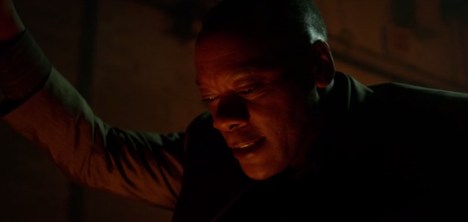
Flat-out contempt.

Flat-out contempt.

Continue reading

Luke Cage – Soliloquy of Chaos (Review)

However complicated (and contradictory) its politics might be, Luke Cage has its heart in the right place.

What is most striking about the series, watching it from beginning to end, is the enthusiasm with which the series embraces its superhero roots. In many ways, Luke Cage is a much more traditional and conventional superhero story than Daredevil or Jessica Jones. In fact, it is a much more conventional superhero story than Captain America: Civil War or Batman vs. Superman: Dawn of Justice or Deadpool. It is almost certainly the most old-fashioned live action superhero story since Thor.

lukecage-soliliqueyofchaos17a

Luke Cage is a television series that understands the iconic power of superhero narratives, the appeal and resonance that such stories hold. It is a show that recognises the way that such stories elevate essential aspects of the American experience to mythic status. This is true of the genre in general, with its emphasis on rugged individualism outside conventional power structures. However, it is also true of specific heroes. What is Superman by a mythic tale of the immigrant experience? What is Spider-Man but the oft-referenced “little guy” filtered through teen life?

More than any other superhero adaptation in recent memory, Luke Cage fundamentally understands that and pitches its story squarely at mythologising certain aspects of the African American experience.

lukecage-soliliqueyofchaos27

Continue reading

Non-Review Review: Inferno

Inferno is not a good movie.

It is clunky and contrived, moving at so gentle a pace that even the character need to constantly remind each other that the fate of the human race lies in the balance. Its action sequences are clumsily staged, its twists are all entirely predictable and its impressive international cast strain to stretch their roles out to two dimensions. This is a film that has trouble generating tension despite the fact that there is an imminent threat to half of the world’s population. Inferno simply doesn’t work.

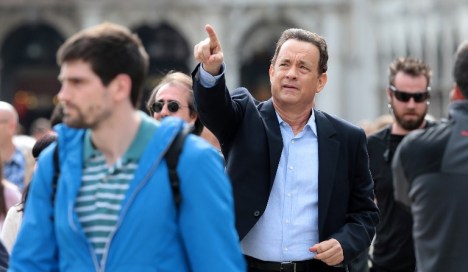
"It says... 'one if by land, two if by sea'?"

“It says… ‘one if by land, two if by sea’?”

And yet, in spite of all that, there is something strangely compelling about it. Inferno is amess of a film, but one that holds attention by virtue of how strikingly odd it is. Inferno feels very much like a James Bond film, if only they’d sanded down the rough edges of that nice old Roger Moore fellow, cast that quirky uncle who is really useful at table quizzes, and combined it with something like The Crystal Maze. The film plays like afternoon television on an epic scale, with Robert Langdon feeling like he could call in a favour from Perry Mason or R. Quincy at any moment.

Inferno is strange enough that it holds interest, feeling more unique than the recycled pseudo-histories of The DaVinci Code or Angels and Demons. There is an endearing eccentricity to the film, which might just be the gentlest apocalyptic thriller ever made. It is a weekday afternoon blockbuster.

"I belong in a museum!"

“I belong in a museum!”

Continue reading

Star Trek: Deep Space Nine – Things Past (Review)

At a time when Star Trek: Voyager was working very hard to disentangle itself from its own past, Star Trek: Deep Space Nine committed to exploring its own.

Things Past hits on one the big recurring themes of the series in general and fifth season in particular. Deep Space Nine has always been a show about memory and history, the relationship between past, present and future that is seldom as clear-cut as one might like it to be. Across the show’s run, characters are constantly exploring and re-evaluating their own histories. This has always been the case, dating back to Sisko working through his trauma with the Prophets in Emissary, Kira facing her past in Past Prologue and Odo doing the same in A Man Alone.

"You know, my subconscious can be pretty heavy handed."

“You know, my subconscious can be pretty heavy handed.”

At this point, Deep Space Nine has been on the air for over four years. Many other shows would already have moved on from their foundational premises. Voyager has already completely forgotten what it originally promised, and it is less than half way through its third season. However, the fifth season finds Deep Space Nine engaging repeatedly and enthusiastically with a history that stems back to before the events of the first episode. The characters on Deep Space Nine are shaped and informed by events that occurred long before fate or chance brought them together.

Some of these episodes work better than others, but the fifth season is still fascinated with the characters’ lives long before the series began. Let He Who Is Without Sin… attempted to build a story like this around Worf, playing almost as a parody of this kind of storytelling. Doctor Bashir, I Presume walks a very fine line between when it comes to exploring Bashir’s secret history. Empok Nor returns to the question of whether O’Brien is an engineer or a soldier in a much pulpier and trashier vein than earlier episodes like Hippocratic Oath.

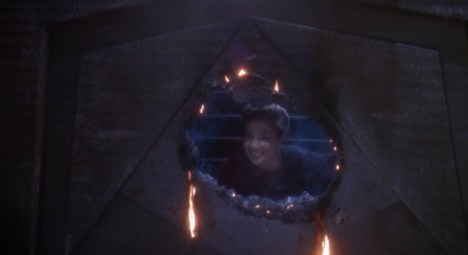
The hole in things...

The hole in things…

Unsurprisingly, the best examples of these sorts of stories tend to focus on the characters who were actually around Terok Nor during the Occupation. The Darkness and the Light and Ties of Blood and Water, the two episodes focusing on Kira, are among the strongest of the season. They also have some pretty great titles, although neither is quite Wrongs Darker Than Death or Night. However, it is Things Past that marks the fifth season’s first trip back to the Cardassian Occupation, telling the story from Odo’s perspective.

It is an episode that really pushes Odo, to the point where it seems like the changeling might snap. “Nobody ever had to teach me the justice trick,” Odo monologued in Necessary Evil, way back in the second season. “That’s something I’ve always known.” Over the course of Things Past, Odo must eventually admit that this is not the case.

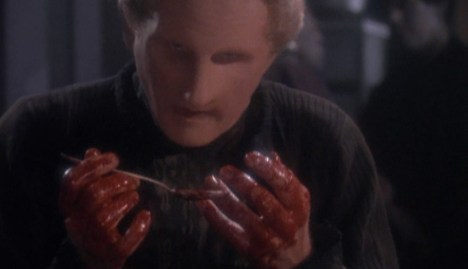
Barriers to entry.

Barriers to entry.

Continue reading

Luke Cage – Now You’re Mine (Review)

Now You’re Mine represents the action climax of Luke Cage.

It is very much a stock action episode. Stryker has taken a bunch of hostages at Harlem’s Paradise, and is holding them at gunpoint. Meanwhile, the police are massing outside, contemplating whether to breach and believing that Luke Cage is responsible. At the same time, Luke is trapped inside the club with Misty, who was wounded in the shootout. The characters are all locked in a confined space together with lots of automatic weapons, and the inevitable results.

lukecage-nowyourmine14a

It is quite thrilling in execution. Luke and Misty are forced to hide in the basement as Stryker stalls the cops. Shades worries that his boss has gone off the deep end, while Claire tries to improvise her way out of the crisis. Meanwhile, Ridley is managing the crisis from the outside in with the assistance of Assistant District Attorney Blake Tower, watching the sort of political manoeuvring that unfolds as the crisis builds towards a massive firefight and a confrontation between all of the major players involved in the show.

The only problem is that there are two more episodes left in the season.

lukecage-nowyourmine11a

Continue reading

Luke Cage – Take It Personal (Review)

The politics of Luke Cage are kind of tricky.

To be fair, a lot of this has very little to do with the show itself. Luke Cage is the first Marvel Studios project headlined by a black character. It is also the most high-profile black superhero project since Catwoman and Blade: Trinity in 2004. More than that, it is the first major African American superhero story of the modern franchise age, arriving on Netflix two years before the scheduled release of Ryan Coolger’s Black Panther adaptation. This means that Luke Cage carries a phenomenal burden of representation.

lukecage-takeitpersonal35a

More than that, Luke Cage arrives at a time when racial politics are more overt than they have been in a very long time. The politics of race have long been an essential part of American political discourse, but they have seldom been placed front and centre in the way that they have been over the past couple of years; the shooting of Trayvon Martin by vigilante George Zimmerman, the high-profile deaths of young black men at the hands of law enforcement, the protests in Ferguson, scandals like the poisoned water in Flint.

When Luke Cage was released to stream, the United States was in the middle of a particularly heated (and racially charged) election cycle. The Republican Presidential nominee, Donald Trump, was threatening to deport Mexican immigrants and build a wall along the border. A cornerstone of the Republican primaries had been a debate about limiting immigration of Muslims. Trump described African American communities in apocalyptic terms, while also arguing that talk of racism was more damaging than racism itself. Trump appealed to resurgent white nationalism.

lukecage-takeitpersonal25a

This was the climate in which Luke Cage was released. As such, the show was always going to be political, whether it chose to engage with those politics in a literal manner or otherwise. As showrunner Cheo Hodari Coker argued at Comic Con in 2015 and as Method Man explicitly states in Soliloquy of Chaos, the world is ready for a bulletproof black man. No matter what story Coker and his team chose to tell, there would always be a raw political element to the story.

At the same time, there is also a certain clumsiness to the show’s politics that become clear in the way that Take it Personal deals with some of that baggage.

lukecage-takeitpersonal15a

Continue reading

Luke Cage – DWYCK (Review)

DWYCK opens with a long take, staring at Misty Knight.

As brought to life by Simone Missick, Misty Knight is another example of just how carefully and how effectively Luke Cage draws its characters. Missick has earned a lot of praise for her work in the role, with many fans and commentators even calling for a solo vehicle built around the detective. Knight is a fascinating and well-drawn character. She has been so since her first appearance in the show, flirting with Luke Cage over the bar in Moment of Truth. However, the show has given the character more to play with as it progresses.

lukecage-dwyck

In fact, the second half of the show represents something of a pivot towards the female members of the ensemble. Following the death of Cornell in Manifest and the arrival of Stryker in Blowin’ Up the Spot, the series has taken a renewed interest in its female characters. Indeed, the last six episodes of the season take a create deal of pleasure in throwing actors like Simone Missick, Rosario Dawson, Alfre Woodard and Karen Pittman into scenes together. Indeed, with the conflict between Luke and Stryker feeling rather generic, these scenes are where the spark lies.

DWYCK does an excellent job setting the tone for the second half of the season.

lukecage-dwyck6a

Continue reading

Star Trek: Voyager – Future’s End, Part II (Review)

In a very real way, the Rick Berman era of Star Trek ends with Future’s End, Part I and Future’s End, Part II.

Future’s End, Part I and Future’s End, Part II marks the point at which Star Trek: Voyager stops moving forward. It is the point at which the show decides that it has accomplished just about everything that it could ever want to accomplish, and that it has crystalised into its final form. There are some changes still to come, with the introduction of Jeri Ryan in Scorpion, Part II and the departure of Jeri Taylor following Hope and Fear, but (by and large) the show has pretty much figured out the kinds of stories that it wants to tell and the ways in which it wants to tell those stories.

More like a hole-o deck character...

More like a hole-o deck character…

Future’s End, Part I and Future’s End, Part II feels like an appropriate place at which to draw that line in the sand. It is the two-parter that really introduces the concept of big blockbuster storytelling to Voyager, and which restructures the series as a mechanism through which generic Star Trek stories might be told. The template for the remaining three-and-a-half seasons can be found in this episode, from the “everything is back to normal” ending through to the idea of giving Janeway a a singular action-movie antagonist against which she might define herself.

The two-parter seems to freeze Voyager in amber, and set its storytelling sensibilities in stone. There will be no more experimentation, no more evolution. This is how things are to be from this point onwards. Appropriately enough, Future’s End, Part I and Future’s End, Part II mark the future’s end.

Tom and Tuvok's Bogus Journey...

Tom and Tuvok’s Bogus Journey…

Continue reading

Luke Cage – Blowin’ Up the Spot (Review)

Blowin’ Up the Spot renews the emphasis on Luke Cage as a blaxploitation superhero, to an extent not seen since Step in the Arena.

Cornell Stokes was shuffled off the stage at the end of Manifest to make room for Willis Stryker. Stryker has lurked at the edge of Luke Cage‘s narrative since Moment of Truth, nominally represented by the mysterious gangster known as “Shades.” Stryker has been a mysterious and ominous presence, a business associate of Cornell’s with designs upon Harlem. His name is whispered in conversations, the characters sharing some unspoken understanding of who he is and what he does in a way that evokes the way criminals spoke of Wilson Fisk in the early episodes of Daredevil.

lukecage-blowinupthespot4

However, Blowin’ Up the Spot wastes no time in establishing Stryker as a new antagonist for Luke Cage. The character was teased in the closing minutes of Manifest, offering Luke “one Judas for another.” He is very much front and centre in Blowin’ Up the Spot. The episode’s teaser closes on the image of Stryker dressed in a bulletproof vest, standing beside a humvee and carrying a grenade launcher. There is no ambiguity there, no subtlety. Stryker has arrived in force, and is ready to take centre stage.

After all, Luke Cage is a superhero story. And every superhero story needs a super villain.

lukecage-blowinupthespot31a

Continue reading

Luke Cage – Manifest (Review)

By and large, the first season of Luke Cage is not a radically subversive superhero tale.

Indeed, a lot of the show’s strengths come from how steadily and reliably it hits on the expected superhero plot beats while reconfiguring them for this particular hero at this particular time: Pop as Uncle Ben in Code of the Streets; the superhero origin story in Step in the Arena; the hero hunted by the authorities in Soliloquy of Chaos; the secret family tree drama in Take it Personal; the throwdown with the super villain ascendant in the streets in You Know my Steez.

lukecage-manifest33a

These are all familiar elements of the archetypal superhero story, but pivoted around the idea that Luke Cage is fundamentally a black superhero story and rooted in those experiences as well. As such, Manifest represents the sharpest and most subversive twist on the format of the first season. After spending six episodes establishing the character of Cornell “Cottonmouth” Stokes and elevating him to the status of primary antagonist in Luke’s battle for the heart and soul of Harlem, Cornell is unceremoniously and brutally murdered. And not even by Luke Cage.

It is a wry and a clever twist, perhaps the most daring storytelling decision of the entire season. It is visceral, and enough to jolt the series back to life after Luke reached the climax of his own emotional arc in Just to Get a Rep. Of course, this bold decision to kill off the presumptive primary antagonist half way through the season causes its fair share of problems in the season’s troubled second half, but it is still a striking and bold choice for a series that largely played by the rules to this point.

lukecage-manifest4

Continue reading