












“At least your special effects are improving.”
To be fair, a pretty solid run had to end at some point, and a Pete McTighe script is as good a place as any.
Lucky Day is an interesting episode. It solidifies the sense of this second Davies era as its own distinct object with its own distinct rhythms and structures. Just as one might pair Space Babies and The Robot Revolution, The Devil’s Chord and Lux, or Boom and The Well, Lucky Day is very obviously designed for the same slot as 73 Yards. This is another Doctor-lite episode built around Ruby Sunday, featuring U.N.I.T., set on contemporary Earth. It even brushes against rural folk horror, invoking The Wicker Man in its discussion of English villages.

Food for thought.
However, the episode takes a sharp and ambitious turn in its second half. As with a lot of recent Doctor Who, Lucky Day is an episode engaged with the larger context of the show and its place in the popular discourse. It is obviously structured around things that matter to both Davies and McTighe. It is commendably self-aware and playful. There is, on paper, a lot to appreciate about Lucky Day.
The problem is the execution, as the episode’s themes break like waves against the actual narrative itself. Lucky Day only really makes sense as metatext, but cannot support the weight of its big ideas whether inside or outside the fictional universe. It’s an unlucky break.
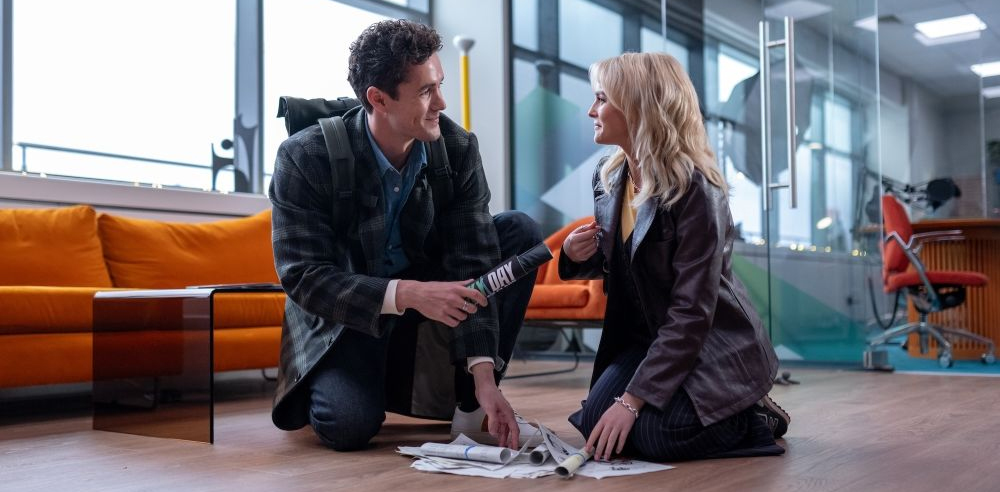
Absolutely floored.
It is tempting to situate Lucky Day in the larger context of Pete McTighe’s contributions to Doctor Who. Certainly, the episode makes a certain amount of sense as a McTighe script. McTighe is the architect of the promotional videos for the blu ray boxsets of classic Doctor Who, often built around the lives of companions like Jo, Mel, Peri and Ace after their departure from the show. Lucky Day is a logical extension of that body of work, an episode built around Ruby Sunday following her departure in Empire of Death.
This is a clever hook for an episode on its own. Davies has long been fascinated by what happens to a companion after they leave Doctor Who, as demonstrated by his use of Sarah Jane in School Reunion, Martha in The Sontaran Stratagem and The Poison Sky and even Donna’s return in Partners in Crime. Davies has long been fascinated by what it means for a companion to return to the normal world after leaving the TARDIS.
While Lucky Day is obviously in conversation with those early takes on the topic, it is also a clear escalation. Barring two flashbacks and a late cameo, the Doctor does not appear in Lucky Day. Lucky Day is built entirely around Ruby Sunday and her attempt to get back to life following her time in the TARDIS. It’s a more structurally ambitious take on something that Davies has clearly thought about, and so feels like a logical escalation of his previous work. In short, it’s a nice illustration of the potential of this era.
However, the episode falls apart when it comes to the actual story that the show chooses to tell with Ruby. Lucky Day is a story about toxic fandom and masculine anxieties that manifest in the worst way possible. Again, this feels like something familiar to McTighe. McTighe was the credited writer on Kerblam!, the episode in which the Chibnall era finally and inevitably completely came off the rails. That was another story about an angry young man channeling his resentment into destruction and chaos.

Finally, Doctor Who confronts the real monster: podcasters.
The biggest issue with Kerblam! was that it lacked any larger context. It understood male rage and entitlement, but never engaged with the question of what had provoked such anger. It never exploring the target of such madness. Kerblam! is an episode that culminates in the Doctor saving space!Amazon because she likes its corporate mascot, boldly declaring, “The systems aren’t the problem!” It was a moment that crystalised the limitations of Chibnall’s vision of Doctor Who, and demonstrated its central unresolvable tensions.
As such, it’s probably unfair to put all the blame for Kerblam! on McTighe. However, it’s interesting that Lucky Day has a version of the exact same problem, right down to illustrating Davies’ own blind spots when comes to writing Doctor Who. It is a long-term problem with a fundamental aspect of the show, and it’s a tension that the series has never really been able to resolve. The problem is that Lucky Day builds its entire premise out from that big flawed foundation.
Lucky Day is very obviously an episode about fandom. It is an obvious companion piece to Love and Monsters from Davies’ original tenure. Indeed, the start of the episode feels very similar to Love and Monsters, with Conrad’s childhood encounter with the Doctor recalling Elton’s origin story and even the use and design of the Shreek evoking the Hoix. Love and Monsters was engaged with an older notion of fandom, with Victor Kennedy obviously suggesting Ian Levine. Lucky Day uses this similar premise to explore a more modern expression of fandom toxicity, that is tied to larger political issues.
Davies is very obviously interested in this modern culture of hatred and paranoia. The starting premise of The Giggle was the idea that mass media had driven the human race insane, turning them into self-centred monsters. Lucky Day is very obviously in conversation with those early scenes from The Giggle, marking a return to U.N.I.T. Tower and even featuring a cameo from Trinity Wells as an American conspiracy theorist.
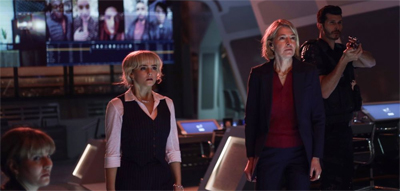
Absolute U.N.I.T.
In particular, Lucky Day is engaged with the legacy of the global international pandemic and the wave of insanity that spun out of social media in response to that. “Masks” are a major recurring motif in the episode, recalling the way that the act of wearing a mask became a cultural and political signifier. “Everyone is taking their masks off,” a comedian quips on television. “What’s behind your mask, Conrad?” Kate challenges Conrad at one point. The chant “U.N.I.T. lies, U.N.I.T. spies” even recalls “Trump lied, people died.”
The subject of vaccine conspiracy theories also haunts Lucky Day. The climax of the episode is only made possible because Conrad refuses to drink the antidote that Ruby provides to the Shreek pheromones. He claims not to have taken it during the staged attack on the pub, and he clearly has not taken it by the time the creature gets loose in U.N.I.T. Tower, because he is broadcasting that the Shreek – and therefore the antidote – do not exist and are not real.
This is fairly hefty subject matter, and it is a lot to put on an episode of Doctor Who. It is admittedly a very big swing for the show, and it is in someways commendable to see Lucky Day deal with this sort of reality in such a direct and aggressive way. There is very little concession made to Conrad and his followers. The show’s contempt for the real-life hucksters is endearing and well-earned.
The problem is the execution. Lucky Day is focused around U.N.I.T. This makes sense from a pragmatic and narrative standpoint. The supporting cast is already established. The set has been built. U.N.I.T. are a fixture of Doctor Who lore. Davies has established U.N.I.T. as a home for veteran companions. A U.N.I.T. spin-off seems inevitable, even setting aside The Battle Between Land and Sea, so it makes sense to build a Doctor-lite episode around U.N.I.T.
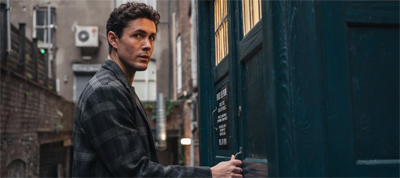
Tardy to the TARDIS.
The problem is that U.N.I.T. really does not work as a metaphor for either the global healthcare system in particular or the concept of democracy in general. U.N.I.T. is a cool science-fiction spy agency that operates outside the boundaries and structures of civilised society, dealing with absurd and fantastical elements of this imaginary universe. They are a handy plot device and a fun bit of Doctor Who continuity.
However, they also come with baggage, in that the primary plot function of U.N.I.T. is to show up with big guns. Then, they either mess up a situation that the Doctor needs to solve or just serve at the behest of the Doctor. Finally, they tidy up the situation in such a way that Doctor Who can continue to unfold in a universe that loosely resembles the real world. This usually involves some sort of cover-up, often treated as a joke. U.N.I.T. are a handy bit of shorthand for a show like Doctor Who.
There is a sense that, by its nature, U.N.I.T. is not designed to withstand any real weight or scrutiny. There is a reason why the acronym has shifted over the years and why the history of the organisation is so muddled. If anyone, including Doctor Who itself, starts to think about U.N.I.T. too heavily, the show threatens to cave in.
This is quite apparent in Lucky Day. It is clear in small ways from the outset. Conrad first properly meets Ruby when she appears on his podcast. She states, bluntly, “Aliens are real. We all know that.” This is a strange line. It is obviously true within the world of Doctor Who, where the world has been subject to a seemingly endless series of alien invasions. However, outside of the show’s continuity, it is exactly the sort of conspiratorial thinking espoused by people like Conrad. There are entire podcast ecosystems dedicated to that sort of argument.
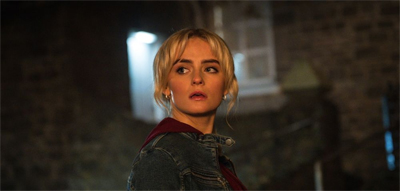
Ruby gets a chance to shine.
Ruby just shows up on a podcast, announces that the Doctor is real and that U.N.I.T. exists. “There’s no reason to be scared,” she tells listeners. “I mean the people at U.N.I.T. are doing good work, keeping us safe.” This immediately generates a real tension within the episode. This is immediately more public-facing than the Doctor and U.N.I.T. have ever seemed within the reality of Doctor Who, doing literal podcast appearances. Conrad’s argument is built around the idea that U.N.I.T. is too secretive, which makes sense historically, but is at odds with what Lucky Day exposits.
Watching Lucky Day, it is possible to wonder if the entire problem within the episode arises because U.N.I.T. is not as fascistic is it used to be. Maybe U.N.I.T. should go around wiping witnesses’ memories and destroying evidence and silencing dissent. It would certainly make Conrad less effective against them. Also, it would make U.N.I.T. much more efficient in the context of Doctor Who.
After all, the biggest problem with Lucky Day is that Conrad is kinda right. Obviously, anti-vaccine nonsense and the alt-right are actively dangerous to modern society. However, U.N.I.T. is not the World Health Organization. It is a gigantic global paramilitary force with superweapons and gigantic guns, that seems to be completely unaccountable to any public body.
At one point, Kate returns from a meeting with the British government, complaining that Whitehall might request “a full inventory of U.N.I.T. property.” That is probably a good idea, to be honest. It is probably worth knowing all of the potential world-ending threats that are being stored in central London. “Our technology would tear the world apart,” she opines, which neatly glosses over the question of what that implies about U.N.I.T. being the one entity with exclusive access to such technology.
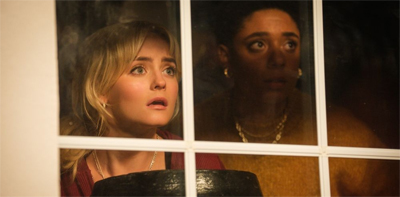
The inside looking out.
Davies has obviously taken some of his cues from superhero blockbusters in reconfiguring Doctor Who. It’s interesting that the siege of U.N.I.T. Tower happens the same week that Thunderbolts* reveals the entity of the person who purchased Avengers Tower back in Spider-Man: Homecoming. In this reimagined Doctor Who, U.N.I.T. operates by the logic of modern superhero movies: maximum power and minimum responsibility, with any attempt to interrogate that dynamic treated as inherently hostile to the larger franchise.
At the climax of the episode, Kate basically uses the Shreek to publicly humiliate and torture Conrad. It’s a moment that is cathartic, for Kate and for Ruby and for the audience. While Lucky Day toys with making this a moment of moral ambiguity for Kate, it also makes it clear that Kate knows what she is doing and is not going to cross the line. This is less skeptical of Kate Lethbridge-Stewart than The Zygon Invasion and The Zygon Inversion are. “Last night went way too far,” Colonel Ibrahim states, suggesting that Geneva will want oversight, as if oversight is an inherently bad thing.
To be fair, this is a longstanding tension within Doctor Who, a show about an alien who hates guns but counts a character who famously ordered “five rounds rapid” among his closest personal friends. Doctor Who is a show that is anarchistic and skeptical of authority, but which also kinda loves the military organisation that shows up dressed in black and carrying big guns.
Lucky Day tries to use U.N.I.T. as a metaphor for Doctor Who itself, and while this perhaps makes sense in the specific context of the influence of Disney on the budget, it also somewhat misunderstands the appeal of Doctor Who. U.N.I.T. is a paramilitary organisation that houses existential threats to mankind. If it actually existed, it should probably be subject to the sort of scrutiny and oversight that Conrad is suggesting.
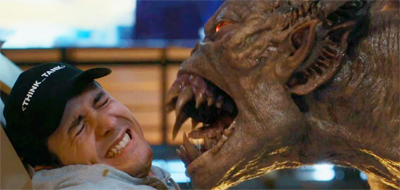
Mr. Beast.
Indeed, it is worth acknowledging that the entire plot happens because Ruby conspires to meet Conrad under false circumstances. During their lunch date, it becomes clear that Ruby didn’t respond to that social media tag because she wanted to, she responded as a pretense to get close enough to Conrad to convince him to take the antidote for he pheromone. It is a minor deception in the grand scheme of things, particularly considering what Conrad does, but it is still illustrative of how U.N.I.T. operates and why a little mistrust might make sense.
As such, the narrative of Lucky Day simply does not work. It makes no sense. This is obvious at the point of the turn, in which Conrad lures Ruby to a remote village and stages an attack by the Shreek. This is, in isolation, a very clever twist. It is very similar to The Rescue, a story in which an actor in an unconvincing rubber suit is revealed to be an actor in an unconvincing rubber suit. As with a lot of Doctor Who, it is very self-aware and playful, with Conrad describing the scene like a Doctor Who production populated by “actors and special effects.”
However, while the scene is clever, it makes no sense dramatically. Conrad boasts that he has lured U.N.I.T. out into the open to prove that “all this talk of monsters is just a cover story for something else.” However, Conrad literal just staged a monster attack and U.N.I.T. responded to it as if it were real. This is akin to suggesting that the fire brigade is fake because they responded to a hoax call in which somebody set their own house on fire.
“The only monsters out here are U.N.I.T.,” Conrad boasts. “Lying to the public, spending our money, hiding in your tower and doing what? Doing what?” Ruby replies, “Protecting people like you.” Conrad protests, “Oh, they can’t stop lying. There are no Shreek, no Cybermen, no Sycorax, no yetis in the underground. Hey, look, look. They’re stooges, and actors, and special effects, paid for using tax payers’ money to hide their real agenda.” However, Conrad paid for those “stooges.” Alfie called him “boss.” The way Alfie menaces Ruby makes it clear that the guys in costume work for Conrad.
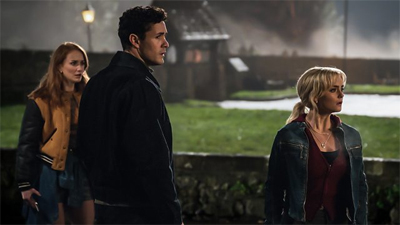
Conrad to The Rescue.
As with the use of U.N.I.T. as a stand-in for the scientific and medical communities, it’s easy to understand what this scene is attempting to do. It is attempting to demonstrate how these sorts of personalities stage events to boost their public profile, goading authorities into confrontation. However, the particularities of U.N.I.T. and Doctor Who mean that the metaphor really does not work.
More broadly, once these sorts of details stop working, the episode collapses around them. U.N.I.T. was able to produce an antidote to the Shreek toxic and put Ruby in contact with Conrad, but it wasn’t able to figure out that he was part of the alt-right pipeline. Given how quickly Shirley Bingham puts the pieces together after the village encounter, and the fact that Conrad was established enough in that ecosystem to own three houses, it really does make U.N.I.T. look like they didn’t do even a quick Google.
It is frustrating, because there are moments that hint at a version of this story that might work. Conrad’s thinly-veiled misogyny is well-observed, from the disdain that he directs towards Ruby to his very obvious anger at Kate as a woman in position of authority, taunting her, “You think you’re so superior. Up in your tower, looking down on us.”
It is interesting that Lucky Day was shot in the same production block as The Robot Revolution, and was directed by Peter Hoar. It ends with Conrad sending the Doctor to find Belinda. There is an obvious parallel between Alan’s relationship with Belinda and Conrad’s relationship to Ruby. This idea of toxic and controlling masculinity is a timely recurring thread within the season. Once again, Lucky Day makes a point to parallel the manipulative boyfriend with the Doctor. “Look, everything he was, I can be,” Conrad tells Ruby, who clearly sees Conrad as a potential replacement for the Doctor in her life.

A vile vial.
In this context, it is also notable that Lucky Day touches on the disconnect from reality that feeds this ecosystem. In his final conversation with the Doctor, Conrad boasts, “I don’t accept your reality, Doctor. I reject it.” It is another parallel with the Doctor, directly referencing an iconic moment from The Deadly Assassin. This is just how Conrad thinks. Kate points out that Conrad shot Jordan, he is quick to disavow it, insisting “maybe you shot him. Or he was an actor. Or he never existed.”
Indeed, the most compelling aspect of Lucky Day is the unvarnished anger and contempt that it feels for Conrad. The episode even rejects any concept of redemption for Conrad. “What is this?” Conrad demands. “An intervention? Are you here to save my soul?” Instead, the Doctor tells Conrad that he will die alone and unloved. This is the same Doctor who can – on occasion – find empathy for the Master or Davros.
There is a sense that Lucky Day hates Conrad so much because it knows him so well. Conrad is a Doctor Who fan. He is introduced as a child in the episode’s teaser. He meets the Doctor in December 2007 into January 2008, just months before Davies’ final full season would premiere, the peak of his tenure. He even meets the Doctor in the shadow of the London Eye, the landmark central to Rose. He is a fan of the first Russell T. Davies era of Doctor Who. “2007 was the first time I saw that blue box,” he explains. He even sneaks into a store surrounded by mannequins, evoking Rose.
It seems to have been Doctor Who that brought Conrad online. “When I was kid, meeting him was what got my into strange tech, UFOs,” Conrad tells Ruby. “He inspired the podcast.” While Conrad could be speaking ironically, the episode does suggest that he does really believe in all of this stuff but is just posing to cultivate a following – he does see the Shreek in London in 2024 and he does see Ruby drink the antidote. It’s like that Doctor Who brought Conrad online, which is where he fell down the radicalisation pipeline.
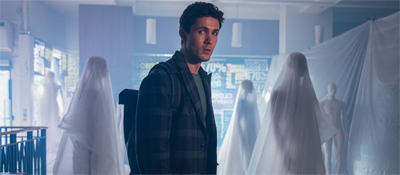
Mannequin-o-sphere.
This is clearly something on Davies’ mind. Much of his return to Doctor Who exists in conversation with ideas of science-fiction and fandom. A large part of the thrill of stories like The Robot Revolution and The Well is taking classic science-fiction subgenres like retro-futurism or hard science-fiction, and placing two people of colour at the centre of the narrative. This is a choice that is clearly informed by the way that men like Conrad has reacted to the arrival of women or people of colour into their cultural spaces.
Indeed, it’s notable that many of the loudest voices online complaining about diversity and inclusivity in Davies’ return to Doctor Who justify their arguments by appealing to the show’s history and past. This is obviously disingenuous. There is no way to know if these people were ever actually fans and it discounts the criticism Davies received for “the gay agenda” in his first tenure, but there is a clear sense that something is rotten in a lot of mainstream science-fiction fandom, including Doctor Who.
Tellingly, a lot of Conrad’s language is that of a fan. He grumbles about “actors” and “special effects.” He questions the plot logic of the episode in which he finds himself. He even pauses to complain about the way that Davies has chosen to name his characters. “You have gifted me this moment, Ruby Sunday,” he boasts. “Is that even your real name? Because it’s ridiculous.”
The anger that Lucky Day holds for Conrad feels truer and more pointed than anything else in the episode, and it is undoubtedly both informed by and informs the strong emphasis that Davies has placed on inclusivity within his return to the show. Much of Davies’ return to Doctor Who is about the power and the responsibility of the image: the madness spread by media in The Giggle, the image of the TARDIS becoming a TARDIS in The Legend of Ruby Sunday, the dystopia conjured from a gamer’s imagination in The Robot Revolution, the appeal not to turn one’s back in The Well.
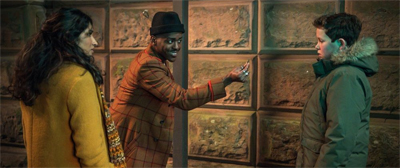
Fifty pence none the richer.
There is an interesting contrast within Lucky Day between Ruby and Conrad as two different visions of ageing Doctor Who fans. Ruby has effectively aged out of the show. She has gotten on with her life. Lucky Day is about Ruby learning to let go of the Doctor in order to be healthy. In contrast, Conrad stews in his obsession over Doctor Who, and lets his resentment at his own lost innocence translate into contempt for the object of his affection.
The final scene between Conrad and the Doctor in Lucky Day feels like Davies just venting his contempt for the fans who have used their love of his work to justify their small-minded bigotry and hatred. The Doctor’s admonishment of Conrad can feel like that of a creator trying to justify their own work and why what Conrad is doing feels like such a betrayal of what the work represents.
“You see, I am fighting a battle on behalf of everyday people who just want to get through their day,” the Doctor argues. “And feel safe and warm and fed. And then along comes this noise. All day long, this relentless noise. Cowards like you, weaponising lies, taking people’s insecurity and fear, and making it currency. You are exhausting. You stamp on the truth, choke our bandwidth, and shred our patience, because the only strategy you have is to wear us down.”
Without wanting to minimise McTighe’s authorship of Lucky Day, this scene in particular sounds like the voice of an author who has become increasingly aware of the social responsibilities that having a platform for their work, reflected in Davies’ writing of Years and Years or It’s a Sin. Davies’ return to Doctor Who is preoccupied with the power of media and the potential for its abuse, so Conrad represents something especially grotesque.
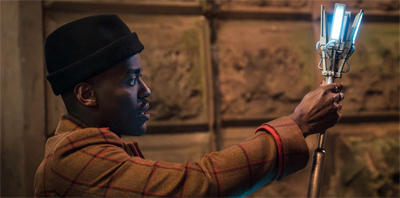
Electric.
It’s in this moment that Lucky Day comes alive, because it uses the Doctor himself as a stand-in for Doctor Who, rather than trying to use U.N.I.T. as a stand-in for the medical community. It’s a framework of understanding the episode that coheres a lot better, and it’s a real shame that production realities mean that Lucky Day had to be conceived from the outset as an episode that was extremely light on the Doctor.
It is a shame, because there are some very interesting ideas in Lucky Day. It’s the episode’s misfortune that none of them manage to cohere.
Filed under: Television | Tagged: alt-right, conspiracy theories, doctor who, fandom, media, metaphor, Online, paranoia, peter mctighe, ruby sunday, russell t. davies, skepticism, u.n.i.t., youtube |



 the m0vie blog
FYI, ”Rose” aired in 2005.
IDK, I think it’s too reductive to consider this solely a comment on fandom. It may be that in part, but that’s because the right-wing assholes who have infested every sci-fi/fantasy franchise, complaining about women and wokeness, are themselves a part of the larger societal rot that many of us are dealing with every damned day.
Just yesterday, I found myself making a rage-filled tirade to a smug, smiling asshat who was holding court in a McDonald’s, retelling the lies of the Trump administration. Conrad felt all too familiar. Over here in America, these people aren’t just making things uncomfortable for TV producers and fandoms. They are dismantling our country’s infrastructure, sowing distrust, and rewriting reality again and again.
“You are exhausting. You stamp on the truth, choke our bandwidth, and shred our patience, because the only strategy you have is to wear us down.”
That’s exactly how I feel. Worn down, shredded. It’s why I went off on an expletive-intensive rant in the middle of a public place. The rage expressed in the Doctor’s speech spoke to me about something much, much larger than bad-faith complaints about the “gay agenda.”
Apologies. I misread your paragraph about Conrad meeting the Doctor in 2007. I thought you were implying that it was a reference to “Rose,” rather than to the RTD1 era as a whole.
So Pete McTighe might be the next showrunner, I hear? Assuming we’re not heading for another Wilderness Period?
Well, if that is what RTD is saying, then in my case at least he’s clearly right— I have indeed become very obsessed with this show in a way that seems unhealthy, and I can’t escape.
But then I might also say that I am, at least, not broadcasting my thoughts on this on an international streaming service, through a whole new episode of Doctor Who. Making an angry and increasingly online story about people who can’t move on from Doctor Who becoming angry and increasingly online… well, there’s an irony there, I would say. It feels like the emotion driving the writer and the people who he hates is very similar.
And I was going to end that sentence by saying that at least the causes of the writer are much more noble. But in Lucky Day’s case, I don’t know if that’s even a good thing especially. It disturbed me to see people cheering on the heroes in this episode, for all of the reasons you outline.
I saw someone say that they were glad it was airing on a day the right made massive gains in Britain, because it was attacking the right sort of people. I think I thought more or less the opposite— that a very right-wing government indeed might not have a lot of issues with the story. In fact it reminded me of the dark authoritarian version of Doctor Who I’ve had in my head for about 17 years, which alarms me when it shows its face in the real thing.
I suppose I think that the road from being the Doctor to being a Dalek is a shorter one than I’d like, at least to me. And that it’s worth finding it ominous to get the sense of Doctor Who getting driven by anger, even if that anger is well directed. It’s well directed now, but it’s building something that can be directed somewhere else? So I ended up feeling very disturbed by the thing