• Following Us

  • Categories

  • Check out the Archives


  • Awards & Nominations

Daredevil – Guilty as Sin (Review)

This month, we’re doing daily reviews of the second season of Daredevil. Check back daily for the latest review.

Part of what is so infuriating about the second season of Daredevil is that fact that there is a lot of good material here.

The issue is nothing as simple as saying “good ideas, terrible execution”, or anything as trite. There are good ideas that are executed well and bad ideas that are handled with a surprisingly deft touch; there are also good ideas that are needlessly squandered and bad ideas that turn out to be exactly as terrible as they initially appear. It isn’t even that there are clearly discernible unambiguous flaws. Everything is a mix. For all the issues with the writing of the Punisher and Elektra, Jon Bernthal and Elodie Yung do great work with the material afforded to them.
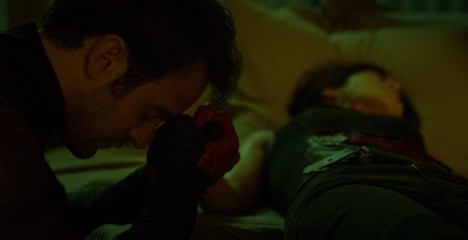
Let us pray...

Let us pray…

The second season of Daredevil is very much a curate’s egg of a television season. There are good bits and bad bits. There is breathtaking ambition and incredible miscalculation in equal measure. The series is not entirely a failure, but it is far from a success. With Guilty as Sin, the show clumsily repositions itself as a morality play about the conflict between good and evil within the soul as Elektra Natchios. However, there is a similar conflict brewing at the heart of the show.

Even in the season’s strongest moments, there are clear weaknesses shining through. Even in the season’s weakest moments, its strongest elements are frequently in play.
Eye see.

Eye see.

Continue reading

Star Trek: Voyager – Deadlock (Review)

This February and March, we’re taking a look at the 1995 to 1996 season of Star Trek, including Star Trek: Deep Space Nine and Star Trek: Voyager. Check back daily for the latest review.

In some ways, Deadlock is Star Trek: Voyager‘s original sin.

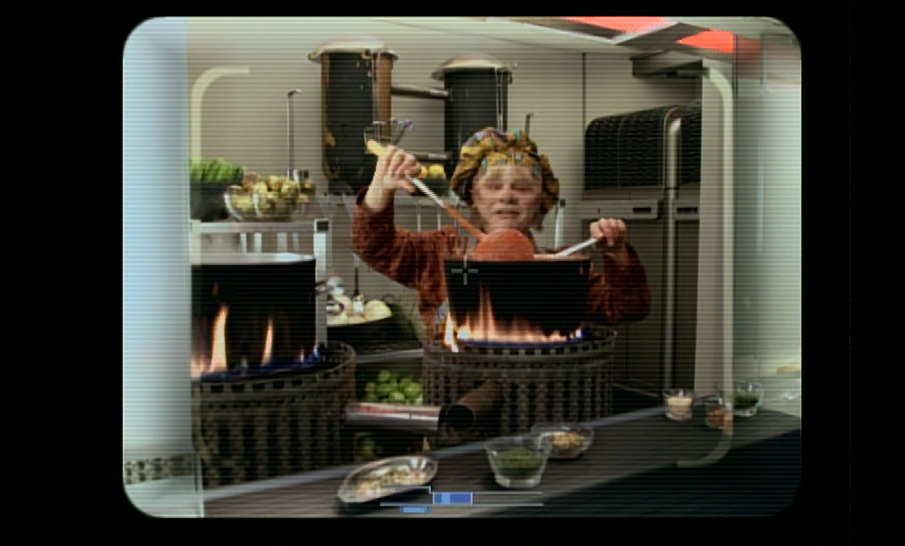
Of course, Deadlock is good. It is really good. It is a well-constructed piece of television that moves with an incredible momentum; it gathers speed and builds towards a suitably epic finalé. In many ways, Deadlock is one of the strongest episodes from the first two seasons of Voyager. There is a credible argument to be made that Deadlock belongs on any list of “best Voyager episodes ever”, thanks to the potent combination of Brannon Braga’s high-concept script and David Livingston’s dynamic direction.

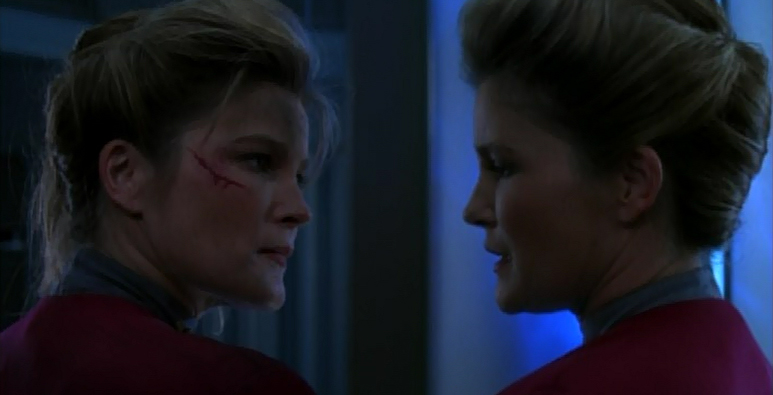
Janeway²...

Janeway²…

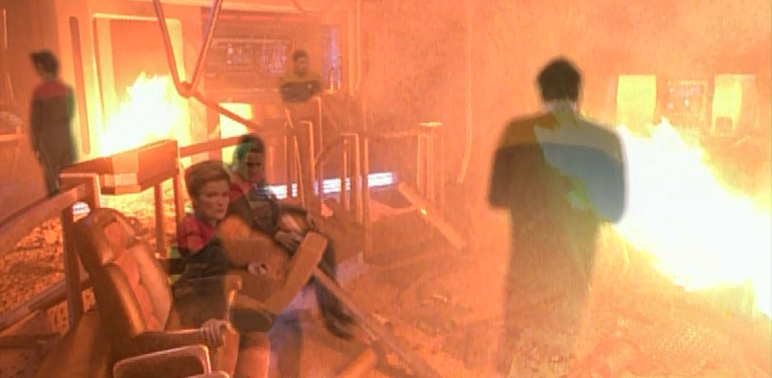
At the same time, it is hard not to look at Deadlock in retrospect and see the shape of things to come. It is, perhaps, the ultimate “reset” button episode; it provides a clear template for later “blow up Voyager and kill Janeway” episodes like Year of Hell or Timeless. The trick works very well once; it loses any real impact when it is repeated several times over the course of the show’s run. More than that, the episode feels somewhat generic. Due to the nature of the high-concept premise, there is little room for detail specific to Voyager.

It seems that the end of the second season set the course for the next five years of Voyager. The production team had tried to tell an experimental story specific to Voyager with Investigations, only to fail spectacularly; it would be the last time that the show attempted anything so bold. In contrast, the production team managed to construct a fantastic episode around a generic premise in Deadlock, perhaps indicating that the future of the show lay in that direction. It is easy to see why that production team opted for safe and generic ahead of ambitious and experimental.

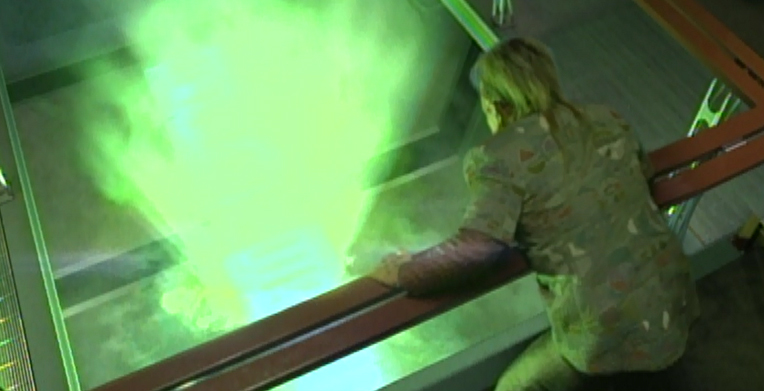
Ghost stories...

Ghost stories…

Continue reading

Daredevil – Semper Fidelis (Review)

This month, we’re doing daily reviews of the second season of Daredevil. Check back daily for the latest review.

There is probably no greater single missed opportunity during the second season of Daredevil than the trial of Frank Castle.

The show does not necessarily do a great job with Elektra, but that character was always going to be deeply problematic owing to her comic book origin. Ironically, the changes that the show makes to her arc do little to alleviate the issues with the character, just shunting them around a little. The Hand are also ill-served by the second season as a whole, but it is hard to imagine how the Hand might have made a credible and organic season-long threat in the first place. Even Frank Miller made a point to tie them into his larger character/thematic arcs.

This visual is more compelling than anything actually tied to the trial of Frank Castle.

This visual is more compelling than anything actually tied to the trial of Frank Castle.

In contrast, the trial of Frank Castle is a legitimately good idea. In fact, it is a brilliant idea. On paper, the idea of “the trial of Frank Castle” is one of the smartest concepts applied to the character in recent memory. The season has struggled with the challenges posed by Frank Castle, opting to smooth the rough edges off the character by having him walk through a familiar “avenging father” arc three times over the course of the year. Building a trial arc around Frank Castle goes a long way towards mitigating that; it is a story about Frank that doesn’t need to soften him.

More than that, it is an arc that seems designed to shore up some of the season’s weaknesses. The second season of Daredevil suffers from a lack of generality, a feeling that Matt and his cast exist in the tapestry of a larger New York; not the version of New York seen in The Avengers, but a real place inhabited by real people somewhat disconnected from undead ninjas and blind devil vigilantes. By providing a public spectacle, the trial of Frank Castle provides the opportunity for Daredevil to anchor itself back in a living and breathing New York.

The hole in things...

The hole in things…

It also ties neatly into Matt Murdock’s secret identity as a defence attorney, in a manner that is more interesting and engaging than simply offering a half-assed impression of Law & Order. By its nature, “the trial of Frank Castle” is a plot that is only really possible in the shared fictional space of the Marvel Cinematic Universe. However, it is a concept that is a more intriguing application of the shared universe than “… gee, I hope Iron Man shows up.” It plays with some of the genre’s core ideas in a way that is fairly novel and ripe for commentary and metaphor.

It is a shame that the show messes up this plot point so spectacularly.

Trial be there.

“Absolutely, one hundred percent, not guilty.”

Continue reading

Star Trek: Voyager – Investigations (Review)

This February and March, we’re taking a look at the 1995 to 1996 season of Star Trek, including Star Trek: Deep Space Nine and Star Trek: Voyager. Check back daily for the latest review.

Investigations is a misfire. It is a spectacular misfire.

Investigations is the episode that pretty much single-handedly killed any chance of Star Trek: Voyager embracing long-form storytelling once and for all. The first season had enthusiastically embraced an episodic structure, but the second season had played with the idea of playing out an arc across the majority of the season. Tying together the Kazon with the idea of a traitor on Voyager and the redemption of Tom Paris, the production team decided to attempt something relatively novel for Star Trek.

Kill me. Kill me now.

Kill me.
Kill me now.

It is worth stressing just how experimental this kind of story was. Star Trek: Deep Space Nine had played with the idea of serialisation. Threads like the Romulan and Cardassian invasion of the Gamma Quadrant were carefully seeded through episodes like Defiant and Visionary, but there was not the same tension and momentum afforded to the arcs of Michael Jonas and Tom Paris in the second season. The Romulans and the Cardassians were not discussed in every episode leading up to Improbable Cause and The Die is Cast.

At the same time, Deep Space Nine eased into serialisation in a way that allowed for failures and miscalculations that did not publicly humiliate the show. Bajoran politics could be quietly eased into the background when they weren’t quite working, characters like Primmin and T’Rul could be dropped when they weren’t what the show needed. The second season of Voyager was perhaps a bit too bold in its attempts at long-form storytelling, creating a situation where there was no way to pull back from an arc that wasn’t working.

"Well. That escalated quickly."

“Well. That escalated quickly.”

It became quite clear early on that the Paris and Jonas arc was not working. Episodes like Threshold and Dreadnought ground to a halt so that the audience could get yet another scene of Jonas selling out Voyager to the Kazon; treachery that never seemed to actually go anywhere. At the same time, Paris’ rebellious behaviour was tackled in a superficial manner in episodes like Meld and Lifesigns, with no real exploration of the interesting side of such a sting operation.

Investigations serves to bring the arc to a close, but in a manner that feels perfunctory rather than compelling. It is resolved out of a sense of tired desperation rather than any real inspiration. There is a feeling that the production team have determined this to be a failed experiment, of which they will never speak again.

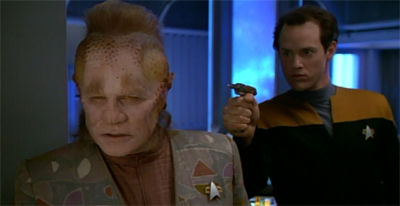
See? I told you EVERYBODY's thought about it.

See? I told you EVERYBODY’s thought about it.

Continue reading

Daredevil – Regrets Only (Review)

This month, we’re doing daily reviews of the second season of Daredevil. Check back daily for the latest review.

And, just like that, the season’s middle act runs into trouble.

One of the most fascinating aspects of the second season of Daredevil is how carefully and meticulously the season is structured. Producers Doug Petrie and Marco Ramirez have adopted a very clear three-act structure to the season, and great care has been taken to treat the year as a thirteen-episode origin story for the Punisher. Even within that, there is conscious mirroring and reversals that rely on the show reflecting its own continuity back at itself. For example, Frank addressing a defeated Daredevil in New York’s Finest is reflected in both Penny and Dime and .380.

Who punishes the Punisher?

Who punishes the Punisher?

There is great attention to detail, very careful craftsmanship. The actual plotting of the arcs on an episode-by-episode basis might not be particularly robust, but there is a definite and very precise plan laid out. However, all this delicate craftsmanship belies the fact that this structuring is built around a story with several beats missing or repeated. The second season of Daredevil is laid out like a three-act superhero story, but with the biggest issue being the nature of the story itself. There are missing structural elements that leave the formula feeling hollow.

The second season of Daredevil might consciously aspire to be a televisual version of The Dark Knight, but it actually lands somewhere closer to The Wolverine. And not just because it is a superhero love story that pits its protagonist against an assortment of ninjas.

The name's Murdock. Matt Murdock.

The name’s Murdock. Matt Murdock.

Continue reading

Star Trek: Deep Space Nine – Accession (Review)

This February and March, we’re taking a look at the 1995 to 1996 season of Star Trek, including Star Trek: Deep Space Nine and Star Trek: Voyager. Check back daily Tuesday through Friday for the latest review.

In its third and fourth seasons, Star Trek: Deep Space Nine is undergoing something of a transformation; a metamorphosis.

This is only natural. Shows evolve and grow as they go on. The production team discovers what works and what doesn’t, allowing them to play the strengths of the premise and the ensemble. It happens to most shows, if they live long enough. It happened to Star Trek: The Next Generation when Michael Piller came on board in its third season. It will happen to Star Trek: Voyager when Michael Piller departs in its third season. Change and transformation is inevitable, for television shows as much as for people.

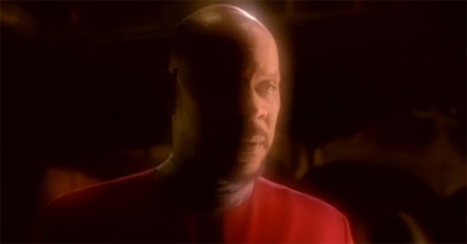
That healthy orb-experience glow...

That healthy orb-experience glow…

The third and fourth seasons of Deep Space Nine saw a change taking place. Ira Steven Behr had taken more and more control of the show since the late second season, starting with The Maquis, Part II. Michael Piller had stepped back from the show in its third season, completely ceding control with Life Support. The show was changing in a material sense. The Dominion came to the fore, Bajor faded to the background; Worf joined the cast, Odo found his people, the Klingons were an on-going concern again.

By this point in the fourth season, the transformation is almost complete. Deep Space Nine is very close to its final form, standing on the edge of its biggest departures from the established Star Trek canon. Part of those changes involves a reconfiguring of what Bajor means to the series. Accession begins the process of drawing down the curtain on the Bajor arc as it began with Emissary all those years ago, allowing Sisko to find some peace in his position and a sense of closure in his appointment before the show’s emphasis on Bajor changes dramatically.

Gotta have faith...

Gotta have faith…

Continue reading

Daredevil – Kinbaku (Review)

This month, we’re doing daily reviews of the second season of Daredevil. Check back daily for the latest review.

Although she appeared in a small cameo at the end of Penny and Dime, Kinbaku marks the proper introduction of Elektra.

Elektra is very much an essential part of the Daredevil mythos, tied to Matthew Murdock since her introduction all the way back in Daredevil #168. There was even a thinly-veiled reference to the character buried deep in the first season, with Foggy making a nod towards Matt’s Greek girlfriend in one of the flashbacks in Nelson v. Murdock. Elektra was always going to be a part of Daredevil. It seems the only reason the show waited a full season was due to the Jennifer Garner twin disasters of Daredevil and Elektra.

Enter Elektra...

Enter Elektra…

After all, Daredevil owes a lot to Frank Miller. Like every Daredevil story or adaptation after 1980, the television show is steeped in the mythology that Frank Miller carved out for the character. It was Frank Miller who elevated the Kingpin from a b-list Spider-man villain to an a-list Daredevil baddie. It was Frank Miller who introduced Stick, adding a whole host of ninja training to Matt Murdock’s back story. It was Frank Miller who turned Matt Murdock’s life into a slow-moving trainwreck. As such, Frank Miller’s fingerprints are all over this adaptation.

However, Elektra remains Frank Miller’s most lasting and enduring original contribution to Marvel. While Miller transformed and defined characters like Daredevil and Wolverine, Elektra was created from whole cloth. More than any other character, Elektra is Frank Miller’s baby. She represents the pinnacle of Frank Miller’s contribution to the character’s mythos. She is very much “peak Miller.”

Superhero sex...

Superhero sex…

Continue reading

Daredevil – Penny and Dime (Review)

This month, we’re doing daily reviews of the second season of Daredevil. Check back daily for the latest review.

Penny and Dime closes out the first act of the second season of Daredevil.

It effectively brings an end to the “Daredevil vs. Punisher” section of the season, excluding a brief reprise in .380 towards the end of the year. It does so by offering perhaps the most straightforward “Punisher” story of the season, with Frank Castle effectively finishing the task of dismantling the Kitchen Irish so that his family might rest in peace and he might be remanded in custody. Bringing the arc to a close so early is a fairly bold move from producers Marco Ramirez and Doug Petrie. The temptation would have been to run the arc across the full season.

That's not creepy.

That’s not creepy.

In theory, the idea of structuring a thirteen-episode season of Daredevil as a collection of mini-arcs that coalesce makes a great deal of sense. In some respects it is a very “comic-book-y” way of structuring the season. It recalls Scott Snyder’s structuring of mega-arcs like Black Mirror or Zero Year into easily-digestible three- or four-issue chunks. The idea of spending four issues introducing the Punisher before moving on to another run developing his arc and introducing Elektra is a clever storytelling idea. It helps establish “binge-able chunks.”

Unfortunately, this is a rather mixed bag in practice. The second season of Daredevil is full of very clever ideas and is very meticulously crafted, but it lacks a sense of purpose and a commitment to realising these ideas. While Penny and Dime is a very neat episode in theory, it is fairly clunky in practice. It becomes even clunkier in hindsight.

Yeah, that's not creepy at all...

Yeah, that’s not creepy at all…

Continue reading

Daredevil – New York’s Finest (Review)

This month, we’re doing daily reviews of the second season of Daredevil. Check back daily for the latest review.

The stock comparison for the first season of Daredevil was Batman Begins. There were certainly plenty of reasons. The yellow-ish colour scheme. The non-linear superhero origin story focusing on a protagonist who subsumes his anger into something greater. The erosion of the existing organised crime framework, replaced by something altogether weirder. The ninjas who plot to smuggle a potentially dangerous (and pseudo-mystical) weapon into the heart of the city through th docklands. It was a good comparison, and it served Daredevil well.

As such, it makes sense that the second season of the show would desperately want to be The Dark Knight.

That'll make a nice logo...

That’ll make a nice logo…

Continue reading

Daredevil – Dogs to a Gunfight (Review)

This month, we’re doing daily reviews of the second season of Daredevil. Check back daily for the latest review.

Dogs to a Gunfight is the only episode of Daredevil to engage with the Punisher on a philosophical level, and it does so only fleetingly.

This is largely because the Punisher still exists as an abstract menace at this point in the narrative. The character stalked through Bang, but was largely remote. The Punisher gets a bit more to do in Dogs to a Gunfight, but is still largely unknowable to the audience. The name “Frank Castle” has yet to be uttered. Although his victims all fit a pattern that will be articulated in Penny and Dime, and expanded upon in The Man in the Box, those facts are concealed from the audience.

Coming up with these puns on a daily schedule promises to be a pun-ishing endeavour...

Coming up with these puns on a daily schedule promises to be a pun-ishing endeavour…

As such, deprived of characterisation or development, Dogs to a Gunfight can present the Punisher in his purest form. The Punisher is a man with a gun who kills bad people. That is a fairly potent vigilante motif, particularly in the current social and political climate. The Punisher is a very loaded concept, tied into broader questions about justice and violence in a way that is more relevant than undead ninja assassins or blind radar-guided superheroes. The Punisher is something very primal and very basic; but also something unsettling in the modern world.

Watching Dogs to a Gunfight, there is a sense that the Punisher might easily have provided a window into a broader cultural debate. Jessica Jones was able to use Kilgrave to jumpstart a clever and insightful discussion about gender issues, so it makes sense that Daredevil might be able to use the Punisher to spark a discussion about contemporary cultures of violence. Unfortunately, it seems like the show sees this discussion coming and runs very quickly.

"The Punisher's just a mad dog. I want whoever let him off the leash."

“The Punisher’s just a mad dog. I want whoever let him off the leash.”

Continue reading