• Following Us

  • Categories

  • Check out the Archives


  • Awards & Nominations

The X-Files – Biogenesis (Review)

This July, we’re taking a trip back in time to review the sixth season of The X-Files and the third (and final) season of Millennium.

‘When Alexan­der saw the breadth of his domain, he wept for there were no more worlds to con­quer.’ Ben­e­fits of a clas­si­cal education.

– Hans Gruber, Die Hard

In hindsight, “ending” the mythology with a two-parter in the middle of the season was always a risky proposition.

Airing Two Fathers and One Son during February Sweeps was a logical decision. Ending the mythology that had been running through the show for five-and-a-half seasons was certain to grab the attention of casual viewers, reeling them in to boast up ratings. The X-Files had always aired mythology two-parters during Sweeps, putting them forward as examples of the best that the series could do and cementing the show’s claim to be “blockbuster television.” Choosing to wrap up the mythology during February Sweeps was just an extension of that approach.

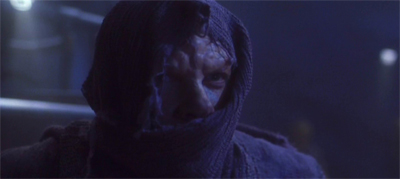
Look what just washed up...

Look what just washed up…

And it worked. Two Fathers earned the second highest Nielsen score of the sixth season, landing just behind The Rain King. Two Fathers was the last time that The X-Files would rate so highly. As such, the decision to “close off” the mythology in the middle of the season was a very shrewd decision. However, it did raise questions about what the show would do at the very end of season. After all, The X-Files liked to bookend its seasons with mythology episodes, counting on a mythology cliffhanger to carry viewers across the long gap between seasons.

How do you tell a mythology story when you’ve just worked so hard to tidy it all away?
Behind the curtain...

Behind the curtain…

Continue reading

Star Trek: Enterprise – The Xindi (Review)

Next year, Star Trek is fifty years old. We have some special stuff planned for that, but – in the meantime – we’re reviewing all of Star Trek: Enterprise this year as something of a prequel to that anniversary. This August, we’re doing the third season. Check back daily for the latest review.

Delivering on change is always more difficult than promising change.

The first block of episodes in the third season of Star Trek: Enterprise struggle with the weight of expectation and the sense that the production team have no real idea of how to manage this sort of storytelling. Rick Berman and Brannon Braga had consulted with Ira Steven Behr towards the end of the second season, suggesting that they wanted to model the storytelling loosely on the blend of episodic and serialised scripting that Behr oversaw on Star Trek: Deep Space Nine. It makes sense, as Deep Space Nine was the only Star Trek series to really engage with that sort of storytelling.

A primate example of the Xindi...

A primate example of the Xindi…

In hindsight, it seems a shame that the writing room on Deep Space Nine was allowed to disintegrate so thoroughly. Ira Steven Behr, Hans Beimler and Rene Echevarria departed immediately following What You Leave Behind. Ronald D. Moore migrated briefly over to Star Trek: Voyager, but quit quite promptly following creative disagreements with former collaborator Brannon Braga. The veteran writers on Enterprise came from Voyager. Brannon Braga, Mike Sussman, Phyllis Strong and André Bormanis were all writers who had come into their own working on Voyager.

Star Trek: Voyager a show that was incredibly episodic and seemed to actively resist serialisation even more than Star Trek: The Next Generation. This is not a reflection on the production team. Braga had lobbied to expand Year of Hell into a year-long story arc during the fourth season, but his proposal had been rejected. Discussing the Xindi arc, Braga has talked about how he wanted to tell a year-long Star Trek story, and it is telling that one of his post-Star Trek writing assignments was on 24.

The ascent...

The ascent…

Nevertheless, it meant that the writers working on Enterprise faced a sharp learning curve when it came to structuring the third season. The experience accumulated during the arc-building on Deep Space Nine was largely lost to the franchise, and a lot of the early part of the third season sees Enterprise making a number of teething mistakes. The early stretch of the third season struggles to pace itself, and it struggles to integrate stand-alone stories with its larger serialised arc.

The Xindi is a prime example of this, an episode that has a wealth of interesting ideas and great concepts, but one that stumbles in the execution.

Pointing the finger...

Pointing the finger…

Continue reading

Millennium – Via Dolorosa (Review)

This July, we’re taking a trip back in time to review the sixth season of The X-Files and the third (and final) season of Millennium.

And so, Millennium ends.

That is not entirely accurate. Via Dolorosa and Goodbye to All That are really the third ending to Millennium. Chris Carter’s oft-overlooked series famously reinvented itself in each of its three seasons. Every season finalé was a series finalé, bidding farewell to one version of the show before another arrives. In the first season, it was a serial killer procedural with ominous spiritual undertones. In its second season, it was the story of a family breakup that drew in all manner of religious conspiracy theories and eschatology. In its third season, it was…

"Did I tell you that I REALLY like The Silence of the Lambs?"

“Did I tell you that I REALLY like The Silence of the Lambs?”

Well, it is hard to tell what the third season was – or even what it wanted to be.

Nevertheless, Via Dolorosa and Goodbye to All That feel like an attempt to grant the series some sense of closure. In a way, these episodes typify the third season. They are messy and confused, awkwardly paced and drawn in broad strokes. At the same time, there are enough interesting ideas and clever concepts that one can see how they might have come together with a bit more craft. There is an outline of a great episode here, with Via Dolorosa and Goodbye to All That making a valiant effort to pull together messy strands of continuity from across the show’s run.

"Yep, it feels a little bit like that."

“Yep, it feels a little bit like that.”

The third season of Millennium was hampered by terrible decisions made out of the gate, but the final stretch of the season has no shortage of ambition and drive. It is no secret that the third season suffered from a number of serious problems at the start of the year. Maybe if those had been avoided, Via Dolorosa and Goodbye to All That would have an easier time drawing down the blinds. Still, it is impossible to know what might have been, and the truth is that Via Dolorosa and Goodbye to All That are a flawed conclusion to a flawed year.

Perhaps appropriately, Via Dolorosa and Goodbye to All That offer a rather disjointed conclusion to a rather disjointed year. Via Dolorosa and Goodbye to All That are written by two different teams of writers and directed by two different directors. Although the plot carries across both episodes, there are points where the transition seems rather inelegant or incongruous. Then again, this is about wrapping up the show’s troubled third season, so it is certainly representative.

"Take a picture. It'll last longer."

“Take a picture. It’ll last longer.”

Continue reading

The X-Files – Field Trip (Review)

This July, we’re taking a trip back in time to review the sixth season of The X-Files and the third (and final) season of Millennium.

Field Trip works well as the penultimate episode of the sixth season.

It returns to a lot of big ideas threaded through the sixth season, particularly as they relate to endings and mortality. It also pushes the bond between Mulder and Scully to the fore; it feels like something of a spiritual successor to both Bad Blood and Folie á Deux in its portrayal of the dynamic between Mulder and Scully, charting a rough arc in how Mulder and Scully come to see themselves and each other. Even beyond all that, it contains another surrogate romantic relationship for Mulder and Scully, this time in Wallace and Angela Schiff.

A lot to digest...

A lot to digest…

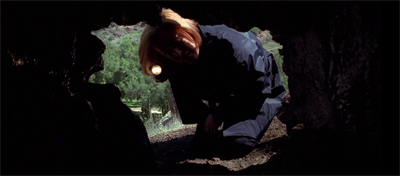
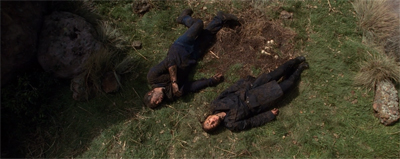
More to the point, Field Trip seems to hit on the core anxieties at the heart of the sixth season. It is a meditation on the show’s success and the status quo that has to be so careful maintained to keep the show from tipping over. As with TriangleDreamland IDreamland II, How the Ghosts Stole Christmas and Monday, our heroes find themselves trapped in something of a weird alternate reality. The climax of Field Trip hinges on both Mulder and Scully deducing that their world operates according to the logic of a television show.

However, Field Trip is perhaps most intriguing in the way that it proposes two separate endings to The X-Files. The humongous fungus at the heart of Field Trip offers both Mulder and Scully a conclusion to their six-year journey, an opportunity for closure and satisfaction. In doing so, Field Trip suggests that it is the central tension at the heart of The X-Files that keeps the show young. There is no way to end the show without absolutely and definitively declaring that one of the characters is right and the other is wrong.

Down the rabbit hole...

Down the rabbit hole…

As such, the endings seem mutually exclusive. Field Trip suggests that endings designed to satisfy Mulder and Scully and mutually exclusive and irreconcilable – recalling the implication in Bad Blood that both Mulder and Scully filter the same events through different lenses. However, Field Trip is rather more optimistic in its assessment of the dynamic between Mulder and Scully. While it might not be able to provide an ending to the show that satisfies both, Field Trip suggests that the duo have reconciled themselves to each other.

Whereas Bad Blood seemed to state that Mulder and Scully would never share the same perspective, Field Trip suggests that both characters have evolved and matured to the point where they can see the world through the eyes of the other. Bad Blood featured the two characters positing wildly different accounts of the same event, but Field Trip only resolves when Mulder and Scully come to share each other’s perspective. It feels entirely appropriate to close out the sixth season suggesting a new harmony between the two leads.

It's a dirty job...

It’s a dirty job…

Continue reading