• Following Us

  • Categories

  • Check out the Archives


  • Awards & Nominations

Daredevil – World on Fire (Review)

To celebrate the launch of Marvel’s Daredevil and the release of Avengers: Age of Ultron, we are reviewing all thirteen episodes of the first season of Marvel and Netflix’s Daredevil. Check back daily for the latest review.

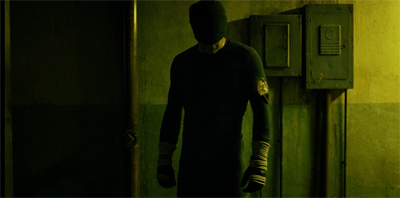
Having paused to catch its breath – and properly introduce the character of Wilson Fisk – World on Fire and Condemned restore the season’s sense of forward moment. The clutter of the Russian mob is tidied away, allowing the series to throw Matt Murdock and Wilson Fisk into proper conflict with one another. It is no coincidence that Matt and Fisk first talk to one another in Condemned, the episode that brushes aside the last remnants of the Russian mob. World on Fire is largely about setting up all that, serving as a bridge from In the Blood into Condemned.

It is a testament to all involved that it works as well as it does. Charlie Cox is fantastic as a conflicted Matthew Murdock, Rosario Dawson does great work as Claire Temple. Once again, Deborah Ann Woll and Elden Henson are trapped in a somewhat generic subplot that exists to explain why Hell’s Kitchen might be worth saving in its current state. Vincent D’Onofrio and Ayelet Zurer continue to have an endearing chemistry, portraying a fairly convincing love story about power and justification – the show never seems confused about what Wilson Fisk and Vanessa Marianna see in one another.

daredevil-worldonfire8

All the formal elements continue to work very well. The writing staff do an excellent job mirroring Matt and Claire with Vanessa and Fisk; one couple separated by the anger and drive of the protagonist, another intoxicated by those same qualities in the antagonist. Although it is easy to take the show’s camera and stunt work for granted after the climax of Cut Man, there is an impressive long shot in the middle of the episode that is executed beautifully as Matt intercepts a drug delivery to the Russians.

At the same time, there is something a little bit forced about the plotting and structure of World on Fire, which is largely a result of its transitional state. The first season often felt like it was spinning its wheels as it set Matt against the Russians – neither Anatoly nor Vladimir felt like fully-formed or fleshed out characters, in spite of the teaser to In the Blood. As a result, a lot of World on Fire feels like necessary housekeeping before the show can really get down to business.

daredevil-worldonfire7

Continue reading

Star Trek: Enterprise – The Catwalk (Review)

Next year, Star Trek is fifty years old. We have some special stuff planned for that, but – in the meantime – we’re reviewing all of Star Trek: Enterprise this year as something of a prequel to that anniversary. This April, we’re doing the second season. Check back daily for the latest review.

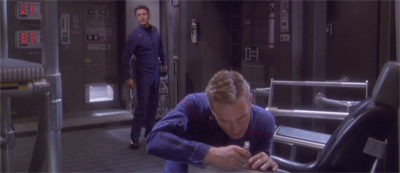
The Catwalk is a solid, if unexceptional, piece of Star Trek.

Given the problems that the second season of Star Trek: Enterprise has been having to date, it feels like a breath of fresh air. As with a lot of the episodes around it, The Catwalk feels a little familiar. There are refugees with a secret; an alien take-over of the ship; a clever bluff to reclaim the ship from a position of weakness. If we are looking at The Catwalk in the “… by way of …” formula that seems to apply to most of this stretch of the second season, The Catwalk is “Starship Mine by way of Basics.”

"Right, right! Goddammit, Trip, now we'll never get the high score!"

“Right, right! Goddammit, Trip, now we’ll never get the high score!”

However, The Catwalk feels a lot more functional than many of the earlier episodes in the season. A large part of that is down to the way that writers Mike Sussman and Phylis Strong play to their strengths. The inevitable alien hijacking and threat is relegated to the background; The Catwalk is almost half over by the time that anything actually happens. While the episode’s pacing is a little uneven, it does allow Sussman and Strong a bit of room to explore the characters, building up the sense that the crew is something of a family unit.

While The Catwalk isn’t innovative or particularly adventurous, it works quite well. The idea of pushing the whole crew into a confined space and having them weather the storm together feels like it captures a lot of the pioneering sense of adventure that the show has allowed to fade over the second season.

Don't forget to turn out the light...

Don’t forget to turn out the light…

Continue reading

Daredevil – In the Blood (Review)

To celebrate the launch of Marvel’s Daredevil and the release of Avengers: Age of Ultron, we are reviewing all thirteen episodes of the first season of Marvel and Netflix’s Daredevil. Check back daily for the latest review.

There is something very functional and formulaic about stretch of the season running from Rabbit in a Snowstorm through to Condemned.

After a great opening set of episodes, it feels like the show stalls a little. It pulls back, taking the time run through some stock superhero origin plot elements before pressing ahead. This might just be a result of the thirteen-episodes-in-one-go format of the series, or it could be a result of the transition from original showrunner Drew Goddard to new showrunner Steven DeKnight. Whatever the reason, it feels like the first season slows down its plotting for Matt Murdock so that it can catch up on developing Wilson Fisk – a character who spent the first two episodes of the season as a phantom.

daredevil-intheblood18

As a result, it is rather unsurprising that Fisk’s plot should be the most interesting part of In the Blood. This is the audience’s first extended encounter with the new crime boss of Hell’s Kitchen, as we join him on an awkward first date right before we are reminded of just how violence he can be. As ever, Daredevil provides a nice sense of contrast with its characters, offering a striking juxtaposition between the well-meaning and innocent version of Wilson Fisk presented to Vanessa Marianna and the brutal and violent version of Wilson Fisk who decapitates Anatoly Ranskahov with a car door.

The problem, then, is the plotting as it relates to Matt Murdock. While the show is making up for lost time by developing Wilson Fisk, it seems like Matt is relegated to level-grinding against the Russian mob. These are villains so generic that it seems like everybody in Hell’s Kitchen just refers to them as “the Russians.” To be fair, the teaser to In the Blood does give us some sense of back story for Vladimir and Anatoly Ranskahov, but they feel rather transparently like a stalling tactic designed to eat up time before the show can get to the interesting stuff.

daredevil-intheblood6

The situation is not aided by the decision to play out the cliché “attack the hero by targeting a female acquaintance” plot as the centrepiece of Matt’s arc in the episode. In the Blood cleverly underscores the parallels between Wilson Fisk and Matt Murdock by juxtaposing their relationships with Vanessa and Claire respectively, but this structural cleverness is undercut by the decision to reduce Claire to emotional leverage. Victimising a female character to drive a male character to action is also a risky plotting decision, but particularly so when it feels like the show is just marking time.

In the Blood is a perfectly functional episode, albeit one that works much better when it focuses on its villain than when it focuses on its hero.

daredevil-intheblood1

Continue reading

Star Trek: Enterprise – Precious Cargo (Review)

Next year, Star Trek is fifty years old. We have some special stuff planned for that, but – in the meantime – we’re reviewing all of Star Trek: Enterprise this year as something of a prequel to that anniversary. This April, we’re doing the second season. Check back daily for the latest review.

Precious Cargo is a disaster. It is a spectacularly terrible piece of television. It is the kind of episode that fans point towards when they want to belittle or diminish Star Trek: Enterprise.

To be fair, it isn’t as if the show has the monopoly on bad episodes of the franchise. After all, the original Star Trek gave us And The Children Shall Lead, The Way to Eden and The Apple. Star Trek: The Next Generation gave us Code of Honour, Angel One, The Child and Up the Long Ladder. Star Trek: Deep Space Nine produced Let He Who Is Without Sin, Profit and Lace and The Emperor’s New Cloak. Star Trek: Voyager is responsible for Fair Haven and Spirit Folk. When you produce twenty-something episodes of television a year, terrible episodes happen.

We are Trip, of Bored...

We are Trip, of Bored…

Indeed, they will keep happening. Precious Cargo cannot even make an indisputable claim to being the weakest story of the troubled second season. There are fans who will argue that A Night in Sickbay or Bounty deserve that accolade. Nevertheless, it seems like everyone is agreed that Precious Cargo is a disaster from start to finish. It is a collection of pulpy science-fiction clichés that feels overly familiar, a lazy comedy without any solid jokes and a complete lack of chemistry between the two leads.

Precious Cargo is a spectacular misfire, an ill-judged and poorly-constructed addition to the franchise.

"Wait, another Trip comedy episode?"

“Wait, another Trip comedy episode?”

Continue reading

Daredevil – Rabbit in a Snowstorm (Review)

To celebrate the launch of Marvel’s Daredevil and the release of Avengers: Age of Ultron, we are reviewing all thirteen episodes of the first season of Marvel and Netflix’s Daredevil. Check back daily for the latest review.

One of the more interesting aspects of Daredevil is the way that it wears its influences so confidently on its sleeve. As if aware that the stock comparison for the show will be Batman Begins, the series goes out of its way to hit a number of key points from that particular film – introducing its masked vigilante during an atmospheric attack at a dockland smuggling operation, stopping the import of superweapon into the city by a secret society of ninjas. The show returns to the work of Frank Miller time and time again, knowing that he is the defining Daredevil writer.

In terms of televisual influences, it feels like producer Steven DeKnight was heavily influenced by a lot of prestigious contemporary drama. In particular, Rabbit in a Snowstorm features sequences that feel like they might have been lifted from Breaking Bad and The Wire. This makes a certain amount of sense; those are two very well-respected shows that lend themselves to “binge” watching of (relatively) short seasons. Netflix has even found great success as a distributor of Breaking Bad in Europe. There are worse influences for Daredevil.

daredevil-rabbitinasnowstorm16

To be fair to Daredevil, the show never loses sight of itself. This is a superhero story about a masked vigilante who cleans up Hell’s Kitchen and comes face-to-face with honest-to-goodness ninjas and other possibly supernatural events. Nuance and subtlety have their place, but Daredevil arguably works best when it revels in its theatricality – grand sweeping statements, bold imagery, heightened drama. For all that Rabbit in a Snowstorm tries to expand and ground the world of Daredevil, it is marked by two acts of over-the-top violence at the open and close of the hour.

At the same time, this underscores the biggest problem with Rabbit in a Snowstorm. Daredevil is not a show that lends itself to the same sort of aesthetic as The Wire, and some of the attempts to ground the show feel clumsy and awkward; the show works best when it is big and bold and operatic, stumbling a bit when it tries to present a grounded real-world setting.

daredevil-rabbitinasnowstorm12

Continue reading

Star Trek: Enterprise – Vanishing Point (Review)

Next year, Star Trek is fifty years old. We have some special stuff planned for that, but – in the meantime – we’re reviewing all of Star Trek: Enterprise this year as something of a prequel to that anniversary. This April, we’re doing the second season. Check back daily for the latest review.

Vanishing Point continues the “remix” formula that we’ve come to expect from the second season of Star Trek: Enterprise. In particular, Vanishing Point is a rather heady Star Trek: The Next Generation cocktail. It has shades of Remember Me, Realm of Fear, The Next Phase and even The Inner Light – with a healthy dose of Brannon Braga’s questions about the nature of reality. All of these elements blend together to form Vanishing Point, an episode that feels overly familiar and rote despite an intriguing set-up.

It is a shame that it doesn’t work better. Vanishing Point brings us back to the idea that Archer and his crew are pioneers in space exploration. The teaser reminds us that the crew of the Enterprise still don’t take the transporter for granted – that it is still something of a mystery to them, despite the audience’s familiarity with the device. Vanishing Point feels like the first time that Enterprise has emphasised this sense of novelty and inexperience since the first season.

Reflections...

Reflections…

However, the episode feels like something of a disappointment. The entire story turns out to be a gimmick and a twist. There is nothing wrong with this sort of storytelling. After all, the franchise has played these sorts of games before. Indeed, some of Braga’s best scripts – Frame of Mind and Projections come to mind – touch on similar ideas with similar twists. The problem with Vanishing Point is that these twists seem a bit too loose or too disconnected to properly resonate.

Vanishing Point feels like the rough sketch of a good episode doodled quickly on the back of a napkin, a collection of connective clauses all designed to keep the story ticking for forty-five minutes before ending on a fairly stock twist. There is a great deal of potential here, but Vanishing Point never quite delivers on it.

Trip Tucker: Space Tourist...

Trip Tucker: Space Tourist…

Continue reading

Daredevil – Cut Man (Review)

To celebrate the launch of Marvel’s Daredevil and the release of Avengers: Age of Ultron, we are reviewing all thirteen episodes of the first season of Marvel and Netflix’s Daredevil. Check back daily for the latest review.

If Into the Ring skilfully sets its tone in the opening teaser, telling the audience everything that they need to know about Daredevil before the first roll of the opening credits, then Cut Man saves its biggest and most defining moment for the closing seven minutes of the episode. It is almost impossible to talk about Cut Man without talking about the superb action sequence that closes out the episode – a single-take piece of stunt work that sees Matt Murdock tearing through an army of Russian mobsters in a way reminiscent of Oldboy.

That sequence is jaw-dropping, and possibly the visceral highlight of the thirteen-episode season. It is a very visceral demonstration of just what Daredevil can do. The technical skill on display in that seven-minute sequence rivals anything in the big-budget blockbuster Marvel movies. It eschews the clean-cut violence of something like the (also superb) elevator fight scene from Captain America: The Winter Soldier in favour of a more low-key and naturalistic vibe. Daredevil might not have the budget for monsters or armour suits, but it has a great stunt team.

daredevil-cutman11

In a way, the fact that Into the Ring is defined by its opening scene and Cut Man is defined by its closing scene feels appropriate. These are the only two episodes of the first season to be scripted by Drew Goddard, before he left the production and was replaced by Steven DeKnight. As such, these two episode have a tone that feels slightly distinct and removed from the episodes following on from this point. Although there is a very clear through line running from one end of the season to the other, Into the Ring and Cut Man feel like their own little part of the season.

These two episodes tidy away the broad strokes outline of Matt Murdock’s origin, to the point where the audience knows what they need to know before the actually story can kick in. The show will return to Matt’s early years in both Stick and Nelson v. Murdock, but Into the Ring and Cut Man represent the foundations of a superhero origin that will span the season.

daredevil-cutman13

Continue reading

Star Trek: Enterprise – Singularity (Review)

Next year, Star Trek is fifty years old. We have some special stuff planned for that, but – in the meantime – we’re reviewing all of Star Trek: Enterprise this year as something of a prequel to that anniversary. This April, we’re doing the second season. Check back daily for the latest review.

Star Trek: The Next Generation casts a pretty long shadow.

Singularity aired over eight years after All Good Things… and it still feels like an attempt to re-capture the mood and atmosphere of that second-generation Star Trek spin-off. Singularity feels like it might have made for a passable seventh-season instalment of The Next Generation, airing somewhere between Phantasms, Masks and Genesis. You would probably only have to tweak Singularity ever-so-slightly for that earlier cast.

"Hai!"

“Hai!”

Of course, this fixation on The Next Generation is not unique to the second season of Star Trek: Enterprise. After all, Star Trek: Voyager spent a significant portion of its run trying to re-capture the magic associated with The Next Generation. There were lots of generic aliens- and anomalies-of-the week. The second season of Enterprise is just interesting in this regard because it is really the last gasp of this sort of nostalgic storytelling on so wide a scale.

It would not be easy. It would take the box office failure of Star Trek: Nemesis, a change of management at UPN, falling ratings and the threat of cancellation. Nevertheless, Enterprise would eventually manage to exorcise the ghost of The Next Generation. In the meantime, Singularity offers a reminder of just how closely Enterprise was hewing to The Next Generation.

"Are you sitting comfortably? Then we'll begin."

“Are you sitting comfortably? Then we’ll begin.”

Continue reading

Daredevil – Into the Ring (Review)

To celebrate the launch of Marvel’s Daredevil and the release of Avengers: Age of Ultron, we are reviewing all thirteen episodes of the first season of Marvel and Netflix’s Daredevil. Check back daily for the latest review.

Daredevil is an ambitious piece of work.

It represents an astonishing commitment from both Marvel and Netflix to realise a thirteen-episode run on a superhero character that will be produced and released in one big chunk. One of the unsung features of Netflix’s “full season” model is the fact that there is minimal room for course correction or reevaluation; there is no time for audience feedback or retooling. The model is all or nothing. Before the first episode has been released to the public, the last episode has already been cut and gone through post-production.

daredevil-intothering12

That is an impressive gamble, even in this day and age when Marvel has demonstrated that it can pull off almost anything that it wants to accomplish. Daredevil is part of the tapestry of interconnected continuity that forms the Marvel Cinematic Universe, a single unfolding narrative space that dates back to Jon Favreau’s Iron Man back in 2008. In the seven years once, one of the resounding (and effective) criticisms of Marvel’s creative model has been the sense that their projects are drowned in a “house style”, as if the individual works feel obligated to fit together.

These criticisms date back to the sense that Jon Favreau’s Iron Man 2 was smothered by its obligations to a shared universe, and was only fuelled by the high-profile departure of respected film-makers like Edgar Wright and Patty Jenkins from Marvel projects, citing a irreconcilable differences. To be fair, recent efforts like Iron Man 3, Captain America: The Winter Soldier and Guardians of the Galaxy have helped to add a great deal of diversity to the tapestry of the shared Marvel universe.

daredevil-intothering16

Into the Ring works hard to establish a clear and distinct mood for its own hero. Released on Netflix, it is not bound by the same set of constraints that hem in Agents of S.H.I.E.L.D. or Peggy Carter. The brutality on display in the teaser and at the climax is utterly unlike anything else produced under the banner of this shared universe; the montage at the end of the episode makes it clear that Matt Murdock exists in very different corner of the same universe. Child abductions and drug rings and white collar crime aren’t quite covered by Tony Stark or Steve Rogers.

Although there are a few bumps along the way, Into the Ring does a good job at setting the tone for what is to come.

daredevil-intothering6

Continue reading

Netflix and Marvel’s Daredevil – Season 1 (Review)

Marvel and Netflix’s Daredevil owes as much to the work of Christopher Nolan as it does to the larger Marvel Cinematic Universe. Taking advantage of the change in platform and format, the thirteen-episode season is a bit rougher and meaner than most of Marvel’s recent output. The show never reaches the excesses of The Punisher or Punisher: War Zone, but the show has a much rougher edge to it than many of its contemporaries. It is very much grounded in an urban noir storytelling style.

With thirteen episodes released to stream simultaneously, Daredevil is a unique venture for a studio that has been experiment in different media and different delivery methods. Daredevil is much more cohesive than either Agents of S.H.I.E.L.D. and Peggy Carter, feeling much more like its own thing. While each of the thirteen episodes is structured as an episode in its own right, the whole season amounts to a single long-form story. Distilled to its essence, Daredevil is the story of the conflict between an emergent vigilante and an ascendant crime lord.

daredevil-daredevil14

The series is not flawless; there are some pacing and structural issues that do haunt the series. However, it is a bold piece of work that stands unique among the prolific output from Marvel Studios. It is hard to imagine that either Avengers: Age of Ultron or Ant-Man will feel anything like this more grounded adventure, giving Daredevil a distinctive texture and demonstrating that Marvel is willing to experiment with the tone and style of some of its product. Given the volume of the studio’s output, this is inherently a good thing.

Daredevil is anchored in a set of terrific central performances and a clear sense of purpose. It might lose focus at points, or stumble into some plotting or pacing issues, but it marks a high point in Marvel’s television output.

daredevil-theonesweleavebehind8

Continue reading