• Following Us

  • Categories

  • Check out the Archives


  • Awards & Nominations

The X-Files – Duane Barry (Review)

This August (and a little of September), we’re taking a trip back in time to review the second season of The X-Files. In November, we’ll be looking at the third season. And maybe more.

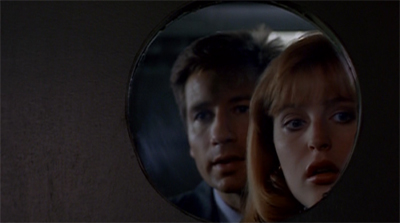
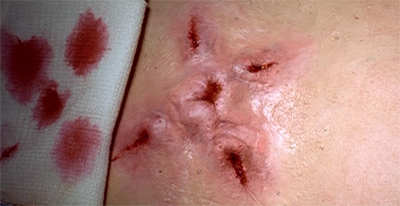
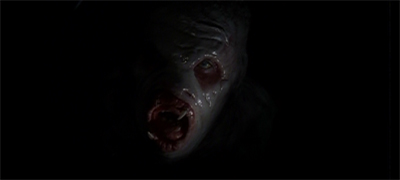
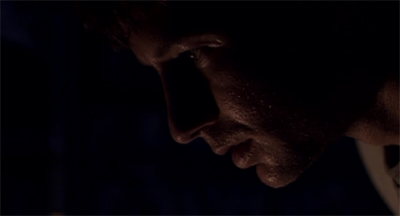
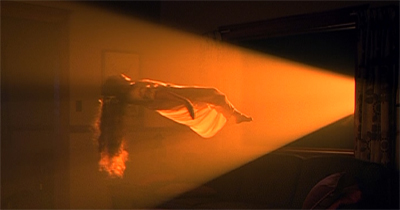
Duane Barry is Chris Carter’s directorial début on The X-Files, and it’s a staggering confident piece of work. From the opening scene where Carter’s camera stalks through Duane Barry’s run-down house through to the memorable abduction sequences and decision to play the episode’s big action sequence against a black screen, Duane Barry looks very impressive. It’s an episode that stays with the viewer, one that is every bit as visually distinctive as Blood earlier in the year.

It’s also a demonstration of how versatile The X-Files actually is. The show has already proven its horror bona fides, carving out a niche for itself on the Friday night line-up on Fox with a variety of spine-tingling adventures. While Duane Barry retains the show’s alien mythology, it arguably works best as a straight-up hostage suspense thriller. Mulder is drafted in to assist with a hostage crisis, and then finds himself getting more and more caught up in the story told by the raving gun man.

Duane's world...

Duane’s world…

This is pretty far outside the “procedural” format that has been loosely established by the show, and Duane Barry plays out rather differently than any of the earlier cases-of-the-week. Of course, The X-Files would go on to get more and more experimental in later seasons, but Duane Barry sees the show consciously stepping outside the box. This is a demonstration of how strong the show’s foundations are, proof that it can carry itself as a legitimate drama. Duane Barry is an episode that argues The X-Files is not cult television, but just good television.

It’s no wonder that Duane Barry picked up the show’s first two Primetime Emmy nominations and a significant number of Creative Emmy nominations on top. It’s also a damn fine piece of television.
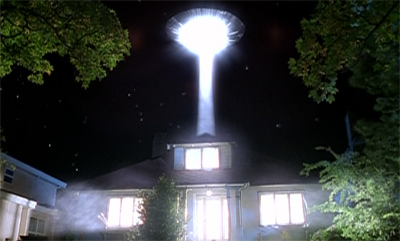
The Truth is up there...

The Truth is up there…

Continue reading

Non-Review Review: The Rover

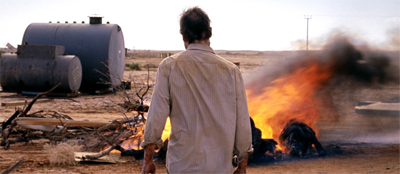
The Rover isn’t quite a post-apocalyptic road movie. A title card places the story “ten years after the collapse”, but it’s never clear what exactly “the collapse” is. Buildings still stand. Trains still run. Telegraph polls are still connected. Cars still drive. Military units still offer some small semblance of law and order. This isn’t a world that has collapsed, it is the decaying structure of a world still struggling to stand.

The Rover is a starkly beautiful and haunting film, one that says a lot with only a few scattered words. It’s unsettling not in its portrayal of a world that is dead, but instead in its attempt to capture a world struggling to keep breathing.

As the world burns...

As the world burns…

Continue reading

The X-Files – Sleepless (Review)

This August (and a little of September), we’re taking a trip back in time to review the second season of The X-Files. In November, we’ll be looking at the third season. And maybe more.

Vietnam casts a long shadow over The X-Files, just as it casts a long shadow over the rest of American popular culture. It was a conflict that left a scar on the American psyche, prompted no small amount of soul-searching and naval-gazing, forcing the country to contemplate its role on the global stage. The issues of war guilt and veterans rights haunted America well into the nineties, with films like Forrest Gump and Heaven and Earth still trying to make sense of it all.

Along with Watergate, Vietnam came to embody the disillusionment and disengagement of the seventies. While public discomfort with American involvement the Korean War never climbed above 50%, public disapproval of American involvement in Vietnam would reach almost 75% in March 1990. Vietnam remains a boogeyman, with memories of Vietnam arguably informing Clinton’s reluctance to commit American ground troops to foreign theatres during the nineties and serving as a frequent point of comparison to twenty-first century entanglements in Afghanistan or Iraq.

Howard Gordon’s first solo teleplay for The X-Files, Sleepless is an episode that explores Vietnam as a perpetual waking nightmare.

Preaching to the choir...

Preaching to the choir…

Continue reading

The X-Files – Blood (Review)

This August (and a little of September), we’re taking a trip back in time to review the second season of The X-Files. In November, we’ll be looking at the third season. And maybe more.

It’s interesting to get The Host and Blood produced back-to-back. Both episodes serve to draw writer Darin Morgan into the world of The X-Files. Brother of staff writer Glen Morgan, Darin Morgan would go on to become one of the most unique and distinctive voices to work on Chris Carter’s television shows – his scripts for The X-Files and Millennium stand out among the very best episodes the shows ever produced, with a very subversive and wry approach to the subject matter.

Morgan enjoyed one of the most surreal paths to the writers’ room imaginable. An actor with a few scattered credits on eighties television, including various shows his brother worked on like 21 Jump Street and The Commish, Morgan was cast as in the thankless role of “Fluke man” in The Host. However, he also found himself drawn into the production of the next episode, Blood. An episode with some production difficulties, Darin Morgan offered some ideas on how to develop the story.

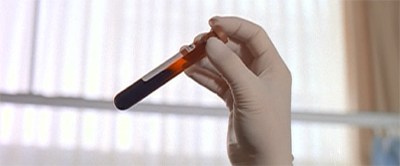
Blood work...

Blood work…

Ultimately, Darin Morgan didn’t write Blood. The script was written by Glen Morgan and James Wong, with Darin receiving a “story” credit on the finished episode. However, his ideas had impressed producer Howard Gordon, who would later propose that Darin Morgan join the writing staff. Morgan would accept the invitation and write Humbug later in the second season, before producing two genuine classics during the show’s phenomenal third year. (And also War of the Coprophages.) Darin Morgan would later write two more scripts for Millennium.

As such, Blood isn’t really a Darin Morgan episode. As it was written by Glen Morgan and James Wong, their own sensibilities shine through on the broadcast episode. However, Blood does contain a few of the wonderful trademarks of Darin Morgan’s approach to the show, not least of which a very post-modern cynicism about cynicism. Blood feels like a rather subtle and incisive critique of the culture of paranoia that The X-Files thrives on, refusing to offer clear-cut answers and suggesting that Mulder might be just a little bit off-balance.

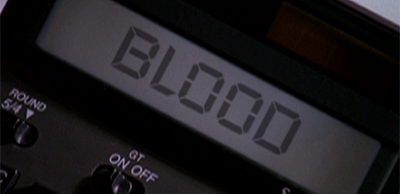
A very calculated title drop!

A very calculated title drop!

Continue reading

The X-Files – The Host (Review)

This August (and a little of September), we’re taking a trip back in time to review the second season of The X-Files. In November, we’ll be looking at the third season. And maybe more.

The Host and Little Green Men represent a fantastic one-two punch combination to open the second season of The X-Files. It’s very hard to think of two back-to-back standalone stories that most effectively sum up the show, capturing a lot of what makes the series so beautifully compelling and enduring. The two episodes are also quite surprising. It feels strange that Chris Carter didn’t write Little Green Men, given the importance of the premiere to the show. However, in light of that, it also feels strange that Carter did write The Host.

Working on The X-Files, Carter tends to gravitate towards “event” episodes. His name is frequently seen on episodes that push the show forward – in multiple senses. Carter is the architect of the show’s grand mythology, so his name pops up quite frequently on those scripts. However, Carter is also prone to write occasional “big” episodes of a given season. He wrote and directed The Post-Modern Prometheus and Triangle, for example, two of the more unique and distinctive episodes of the fifth and sixth seasons.

Through the looking glass...

Through the looking glass…

So, seeing Chris Carter’s name on the first “monster-of-the-week” of the new year rather than the all-important season premiere feels a little strange – particularly since The Host is an episode that seems a lot less ambitious than Little Green Men. After all, Little Green Men depicted Samantha Mulder’s abduction, revealed the show’s aliens and tried to make Vancouver look like Puerto Rico. In contrast, The Host is about an overgrown mutant worm.

And yet, perhaps that’s the point. The second season of The X-Files was a massively important year for the show. Along with the Fox Network itself, this was the year that The X-Files defined its own identity and really began to aggressively carve out a niche. The show did not make the top 100 shows of the 1993-1994 season, but almost reached the top 50 shows of the 1994-1995 season. That’s a meteoric rise, and the second season is very ruthlessly refining itself.

X marks the spot...

X marks the spot…

To describe The Host as a simple “monster-of-the-week” is to miss the point entirely. The show doesn’t exist yet another entry in a genre that the show established during its first year on the air. Instead, The Host is clearly constructed to be the monster-of-the-week episode. It’s an hour of television that is designed to get a reaction, to push buttons, to get people talking. This is an episode squarely aimed at anybody who heard the buzz over the summer hiatus and wanted to see what the fuss was about.

It works very well in this capacity. There is a reason that The Host as endured as a classic episode of The X-Files, packed with all manner of iconic and memorable imagery. Chris Carter constructed The Host as an example of what The X-Files does very well – and it’s a piece of science-fiction horror that sticks with people. It’s incredibly hard to forget. And that’s the beauty of it.

A monster mash-up...

A monster mash-up…

Continue reading

Robin: Year One (Review/Retrospective)

23rd July is Batman Day, celebrating the character’s 75th anniversary. To celebrate, this July we’re taking a look at some new and classic Batman (and Batman related) stories. Check back daily for the latest review.

Chuck Dixon is one of the definitive Batman writers, particularly in the context of the nineties. Dixon enjoyed a long and well-regarded run on Detective Comics in the nineties, serving as one of the three writers driving the Batman franchise – along with Doug Moench and Kelley Jones on Batman and Alan Grant on Shadow of the Bat. Dixon even got to stay involved with the Bat titles for a little while after No Man’s Land in 1999, when the entire line had a massive turnover in talent.

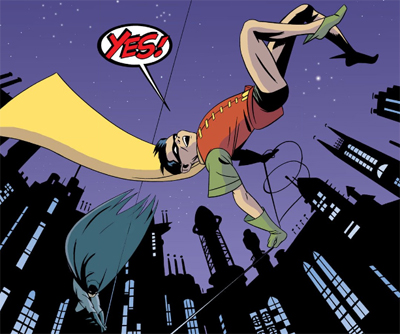
However, while Dixon is an incredibly influential writer on Batman, he had as much of an influence on Dick Grayson. Dixon was the writer who handled Dick Grayson’s first on-going Nightwing series, building off a miniseries written by Denny O’Neil. Dixon worked on Nightwing for seventy issues between 1996 and 2002. He even returned to the title with collaborator Scotty Beatty after its one hundredth issue to write Nightwing: Year One, an origin story covering the former Robin’s transition into his new superhero persona.

Swinging into action...

Swinging into action…

As such, it makes a great deal of sense for Dixon to collaborate with writer Scott Beatty on Robin: Year One, a prestigious miniseries spanning four extended issues and featuring wonderful artwork from Javier Pulido. Pulido’s distinctive artwork lends itself to vibrant colours and dynamic expression, as demonstrated during his wonderful stint as part of the rotating art team on The Amazing Spider-Man. If ever a comic book lent itself to Pulido’s style, Robin: Year One is it.

Dixon does some nice work trying to explain the dynamic between Batman and Robin, and even to argue why Robin is an essential part of the mythos. Most interestingly, he, Beatty and Pulido try to integrate the arrival of Robin with the atmosphere and mood established by Frank Miller and David Mazzucchelli in Batman: Year One.

Suit up!

Suit up!

Continue reading

The X-Files – Little Green Men (Review)

This August (and a little of September), we’re taking a trip back in time to review the second season of The X-Files. In November, we’ll be looking at the third season. And maybe more.

“We wanted to believe,” Mulder’s opening monologue explains. In a way, The X-Files works best as a profound meditation on faith. Not just Scully’s traditional religious faith, but Mulder’s belief that the world must make sense – even a crazy conspiratorial sort of sense. While Scully is a practising Roman Catholic, Mulder’s officer poster proclaims “I want to believe.” It’s a show about faith in humanity. A show about two people with unshakeable faith in each other.

“Trust no one,” a dying Deep Throat advised Scully in The Erlenmeyer Flask, words impossible to live by. Unsurprisingly, while treated as a mantra and motto for the show, the agents seem to freely ignore that last warning. Mulder and Scully trust each other. Mulder trusts the Lone Gunmen, and Senator Matheson, along with just about everything he reads or is told that reinforces his faith. It’s telling that – despite his cynicism about the government and her religious faith – the show casts Scully (rather than Mulder) in the role of skeptic.

His darkest hour...

His darkest hour…

Little Green Men is effectively a second pilot for the show. While set in the new status quo established during the closing scene of The Erlenmeyer Flask, the episode is very much structured as a “jumping on” point for those who might want to start watching the series. After all, the first season had been a cult hit, but hadn’t quite set the world on fire. Offering an introduction to those attracted by the growing buzz surrounding the show over the summer hiatus makes sense.

And so Little Green Men is built around Mulder’s crisis of faith and his attempts to vindicate that faith, offering a thoughtful examination of a man who wants to believe. While Little Green Men doesn’t offer any large steps forward in the show’s mythology or story arcs, it is a moving and introspective piece.

Samantha gets carried away...

Samantha gets carried away…

Continue reading