• Following Us

  • Categories

  • Check out the Archives


  • Awards & Nominations

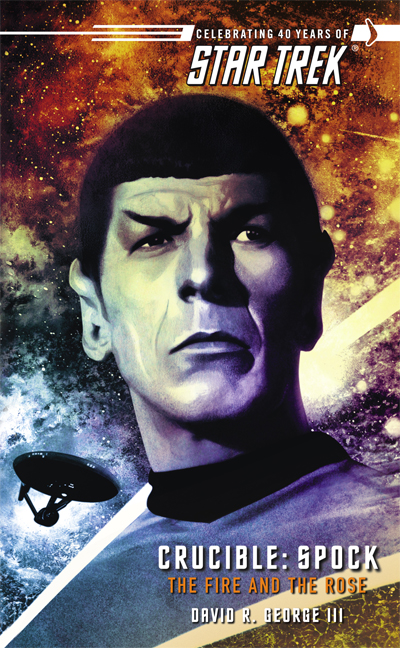
Star Trek – Crucible: Spock – The Fire and the Rose by David R. George III (Review)

This August, to celebrate the upcoming release of Star Trek: Into Darkness on DVD and blu ray, we’re taking a look at the Star Trek movies featuring the original cast. Movie reviews are every Tuesday and Thursday.

We’ll be supplementing our coverage of the movies with tie-ins around (and related to) the films. We’ll be doing one of these every week day. This is one such article.

The second part of David R. George II’s epic Crucible trilogy, The Fire and the Rose, can’t quite measure up to the charm and warmth of the first instalment in the series, Provenance of Shadows. George’s Crucible trilogy is a breathtakingly ambitious piece of work. Celebrating the fortieth anniversary of Star Trek with a trilogy of novels, each grounded in The City on the Edge of Forever and each based around a different member of the show’s leading trinity. The Fire and the Rose is still a very smart and well-constructed read, but it stands in the shadow of the first of George’s three books.

I suspect that at least part of the reason The Fire and the Rose doesn’t work as well is down to the subject. Leonard McCoy is a vitally important Star Trek character, but he was also a relatively under-developed one. While he was one of the leading trio on the original show, he was never as popular as Kirk and Spock, and never garnered the same amount of attention. (Notwithstanding solid work done by writers like Diane a Duane.) So McCoy was a relatively blank canvas for George to develop.

In contrast, Spock is the face of Star Trek. He was part of the first episode of Star Trek ever produced. He appeared in the most recent film released. Although DeForest Kelley christened Star Trek: The Next Generation with a cameo in Encounter at Farpoint, Leonard Nimoy’s visit to the spin-off earned a full two-parter in Unification. As such, Spock is a character who has been developed and explored and expanded by countless writers over the franchise’s long history.

Quite frankly, it’s hard to imagine there’s too much left to say about him. George tries quite hard, and find a nuance or two, but The Fire and the Rose feels more like an attempt to consolidate what we already know of Spock.
cruciblespock

Continue reading

Doctor Who: Day of the Daleks – Special Edition (Review)

To celebrate the fiftieth anniversary of the longest-running science-fiction show in the world, I’ll be taking weekly looks at some of my own personal favourite stories and arcs, from the old and new series, with a view to encapsulating the sublime, the clever and the fiendishly odd of the BBC’s Doctor Who.

Day of the Daleks originally aired in 1972.

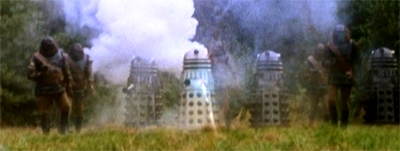
Day of the Daleks is a rather wonderful little story that’s been tucked away and forgotten about due its fairly lousy execution. After all, it’s hard to take a story particularly seriously when it suggests that the fate of the world will be decided by an assault on an old country house by three Daleks and a handful of extras. The wonderful people on the Doctor Who Restoration Team have done a wonderful job putting together a special edition of the adventure, using enhanced CGI effects and new footage to give the story the scale that it really deserves. After all, Day of the Daleksrepresents a bold attempt to do something new with the time travel at the very heart of the series.

Dawn of the Daleks...

Continue reading

Non-Review Review: Percy Jackson and the Sea of Monsters

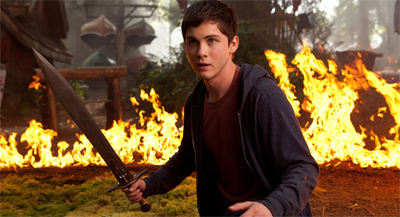
Percy Jackson and the Sea of Monsters demonstrates just how lucky the Harry Potter films were when it came to casting teenage performers. As a movie series centred around the off-spring of Greek deities, the movie relies on the charisma of its leads to sell the premise. Unfortunately, they aren’t quite up to the task. While none of the performers are terrible or wooden, the film drags to a hault when the teenage actors are asked to carry a scene. As a result, a quiet boat ride in the middle of the film seems interminable, and a heart-to-heart before the climax feels overlong.

None of the cast are assisted by a script from Marc Guggenheim. Guggenheim is capable of a well-placed zinger, and the movie offers its fair share of wit, but everything about the movie feels pandering and simplistic, as if Guggenheim doesn’t trust his audience to pick up on the plot points if they aren’t painstakingly catalogued and repeatedly spelt out with cringe-worthy dialogue. Indeed, Guggenheim’s desire to slow everything down so he can repeatedly explain what’s going on only adds to the pacing issues caused by the weak leads.

It’s a shame, because the adult cast seem to be genuinely enjoying themselves, and there’s something quite charming about the idea of “demi-googling” as a means of retrieving information.

Another stab at a Percy Jackson film...

Another stab at a Percy Jackson film…

Continue reading

Hannibal – Aperitif (Review)

I’ll admit to being a bit sceptical about Hannibal as a concept. I am quite fond of all three of the Anthony Hopkins films, although I realise that both Red Dragon and Hannibal are flawed pieces of work at best. I also have a soft spot for Michael Mann’s Manhunter, even if I am not as firm a devotee as others. However, there’s a point where you reach saturation even with an especially interesting character.

There was something increasingly frustrating about watching Thomas Harris and various writers and directors delve beneath the surface of “Hannibal the Cannibal” to offer trite explanations and rationalisations for a character who was originally a force of nature. A television series seems to be the perfect way to over-saturate the market even further. If the character of Hannibal could seem trite and mundane after four films released years apart, how do you make a weekly television series exciting?

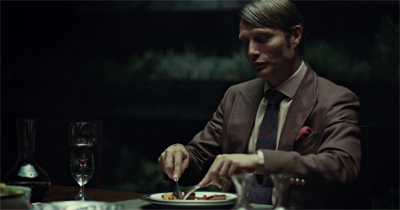
Surely you’ll either resort to explaining away all the mystery of the character, or you’ll simply wind up with a particularly shallow and generic serial killer show. There is a middle ground to be found, but it will be hard to strike that balance. With that in mind, I will confess that I am quite impressed with the pilot for Bryan Fuller’s Hannibal. Although it’s too early to form a definitive judgement, Aperitif is quite appetising.

The meat of the matter...

The meat of the matter…

Continue reading

Non-Review Review: Only God Forgives

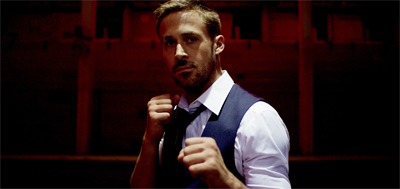
Only God Forgives is a journey into hell. It’s an unpleasant, uncomfortable, terrifying, surreal, macabre, haunting, eerie and beautiful exploration of brutality and violence. Nicolas Winding Refn’s latest film isn’t anywhere near as accessible as Drive. It isn’t just bereft of sympathetic characters, it doesn’t even feature any characters who lend themselves to empathy or recognisability. Ryan Gosling’s Julian is so introverted and withdrawn that it’s often difficult to determine the difference between reality and his surreal dream sequences.

Then again, given Refn suggests the man is living in his own private hell, perhaps there’s not too much difference any way.

Wanna fight?

Wanna fight?

Continue reading

Non-Review Review: Elysium

Elysium is good old-fashioned high-concept science-fiction. With production design alternately evoking the seventies (the upper class satellite that gives the movie its name) and eighties (the apocalyptic wasteland of future Los Angeles), Elysium feels like a conscious attempt to evoke classic genre films. Blomkamp builds in a healthy amount of social commentary, and there’s something quite satisfying in seeing a large-scale science-fiction film that isn’t afraid of big bold ideas.

However, the execution feels just a little bit muddled. The plotting is a little convoluted, and the third act becomes incredibly messy. The characters inhabiting the world never seem organic, with their motivations and behaviour prone to change rapidly to meet the rapidly-changing demands of a very messy script.

In a bit of a fix...

In a bit of a fix…

Continue reading

Star Trek – Ex Machina by Christopher L. Bennett (Review)

This August, to celebrate the upcoming release of Star Trek: Into Darkness on DVD and blu ray, we’re taking a look at the Star Trek movies featuring the original cast. Movie reviews are every Tuesday and Thursday.

We’ll be supplementing our coverage of the movies with tie-ins around (and related to) the films. We’ll be doing one of these every week day. This is one such article.

Ex Machina is really an astoundingly clever piece of work. On the surface, a lot of reads like a fan’s wishlist, a collection of “snags” made while watching the classic Star Trek films and making a conscious effort to fix them up a bit. There’s a lot of effort into explaining the changes between Star Trek: The Motion Picture and Star Trek II: The Wrath of Khan, with character-centric subplots focusing on Kirk’s ego or Chekov’s growing disenfranchisement.

Indeed, Bennett even provides an entirely unnecessary but quite-enjoyable-nonetheless set of annotations for Ex Machina, explaining where and how he’s tying his story into a rake of continuity. He describes Ex Machina as probing “an unexplored gap” in the franchise’s chronology. Ex Machina exists as both a sequel to a rather bland third-season episode of the show (For the World is Hollow and I Have Touched the Sky) and The Motion Picture. Neither is especially loved among fans.

However, what’s fascinating about Ex Machina is the way that none of this prevents Bennett from crafting a compelling and intriguing narrative. It’s clear that he’s enjoying attempts to fill in various gaps, but Ex Machina works incredibly well as a piece of Star Trek which stands on its own two feet.

st-exmachina

Continue reading

Non-Review Review: Star Trek – The Motion Picture

This August, to celebrate the upcoming release of Star Trek: Into Darkness on DVD and blu ray, we’re taking a look at the Star Trek movies featuring the original cast. Movie reviews are every Tuesday and Thursday.

Star Trek: The Motion Picture has a lot to recommend it. It’s big, thoughtful science-fiction, ripe with ideas and high-concepts tying directly into the root of the franchise. It gives both Kirk and Spock clear character arcs. It looks and sounds amazing, demonstrating just how far special effects had evolved in the decade since the show went off the air. However, it suffers from a pace that might best be described as “glacial”, and a sense that – for all the grand ideas – we aren’t really boldly going anywhere that new. Elements of the film can’t help but recall both the 1968 science-fiction classic 2001: A Space Odyssey and even the show’s own episode The Changeling.

While it’s easy to admire The Motion Picture, it’s a lot harder to enjoy it.

Strange new worlds...

Strange new worlds…

Continue reading

Star Trek – Leonard McCoy, Frontier Doctor by John Byrne (Review)

The August, to celebrate the upcoming release of Star Trek: Into Darkness on DVD and blu ray, we’re taking a look at the Star Trek movies featuring the original cast. Movie reviews are every Tuesday and Thursday.

We’ll be supplementing our coverage of the movies with tie-ins around (and related to) the films. We’ll be doing one of these every week day. This is one such article.

It’s fascinating how few stories take place around Star Trek: The Motion Picture. There’s a rake of tie-in material that exists to flesh-out the Enterprise’s five-year mission, and a large volume of material set during the period from Star Trek II: The Wrath of Khan straight through to Star Trek VI: The Undiscovered Country. However, the space around The Motion Picture has been somewhat overlooked by writers delving into the expanded world of Star Trek tie-in fiction.

To be fair, there are reasons for this. Although it was a box office success, looked stunning for the time, had a rake of big ideas and welcomed the crew to the screen, The Motion Picture isn’t generally considered to be one of the high points of the franchise. As such, it seems reasonable that it garners less attention, the affection shown by a few writers aside. There’s also the fact that The Motion Picture opens with the crew of the Enterprise broken up, scattered amongst the cosmos.

The Motion Picture sees Kirk putting the band back together after the universe seems to have forgotten about them, pulling them out of mothballs. Any story set in the lead-up to The Motion Picture would have to feature the ensemble all separated and going about their own thing. This limits the kind of stories that can be told in the setting, and makes it less appealing than other settings in Star Trek continuity.

John Byrne’s Leonard McCoy, Frontier Doctor gives us a glimpse of what a project set between the end of the Enterprise’s mission and the start of The Motion Picture might look like. It’s essentially a solo adventure series focusing on one member of the cast, and it’s absolutely fascinating.

These are the voyages of the Starship... Yorktown...

These are the voyages of the Starship… Yorktown…

Continue reading