• Following Us

  • Categories

  • Check out the Archives


  • Awards & Nominations

Star Trek: Deep Space Nine – The Quickening (Review)

This February and March (and a little bit of April), we’re taking a look at the 1995 to 1996 season of Star Trek, including Star Trek: Deep Space Nine and Star Trek: Voyager. Check back daily for the latest review.

Somehow, it happened. Star Trek: Deep Space Nine went from a show that could barely produce one good Bashir episode in a season to a series that could crank out three great Bashir episodes within the same production year.

The fourth season of Deep Space Nine is a fantastic season of television, even allowing for the episodes that don’t quite work (Sons of Mogh, Rules of Engagement) and those that fall completely apart (Shattered Mirror, The Muse). There any number of ways of measuring this success: the ease with which Worf has been integrated into the ensemble; the very high average quality of the individual episodes; the skill with which the production team navigated the introduction of the Klingon plot threads at the suggestion of the studio.

Paradise lost.

Paradise lost.

These are all perfect valid barometres of the season’s success. As is the most obvious indicator: the season is fun to watch and largely holds up on rewatch. However, the simple fact that Deep Space Nine could produce three great centring around Julian Bashir over the course of a single season speaks to how far the production team had come. After all, the studio had repeatedly asked the staff to write Bashir out of the show, convinced that fans were not responding to the station’s chief medical officer.

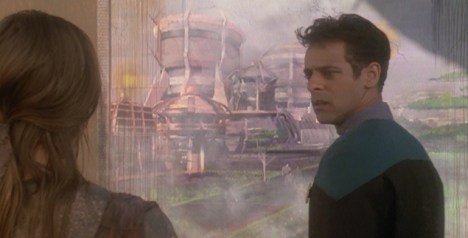
The Quickening is the third and final “good Bashir episode” of the fourth season, and it demonstrates just how important Bashir is to the fabric and framework of Deep Space Nine. Bashir represents Deep Space Nine‘s esoteric utopianism.

Bashir determination...

Bashir determination…

Continue reading

Star Trek: Deep Space Nine – Rejoined (Review)

This February and March, we’re taking a look at the 1995 to 1996 season of Star Trek, including Star Trek: Deep Space Nine and Star Trek: Voyager. Check back daily Tuesday through Friday for the latest review.

For a show that is supposedly about an enlightened and utopian future, Star Trek really doesn’t have the best record when it comes to gay rights.

Many fans laud the work that the franchise did in popularising the Civil Rights anxieties of the sixties, offering memorable and distinctive parables and the futility of racism while offering one of the first interracial kisses to air on national television. Fans of the franchise are quick to celebrate these triumphs as an example of Star Trek holding up a mirror to contemporary society and championing the causes of equality and social justice. It is part of the mythmaking that Gene Roddenberry baked into the foundation of the Star Trek legend.
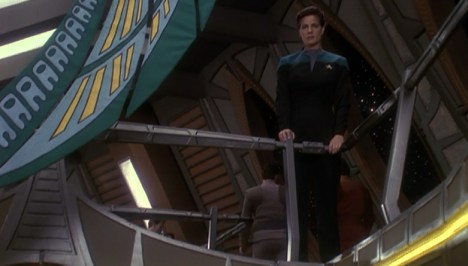
A Trill alone...

A Trill alone…

Of course, the reality is more complicated. As important as it was to have a racially diverse crew on the bridge of the classic Enterprise, that idea came from the studio rather than Roddenberry. The show defended and vindicated the Vietnam War just as often as it criticised and opposed it. The interracial kiss in Plato’s Stepchildren might had more meaning if it weren’t an example of telepathic mindrape by sadistic aliens, or if it had aired before I, Spy had broadcast its own interracial kiss.

As much as fans like to believe Star Trek is progressive and enlightened, the franchise does not have as strong a track record as its advocates would contest. This is particularly true of the depiction of homosexuality in Star Trek. In the first season of Star Trek: The Next Generation, David Gerrold’s script for Blood and Fire was scrapped. Richard Arnold claimed that it was because the script was terrible; but this was the same season that produced The Last Outpost, Angel One and The Neutral Zone. It seems “terrible” is a relative term.

Kiss me.

Kiss me.

There were other examples. During production of The Offspring, there are accounts of David Livingston sprinting down to the sets to stop a shot of a same-sex couple holding hands making it into the episode. When the show finally decided to do an allegory for homosexuality, it was careful to cast a female performer in the role of Riker’s love interest to be sure that the audience did not get the wrong idea. The mirror universe episodes of Star Trek: Deep Space Nine are populated with gay stereotypes and clichés.

No matter how alien the creatures in Star Trek might get, sexuality tends towards heterosexual. In Metamorphosis, Kirk and Spock only realise that the Companion is attracted to Cochrane once they deduce the creature’s gender. Odo’s pseudo-sexual relationship with other Founders is typically expressed in relation to the character known as the Female Changeling. (Chimera does try to fix this.) Although there have been allusions to Andorian marriages featuring four partners, Star Trek: Enterprise presents the relationships as decidedly normative.
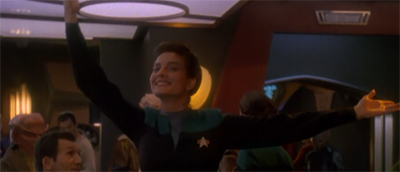
Take a bow!

Take a bow!

What little queer content exists seems to have slipped in under the radar. There is a decidedly homoerotic undertone to Amok Time. In The Offspring, Data allows Lal to assign her own gender and Whoopi Goldberg defined kissing as something that happens when “two people” (rather than “a man and a woman”) fall in love. In Rules of Acquisition, Jadzia Dax suspected that Quark’s newest employee had a crush on the rogue trader; Dax was just surprised to discover that the waiter in question was a woman in disguise who was trying to subvert the Ferengi patriarchy.

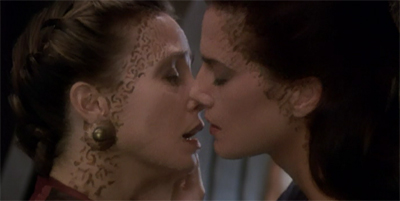
All of this serves to make Rejoined the most successful Star Trek episode to deal with the topic of homosexuality. This is not to argue that Rejoined is perfect or flawless. It is a science fiction show that aired in 1995, and there are some uncomfortable subtexts to the whole story. At the same time, its heart is in the right place. Rejoined is a beautiful piece of work, because it represents a rare example of the franchise trying to live up to its own publicity. In doing so, it serves to emphasise how frequently (and easily) the property has allowed itself to fall short.

Just Trilled to be there...

Just Trilled to be there…

Continue reading

Star Trek: The Motion Picture by Gene Roddenberry (Review)

This June, we’re taking a look at some classic Star Trek movie tie-ins and other interesting objects. Check back daily for the latest reviews and retrospectives.

Star Trek: The Motion Picture is heavily influenced by Gene Roddenberry. It’s a piece of work that serves as an example of Roddenberry’s vision of the franchise – what he felt Star Trek should look like in the late seventies and beyond. Much like the first and second seasons of Star Trek: The Next Generation, there’s a sense that this is the perfect distillation of Roddenberry’s later-day version of Star Trek, distinct from the versions that existed before and afterwards.

Although Roddenberry doesn’t have a writing or story credit on The Motion Picture, his influence is keenly felt; right down to hiring a bona fides science-fiction writer (Alan Dean Foster) to provide the story. (After hearing pitches from other authors like Ray Bradbury, Harlan Ellison and Theodor Sturgeon.) This was in keeping with his work on the early seasons of the show, where he tried to convince published science-fiction authors to contribute to Star Trek.

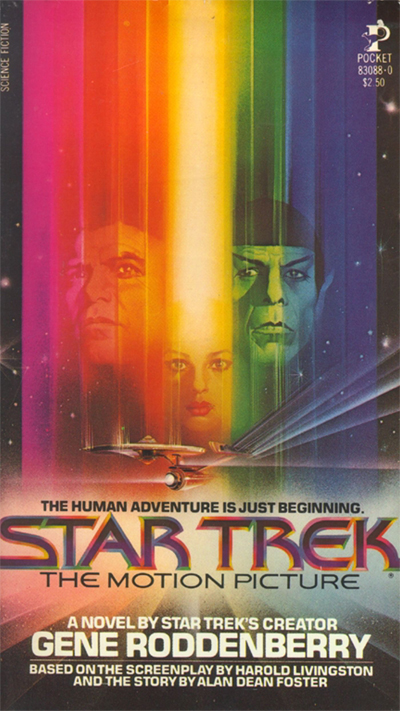
While Roddenberry doesn’t have a writing credit on the film, he did write the novelisation of the screenplay, which serves as a direct insight into how Roddenberry approached the franchise and how he saw Star Trek in 1979.

st-tmp-roddenberry

Continue reading

Star Trek: The Next Generation – Season 3 (Review)

This January and February, we’ll be finishing up our look at the second season of Star Trek: The Next Generation and moving on to the third year of the show, both recently and lovingly remastered for high definition. Check back daily for the latest review.

The third season is on a very short list of contenders for “the best season of Star Trek ever produced.” Maybe one or two other Star Trek: The Next Generation seasons make the list, maybe the first two seasons of the original Star Trek and maybe two seasons of Star Trek: Deep Space Nine. From beginning to end, the third season of The Next Generation hangs together remarkably well, churning out consistently entertaining adventures and several runs of truly classic episodes.

There are two main stretches in the season where the show produces episodes that could legitimately be ranked as the best of The Next Generation. The first comes around the midpoint of the season, from Yesterday’s Enterprise through to Sins of the Father, all episodes that would not look out of place on a “top ten episodes of The Next Generation” list. The second runs from Tin Man through to Sarek. And that’s ignoring the wonderful gems scattered throughout the season, from The Defector and The Hunted through to The Best of Both Worlds.

Of course, one of the most impressive aspects of the third season is the fact that the consistent quality visible on the television screen belies the chaos unfolding behind the scenes. The third season was a deeply troubled year of television, with plenty of unfortunate conflicts and moments of sheer desperation from the creative team. Perhaps the most wonderful demonstration of how far the show has come is obvious in the consistent professional quality of the output.

tng-bestofbothworlds1n

Continue reading