• Following Us

  • Categories

  • Check out the Archives


  • Awards & Nominations

Doctor Who: Utopia (Review)

To celebrate the fiftieth anniversary of the longest-running science-fiction show in the world, I’ll be taking weekly looks at some of my own personal favourite stories and arcs, from the old and new series, with a view to encapsulating the sublime, the clever and the fiendishly odd of the BBC’s Doctor Who.

Utopia originally aired in 2007.

Ooo, new voice. Hello, hello. Hello. Anyway, why don’t we stop and have a nice little chat while I tell you all my plans and you can work out a way to stop me, I don’t think.

Hold on. I know that voice.

I’m asking you really properly. Just stop. Just think!

Use my name.

Master. I’m sorry.

Tough!

– the Master, Martha and the Doctor welcome a new old face back

It’s very hard to talk about Utopia without seguing into talking about The Sound of Drums or The Last of the Time Lords. Certainly the third season finalé is the most ambitious of Russell T. Davies’ end-of-season adventures. It’s a three-part adventure, the equivalent to one of those classic gigantic six-part serials. If you accept that logic, it breaks down neatly into the old two-parter-and-four-parter format that the writers used to use to prevent an extended story from dragging too much.

Utopia, of course, serves the function of the two-parter in this classic structure – the smaller chunk of the episode with its own plot points and characters and settings, but with very definite connections to the rest of the adventure. However, I’d argue that Utopia is a lot more successful than either of the two episodes following, and a lot of that stems from the fact that it devotes a considerable amount of time to quietly setting up plot points and characters that will pay off down the line.

It’s also a powerful subversion of the fundamental ethos of Doctor Who, which makes it particularly effective as we head into two episodes where the Master hijacks not only the TARDIS but the show itself.

No time like the end of the universe...

No time like the end of the universe…

Continue reading

Doctor Who: Destiny of the Daleks (Review)

To celebrate the fiftieth anniversary of the longest-running science-fiction show in the world, I’ll be taking weekly looks at some of my own personal favourite stories and arcs, from the old and new series, with a view to encapsulating the sublime, the clever and the fiendishly odd of the BBC’s Doctor Who.

The Last of the Time Lords originally aired in 1979.

Oh, look! Rocks!

– the Doctor

Destiny of the Daleks is a bit crap. I know that there’s a whole bunch of “a bit crap” Dalek episodes, but Destiny of the Daleks doesn’t suffer because it doesn’t make sense, or it hangs on plot contrivance. Instead, it’s just a little bit dull. At least Resurrection of the Daleks bangs along making no sense in a reasonably exciting manner. In contrast, Destiny of the Daleks just sort of… is. In a way, it serves as the perfect opener to Graham Williams’ final year as producer, perfectly capturing the gap between the production staff the cast and the writers that so often led to bit of a mismatch in this part of the show’s history.

While I have a fondness for Terry Nation, I think it’s perfectly reasonable to argue that his style was hardly progressive or dynamic when he first wrote for the show in 1963. Indeed, my fondness for his work in the early years of the show is mostly down to how it harks backwards to pulpy classic science-fiction. If Nation wasn’t the most forward-looking of writers in 1963, then perhaps he really wasn’t best suited to open a season for Graham Williams and Douglas Adams in 1979.

Romana II goes through one of the oldest companion rites of passage...

Romana II goes through one of the oldest companion rites of passage…

Continue reading

Doctor Who: Evolution of the Daleks (Review)

To celebrate the fiftieth anniversary of the longest-running science-fiction show in the world, I’ll be taking weekly looks at some of my own personal favourite stories and arcs, from the old and new series, with a view to encapsulating the sublime, the clever and the fiendishly odd of the BBC’s Doctor Who.

Evolution of the Daleks originally aired in 2007.

Caan, let me help you. What do you say?

Emergency temporal shift!

– sadly the Doctor doesn’t follow this with a dramatic “CAAAAAAAN!!!”

Well, that went off the rails rather quickly. Okay, to be fair, the problems here were all hinted at in the first part, with those potential obstacles only turning into gaping flaws as this two-part adventure galloped toward the finish line. And, again, Evolution of the Daleks fails because it has too much ambition, rather than a complete lack of it. Still, the episode is a mess, full of mismatched ideas and crazy concepts that really don’t work especially well within the context of a Dalek episode. It’s not too hard to imagine a lot of these elements being recycled into a working story for the show, but the main problem seems to be that none of those elements work especially well with the Daleks.

I can see it in its eye-stalk...

I can see it in its eye-stalk…

Continue reading

Doctor Who: The Dalek Invasion of Earth (Review)

To celebrate the fiftieth anniversary of the longest-running science-fiction show in the world, I’ll be taking weekly looks at some of my own personal favourite stories and arcs, from the old and new series, with a view to encapsulating the sublime, the clever and the fiendishly odd of the BBC’s Doctor Who.

The Dalek Invasion of Earth originally aired in 1964.

We are the masters of Earth. We are the masters of Earth. We are the masters of Earth.

– who are the Daleks trying to convince?

Watching the early years of Doctor Who, I often find myself struggling to measure the quality of a show as against its importance to the series as a whole. Sixties Doctor Who has perhaps an unfair reputation when it comes to quality. In fact, as a rule, I’ve been pleasantly surprised on my trips back to the archives for these reviews. However, it’s often much more interesting to look at the context and the legacy of these classic episodes, as the show begins to define what it is and what it isn’t, what it can do and what it can’t do.

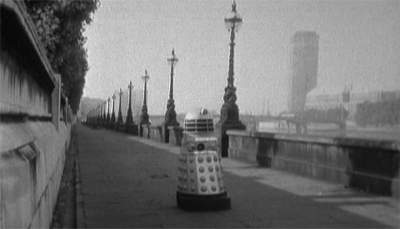
In that context, The Dalek Invasion of Earth is a massively important story. It features the first returning monsters of the series (go on, guess!), the first departure of a companion, the first invasion of Earth, the first aliens in London. The list goes on and on. There’s an incredibly vast influence that The Dalek Invasion of Earth has on the half-century of Doctor Who that follows. It’s nearly impossible to deny the shadow that this adventure casts.

However, it’s also a very flawed piece of television, for all its iconic status. Indeed, watching these six episodes I’m more often struck by what is important rather than what is good.

The Daleks of London...

The Daleks of London…

Continue reading

Doctor Who: Attack of the Cybermen (Review)

To celebrate the fiftieth anniversary of the longest-running science-fiction show in the world, I’ll be taking weekly looks at some of my own personal favourite stories and arcs, from the old and new series, with a view to encapsulating the sublime, the clever and the fiendishly odd of the BBC’s Doctor Who.

Attack of the Cybermen originally aired in 1985.

We realise this must be confusing for you.

– Threst tells it how it is

There is a tendency, these days, to be more sympathetic in appraisals of the Colin Baker years. Everybody – including Baker – accepts that his tenure could have gone a lot smoother. Watching Attack of the Cybermen, I can’t help but feel sorry for just about everybody involved. Rewatching Colin Baker’s first season, I can’t help but feel that the problem with this period of the show wasn’t that the production crew were making new mistakes or deviating from good ideas. It seems quite apparent that a lot of the major problems were embedded during Peter Davison’s time in the role.

The problem with Colin Baker’s first year on the show was that the writers and producers allowed those already significant flaws to attain critical mass.

A crushing blow...

A crushing blow…

Continue reading

Doctor Who: The Age of Steel (Review)

To celebrate the fiftieth anniversary of the longest-running science-fiction show in the world, I’ll be taking weekly looks at some of my own personal favourite stories and arcs, from the old and new series, with a view to encapsulating the sublime, the clever and the fiendishly odd of the BBC’s Doctor Who.

The Age of Steel originally aired in 2006.

Human race. For such an intelligent lot, you aren’t half susceptible. Give anyone a chance to take control and you submit. Sometimes I think you like it.

– oh, Doctor, you kinky so-and-so

I really don’t like Rise of the Cybermen. I think it’s a waste of a potential origin story for one of the Doctor’s most iconic adversaries. However, most of the problems with this two-parter are front-loaded. The set-up, quite frankly, is relatively pedestrian. It’s Doctor Who on auto-pilot. The follow-up, Age of Steel, actually works a bit better. That’s not to suggest that the script is any smarter or any tighter. Indeed, this is very much Doctor Who in big blockbuster mode. However, Age of Steel does have one massive advantage. It has director Graeme Harper working on it.

At least they're stylish...

At least they’re stylish…

Continue reading

Doctor Who: Shada (2003) (Review)

To celebrate the fiftieth anniversary of the longest-running science-fiction show in the world, I’ll be taking weekly looks at some of my own personal favourite stories and arcs, from the old and new series, with a view to encapsulating the sublime, the clever and the fiendishly odd of the BBC’s Doctor Who.

Shada originally broadcast on the BBC website in 2003.

Doctor, a fool would realise that it was written in code!

Skagra, this thing is written in code!

– Skagra and the Doctor have some communication difficulties

Has a failed Doctor Who story every haunted the collective consciousness in the way that Shada does? There’s a wealth of adventures that were proposed and never produced, from the last Master story that never happened in The Final Game, through to the laundry list of unproduced adventures that would have made up Colin Baker’s second season if the show hadn’t been parked by the BBC. However, Shada is something different. So different, in fact, that it has been told quite a few times. In fact, it might be the only Doctor Who story I end up covering twice.

This was a webcast version, a very simply animated version of the tale produced for the BBC website, using an audio play adapted from Douglas Adams’ original script by Big Finish, the fan collective who produce a range of celebrated audio plays for the classic series. Starring Paul McGann, the Eighth Doctor who never really got a chance to develop the role in live action, it’s an interesting glimpse at what might have been.

Lost in time...

Lost in time…

Continue reading

Doctor Who: The Vampires of Venice (Review)

To celebrate the fiftieth anniversary of the longest-running science-fiction show in the world, I’ll be taking weekly looks at some of my own personal favourite stories and arcs, from the old and new series, with a view to encapsulating the sublime, the clever and the fiendishly odd of the BBC’s Doctor Who.

The Vampires of Venice originally aired in 2010.

Tell me the whole plan!

One day that will work.

– the Doctor

The Vampires of Venice is interesting because it looks very different in 2013 as compared to when it was originally broadcast in 2010. In 2010, it looked a bit overly familiar, a collection of the tropes and storytelling tricks that we took for granted in the show under Russell T. Davies. The elements felt, at the time, a little over-familiar. Indeed, it seemed like Toby Whithouse’s script owed a great deal to his earlier adventure School Reunion.

However, Doctor Who looks very different in 2013. The show has definitely radically changed, so that these familiar plot points don’t seem quite so familiar any longer. Whereas The Vampires of Venice didn’t feel so strange after five years of Russell T. Davies, it does seem a bit more unique after three years of Steven Moffat. It doesn’t seem so much an attempt to repackage these story elements as it does one final celebration of them, a fond farewell to many of the narrative bits and pieces that we’d come to take for granted.

How times change.

A late-night bite...

A late-night bite…

Continue reading

Doctor Who: Tooth and Claw (Review)

To celebrate the fiftieth anniversary of the longest-running science-fiction show in the world, I’ll be taking weekly looks at some of my own personal favourite stories and arcs, from the old and new series, with a view to encapsulating the sublime, the clever and the fiendishly odd of the BBC’s Doctor Who.

Tooth and Claw originally aired in 2006.

I want her to say “we are not amused.” I bet you five quid I can make her say it.

Well, if I gambled on that, it’d be an abuse of my privileges of traveller in time.

Ten quid?

Done.

– Rose and the Tenth Doctor are “cute”

There’s something quite interesting at the heart of Tooth and Claw, which might be the best  “historical celebrity + monster” mash-up of the Davies era. It’s a wonderful pulpy genre hybrid run-around with Queen Victoria, ninja monks and a werewolf, but it’s also a quite interesting vehicle to explore the way that the show deals with historical characters. After all, Queen Victoria is a British icon, a monumentally important part of the British Empire. It would be tempting to reduce her to a bunch of catch-phrases and a stiff upper lip. It’s a testament to Davies as a writer that he can flesh her out a fully-drawn character.

However, there does seem to be something quite strange about a show that opens with a cheap shot at Margaret Thatcher only to wallow in the iconic status of Queen Victoria.

This year's Bad Wolf is in Torchwood...

This year’s Bad Wolf is in Torchwood…

Continue reading

Doctor Who: The Parting of the Ways (Review)

To celebrate the fiftieth anniversary of the longest-running science-fiction show in the world, I’ll be taking weekly looks at some of my own personal favourite stories and arcs, from the old and new series, with a view to encapsulating the sublime, the clever and the fiendishly odd of the BBC’s Doctor Who.

The Parting of the Ways originally aired in 2005.

Everything must come to dust. All things. Everything dies. The Time War ends.

– Rose

And so the first season of Russell T. Davies’ revived Doctor Who comes to a close. If you asked me, it’s the best season of the show that Davies has produced. The year contains a few clunkers, and it doesn’t contain the highest concentration of enjoyable episodes, but I think the first year has a much clearer direction and purpose than any of the years that followed. Although apparently Christopher Eccleston’s departure was only decided after the show went into production, the first season seems like it is constantly building to the death of the Doctor. The entire first season seems to build, logically and rationally, towards that moment.

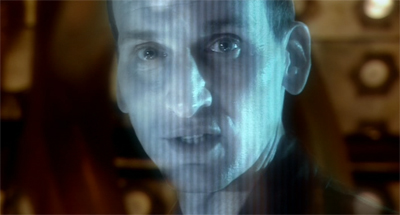
He's not all there...

He’s not all there…

Continue reading