• Following Us

  • Categories

  • Check out the Archives


  • Awards & Nominations

The X-Files – Excelsis Dei (Review)

This August (and a little of September), we’re taking a trip back in time to review the second season of The X-Files. In November, we’ll be looking at the third season. And maybe more.

The horror genre is much maligned.

Horror films typically fight harder for recognition than films in many other genres – often finding themselves consigned to the same ghetto as science-fiction or fantasy films. They are less likely to take home major mainstream awards, and it seems like horror films typically have to wait longer for reappraisal. Outside of aficionados, there’s a wariness of the horror genre – a skepticism towards it.

Window of opportunity...

Window of opportunity…

There are a lot of reasons for that. Some of them make sense; some of them don’t. One of the more common assumptions about horror is that the genre is more likely to produce “cheap” or “trashy” entertainment, as opposed to something more profound or insightful. There are, again, lots of reasons for this assumption. Most obviously, there’s the absurd cost-to-profit ratio of cheap terrible horror films that incentivises studios to churn out as many as they can as fast as they can. There’s a reason there’s an absurd number of Saw sequels.

However, that “cheapness” or “trashiness” isn’t just a result of business decisions. There are certain story tropes and narrative techniques that exist within the horror genre that feel like the cheapest sort of thrills. If you want to make an audience uncomfortable, just throw in something one of those trashier elements. As long as the audience squirms in their seats, it doesn’t matter what the implications of your decisions are. After all, your job is to creep them out?
Bitter little pill...

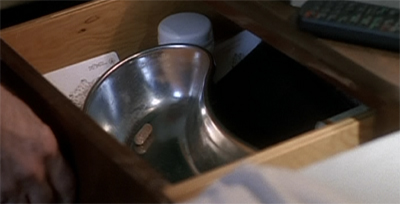
Bitter little pill…

So horror takes all manner of shortcuts, without any real thought as to what those elements actually mean. They are just something that catches the audience off-guard and makes them sit up in their seat. So horror tends to indulge in the worst sorts of racism and sexism as a means of drawing any sort of response from the audience. These tried-and-tested horror staples become effective storytelling shortcuts. The foreign becomes horrific. Conservative sexual morality is enforced with brutality. Rape – literal or metaphorical – is a cheap thrill.

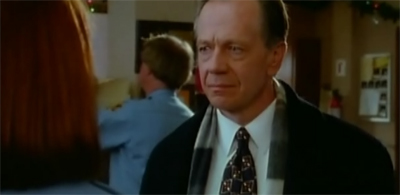
The X-Files struggles with these sorts of issues as it tries to bring horror to television. It occasionally does a very good job. However, there are also times when the series gives into its baser instincts. Excelsis Dei is an absolutely terrible episode, and an example of why the horror genre gets written off by so many people so quickly. It’s a poorly constructed hour of television, one about how old men are perverts, the rape of an under-developed character is a story hook and foreigners are magic.
The writing (or fine art) is on the wall...

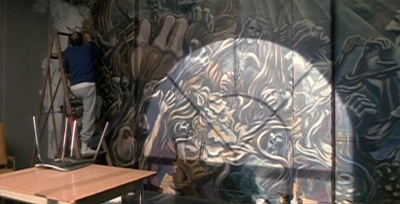
The writing (or fine art) is on the wall…

Continue reading

Picket Fences – Away in the Manger (Review)

This August (and a little of September), we’re taking a trip back in time to review the second season of The X-Files. In November, we’ll be looking at the third season. And maybe more.

The crossover that almost was.

Red Museum is a mess of an episode. There are a lot of reasons for that, but perhaps the most obvious is the fact that it was originally intended as a very different story. In fact, Chris Carter had planned to cross The X-Files over with Picket Fences. While The X-Files was airing on Fox, Picket Fences was broadcast on CBS. Perhaps predicting the long-running feud that would evolve between those two networks in the twenty-first century, CBS decided it had better things to do on Friday nights than promote The X-Files.

We can talk about it till the cows come home...

We can talk about it till the cows come home…

The result is that Chris Carter and David E. Kelley had to hastily re-work their episodes, averting the crossover rather late in the cycle. Carter shifted the location of the story, and had to write a new ending. Kelley seems to have been a bit more casual, with Away in the Manger feeling like an episode that takes place perpendicular (if not quite overlapping) to Red Museum. The result is curious, two episodes that speak to their own shows – but also the differences and similarities between Picket Fences and The X-Files.

In some ways, Away in the Manger feels almost like an episode of The X-Files shot from a different perspective.

Agent Morrell, FBI...

Agent Morrell, FBI…

Continue reading

The X-Files – Red Museum (Review)

This August (and a little of September), we’re taking a trip back in time to review the second season of The X-Files. In November, we’ll be looking at the third season. And maybe more.

While Firewalker is a solid episode ill-served by its position in the schedule and its similarity to an early episode of the show, Red Museum is just a mess.

The production issues with Red Museum are infamous. It was intended as the first part of a crossover between The X-Files and Picket Fences, both airing on Friday nights. The idea was that fans could tune into The X-Files on Fox for the first part of the story, and then move over to CBS after the credits rolled to pick up the case on Picket Fences. It was an ambitious effort – too ambitious. Although showrunners Chris Carter and David E. Kelley agreed on the idea, CBS vetoed it. It resulted in two orphaned hours of television, Red Museum and Away in the Manger.

Well, not quite. The result is something of a malformed two-parter composed of two individual malformed episodes.

He likes to watch...

He likes to watch…

Continue reading

The X-Files – Firewalker (Review)

This August (and a little of September), we’re taking a trip back in time to review the second season of The X-Files. In November, we’ll be looking at the third season. And maybe more.

Firewalker is a perfectly solid episode of The X-Files.

The problem is that Firewalker needs to be so much more than “solid.” It’s the first show of the season that has Mulder and Scully working together on an X-file. Nine episodes into the season, the show has finally put the two characters together and dropped them into a regular episodic adventure plot. Scully is back. There is no Cigarette-Smoking Man, no Skinner, no Krycek. The show had waited more than two months to get back to the familiar formula, so there was a palpable sense of anticipation.

Burn, baby, burn...

Burn, baby, burn…

To be fair to Firewalker, there’s a lot to like here. It’s a nice paranoia thriller, one that could easily serve as a text book example of a stand-alone X-Files episode. As you might expect from a script by Howard Gordon, Firewalker is also a nice character study for Mulder. It has a phenomenal guest cast – featuring actors like Bradley Whitford, Leland Orser and Shawnee Smith. On paper, Firewalker is a great episode of The X-Files. Divorced from context, it holds up rather well.

Unfortunately, Firewalker can’t be divorced from context. The episode has quite a few glaring problems. It seems a little disappointing that the first episode after Gillian Anderson’s return to full-time work on the show is a character study of Mulder. The plot is just a little too archetypal, feeling like a retread of Ice from the first season. The episode tries to get back to business as usual without bother to unpack everything that has happened since The Erlenmeyer Flask.

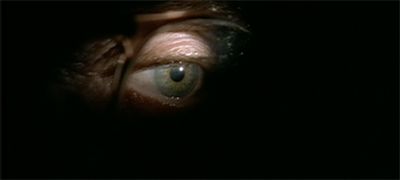
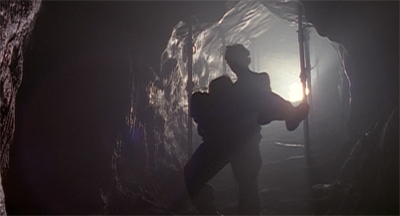
Into darkness...

Into darkness…

Continue reading

The X-Files – One Breath (Review)

This August (and a little of September), we’re taking a trip back in time to review the second season of The X-Files. In November, we’ll be looking at the third season. And maybe more.

If there were ever any doubt that The X-Files is fundamentally about faith in the nineties, One Breath should put the matter to rest.

An astounding, moving, staggering and thoughtful piece of work, One Breath not only wraps up the arc that opened the second season, it also provides closure to the themes that writers Glen Morgan and James Wong had been seeding throughout this first stretch of the season. One Breath bookends the meditation on faith that began in Little Green Men and serves as a counterpoint to the paranoia of Blood and the nihilism of 3.

One Breath is a tremendous piece of work, the best episode of the season and one that deserves to be mentioned among the very best the show ever produced.

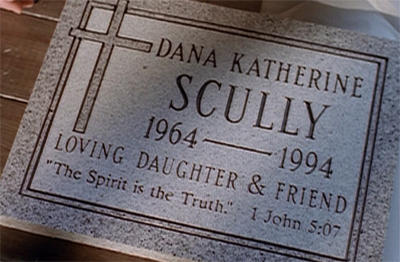
Grave stakes...

Grave stakes…

Continue reading

The X-Files – 3 (Review)

This August (and a little of September), we’re taking a trip back in time to review the second season of The X-Files. In November, we’ll be looking at the third season. And maybe more.

3 is the first absolute misfire from the second season of The X-Files.

It’s easy enough to account for the problems with 3. The production on the episode was a mess. It was the first episode produced without one of the show’s two lead characters. It existed to plug a hole in the schedule caused by factors outside the control of the production staff. Writers Glen Morgan and James Wong were working on both this and One Breath simultaneously. And it’s also a traditional monster story, which is something that The X-Files had struggled with and would struggle with again.

Vamping it up...

Vamping it up…

To be fair, 3 does what it says on the tin. It is the episode between Ascension and One Breath, a forty-five minute breather that fills a broadcast slot and allows the show to continue on while Gillian Anderson takes maternity leave. The fact that there was only one slot to fill without Anderson is a testament to both the production team’s organisational skill and Anderson’s work ethic. Really, all that 3 needs to do is exist.

Even with that in mind, 3 still feels like a disappointment. Given how Anderson’s pregnancy managed to spur the production team to create a compelling long-form story for the show, culminating in stories like Duane Barry and One Breath, it’s disappointing that her absence doesn’t inspire the same creativity. Seeing The X-Files without Scully should be the opportunity for a fascinating adventure or insightful character study; it could play with audience expectations or the show’s rigid format. Instead, the result is just a mess.

"All by myself..."

“All by myself…”

Continue reading

The X-Files – Blood (Review)

This August (and a little of September), we’re taking a trip back in time to review the second season of The X-Files. In November, we’ll be looking at the third season. And maybe more.

It’s interesting to get The Host and Blood produced back-to-back. Both episodes serve to draw writer Darin Morgan into the world of The X-Files. Brother of staff writer Glen Morgan, Darin Morgan would go on to become one of the most unique and distinctive voices to work on Chris Carter’s television shows – his scripts for The X-Files and Millennium stand out among the very best episodes the shows ever produced, with a very subversive and wry approach to the subject matter.

Morgan enjoyed one of the most surreal paths to the writers’ room imaginable. An actor with a few scattered credits on eighties television, including various shows his brother worked on like 21 Jump Street and The Commish, Morgan was cast as in the thankless role of “Fluke man” in The Host. However, he also found himself drawn into the production of the next episode, Blood. An episode with some production difficulties, Darin Morgan offered some ideas on how to develop the story.

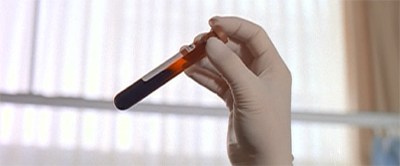
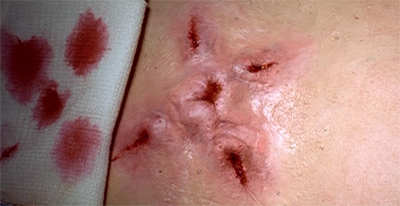
Blood work...

Blood work…

Ultimately, Darin Morgan didn’t write Blood. The script was written by Glen Morgan and James Wong, with Darin receiving a “story” credit on the finished episode. However, his ideas had impressed producer Howard Gordon, who would later propose that Darin Morgan join the writing staff. Morgan would accept the invitation and write Humbug later in the second season, before producing two genuine classics during the show’s phenomenal third year. (And also War of the Coprophages.) Darin Morgan would later write two more scripts for Millennium.

As such, Blood isn’t really a Darin Morgan episode. As it was written by Glen Morgan and James Wong, their own sensibilities shine through on the broadcast episode. However, Blood does contain a few of the wonderful trademarks of Darin Morgan’s approach to the show, not least of which a very post-modern cynicism about cynicism. Blood feels like a rather subtle and incisive critique of the culture of paranoia that The X-Files thrives on, refusing to offer clear-cut answers and suggesting that Mulder might be just a little bit off-balance.

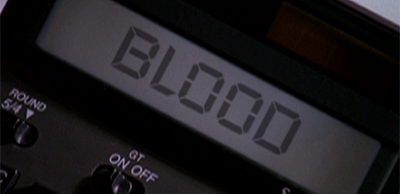
A very calculated title drop!

A very calculated title drop!

Continue reading

The X-Files – The Host (Review)

This August (and a little of September), we’re taking a trip back in time to review the second season of The X-Files. In November, we’ll be looking at the third season. And maybe more.

The Host and Little Green Men represent a fantastic one-two punch combination to open the second season of The X-Files. It’s very hard to think of two back-to-back standalone stories that most effectively sum up the show, capturing a lot of what makes the series so beautifully compelling and enduring. The two episodes are also quite surprising. It feels strange that Chris Carter didn’t write Little Green Men, given the importance of the premiere to the show. However, in light of that, it also feels strange that Carter did write The Host.

Working on The X-Files, Carter tends to gravitate towards “event” episodes. His name is frequently seen on episodes that push the show forward – in multiple senses. Carter is the architect of the show’s grand mythology, so his name pops up quite frequently on those scripts. However, Carter is also prone to write occasional “big” episodes of a given season. He wrote and directed The Post-Modern Prometheus and Triangle, for example, two of the more unique and distinctive episodes of the fifth and sixth seasons.

Through the looking glass...

Through the looking glass…

So, seeing Chris Carter’s name on the first “monster-of-the-week” of the new year rather than the all-important season premiere feels a little strange – particularly since The Host is an episode that seems a lot less ambitious than Little Green Men. After all, Little Green Men depicted Samantha Mulder’s abduction, revealed the show’s aliens and tried to make Vancouver look like Puerto Rico. In contrast, The Host is about an overgrown mutant worm.

And yet, perhaps that’s the point. The second season of The X-Files was a massively important year for the show. Along with the Fox Network itself, this was the year that The X-Files defined its own identity and really began to aggressively carve out a niche. The show did not make the top 100 shows of the 1993-1994 season, but almost reached the top 50 shows of the 1994-1995 season. That’s a meteoric rise, and the second season is very ruthlessly refining itself.

X marks the spot...

X marks the spot…

To describe The Host as a simple “monster-of-the-week” is to miss the point entirely. The show doesn’t exist yet another entry in a genre that the show established during its first year on the air. Instead, The Host is clearly constructed to be the monster-of-the-week episode. It’s an hour of television that is designed to get a reaction, to push buttons, to get people talking. This is an episode squarely aimed at anybody who heard the buzz over the summer hiatus and wanted to see what the fuss was about.

It works very well in this capacity. There is a reason that The Host as endured as a classic episode of The X-Files, packed with all manner of iconic and memorable imagery. Chris Carter constructed The Host as an example of what The X-Files does very well – and it’s a piece of science-fiction horror that sticks with people. It’s incredibly hard to forget. And that’s the beauty of it.

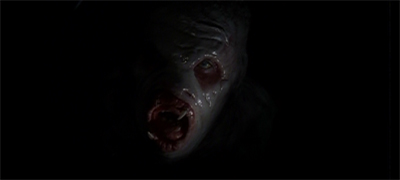
A monster mash-up...

A monster mash-up…

Continue reading

Lost for Words? Do We Really Need an Explanation for Lost?

Lost is entering its final phase. Just two weeks left and it will all be over. I have no doubts that The End, the final episode, will be a bit of a phenomenon – ABC are reportly charging nearly $1m for advertising space during the finale. However, I imagine that a lot of people tuning in will be disappointed – as I expect a large number of viewers will be expecting an easy answer or several to (in fairness, perfectly reasonable) questions like “what is the island?”, “why was there a polar bear on the island and how did it survive?” and “what the hell happened?” To be honest, some of these questions have already been answered (not necessarily satisfactorily), but I still don’t think that the answers – even if they are provided – will be offered in a viewer-friendly mode. And I’m actually reasonably okay with that.

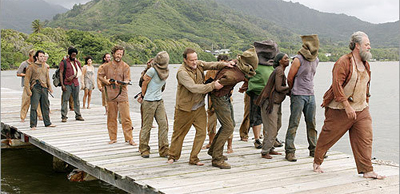
Lost at sea?

Continue reading

The Leading Man Swap-Out…

I live in the same house as my gran (I reckon I’m young enough that it’s still cute rather than creepy), and last week a new boxset of her pet obsession – CSI – arrived in the door. Since she’s in bed shortly after I get home from work, the two of us have been watching episodes of the ninth season of the seminal forensic “drama” (it’s more science-fiction or fantasy, but let’s not quibble). It’s the season that sees former hot young actor of the eighties, William Peterson, replaced by former hot young actor of the nineties, Laurence Fishburne. I’ll admit I haven’t yet watched every episode, but it’s surprising how much I’m not missing the lead who coaxed the show through nearly a decade of airtime. Has CSI seemingly acheived the impossible? Has it successfully swapped out an established leading man?

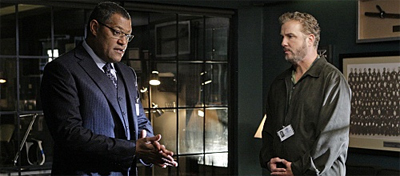
A Fish(burne) out of water?

A Fish(burne) out of water?

Continue reading