• Following Us

  • Categories

  • Check out the Archives


  • Awards & Nominations

Millennium – Jose Chung’s “Doomsday Defense” (Review)

This May and June, we’re taking a trip back in time to review the fifth season of The X-Files and the second season of Millennium.

Well, all’s well that ends well. Though that’s easy for Shakespeare to say – he’ll be around for another millennium. But what of our own millennium? Will it all end well? No one of course can know, but that of course doesn’t stop anyone from guessing. And the nature of these predictions always revolve around the usual suspects: salvation and/or self–satisfaction. With that in mind, I humbly add my own prophecy of what the dawn of the new millennium shall bring forth: one thousand more years of the same, old crap.

– Jose Chung

The write stuff...

The write stuff…

Continue reading

The X-Files – Unusual Suspects (Review)

This May and June, we’re taking a trip back in time to review the fifth season of The X-Files and the second season of Millennium.

On the surface, Unusual Suspects looks like quite a clean little episode.

It is an obvious production save – a story thrown together when it became clear that David Duchnovny and Gillian Anderson’s commitments to The X-Files: Fight the Future meant that they would not be available to film even the shortened order of twenty episodes in the fifth season. Although Unusual Suspects aired as the third episode of the season, it was actually the first produced. With limited availability to David Duchovny, Unusual Suspects was constructed as an episode that could be built around a member (or members) of the supporting cast.
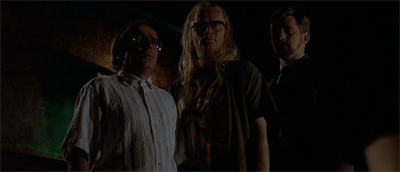
Hero shot!

Hero shot!

Five seasons in, this is not a radical concept. While Mulder and Scully are still very much the heart of the show, the supporting cast has been developed to the point where the show can turn over an episode to somebody who isn’t Mulder or Scully. The fourth season offered a glimpse of the (possible) secret history of the Cigarette-Smoking Man in Musings of a Cigarette-Smoking Man and allowed Walter Skinner to act out his own morality play in Zero Sum. After these two characters, the Lone Gunmen were likely candidates for their own episode.

As such, Unusual Suspects also works quite well as “ground zero” for the eventual development of The Lone Gunmen during the eighth season of The X-Files. It is the episode that demonstrated that the trio could carry their own story with their eccentric little dynamic, while still being engaging and exciting. Given how The Lone Gunmen turned out, a particularly cynical commentator might suggest that Unusual Suspects very much over-sold the appeal. Nevertheless, Unusual Suspects is a logical and clear step forward in the evolution of the Lone Gunman.
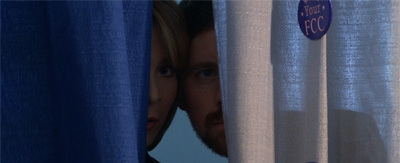
Peering through the curtain...

Peering through the curtain…

And yet, for all that these are the aspects of Unusual Suspects that generate discussion and debate, they are not the heart of the episode. What is most interesting about Unusual Suspects is the way that it allows writer Vince Gilligan to brush up against the show’s central mythology, albeit only fleetingly. Gilligan is fond of arguing that Memento Mori was his only credit on a mythology episode, but that sells Unusual Suspects rather short. Although it does not dabble directly with “black oil” or “alien bounty hunters”, it does allow Gilligan to play with the show’s big central story thread.

Unusual Suspects is not just positioned by Gilligan as the “secret origin” of the Lone Gunmen. The episode is decidedly more ambitious than all that. Without directly acknowledging it, and without explicitly coming out and saying it, Unusual Suspects presents itself as the roots of the show itself. Although nowhere near as boldly and triumphantly subversive as Jose Chung’s “From Outer Space” or Musings of a Cigarette-Smoking Man, the episode allows Gilligan to offer his own sly (and slightly stinging) commentary on the show’s central mythology.

Tonight we're gonna party like it's 1989.

Tonight we’re gonna party like it’s 1989.

Continue reading

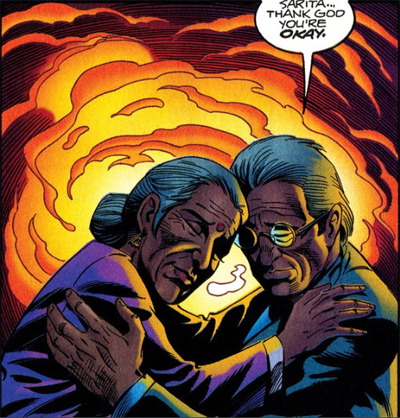
The X-Files (Topps) #33 – Soma (Review)

This May and June, we’re taking a trip back in time to review the fifth season of The X-Files and the second season of Millennium.

Soma is a done-in-one story that fits quite comfortably with the rest of John Rozum’s work on The X-Files.

Indeed, like a lot of Rozum’s output, Soma feels like a story recovered from a fifties horror comic. It is a very traditional ghost story hinging on a number of absurd contrivances and building to a suitably impressive climax. This is not a low-key supernatural thriller – it features vengeful smoke demons who materialise in front of countless witness and almost murder Mulder and Scully at the climax. Despite the insistence on the final page that it was too smoky to see anything, Soma feels a little too loud and campy for the world of The X-Files.

Burnt out...

Burnt out…

The script is very familiar. In many ways, Soma plays like an update of the script to Donor. It is another supernatural “beyond the grave” revenge story, similar in tone to first season episodes like Young at Heart or Lazarus or Born Again. As with Donor, the malicious spirit is a husband who plots a horrific revenge on a wife who disregarded his dying wishes. However, while Donor had an enjoyable pulpy charm to sustain it as an unwilling organ donor attempted to reclaim his harvested organs, Soma feels just a little bit too mean-spirited and malicious in tone.

Soma is a functional and efficient X-Files comic, but one that feels just a little bit too rote and familiar for its own good.

Burning love...

Burning love…

Continue reading

The X-Files – Redux II (Review)

This May and June, we’re taking a trip back in time to review the fifth season of The X-Files and the second season of Millennium.

Redux II would be a lot better if the audience believed anything that the episode was saying.

In fact, Redux II would be a lot better if it seemed like the show itself believed anything that the episode was saying.

"Hm. That resolution is unsatisfying. Deeply unsatisfying."

“Hm. That resolution is unsatisfying. Deeply unsatisfying.”

Continue reading

Millennium – 19:19 (Review)

This May and June, we’re taking a trip back in time to review the fifth season of The X-Files and the second season of Millennium.

One of the interesting aspects of the second season of Millennium is just how carefully structured all the chaos actually is.

There is an endearing and infectious randomness to the plotting of episodes like Sense and Antisense or A Single Blade of Grass, with individual episodes often struggling to fit together on an act-by-act basis. However, things become a lot clearer from a distance. Pulling back, it appears quite clear that there is a method to the madness. The episodes in the season – particularly those positioned towards the beginning and the end – each serve a clear purpose in the larger arc of the second season.

Will he die for our sins?

Will he die for our sins?

The first third of the season is very much about establishing concepts that will be of use later in the story. The Beginning and the End removes Frank from the yellow house and starts him on a new journey. Beware of the Dog introduces the Old Man and teases the mythology of the Millennium Group. Monster introduces Lara Means. The Curse of Frank Black gives Frank his long dark midnight of the soul. 19:19 and The Hand of St. Sebastian were the last two episodes in this opening act, and they exist to affirm the show’s cosmology.

Both 19:19 and The Hand of St. Sebastian firmly establish the show’s apocalyptic worldview in a Christian theological framework. 19:19 does this by exploring biblical prophecy and eschatology, while The Hand of St. Sebastian reveals the Millennium Group to be a secret Christian sect who have existed for over a thousand years. Although the show has always taken a lot of its imagery and iconography from Christianity, 19:19 engages explicitly with the idea of biblical prophecy and millennialism.

All part of the plan...

All part of the plan…

Continue reading

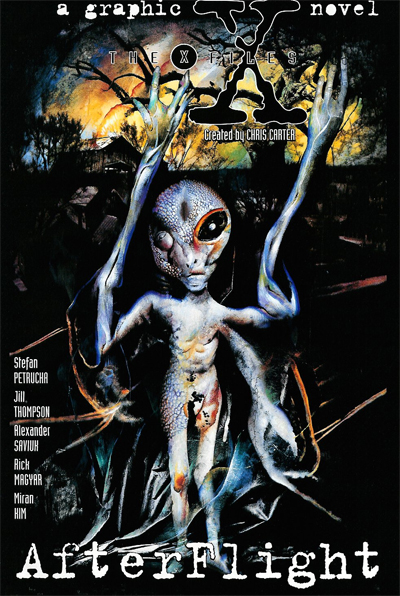
The X-Files (Topps) – Afterflight (Review)

This May and June, we’re taking a trip back in time to review the fifth season of The X-Files and the second season of Millennium.

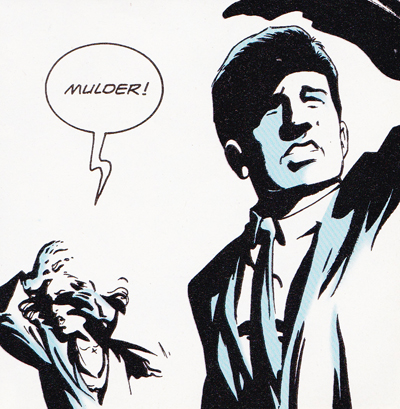
And so we reach the end of Stefan Petrucha’s work on The X-Files.

It is quite a delayed end. Petrucha had originally written Afterflight three months before Home of the Brave, his last script for the monthly tie-in comic book. It was published fifteen months after the publication of Home of the Brave. That meant a year and a half had passed between Petrucha finished and Topps actually publishing it. The delay was rooted in disagreements with Ten Thirteen over the artwork. Still, Afterflight offers just a hint of closure to the sixteen-issue (and more) run that launched Topps’ licensed X-Files comic book line.

The truth is up there...

The truth is up there…

Afterflight is a mournful little comic, a story that takes a lot of the core themes of Petrucha’s X-Files work and distills them down to a single story. Interviewed about his work, Petrucha contended that his writing for The X-Files primarily meditated on themes of “memory, the self and what is reality.” All of these ideas are brought to the fore in Afterflight, a comic that offers a similar thematic resolution to Home of the Brave, suggesting the faintest hint of hope can be found beyond the world of men.

Afterflight is a beautiful piece of work, and a suitable conclusion to a fantastic run.

Aliens among us...

Aliens among us…

Continue reading

The X-Files – Redux I (Review)

This May and June, we’re taking a trip back in time to review the fifth season of The X-Files and the second season of Millennium.

Redux I hits on the same problem that haunted The Blessing Way. It is very hard to structure a three-parter that bridges two seasons of television. The biggest problem is the second episode, which has the unfortunate position of having to serve as a season premiere while carrying the baggage from the last season finalé and remaining unable to resolve anything. So the episode inevitably becomes an exercise in spinning wheels as the show saves all of its potential resolutions for the third episode.

A particular cynical commentator might suggest that Redux I plays as Chris Carter’s twisted take on Aaron Sorkin. Sorkin is famous for his sequences of characters walking through corridors while trading witty banter – a very nice way of keeping physical movement in the midst of largely dialogue-driven plots. This would become a defining feature of The West Wing, the show that Sorkin would launch in September 1999. Redux I seems to prefigure the style, albeit with a twist. There is lots of walking through corridors as characters talk to themselves in monologue.

"Wow, and I though my filing system was bad..."

“Wow, and I thought my filing system was bad…”

Redux I plays as a collection of voice-over monologues transposed over sequences of Mulder wandering through corridors in the Pentagon. One immediately wonders how the Department of Defence could have staged such a complex and convincing hoax against the American people when they cannot find one lost FBI agent inside the Pentagon. The drab setting makes for a shockingly dull episode; the majesty of the Yukon Mountains is lost, replaced by long sequences of grey walls and red doors.

Redux I has more than a few interesting ideas, but its structure is a mess. Sitting between Gethsemane and Redux II, the episode has no clear sense of purpose or momentum; no drive or ambition or excitement.

Don't worry, it could still make sense...

Don’t worry, it could still make sense…

Continue reading

Millennium – Sense and Antisense (Review)

This May and June, we’re taking a trip back in time to review the fifth season of The X-Files and the second season of Millennium.

Sense and Antisense is a misfire.

It is an episode with far too much going on, and no time to unpack it all. Sense and Antisense moves like a rocket ship, jumping from one crazy idea to the next crazy idea. It opens with the threat of a viral contagion, but quickly escalates into the realm of conspiracy theories and mind control. It is an episode that is almost impossible to summarise without sounding as crazy as some of the characters populating the narrative. It is unsatisfying and disjointed, but not in a way that makes those sentiments seem part of the plan.

The pupil has become the master...

The pupil has become the master…

At the same time, it is an incredibly ambitious misfire. The biggest problem with Sense and Antisense is that it tries to cram too much in there. It is constructed almost writer Chip Johannessen tried to condense down contemporary conspiracy theory into a single forty-five minute story that winds up connecting the Department of Energy to the Rwandan Genocide. There is a breathless enthusiasm to all this that would make Fox Mulder blush. As much as Sense and Antisense doesn’t work, it is hard not to admire it’s sheer gumption.

The second season of Millennium might not be the most consistent season in the history of the medium, but even its failures are bold and energetic. Sense and Antisense is not The Curse of Frank Black, Jose Chung’s “Doomsday Defense” or Luminary, but it is a far cry from something like Unrequited, Synchrony or Schizogeny.

A stain on the record...

A stain on the record…

Continue reading

Millennium – The Beginning and the End (Review)

This May and June, we’re taking a trip back in time to review the fifth season of The X-Files and the second season of Millennium.

The Beginning and the End manages the impressive and paradoxical feat of both rebooting Millennium and resolving the cliffhanger at the end of Paper Dove. These two contradictory impulses become part of the thematic fabric of The Beginning and the End, an episode fascinated by duality and opposition. Can the polaroid stalker be both a serial killer of the week and the herald of something so much greater? Can Catherine and Frank Black be both united and separated? Can Millennium be the same show it was last year and something completely new?

The Beginning and the End is the start of the show’s polarising and divisive second season. To critics, the second season completely branches off from the first season of the show, replacing a framework that had grown and developed over the course of the year with a bizarre and unwieldy approach that was gonzo and surreal. To fans, the second season was an ambitious and exciting piece of television utterly unlike anything that had been broadcast before or has been broadcast since.

Up in the sky...

Up in the sky…

With Chris Carter back focusing on the development of The X-Files and the looming release of The X-Files: Fight the Future, Fox drafted in Glen Morgan and James Wong to steer the second season of Millennium. The duo had helped to define the identity of The X-Files in its first year, and had produced the failed (but ambitious and prescient) series Space: Above and Beyond for the network. After working on the fourth season of The X-Files and the first season of Millennium, Fox allowed the pair to produce their own pilot – The Notorious Seven.

When Fox opted not to take The Notorious Seven to series, they asked Glen Morgan and James Wong to take charge of Millennium in its sophomore season. As The Beginning and the End demonstrates, Morgan and Wong promptly made the show their own.

Looking up and wondering...

Looking up and wondering…

Continue reading

Star Trek: Enterprise – Future Tense (Review)

Next year, Star Trek is fifty years old. We have some special stuff planned for that, but – in the meantime – we’re reviewing all of Star Trek: Enterprise this year as something of a prequel to that anniversary. This April, we’re doing the second season. Check back daily for the latest review.

The Temporal Cold War arguably works better as a metaphor than a plot.

There is something quite compelling about the imagery of Star Trek‘s past and future doing battle within the confines of a troubled prequel, of outside forces meddling in a narrative, of the characters caught in the grip of forces they cannot understand. To expect the Temporal Cold War to make sense is to miss the point; to expect clear resolution is foolhardy. Instead of serving as a strong narrative thread running through Star Trek: Enterprise, it serves as a visual manifestation of the troubles haunting the show. It also serves as a very effective story backdrop.

Let's do the time warp again...

Let’s do the time warp again…

Future Tense has a pretty straightforward story. Archer and his crew discover a piece of floating space debris. They bring it aboard, discovering it is not what it appears to be. The Suliban show up, claiming salvage rights. The Tholians arrive, demanding the same. A chase ensues, as Archer tries to outrun the two alien species desperate to get their hands on the technology. Future Tense is a classic chase narrative, as multiple parties fight over what Hitchcock described as a “macguffin.” Little is revealed, nothing is proven, everything is resolved so neatly that it seems divine intervention is at work. Maybe it is.

And yest, despite – or perhaps because – of this narrative simplicity, Future Tense stands as a highlight of the troubled second season. Future Tense leaves almost every question about the Temporal Cold War unanswered, but it is a tight and efficient action adventure. Like Cold Front before it, it recognises that the Temporal Cold War is a story as much as a backdrop. The fact that it is mysterious and nonsensical and arbitrary make it all the more compelling. After all, that is how it must appear to Archer.

Alien bodies...

Alien bodies…

Continue reading