• Following Us

  • Categories

  • Check out the Archives


  • Awards & Nominations

Doctor Who: Wish World (Review)

“We’re going to bring down God. Are you with us?”

In many ways, Wish World feels like a thesis statement for Davies’ return to Doctor Who.

It is a story that is, very overtly, about the power of stories and narratives to warp reality. It is a story about the violence that comes from attempts to impose restrictive and suffocating conformist narratives upon people, and how media can bend reality to a point that doubt can cause the world itself to literally crack open. Davies’ return to Doctor Who has been fascinated by the porous nature of reality and the power of television as a medium, and all of that comes crashing to a head with Wish World.

A delightful John-ty adventure.

Wish World is very obviously setting up The Reality War, the big blockbuster-sized finale that will be the first episode of Doctor Who to premiere on BBC One since The Giggle, allowing for the Christmas Specials The Church on Ruby Road and Joy to the World. A significant portion of the episode amounts to pieces being moved around the board so that they can deliver in the season finale, to the point that the Rani herself has to acknowledge that the final act of the episode is largely “exposition.” It is always difficult to discuss the first part of a two-part episode in isolation, and that is especially true of a the first part of a season finale.

However, Wish World works largely on its own terms, crystalising the ideas that have been simmering across these twenty episodes since The Star Beast, articulating themes that are clearly weighing on Davies’ mind.

Continue reading

Star Trek: Voyager – Unimatrix Zero, Part II (Review)

To be fair, the clue is in the title.

It is hard to overstate just how big a cultural impact The Matrix had. The film was the fifth highest grossing movie in the United States, the fourth worldwide and the highest-grossing R-rated film of 1999. The Matrix immediately entered the Internet Movie Database‘s top 250 movies of all-time at in the twentieth position, and only climbed from there. The Matrix was the first movie to sell more than one million copies on the the nascent DVD format.

Can’t see the forest for the trees.

More than that, The Matrix became a cultural shorthand. Phrases from the film (and its production) entered the popular lexicon; “I know kung-fu”, “the woman in the red dress”, “the red pill”, “bullet time.” Quentin Tarantino named it as one of his favourite movies of the previous quarter-century. The film lives on a context beyond its original production, its language coopted by fringe groups like incels or men’s rights activists or the alt-right. This just speaks to the impact that the film had upon an entire generation of young men.

To be fair, The Matrix did not necessarily articulate anything new, instead bringing together a wealth of science-fiction tropes with an Asian-influenced action aesthetic. After all, it was just one of a wave of films dealing with similar thematic ideas around the same time; The Thirteenth Floor, Pleasantville, The Truman Show, Dark City, eXistenZ, Harsh Realm. Even Star Trek: Voyager had riffed on similar ideas in stories like Projections or Course: Oblivion. Nevertheless, The Matrix seemed to speak to a particular millennial anxiety at the end of the nineties.

Love across light years.

The Matrix was the story of a future in which humanity had been enslaved, in which human bodies were treated as batteries for a vast and uncaring system. In order to keep humanity docile, this system fed mankind a shared illusion of life at the end of the twentieth century. This illusory world was reality for those dreamers trapped within it, touching on various anxieties about reality and unreality in the context of the late nineties. The Matrix packaged up a host of ambient fears about capitalism, virtual reality, illusion and the end of history in a clever and exciting action film.

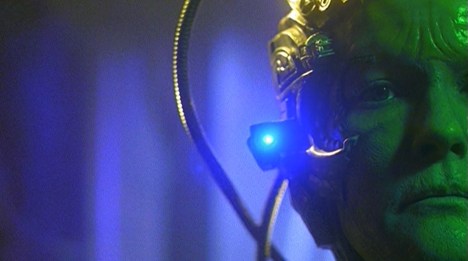
It seems inevitable that Voyager would offer its own take on this concept. After all, the series had been playing with similar ideas dating back to its own first season. The fragility of reality and the dangers of convincing simulation are a recurring motif. Indeed, Unimatrix Zero, Part I and Unimatrix Zero, Part II are not even the only episodes that draw heavily from The Matrix. There are shades of it to Work Force, Part I and Work Force, Part II. Nevertheless, Unimatrix Zero, Part I and Unimatrix Zero, Part II are undoubtedly the most overt examples of this.

Unimatrix reloaded.

Continue reading