• Following Us

  • Categories

  • Check out the Archives


  • Awards & Nominations

Doctor Who: The Stolen Earth (Review)

To celebrate the fiftieth anniversary of the longest-running science-fiction show in the world, I’ll be taking weekly looks at some of my own personal favourite stories and arcs, from the old and new series, with a view to encapsulating the sublime, the clever and the fiendishly odd of the BBC’s Doctor Who.

The Stolen Earth originally aired in 2008.

Someone tried to move the Earth once before. Long time ago. Can’t be.

– the Doctor reminds us that just because the Daleks are threatening doesn’t mean they aren’t completely insane

The Stolen Earth and Journey’s End are not, by any stretch of imagination, tightly-constructed episodes. They don’t represent the pinnacle of the Davies era from any technical or production standpoint. The story logic is questionable at best, and Davies’ primary concern seems to be keeping the script moving fast enough that the plot holes and illogical narrative loose ends never overwhelm the production. It is basically the most bombastic and large-scale season finalé of the Davies era. And given that it’s measured against The Parting of the WaysDoomsday and The Last of the Time Lords, that’s really saying something.

And yet, despite that, I have a strange affection for this season finalé. It’s an excuse for Davies to really bask in the success of the revitalised Doctor Who, creating a plot that draws together all manner of disparate elements into one gigantic tribute to the past four years of Doctor Who. It’s hard to hate, on those grounds alone.

An explosive finalé...

An explosive finalé…

Continue reading

Doctor Who: Turn Left (Review)

To celebrate the fiftieth anniversary of the longest-running science-fiction show in the world, I’ll be taking weekly looks at some of my own personal favourite stories and arcs, from the old and new series, with a view to encapsulating the sublime, the clever and the fiendishly odd of the BBC’s Doctor Who.

Turn Left originally aired in 2008.

You said I was going to die, but you mean this whole world is going to blink out of existence. But that’s not dying, because a better world takes its place. The Doctor’s world. And I’m still alive. That’s right, isn’t it? I don’t die. If I change things, I don’t die. That’s that’s right, isn’t it?

– poor Donna… poor, poor Donna

The fourth season is basically one gigantic victory lap for Russell T. Davies’ Doctor Who. Davies has done the hard work of returning the show to television. He’s made the Daleks threatening. He’s rebooted the Cybermen. He’s made the Master sexy again. The fourth season is really just about enjoying the success of the show, and using that success to do crazy things like bringing back the Sontarans or Davros. Because nobody was clamouring for another Sontaran or Davros story.

That sense of celebration is probably most obvious in Turn Left, the penultimate story of the fourth season. It’s basically It’s a Wonderful Life, starring the Tenth Doctor. Or, to be more accurate, It’s a Wonderful Life for the new series of Doctor Who. It’s an excuse to celebrate a raft of continuity from The Runaway Bride through to The Sontaran Stratagem, to bring back Billie Piper and just to celebrate not only the wonder of Doctor Who, but the virtue of Davies’ approach to the series.

Everything goes up in smoke...

Everything goes up in smoke…

Continue reading

Doctor Who: The Unicorn and the Wasp (Review)

To celebrate the fiftieth anniversary of the longest-running science-fiction show in the world, I’ll be taking weekly looks at some of my own personal favourite stories and arcs, from the old and new series, with a view to encapsulating the sublime, the clever and the fiendishly odd of the BBC’s Doctor Who.

The Unicorn and the Wasp originally aired in 2008.

Oh, it’s you… I was just doing a little research… I say, what are you doing with that lead piping? But that’s impossible. Oh, no!

– Professor Peach discovers the point of crossover between Agatha Christie and Doctor Who

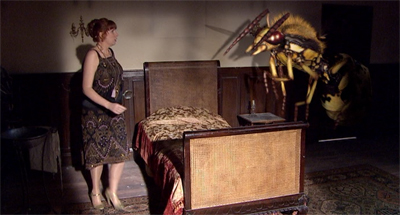
The Unicorn and the Wasp is the most fun episode of the fourth season, by a significant margin. It’s a high-concept high-energy run-around that has a great deal of fun playing with a genre mash-up, as the Doctor intrudes on an Agatha Christie mystery (starring Agatha Christie!) to create curious horror/sci-fi/mystery/class drama hybrid of an episode. It’s an episode that really benefits from the lighter tone of the fourth season. Despite some of the darkness creeping in at the edge of the frame, especially towards the final scenes, it’s an astonishingly light-hearted and playful episode.

In spite of Christie’s stern admonishings, it’s hard not to seize on the story with same glee as the Doctor does.

A sting in the tale...

A sting in the tale…

Continue reading

Doctor Who: The Fires of Pompeii (Review)

To celebrate the fiftieth anniversary of the longest-running science-fiction show in the world, I’ll be taking weekly looks at some of my own personal favourite stories and arcs, from the old and new series, with a view to encapsulating the sublime, the clever and the fiendishly odd of the BBC’s Doctor Who.

The Fires of Pompeii originally aired in 2008.

Pompeii. We’re in Pompeii. And it’s Volcano Day.

– turns out the Doctor likes Steven Moffat scripts as well

What does it mean to be “just passing through” history? To watch events play out, knowing the expected outcome to every major event? To realise that the people you meet have all turned to ash before you were even born? If the Doctor travels through history fighting monsters and saving the world, how can he allow people to die needlessly? Surely it would be just as feasible for him to prevent the Challenger disaster as it is to foil the Nestene? Why can’t he warn people about impending natural disasters? Why do people killed by the Judoon matter more than people killed in car accidents or lightning storms or murdered by other human beings?

The answer is, of course, “because this is a television show”, but it puts the Doctor in a decidedly uncomfortable position. The show is fond of championing the Doctor as a romantic idealist out to make the universe a better place, and one who can’t abide oppression or suffering. And yet he only ever intervenes in cases involving aliens or futuristic technology. Rather than seeming like an agent of radical social change, this tends to make the Doctor feel a bit like an agent of the status quo.

It’s something the show has wrestled with quite a bit, particularly during the Jon Pertwee era. The Fires of Pompeii doesn’t necessarily provide satisfying answers to those questions within the narrative, but it does a lot to develop the role of the Doctor and his own relationship with history.

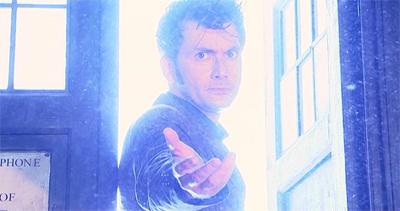
Come with me if you want to live...

Come with me if you want to live…

Continue reading

Doctor Who: Smith & Jones (Review)

To celebrate the fiftieth anniversary of the longest-running science-fiction show in the world, I’ll be taking weekly looks at some of my own personal favourite stories and arcs, from the old and new series, with a view to encapsulating the sublime, the clever and the fiendishly odd of the BBC’s Doctor Who.

Smith & Jones originally aired in 2007.

It’s only roentgen radiation. We used to play with roentgen bricks in the nursery. It’s safe for you to come out. I’ve absorbed it all. All I need to do is expel it. If I concentrate I can shake the radiation out of my body and into one spot. It’s in my left shoe. Here we go, here we go. Easy does it. Out, out, out, out, out. Out, out. Ah, ah, ah, ah! It is, it is, it is, it is, it is hot. Hold on.

Done.

You’re completely mad.

You’re right. I look daft with one shoe.

– the Doctor and Martha get off to a good start

I’d argue that Smith & Jones is Russell T. Davies’ most successful season-opener of Doctor Who. By its third year, Davies had firmly established the format of the show, to the point where he could successfully lose both of his leading actors. Christopher Eccleston had been replaced by David Tennant at the end of the first season, and Billy Piper had departed at the end of the second. Davies had demonstrated that the series could survive a cast rotation like that, and there’s a sense of looseness about Smith & Jones that suggests the show has really found its comfort zone.

The reason that Smith & Jones works so very well is not that it has an abundance of ambition. Its goal is relatively modest: to tell an enjoyable modern day adventure while introducing a new companion to the show. The beauty is in the execution. Smith & Jones races along, barely pausing to catch its breath, relying on Tennant’s abundant charisma, a constant flow of clever high concepts and a charming new companion to carry it through.

It works surprisingly well.

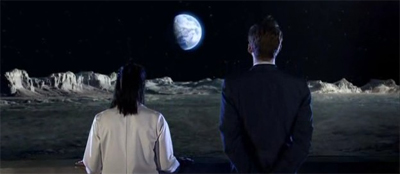
Standing in the Earthlight...

Standing in the Earthlight…

Continue reading

Doctor Who: Kinda (Review)

To celebrate the fiftieth anniversary of the longest-running science-fiction show in the world, I’ll be taking weekly looks at some of my own personal favourite stories and arcs, from the old and new series, with a view to encapsulating the sublime, the clever and the fiendishly odd of the BBC’s Doctor Who.

Kinda originally aired in 1982.

My dear, you can’t possibly exist, so please go away.

– a figment of Tegan’s imagination… or is it?

Every once in a while, there’s a story that undergoes something of a critical reappraisal among Doctor Who fans, as particular fans champion a forgotten story as a classic, attack the assertion that a given story is a classic or even suggest a stinker is in serious need of reevaluation. I actually like that, even fifty years after the show originally aired, there are still discussions to be had around what the good, bad and indifferent stories are. I think Kinda has cycled through this process quite a bit – a story initially overlooked in Peter Davison’s “much better than you remember, if you can get past the cheesy production values” first season, but one that has been somewhat re-appraised in the decades that followed.

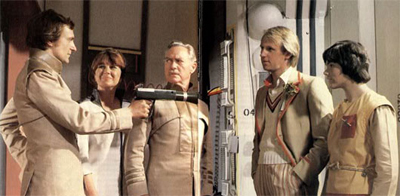
A hot-shot colonist...

Continue reading

Doctor Who: The Bells of St. John (Review)

There’s something in the wifi.

– the Doctor does his best Jaws impression

The Bells of St. John is an intriguing piece of Doctor Who. This is the first time that the show has had to manage a companion swap in the middle of a season. That said, it doesn’t really work to think of the seventh season as a single cohesive entity.

The first five episodes are something of an abridged season, akin to the 2009 season of specials starring David Tennant. They are dedicated to tidying away lingering plot threads from the last two years of the show, and resolving Moffat’s lingering plot threads. The Power of Three and The Angels Take Manhattan are very much about tidying up the Doctor’s lingering connection to Rory and Amy.

In contrast, the second half of the season has a much more celebratory feeling to it, tied together by the over-arching mystery around Clara. While Clara pops up in Asylum of the Daleks, she’s very much a teaser of a mystery to come rather than a character in her own right. Instead, the themes of the season start in The Snowmen, introducing (or reintroducing) the Great Intelligence and Clara, and outlining the mystery of “the twice-dead girl.”

As a result, The Bells of St. John feels very much like a season opener to an unfortunately brief season of celebration.

Maybe that should be "thrice dead"?

Maybe that should be “thrice dead”?

Continue reading

Doctor Who: The War Games (Review)

To celebrate the fiftieth anniversary of the longest-running science-fiction show in the world, I’ll be taking weekly looks at some of my own personal favourite stories and arcs, from the old and new series, with a view to encapsulating the sublime, the clever and the fiendishly odd of the BBC’s Doctor Who.

The War Games originally aired in 1969.

Well, what was happening? Why was it so difficult to move?

It was the Time Lords.

But they’re your own people, aren’t they, Doctor?

Yes, that’s right.

Why did you run away from them in the first place?

What? Well, I was bored.

What do you mean, you were bored?

Well, the Time Lords are an immensely civilised race. We can control our own environment, we can live forever, barring accidents, and we have the secret of space time travel.

Well what’s so wrong in all that?

Well we hardly ever use our great powers. We consent simply to observe and to gather knowledge.

And that wasn’t enough for you?

No, of course not. With a whole galaxy to explore? Millions of planets, eons of time, countless civilisations to meet?

Well, why do they object to you doing all that?

Well, it is a fact, Jamie, that I do tend to get involved with things.

– Jamie, the Doctor and Zoe

The War Games represents the end of the era. It is the last appearance of Jamie as a regular companion. It is the last show featuring Patrick Troughton as the Doctor, although he would return for the occasional guest spot, celebration or charity episode. It was also the last of the series to be shot in black and white. The transition from Troughton to Pertwee would arguably be one of the most dramatic shifts in the history of the show. Not only would the show suddenly be broadcast in colour, and not only would it feature a new lead actor, but it would also have a new focus, grounded on Earth, and with that a new status quo and new rules. The show was only six years old at the time, but the change must have seemed radical to those watching.

The War Games isn’t the perfect episode – it’s too long and too plodding – but it is a lot more entertaining than some of the longer adventures, and it serves as a fond farewell to the “cosmic hobo” interpretation of the Doctor. Indeed, the episode probably seems a great deal harsher than it did in hindsight, with the specifics of regeneration not quite codified, the Doctor’s forced transformation seemed less like a formal execution than it does to modern audiences who watched the Tenth Doctor plead for more time.

The War Games is an effective and fond farewell to not only a particular iteration of the title character, but also a version of the show as a whole.

Run!

Run!

Continue reading

Doctor Who: The Angels Take Manhattan (Review)

The decision to build Steven Moffat’s third season of Doctor Who around a series of done-in-one stories has been a bit of a mixed blessing. Asylum of the Daleks was suitably madcap Saturday tea-time telly, and A Town Called Mercy was an affectionate homage to Americana, but Dinosaurs on a Spaceship barely had room to breath, overloaded on cool moments with little room left for plotting.

The Angels Take Manhattan suffers the most from this sense that it is being compacted. Watching the episode, it feels like Moffat is trying to cram too much story into a single forty-five minute episode. It makes the viewer long for the days when Russell T. Davies would gleefully run his episodes over the allocated forty-five minute slot. Here, Moffat’s big high-concept “timey wimey” ideas and his farewell to his two companions eating up so much of the run-time that the plot itself still feels like an afterthought, running on contrivance and coincidence rather than anything more substantial.

That doesn’t mean it isn’t an affective farewell to Rory and Amy, or that it doesn’t draw fantastic performances from its central quartet, but it does mean that The Angels Take Manhattan is never quite as sturdy as it should have been.

A walk in the park…

Continue reading