• Following Us

  • Categories

  • Check out the Archives


  • Awards & Nominations

Doctor Who: Death Comes to Time (Review)

To celebrate the fiftieth anniversary of the longest-running science-fiction show in the world, I’ll be taking weekly looks at some of my own personal favourite stories and arcs, from the old and new series, with a view to encapsulating the sublime, the clever and the fiendishly odd of the BBC’s Doctor Who.

Death Comes to Time originally broadcast on the BBC website in 2001.

I’m just another alien…

Alien to where?

Everywhere.

– the Doctor and Bedloe

There is quite a lot to like about Death Comes to Time. It offers a conclusion to Ace’s character arc. It features a stellar voice cast. Tannis is great villain. The script isn’t mired in continuity or slavishly devoted to the letter of the continuity of Doctor Who.

On the other hand, there’s quite a lot to loathe about Death Comes to Time. In moving away from Doctor Who continuity, it feels like a generic space opera. There’s a loss of the intimacy that defined the series. There’s a central revelation that makes no sense and a central moral philosophy which seems at odds with the very heart of Doctor Who. On top of that, it seems rather clumsily constructed. If it was intended as a pilot, the wrong characters are in focus for most of its not-insignificant runtime.

Hello, stonehenge!

Hello, stonehenge!

Continue reading

Doctor Who: Real Time (Review)

To celebrate the fiftieth anniversary of the longest-running science-fiction show in the world, I’ll be taking weekly looks at some of my own personal favourite stories and arcs, from the old and new series, with a view to encapsulating the sublime, the clever and the fiendishly odd of the BBC’s Doctor Who.

Real Time originally broadcast on the BBC website in 2002.

Why do you talk so much?

You never know who is listening.

– Cyberwoman Savage and the Doctor discover why he lends himself to audio

It’s remarkably how much energy went in to keeping Doctor Who alive for those years when it was off the air. There was, of course, the fiction produced outside the BBC. Virgin produced The New Adventures in book form, there were comics and various “spin-off” projects. However, these lacked the sort of gravitas that came from having an iconic performer in a classic role. So Big Finish began producing a range of audio adventures (“full cast dramas”) centred around the show. More than that, though, they actually managed to recruit some of the actors. Paul McGann, for example, has had a great run in audio despite only appearing in one televised adventure. Colin Baker has arguably reinvented his take on the Doctor, free from the dodgy writing and behind-the-scenes turmoil that rocked his two-season tenure.

At the same time, the BBC was trying to figure out what to do with the property. There had long been talk of resurrecting the Timelord, the failure of the television movie notwithstanding. BBCi had even produced an official webcast with Sylvester McCoy from writer-director Dan Freedman, named Death Comes to Time. However, while I’ll admit that Death Comes to Time has its strengths, there was something missing. When the time came to do a second webcast, BBCi teamed up with Big Finish, with Big Finish founder Gary Russell stepping up to write and direct an adventure especially for animation.

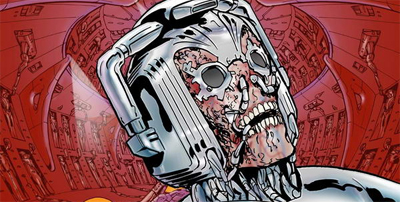
The result is Real Time. While it’s pretty far from perfect, it is intriguing, smart and fun. More than that, though, it supports the oft-heard argument that Colin Baker has been vindicated by his involvement in these projects. In fact, I didn’t want to strangle the Sixth Doctor once while listening to Real Time. It might even inspire me to check out some of the Big Finish range.

Face off...

Face off…

Continue reading

Doctor Who: Bad Wolf (Review)

To celebrate the fiftieth anniversary of the longest-running science-fiction show in the world, I’ll be taking weekly looks at some of my own personal favourite stories and arcs, from the old and new series, with a view to encapsulating the sublime, the clever and the fiendishly odd of the BBC’s Doctor Who.

Bad Wolf originally aired in 2005.

The Dalek stratagem nears completion. The fleet is almost ready. You will not intervene.

Oh, really? Why’s that, then?

We have your associate. You will obey or she will be exterminated.

No.

Explain yourself.

I said no.

What is the meaning of this negative?

It means no.

But she will be destroyed.

No! Because this is what I’m going to do. I’m going to rescue her. I’m going to save Rose Tyler from the middle of the Dalek fleet and then I’m going to save the Earth, and then, just to finish off, I’m going to wipe every last stinking Dalek out of the sky!

But you have no weapons, no defences, no plan.

Yeah. And doesn’t that scare you to death. Rose?

Yes, Doctor?

I’m coming to get you.

– the Daleks, the Doctor and Rose give the Ninth Doctor perhaps his best moment

Looking back at the first season, I’d argue that it’s the most cohesive run of episodes that Russell T. Davies produced on the dhow. Now because of the whole “bad wolf” thing, as that feels a bit like a clumsy link randomly inserted. Instead, as we watch the final episode, it becomes quite clear what Davies was trying to do with his first year on the show. The patterns, the themes, the subtext, the references – it all becomes quite clear. More than any other season of Davies’ tenure, the first season is really one gigantic story – and not just because the show never leaves Earth or the finalé returns to the setting of The Long Game.

The first season is a bridge. It’s a link between the last years of the classic series into the new and revived show as written by Davies. It’s a moment to gather up the dead, tidy away the loose ends and basically manage the stage so that the show can really come into its own. One of the things I loved about Davies’ Doctor Who was how accessible it all was, but it still had all this continuity ticking away in the background.

This first season finalé feels like it isn’t only a conclusion to Christopher Eccleston’s time in the lead role, it’s also closing the last of the dangling threads from the eras of Colin Baker and Sylvester McCoy in the eighties. As soon as David Tennant steps into the lead role, it seems the show is entirely and utterly free of everything that came before. It’s a testament to Davies’ skill that we’re not even sure that he’s doing it.

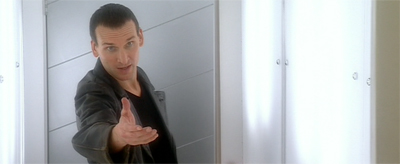
Come with me if you want to live...

Come with me if you want to live…

Continue reading

Non-Review Review: The Hobbit – An Unexpected Journey

I always feel a little embarrassed to admit that I prefer The Hobbit to The Lord of the Rings. Don’t worry, I know that by any objective measure of craft The Lord of the Rings is a far more impressive literary accomplishment, but I never really connected with the characters at the heart of that sprawling epic in the way that I empathised with Bilbo Baggins. As such, it’s a massive relief to me that Peter Jackson turns in an endearing and enjoyable, if padded and indulgent, first instalment in his Hobbit trilogy. The technical advances and the somewhat cynical structuring of the film tend to garner a great deal of discussion and debate, but the heart of Tolkien’s introduction to Middle Earth is still here. The only problem is that absolutely everything else is as well.

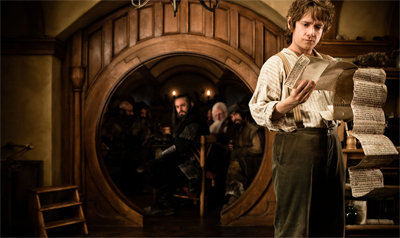
And that's just the script to Part I...

And that’s just the script to Part I…

Continue reading