• Following Us

  • Categories

  • Check out the Archives


  • Awards & Nominations

Star Trek: Voyager – Learning Curve (Review)

This September and October, we’re taking a look at the jam-packed 1994 to 1995 season of Star Trek, including Star Trek: Deep Space Nine and Star Trek: Voyager. Check back daily for the latest review.

So, Learning Curve is the last episode broadcast as part of Star Trek: Voyager‘s first season. It’s hard to get too excited about – or be too disappointed by – that.

Learning Curve is a bit of limp finalé to a mediocre season. Like a lot of the season before it, it’s a passable execution of what should have been a fantastic concept. (Boy, that really is Voyager in a nutshell, isn’t it?)

Is the show finally starting to gel?

Is the show finally starting to gel?

Learning Curve‘s position in the broadcast order was apparently a bit of blind luck. It was actually the fifth-last episode produced of the show’s first season. It just found itself broadcast in the “season finalé” slot when UPN decided to hold back the remaining four episodes of the season until the Fall, to broadcast leading into the second season.

However, despite this, Learning Curve seems as good a choice as any to close out the first season – and certainly a better choice than Brannon Braga and Jeri Taylor’s preferred candidate, The 37’s. It returns to the conflict between Starfleet and the Maquis promised in Caretaker, but only fleetingly acknowledged in episodes like Parallax or State of Flux. Although the execution leaves a lot to be desired, it does create a sense that the show has come something of a full circle.

It's Chakotay or the high way...

It’s Chakotay or the high way…

Continue reading

Star Trek: Deep Space Nine – Heart of Stone (Review)

This September and October, we’re taking a look at the jam-packed 1994 to 1995 season of Star Trek, including Star Trek: Deep Space Nine and Star Trek: Voyager. Check back daily for the latest review.

Heart of Stone feels quite similar to Life Support. Once again, there’s a main plot that doesn’t involve Kira quite as much as it should. Once again, this is supplemented by a subplot involving Quark’s mischievous nephew, Nog. And yet – while still flawed in a number of ways – Heart of Stone works a lot better than Life Support did, primarily because it’s a lot more thoughtfully constructed. The lack of focus on Kira is explained as part of the plot; Nog isn’t holding down an unfunny comedy subplot, he’s getting some nice character development.

Heart of Stone is occasionally a little heavy-handed in its character beats, but it works well because it pitches its plot at the right level, focusing on the characters at the heart of these stories.

A rock and a hard place...

A rock and a hard place…

Continue reading

Star Trek: Deep Space Nine – Prophecy & Change: The Orb of Opportunity by Michael A. Martin and Andy Mangels (Review/Retrospective)

The September and October, we’re taking a look at the jam-packed 1994 to 1995 season of Star Trek, including Star Trek: Deep Space Nine and Star Trek: Voyager. Check back daily for the latest review.

It is fun to imagine the negative space that exists between various episodes of Star Trek: Deep Space Nine. In its third season, the show was making nods towards serialisation, but there was never really a point where the series could not be broken down into reasonably well-defined episodic units. Even during the ten-hour series finalé, each of the constituent elements had its own narrative thrust and its own clear purpose. So it is fun sometimes to try to connect these threads together.

The ordering of episodes in a season of television is very interesting. It creates a fascinating connective tissue in the minds of fans. Although each episode is its own story, they come together to form something larger and more intriguing. On The X-Files, for example, placing Never Again directly after Leonard Betts changed the whole context of the episode. There are threads that do not necessarily exist within the individual episodes, but can be implied by the sequencing of the shows.

Placing Heart of Stone directly after Life Support is an interesting choice in several respects. It creates all sorts of interesting implications and developments, contradictions and possibilities. It is weird to have an episode about Odo’s attraction to Kira air directly after an episode focusing on the death of Kira’s long-term love interest; give her a week or two of space, guys. Similarly, it is strange to go from Nog’s characterisation in Life Support to his development in Heart of Stone.

The Orb of Opportunity is very clearly intended to bridge the gap between those two episodes, explaining how and why Nog developed in the way that he did.

ds9-prophecyandchange

Continue reading

Star Trek: Voyager – Parallax (Review)

This September and October, we’re taking a look at the jam-packed 1994 to 1995 season of Star Trek, including Star Trek: Deep Space Nine and Star Trek: Voyager. Check back daily for the latest review.

Parallax feels like a seventh season episode of Star Trek: The Next Generation nested inside a first season episode of Star Trek: Voyager. It’s Brannon Braga’s first script for the show, having opted to join Star Trek: Voyager rather than moving over to Star Trek: Deep Space Nine. Braga would go on to become one of the longest-serving creative forces on televised Star Trek, becoming an executive producer on Star Trek: Voyager and creating (and producing) Star Trek: Enterprise.

Braga is a fantastic high-concept science-fiction writer. His scripts for The Next Generation count among the best the show ever produced – Cause and Effect, Parallels, Frame of Mind. The team of Brannon Braga and Ronald D. Moore ranks as one of the most consistently great collaborations in the history of Star Trek. On his own, Braga writes fascinating sci-fi concepts. His scripts for the various shows support that.

The problem is that Braga isn’t the franchise’s strongest character writer. Indeed, among the staff writers working on the first season of Voyager, Braga seems like the worst candid to draft in to write the big “establishing character dynamics” episode directly following the pilot. The problem with Parallax is that it’s a nice premise featuring a bunch of characters we don’t care about yet, and the script is more interested in the anomaly of the week than it is in getting us to care about those characters.

"It's like looking into the future..."

“It’s like looking into the future…”

Continue reading

Star Trek: The Next Generation (DC Comics, 1989) #47-50 – The Worst of Both Worlds (Review)

This November and December, we’ll be finishing up our look at the second season of Star Trek: The Next Generation and moving on to the third year of the show, both recently and lovingly remastered for high definition. Check back daily for the latest review.

We’ll be supplementing our coverage of the episodes with some additional materials – mainly novels and comics and films. This is one such entry.

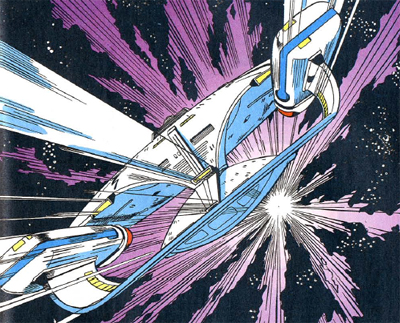
The Worst of Both Worlds, as the name implies, is an excuse to revisit one of the pivotal moments of Star Trek: The Next Generation. (Go on, guess which one!) Unfortunately, it’s not quite up to the task – a failing down to both to the scripts from Michael Jan Friedman and the artwork from Peter Krause. It winds up feeling like an interesting idea, given a rather lackluster execution, working best as a study of the impact that the show’s third season cliffhanger had on the franchise.

A time warp...

A time warp…

Continue reading

Star Trek: The Lost Era – Well of Souls by Ilsa J. Bick (Review)

This November and December, we’ll be finishing up our look at the second season of Star Trek: The Next Generation and moving on to the third year of the show, both recently and lovingly remastered for high definition. Check back daily for the latest review.

We’ll be supplementing our coverage of the episodes with some additional materials – mainly novels and comics and films. This is one such entry.

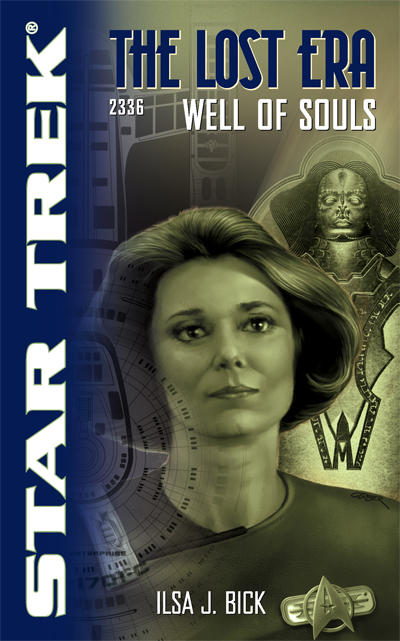
Well of Souls is a story of the Enterprise-C, the ship introduced in Yesterday’s Enterprise. One of the best-received episodes in the history of Star Trek: The Next GenerationYesterday’s Enterprise established Rachel Garrett’s ship as the troubled Enterprise, the tragic flagship, the doomed space craft. Ilsa J. Bick builds on that characterisation in Well of Souls, one small story from some point in Garrett’s command of the Federation flagship.

While Well of Souls feels like a rather unconventional Star Trek novel, it is charming in its own way. Bick connects her tale to the themes of Well of Souls, suggesting a troubled ship manned by a struggling crew. The novel returns time and again to the theme of unfortunate choices, the weight of making the best decision of the options open. Unlike Kirk or Picard, Bick seems to suggest, this version of the iconic starship doesn’t get that many lucky breaks, with her crew repeatedly forced to accept the least bad of a selection of unappetising choices.

Well of Souls is  a thoughtful, introspective piece. It doesn’t flow or pace itself as well as it might, but Bick crafts a compelling picture the never-the-less. While not quite the best of the Lost Era tie-in novels, it’s ambitious and insightful. It lacks the energy of Serpents Among the Ruins or The Art of the Impossible, but it’s still a very worthy read for anybody looking to sketch out a gap in the Star Trek mythos.

tng-wellofsouls

Continue reading

Star Trek: The Lost Era – Serpents Among the Ruins by David R. George III (Review)

This January and February, we’ll be finishing up our look at the second season of Star Trek: The Next Generation and moving on to the third year of the show, both recently and lovingly remastered for high definition. Check back daily for the latest review.

We’ll be supplementing our coverage of the episodes with some additional materials – mainly novels and comics and films. This is one such entry. This is actually supplementary to the first season of the Next Generation, specifically the episode The Neutral Zone.

The first year of Star Trek: The Next Generation was a little rocky when it came to continuity. Skipping roughly a century on from the adventures of James T. Kirk, there were times when it seemed like the writers weren’t entirely sure what had happened during that gap. Early on, for example, it was suggested that the Klingons had joined the Federation, a decision reversed by the show’s third season. Even within the first year of the show, it seemed like the writers hadn’t quite cemented the wider Star Trek universe. In Angel One, we discover that the Romulans are threatening war, only to hear in The Neutral Zone that they’ve actually been absent from galactic affairs for quite some time.

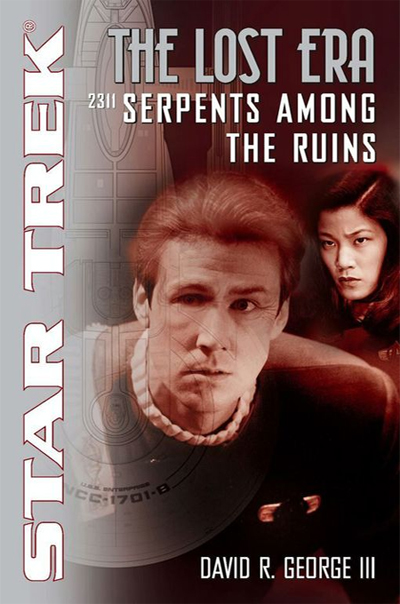
Serpents Among the Ruins is an attempt to explain that absence established in 1988, and contextualise it against the eighteen years of Romulan stories that would follow from the early appearances in Star Trek: The Undiscovered Country through to the end of Star Trek: Deep Space Nine and beyond.

st-serpentsamongtheruins

Continue reading

Star Trek: The Next Generation – Survivors by Jean Lorrah (Review)

This January and February, we’ll be finishing up our look at the second season of Star Trek: The Next Generation and moving on to the third year of the show, both recently and lovingly remastered for high definition. Check back daily for the latest review.

We’ll be supplementing our coverage of the episodes with some additional materials – mainly novels and comics and films. This is one such entry. This is actually supplementary to the first season of the Next Generation, specifically the episode Skin of Evil.

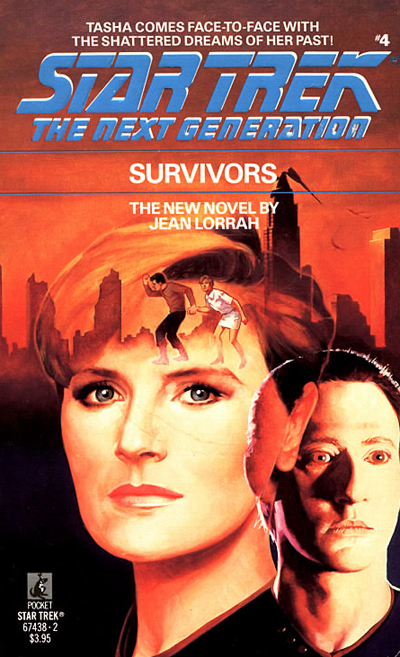
Writing tie-in fiction is tougher than a lot of people seem to think it is. There’s a notion that you’re playing in somebody else’s sandbox, and that you’re confined and restricted by what has and what has not appeared on screen, knowing that your work will always be secondary. As such, I can’t imagine how tough it must have been for Jean Lorrah to write Survivors. Only the fourth tie-in novel for Star Trek: The Next Generation, it was released in January 1989, around a quarter of the way through the show’s second season. Given the time it would take to edit and publish a paperback, it seems that Lorrah likely had to have the novel ready quite early in the life of The Next Generation.

It’s one thing to try to accurately capture the voice of well-defined characters on a long-running show, but it must be infinitely more difficult when writing based off sketchy early episodes that aren’t always consistent in their own characterisation.

tng-survivors

Continue reading

Star Trek: The Next Generation – Pen Pals (Review)

This January and February, we’ll be finishing up our look at the second season of Star Trek: The Next Generation and moving on to the third year of the show, both recently and lovingly remastered for high definition. Check back daily for the latest review.

Pen Pals is a pretty mediocre episode of Star Trek: The Next Generation, one with a lot more potential than the episode actually delivers upon. Centring around Data’s unilateral decision to violate the Prime Directive and the consequences stemming from that decision, there’s a sense that Pen Pals might have been a lot more incisive in earlier version – a lot more willing to ask tough questions about the rules and regulations that our heroes uphold.

Sadly, Pen Pals instead ends with a massive cop out and an unwillingness to really commit to any big idea or to interrogate any of the show’s core concepts.

Everything burns...

Everything burns…

Continue reading

Star Trek: The Lost Era – Deny Thy Father by Jeff Mariotte (Review)

This January and February, we’ll be finishing up our look at the second season of Star Trek: The Next Generation and moving on to the third year of the show, both recently and lovingly remastered for high definition. Check back daily for the latest review.

We’ll be supplementing our coverage of the episodes with some additional materials – mainly novels and comics and films. This is one such entry.

In theory, you can probably tell a good story about just about anything. There’s a knack to constructing a narrative and in making particular characters fascinating or compelling. In the right hands, even the most tired and boring premise can generate some measure of excitement and over a glimpse of depth that we never thought was there. For example, I didn’t come out of Star Trek: Generations thinking that I’d ever read a classic story about John Harriman, and then I read the superb Serpents Among the Ruins.

However, some ideas strike you as a little less exciting than others. Some concepts seem a bit riskier to pull off, a bit more daunting in scope. Constructing a compelling narrative around the youth of Commander William T. Riker, probably one of the blandest members of the Star Trek: The Next Generation ensemble, seems like an uphill struggle.

Unfortunately, Jeff Mariote’s Deny Thy Father isn’t up to the task of making the boring father-son relationship glimpsed in The Icarus Factor seem any more exciting.

tng-denythyfather

Continue reading