• Following Us

  • Categories

  • Check out the Archives


  • Awards & Nominations

Star Trek: Voyager – Cathexis (Review)

This September and October, we’re taking a look at the jam-packed 1994 to 1995 season of Star Trek, including Star Trek: Deep Space Nine and Star Trek: Voyager. Check back daily for the latest review.

Cathexis has a vaguely interesting premise, but it gets a little bit too caught up in science-fiction high concepts and New Age mysticism.

Once again, there’s a sense that the wrong writer has been assigned the wrong brief. The New Age spirituality elements of Chakotay’s character were largely championed by Michael Piller; the “romantic period mystery” story for Janeway clearly comes from Jeri Taylor. The only part of Cathexis that clearly comes from credited writer Brannon Braga is the somewhat generic Invasion of the Body Snatchers plot line – and, as such, it seems to be the only thread in which Braga is particularly interested.

So we get a bunch of half-hearted New Age stuff unfolding, with Chakotay’s wandering spirit represented by a camera with a blurry filter swooping through familiar sets. Once again, Chakotay’s Native American heritage becomes a launching pad for some ill-advised mysticism and exoticism, which Cathexis never even bothers trying to explain.

Frankly, I'm surprised Tuvok put up with this for so long...

Frankly, I’m surprised Tuvok put up with this for so long…

Continue reading

Star Trek: Voyager – Heroes and Demons (Review)

This September and October, we’re taking a look at the jam-packed 1994 to 1995 season of Star Trek, including Star Trek: Deep Space Nine and Star Trek: Voyager. Check back daily for the latest review.

In many ways, Heroes and Demons is a watershed moment for Star Trek: Voyager. The two previous episodes, Prime Factors and State of Flux, may have been far from perfect, but they did at least hint at a direction for the show. They suggested that maybe Voyager might be interested in engaging in some of the big philosophical questions raised by the crew’s unique situation. Stranded seventy thousand light-years from home, the ship was cut off from the Federation. It was isolated and alone. That meant that tough choices at least had to be debated.

While neither Prime Factors nor State of Flux made for particularly exciting television, they were episodes that felt specific to Voyager in a way that a lot of the first season really doesn’t. Unfortunately, Heroes and Demons represents a step backwards. Far from telling a story specific to Star Trek: Voyager, this feels like a script that could easily have been recycled from Star Trek: The Next Generation or Star Trek: Deep Space Nine.

Can the Doctor hack it?

Can the Doctor hack it?

It’s written by veteran Next Generation writer Naren Shankar, who had also served on the staff of Deep Space Nine. He wrote Heroes and Demons as a freelancer, pitching the idea very early in the development cycle. Perhaps what is most remarkable is how little of Shankar’s script was adapted or edited from that first draft. In fact he described it to The Official Star Trek: Voyager Magazine as “the best experience I’ve ever had as a writer, in terms of writing something as a first draft and then seeing those exact words on screen.”

There’s a sense that Heroes and Demons is a fun story that could have really worked in any context, and doesn’t fit particularly well into the mould of Voyager‘s first season. This should be the year where Voyager is trying to find its own voice, rather than simply imitating that of its older siblings.

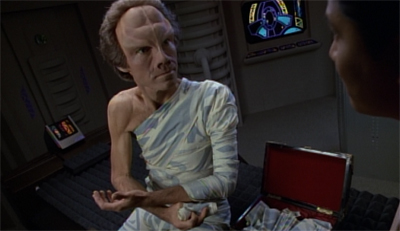
Only mostly armless...

Only mostly armless…

Continue reading

Star Trek: Deep Space Nine – The Soul Key by Olivia Woods (Review)

This September and October, we’re taking a look at the jam-packed 1994 to 1995 season of Star Trek, including Star Trek: Deep Space Nine and Star Trek: Voyager. Check back daily for the latest review.

The Soul Key would wind up being the last novel published as part of the Deep Space Nine relaunch.

The Soul Key was published in July 2009. The next month, Una McCormack’s wonderful The Never-Ending Sacrifice would be published. However, McCormack’s novel was very written outside the relaunch, running as a companion to the series and unfolding in the immediate aftermath. After that, the Deep Space Nine book line found itself folded into various crossovers, like Typhon Pact and The Fall. There was a sense that the line was drifting away from Deep Space Nine and being recontextualised in Pocket Books’ larger Star Trek series.

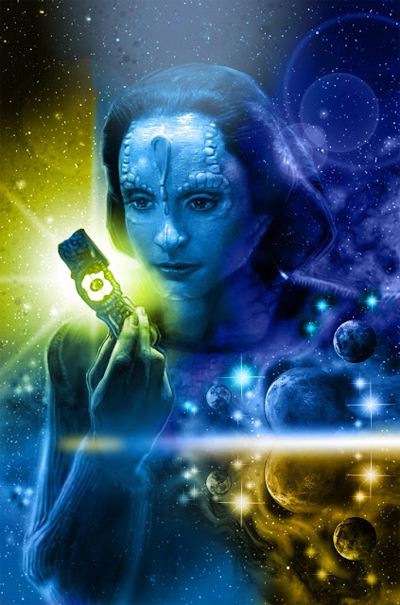
The Soul Key picks up where Fearful Symmetry left off, following Kira, mirror!Iliana and Vaughn as they venture into the mirror universe in pursuit of the crazed Iliana Ghemor.

ds9-soulkey

Continue reading

Star Trek: Deep Space Nine – Through the Looking Glass (Review)

This September and October, we’re taking a look at the jam-packed 1994 to 1995 season of Star Trek, including Star Trek: Deep Space Nine and Star Trek: Voyager. Check back daily for the latest review.

It’s very tempting to write off the problems with the mirror universe episodes of Star Trek: Deep Space Nine as diminishing returns – the idea that repeated exposure to what was once novel robs that item of its novelty. It is possible to become immune to the charms of camp, dulled to absurd space opera, and just worn out by watching the cast play “space pirates meet Star Wars.”

However, this does a bit of a disservice to the mirror universe as a concept. As iconic as it has become, Mirror, Mirror worked very well as a piece of introspection for the original Star Trek. Crossover stands out as one of the strongest episodes in the first two years of Deep Space Nine, because it manages to capture the thoughtful-yet-campy self-criticism of Mirror, Mirror.

Let's face it, after what O'Brien's been through, nobody would be surprised if he snapped...

Let’s face it, after what O’Brien’s been through, nobody would be surprised if he snapped…

In contrast, Through the Looking Glass marks the point at which the mirror universe really ceases to be a clever concept, and becomes something that is simply kept around because it’s old and because the production team like the idea of playing “roguish rebels and evil empires” in a way that’s impossible in the mainstream Star Trek universe.

While the episode does have an interesting central premise and is nowhere near as weak as some of the mirror universe episodes ahead, Through the Looking Glass is the moment where the mirror universe seems to get away from Deep Space Nine.

They really nailed Rom to the wall...

They really nailed Rom to the wall…

Continue reading

Star Trek: Deep Space Nine (Malibu Comics) #29-30 – Enemies and Allies (Review/Retrospective)

This September and October, we’re taking a look at the jam-packed 1994 to 1995 season of Star Trek, including Star Trek: Deep Space Nine and Star Trek: Voyager. Check back daily for the latest review.

Enemies and Allies is a particular brand of oddity. It is the most throwaway story imaginable.

Continuing the trend of recruiting Star Trek actors to write for the comics, Malibu pursued Star Trek: Voyager regular Tim Russ to write for their monthly Star Trek: Deep Space Nine comic. Russ was ably assisted by Mark Paniccia. Paniccia was the editor for Malibu’s Star Trek comics. He co-wrote Rules of Diplomacy with Aron Eisenberg, and also wrote the script for the two-part Sole Asylum headlining the twenty-ninth and thirtieth issues of the Deep Space Nine monthly.

Star Trekkin' across the mirror universe!

Star Trekkin’ across the mirror universe!

As with the other actors to write for the line and the Star Trek actors-turned-writers in general, Russ concentrates on his own character. He crafts a story based around Tuvok. However, it is quite clear that Malibu has not reached the stage where it could launch a Voyager comic. It was in the process of planning such a comic when Marvel bought the rights to license all Star Trek comics in 1996. As such, Tim Russ is tasked with writing a comic centring around Tuvok without taking place in the same continuity of Voyager.

The solution to this problem was quite ingenious, even if the execution was less than satisfying. Tim Russ would write a two-part short story centring around mirror!Tuvok, the character who fleetingly cameo-ed in Through the Looking Glass.

Reflections on Tuvok...

Reflections on Tuvok…

Continue reading

Star Trek: Deep Space Nine – Distant Voices (Review)

This September and October, we’re taking a look at the jam-packed 1994 to 1995 season of Star Trek, including Star Trek: Deep Space Nine and Star Trek: Voyager. Check back daily for the latest review.

Poor Julian Bashir. Even at two-and-a-half seasons in Star Trek: Deep Space Nine, the character is still a blank slate. Distant Voices is a story that takes us inside the character’s head, but it winds up feeling very generic. It turns out that Bashir is afraid of getting old, as awkwardly pointed out in the opening scene. He also might have some self-esteem issues. For an episode that journeys into Bashir’s brain, Distant Voices is really pretty bland. There’s really not too much going on there.

Indeed, the most interesting thing about this glimpse inside Bashir’s mind is that it is so generic that it manages to avoid conflicting at all with the character-shattering revelation that Ronald D. Moore proposes in Doctor Bashir, I Presume. While it’s a nice piece of trivia, it’s hardly a compelling hook.

"So this is what a 100,000th episode party looks like..."

“So this is what a 100,000th episode party looks like…”

Continue reading

Star Trek: Voyager – Emanations (Review)

This September and October, we’re taking a look at the jam-packed 1994 to 1995 season of Star Trek, including Star Trek: Deep Space Nine and Star Trek: Voyager. Check back daily for the latest review.

Emanations has a pretty effective set-up and solid premise. It is very clearly one of Star Trek: Voyager‘s “planet of the week” stories – like the show directly before it and the show directly following it – but it’s build around some vaguely interesting ideas. It’s very clearly an episode designed to function as social commentary in the grand Star Trek tradition, hitting on big ideas and bold concepts.

Unfortunately, it’s not the type of script that Brannon Braga is best suited to handle. It doesn’t feel so much an exploration of an important issue as a social treatise. It’s simplistic and heavy-handed while dealing with ideas that require a bit of nuance and sophistication. It feels under-developed, contrived and a little shallow. Despite an attempt at ambiguity in its closing scene, it feels like an episode driven primarily by an agenda rather than a strong story.

Emanations is a misfire, another example of the weird tendency in the first season of Voyager to assign the wrong writers to the wrong scripts.

Harry really got wrapped up in local culture...

Harry really got wrapped up in local culture…

Continue reading

Star Trek: Deep Space Nine (Malibu Comics) – Blood and Honour (Review)

The September and October, we’re taking a look at the jam-packed 1994 to 1995 season of Star Trek, including Star Trek: Deep Space Nine and Star Trek: Voyager. Check back daily for the latest review.

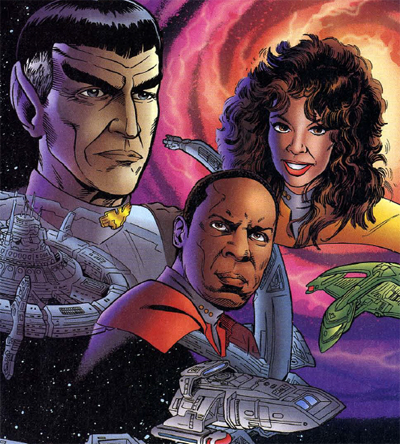
Whatever is to be done about the Romulans?

In space, all warriors are cold warriors...

In space, all warriors are cold warriors…

Continue reading

Star Trek: Voyager – Ex Post Facto (Review)

This September and October, we’re taking a look at the jam-packed 1994 to 1995 season of Star Trek, including Star Trek: Deep Space Nine and Star Trek: Voyager. Check back daily for the latest review.

Ex Post Facto has a lot of problems.

It has logical problems. It has plot problems. It has character problems. It is difficult to fit within the framework of Star Trek: Voyager. It feels like a retread of A Matter of Perspective, a less-than-successful effort from the first season of Star Trek: The Next Generation that Michael Piller produced. It is a bit of a mess, a bit too casual about everything, a bit too contrived.

And yet, despite all this, it almost works. Almost.

"This isn't the head massage I asked for!"

“This isn’t the head massage I asked for!”

Continue reading

Star Trek: Deep Space Nine – Prophet Motive (Review)

This September and October, we’re taking a look at the jam-packed 1994 to 1995 season of Star Trek, including Star Trek: Deep Space Nine and Star Trek: Voyager. Check back daily for the latest review.

Now that Star Trek: Voyager is on the air, there’s a sense that Star Trek: Deep Space Nine can be more relaxed. The show was undeniably contrarian during the short period when it was the only Star Trek on the air, presenting a series of uncompromisingly cynical episodes to assure viewers that it would not be trying to fill the void left by Star Trek: The Next Generation. At the same time, there’s also a sense that show was acutely aware of it potentially wider audience watching during that window.

During that first half of the season, a new adversary was pushed to the fore, the show did a story about Klingons and featured three guest stars from The Next Generation – although not necessarily the guest stars anybody would have chosen. More than that, though, the show seemed to consciously avoid its more controversial types of episodes. Even by the show’s third year, it had become clear that certain “types” of episodes appeared a few times a year – a couple of “old favourites” for the writing team to fall back on while constructing a twenty-six episode season.

'Ear me out 'ere...

‘Ear me out ‘ere…

As such, it’s telling that the most divisive parts of any Deep Space Nine season were pushed into the second half of the season.  So Ira Steven Behr and Robert Hewitt Wolfe’s two Ferengi-centric scripts came after Voyager had premiered. Sure, Quark got to be the focus of the season’s third episode, House of Quark, but he shared that with the popular Klingons. The season’s two big Bajoran plot lines (Life Support and Shakaar) were positioned towards the end of the year.

Prophet Motive feels like the kind of Star Trek episode that could only be produced on Deep Space Nine as part of Ira Steven Behr’s unique vision for the show. It’s the kind of weird script that the show seemed to get away with by virtue of being “the other Star Trek on television.” That doesn’t mean that it’s particularly good, mind you, just that it’s distinctly a Deep Space Nine story.

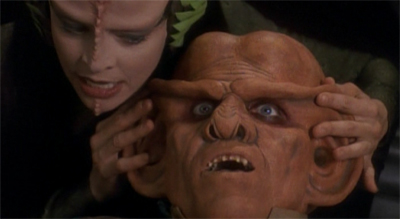
Quark is a by-the-book Ferengi...

Quark is a by-the-book Ferengi…

Continue reading