• Following Us

  • Categories

  • Check out the Archives


  • Awards & Nominations

Star Trek: Deep Space Nine – Paradise Lost (Review)

This February and March, we’re taking a look at the 1995 to 1996 season of Star Trek, including Star Trek: Deep Space Nine and Star Trek: Voyager. Check back daily Tuesday through Friday for the latest review.

Part of what is so remarkable about Star Trek: Deep Space Nine is how prescient it seems.

The Star Trek franchise is renowned for its central metaphors and allegories, its fondness for addressing contemporary issues through abstract philosophical discussions. Even the most casual of television fans can point to episodes like Let That be Your Last Battlefield or A Private Little War as examples of the franchise’s engagement with contemporary social issues. (Of course, they may not be able to actually name those episodes.) Of course, the reality was always more complicated than that, but this social engagement is part of the popular memory of the franchise.

Armed and dangerous...

Armed and dangerous…

While there is a tendency to overstate the importance of social commentary and engagement in the history of the Star Trek franchise, it is a massive part of the cultural behemoth. Although not every (and arguably not even most) Star Trek episodes are explorations of moral philosophy that apply to the contemporary world, they are an essential part of each and every Star Trek series. Sometimes these episodes are brilliant, and sometimes they are heavy-handed. Sometimes they are earnestly sincere, and sometimes they are hopelessly misguided.

However, Deep Space Nine stands out in comparison to its contemporaries. Even twenty years after the show aired, it seems like Deep Space Nine speaks to contemporary anxieties and uncertainties.

The Changeling Face of Evil...

The Changeling Face of Evil…

Continue reading

Star Trek: Voyager – Resistance (Review)

This February and March, we’re taking a look at the 1995 to 1996 season of Star Trek, including Star Trek: Deep Space Nine and Star Trek: Voyager. Check back daily Tuesday through Friday for the latest review.

Resistance is a very episodic instalment of Star Trek: Voyager.

It begins with the ship facing a convenient plot-generating fuel-shortage, the type of problem that the ship had encountered near the start of Phage or The Cloud or Tattoo. It is the kind of problem that was not mentioned in previous episodes, and which will never be presented as a potentially recurring problem. In fact, Resistance is the only episode of Voyager (or Star Trek) where the word “Tellerium” is mentioned. Many of the stock criticisms of Voyager apply here.

Fifty shades of Joel Grey...

Fifty shades of Joel Grey…

At the same time, Resistance is proof that the episodic model is not entirely without merit. For all that modern television has tended towards serialisation and arcs and long-form storytelling, there is nothing inherently wrong with a good old-fashioned done-in-one adventure. On a purely cosmetic level, Resistance is the typical Voyager episode; it relies on contrivance, it features a host of guest characters who will never appear (or be mentioned) again, it has no lasting impact. And yet it works better than any episode to this point in the second season.

As easy as it is to get distracted by arguments about serialised and episodic storytelling, or about arcs and standalones, the truth is that Voyager‘s problems are at once more simple and more complex than that. The grand irony of the second season is that it is the only season of Voyager to attempt a storytelling arc, but that storytelling arc is pretty universally derided as one of the worst things that the show ever did. (It isn’t really, but it’s still pretty bad.) The truth is that it doesn’t matter how Voyager chose to tell its stories, as long as it told them well.

Mellon head...

Mellon head…

Resistance is a fairly standard episode of Voyager, but it is elevated in the telling. The story seems unlikely to rank among anybody’s favourite Voyager episodes, but it is an efficient and effective character study with a solid script and a great central performance. The production team were able to recruit Oscar-winning actor Joel Grey as the primary guest star, lending the story an incredible level of pathos. Lisa Klink also makes quite an impression with her debut teleplay, providing a story that is careful to give most of the cast something to do.

The result is proof that there’s nothing inherently wrong with a largely episodic approach to Star Trek storytelling, as long as the material is up to scratch.

"This is knife reunion, no?"

“This is knife reunion, no?”

Continue reading

Star Trek: Deep Space Nine – Our Man Bashir (Review)

This February and March, we’re taking a look at the 1995 to 1996 season of Star Trek, including Star Trek: Deep Space Nine and Star Trek: Voyager. Check back daily Tuesday through Friday for the latest review.

Our Man Bashir is an underrated masterpiece.

It is possibly the best holodeck (or holosuite) episode in the history of the franchise; only Ship in a Bottle can really compete. A lot of this is down to the production value of the episode; Our Man Bashir looks and sounds beautiful, a delightfully detailed throwback to its source material. The production team on the Star Trek franchise seldom get enough credit for their skill at realising alien worlds and cultures from scratch, but their beautiful evocation of sixties design is breathtaking. Our Man Bashir is a clear forerunner to Trials and Tribble-ations, less than a year away.

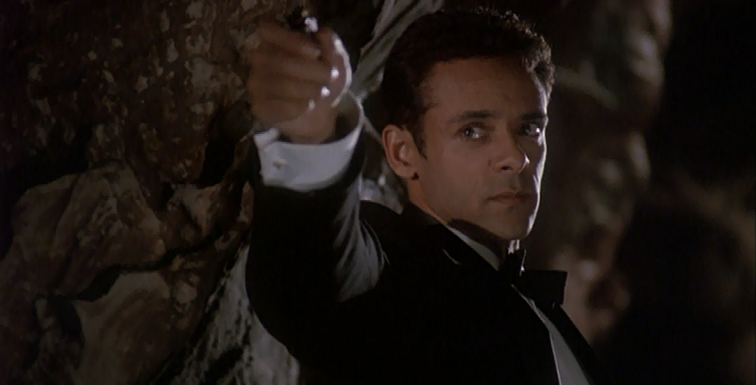
"The name's Bashir, Julian Bashir..."

“The name’s Bashir, Julian Bashir…”

However, there is more to it than that. Like Little Green Men, Our Man Bashir succeeds as a (relatively) light-hearted run-around that never loses track of its characters. The first three seasons of Star Trek: Deep Space Nine struggled with the character of Julian Bashir; audience members could wait entire seasons for a good Bashir episode. With the fourth season, three come along at once. Our Man Bashir might look light and fluffy – and it largely is – but it never loses sight of its core character dynamics in the midst of all the fun unfolding around them.

More than that, Our Man Bashir plays into the broader themes and strengths of the fourth season. The climax of the episode feels like Deep Space Nine is ruminating on its new-found place dictating the direction of the Star Trek canon. Bashir’s decision to “save the day by destroying the world” feels oddly prophetic. The fifth season of the show would find the writers destroying some of the most fundamental rules of the franchise in an effort to keep things vital.

Got some bottle...

Got some bottle…

Continue reading

Star Trek: Deep Space Nine – The Sword of Kahless (Review)

This February and March, we’re taking a look at the 1995 to 1996 season of Star Trek, including Star Trek: Deep Space Nine and Star Trek: Voyager. Check back daily Tuesday through Friday for the latest review.

The Sword of Kahless is the first episode of Star Trek: Deep Space Nine to focus primarily on Worf.

The character arrived on the show (and the station) in The Way of the Warrior, but his development since then had largely been confined to secondary plots. In Hippocratic Oath and Starship Down, Worf learned that life on Deep Space Nine would not be the same as life on the Enterprise. However, he had not really been the centre of any given episode before this point. (Even in The Way of the Warrior, Worf’s arrival and crisis of conscience was just one facet of a larger political situation.)

Sword of destiny...

Sword of destiny…

This is quite remarkable, and a result of a number of unique factors. Most obviously, Worf was not just any new cast member. Worf was a character who had arrived over from Star Trek: The Next Generation, and so was something of a known quantity to fans. There was less of a need to establish who Worf was, because most fans already knew. More than that, a lot of the early fourth season episodes had been in development before Michael Dorn had been confirmed to be joining the ensemble. As such, they tended to focus on other characters.

Nevertheless, it is remarkable that the fourth season is almost one-third of the way through its run before the production team devoted an episode to the newest member of the cast. It is a testament to the production team that the show had the confidence and restraint to adopt such an approach to such an obviously popular character. More than that, The Sword of Kahless is undoubtedly a Worf-centric episode, but it is a Worf-centric episode that makes it quite clear that Worf is a Deep Space Nine character now.

"Thank you, sir. May I have another?"

“Thank you, sir. May I have another?”

Continue reading

Star Trek: Voyager – Cold Fire (Review)

This February and March, we’re taking a look at the 1995 to 1996 season of Star Trek, including Star Trek: Deep Space Nine and Star Trek: Voyager. Check back daily Tuesday through Friday for the latest review.

Cold Fire is an episode that exemplifies the feeling that second season’s treading water.

Cold Fire opens with a somewhat unconventional recap of Caretaker. Unlike most “previously on…” sections of Star Trek: Voyager (or the Star Trek franchise as a whole), this block is narrated by Majel Barrett in-character as the ship’s computer. It becomes clear that Cold Fire is interested in following up on the dangling threads left by Caretaker, with the crew of Voyager encountering the female mate alluded to in Janeway’s conversations with the eponymous Nacene character from Caretaker.

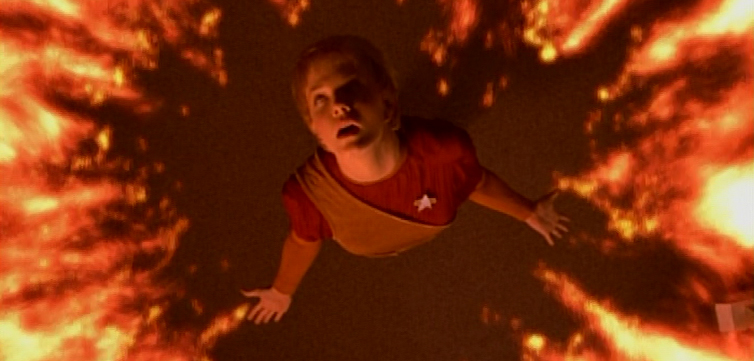
Everything burns...

Everything burns…

This should be a big deal. After all, the Caretaker is the character responsible for plucking Voyager and the Val Jean out of the Alpha Quadrant and depositing them on the other side of the galaxy. Finding another being with a similar amount of power presents a very real and tangible opportunity for Janeway to get her crew home. If the Caretaker could pull them all the way across the Milky Way, then it stands to reason that Suspiria could send them all the way back. Cold Fire presents a potential end to Voyager’s journey.

Unfortunately, Cold Fire never really does anything with that storytelling angle. Even when Janeway comes face-to-face with Suspiria at the climax of the episode, she never asks the powerful entity to send her crew home. So Cold Fire feels like an episode that spends forty-five minutes walking in circles, accomplishing little of note.

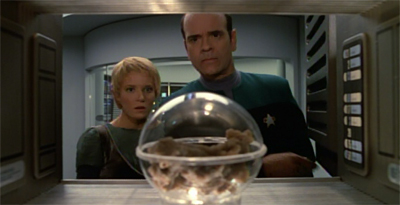
"It's probably just the inertial dampeners acting up..."

“It’s probably just the inertial dampeners acting up…”

Continue reading

Star Trek: Voyager – Tattoo (Review)

This February and March, we’re taking a look at the 1995 to 1996 season of Star Trek, including Star Trek: Deep Space Nine and Star Trek: Voyager. Check back daily Tuesday through Friday for the latest review.

Tattoo is another example of the second season Star Trek: Voyager doubling down on elements that did not work in the first season.

Episodes like The Cloud and Cathexis had suggested that Chakotay might be a problematic character for the show. After all, Chakotay was the first Native American lead character to appear in the franchise, but he was played by a Mexican-American actor. More than that, the first season seemed to draw from an awkward collection of tropes and clichés in its depiction of Chakotay’s culture. The show declined to anchor Chakotay in a single specific Native American cultural tradition, instead drawing from a rake of familiar shallow iconography.

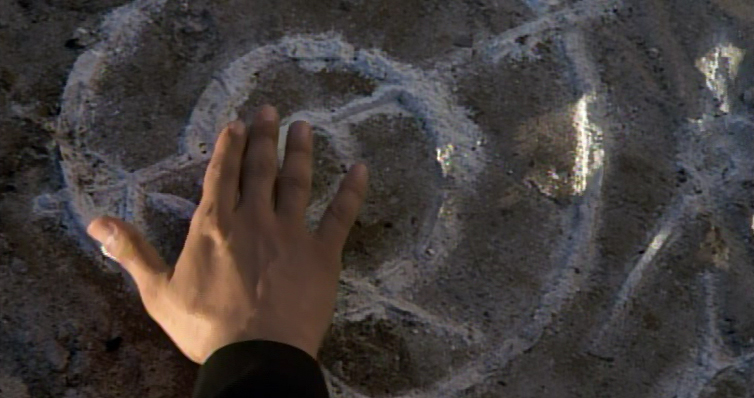
"Oh, here we go again..."

“Oh, here we go again…”

Chakotay didn’t really work in the first season. The problem is that Michael Piller seemed reluctant to accept that Chakotay’s Native American spirituality was borderline racist and offensive. So Tattoo returns to that particular well, with a much greater commitment to patronising and exploiting Native American culture. Exploring the Delta Quadrant, Chakotay comes across a seemingly abandoned moon that turns out to be the home of an ancient alien culture that made contact with Chakotay’s ancestors forty-five thousand years ago.

These aliens were responsible for shaping and molding Native American culture, for putting those groups in closer communion with the land and for fostering a purer spirituality. Not only is the main alien played by white actor Richard Fancy, the make-up design on these “Sky Spirits” emphasises their whiteness. So Tattoo becomes a story about how Native American culture essentially came from a bunch of super-advanced white people. It is astounding that nobody seemed to stop and think about the episode on the way to the screen.

"Oh, hey. That's a new level of offensiveness."

“Oh, hey. That’s a new level of offensiveness.”

Continue reading

Star Trek: Deep Space Nine – Rejoined (Review)

This February and March, we’re taking a look at the 1995 to 1996 season of Star Trek, including Star Trek: Deep Space Nine and Star Trek: Voyager. Check back daily Tuesday through Friday for the latest review.

For a show that is supposedly about an enlightened and utopian future, Star Trek really doesn’t have the best record when it comes to gay rights.

Many fans laud the work that the franchise did in popularising the Civil Rights anxieties of the sixties, offering memorable and distinctive parables and the futility of racism while offering one of the first interracial kisses to air on national television. Fans of the franchise are quick to celebrate these triumphs as an example of Star Trek holding up a mirror to contemporary society and championing the causes of equality and social justice. It is part of the mythmaking that Gene Roddenberry baked into the foundation of the Star Trek legend.
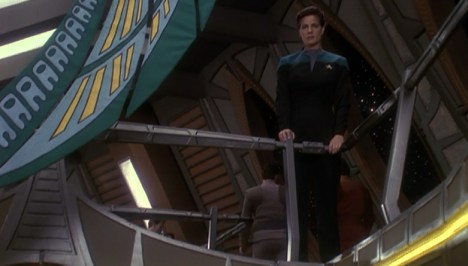
A Trill alone...

A Trill alone…

Of course, the reality is more complicated. As important as it was to have a racially diverse crew on the bridge of the classic Enterprise, that idea came from the studio rather than Roddenberry. The show defended and vindicated the Vietnam War just as often as it criticised and opposed it. The interracial kiss in Plato’s Stepchildren might had more meaning if it weren’t an example of telepathic mindrape by sadistic aliens, or if it had aired before I, Spy had broadcast its own interracial kiss.

As much as fans like to believe Star Trek is progressive and enlightened, the franchise does not have as strong a track record as its advocates would contest. This is particularly true of the depiction of homosexuality in Star Trek. In the first season of Star Trek: The Next Generation, David Gerrold’s script for Blood and Fire was scrapped. Richard Arnold claimed that it was because the script was terrible; but this was the same season that produced The Last Outpost, Angel One and The Neutral Zone. It seems “terrible” is a relative term.

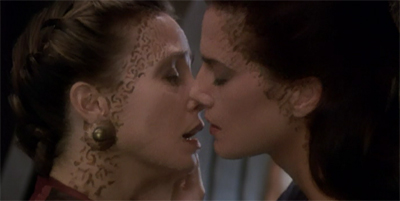
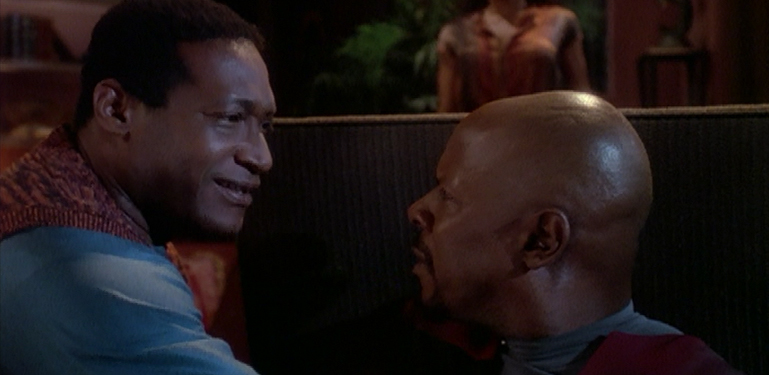
Kiss me.

Kiss me.

There were other examples. During production of The Offspring, there are accounts of David Livingston sprinting down to the sets to stop a shot of a same-sex couple holding hands making it into the episode. When the show finally decided to do an allegory for homosexuality, it was careful to cast a female performer in the role of Riker’s love interest to be sure that the audience did not get the wrong idea. The mirror universe episodes of Star Trek: Deep Space Nine are populated with gay stereotypes and clichés.

No matter how alien the creatures in Star Trek might get, sexuality tends towards heterosexual. In Metamorphosis, Kirk and Spock only realise that the Companion is attracted to Cochrane once they deduce the creature’s gender. Odo’s pseudo-sexual relationship with other Founders is typically expressed in relation to the character known as the Female Changeling. (Chimera does try to fix this.) Although there have been allusions to Andorian marriages featuring four partners, Star Trek: Enterprise presents the relationships as decidedly normative.
Take a bow!

Take a bow!

What little queer content exists seems to have slipped in under the radar. There is a decidedly homoerotic undertone to Amok Time. In The Offspring, Data allows Lal to assign her own gender and Whoopi Goldberg defined kissing as something that happens when “two people” (rather than “a man and a woman”) fall in love. In Rules of Acquisition, Jadzia Dax suspected that Quark’s newest employee had a crush on the rogue trader; Dax was just surprised to discover that the waiter in question was a woman in disguise who was trying to subvert the Ferengi patriarchy.

All of this serves to make Rejoined the most successful Star Trek episode to deal with the topic of homosexuality. This is not to argue that Rejoined is perfect or flawless. It is a science fiction show that aired in 1995, and there are some uncomfortable subtexts to the whole story. At the same time, its heart is in the right place. Rejoined is a beautiful piece of work, because it represents a rare example of the franchise trying to live up to its own publicity. In doing so, it serves to emphasise how frequently (and easily) the property has allowed itself to fall short.

Just Trilled to be there...

Just Trilled to be there…

Continue reading

Star Trek: Deep Space Nine – Indiscretion (Review)

This February and March, we’re taking a look at the 1995 to 1996 season of Star Trek, including Star Trek: Deep Space Nine and Star Trek: Voyager. Check back daily Tuesday through Friday for the latest review.

Much like Hippocratic Oath before it, Indiscretion serves to set the baseline of quality for the fourth season of Star Trek: Deep Space Nine. While The Way of the Warrior and The Visitor were ambitious deviations from form, Hippocratic Oath and Indiscretion offer a much clearer vision of what the show will look like from this point forward. As with Hippocratic Oath, a heavy two-hander a-plot is paired with a lighter b-plot that explores the day-to-day life on the eponymous space station, a structure that allows for world-building with sacrificing momentum.

Indiscretion works very well on its own terms. It throws together two of the show’s more fascinating a well-defined characters, putting Major Kira and Gul Dukat on a road trip from hell that inevitably throws them headfirst into conflict with one another. Watching Nana Visitor and Marc Alaimo interact is worth the price of admission alone, and Indiscretion throws a fairly heated personal conflict into the mix to create some tense and compelling drama. Indiscretion works very well as forty-five minutes of television.

Road trip!

Road trip!

However, it also works quite well as an exercise in setting up a longer game. As with most of the episodes that end up rippling through the continuity of Deep Space Nine, it is hard to be sure if the writers knew exactly where they wanted to go with the plot threads stemming from this instalment. Some of the difficulties dealing with the episode’s biggest legacy suggest that more thought might have gone into it. Nevertheless, Indiscretion is an episode that is clearly written with one eye on the future of the show.

As much as it stands on its own two feet, the episode is clearly written with a view to drama that it might enable further down the line. It is a story that seems to be written so that its consequences might fuel further storytelling opportunity. Deep Space Nine had toyed with the idea of serialised storytelling before, but this marks the point where the show just rolls up its sleeves and jumps right on in.

"You know, I think she likes me."

“You know, I think she likes me.”

Continue reading

Star Trek: Deep Space Nine – Hippocratic Oath (Review)

This February and March, we’re taking a look at the 1995 to 1996 season of Star Trek, including Star Trek: Deep Space Nine and Star Trek: Voyager. Check back daily Tuesday through Friday for the latest review.

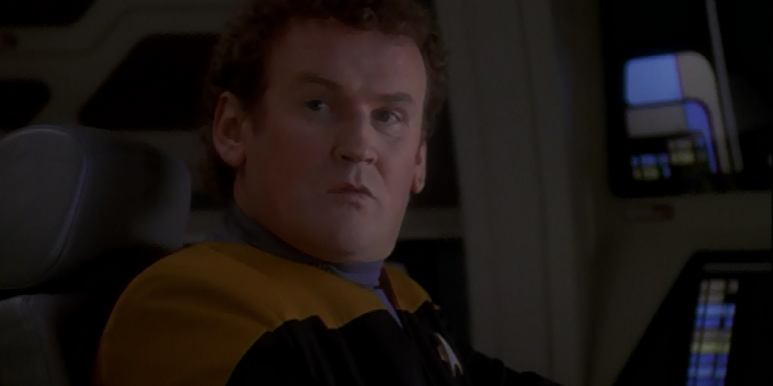
Hippocratic Oath represents a return to normality for Star Trek: Deep Space Nine. The Way of the Warrior was a feature-length war epic tasked with introducing a new regular character and a new status quo, while The Visitor was an intimate character study that stood quite apart from the show around it. With Hippocratic Oath, the show gets back to business as usual. It even has a classic a-story/b-story split with Bashir and O’Brien’s Gamma Quadrant hijinx juxtaposed with Worf learning his place on the station (and the show).

This is not to suggest that Hippocratic Oath is a bland hour of Star Trek. Indeed, it is a tightly-constructed story that hits on some of the show’s core themes and most interesting dynamics. One of the problems with the third season of Deep Space Nine was the fact that it had a strong start but no idea on how to build from that. Hippocratic Oath seems to serve very much as a “business as usual” episode of the fourth season, helping to set a baseline of quality of the show going forward.

Awkward bromantic moment...

Awkward bromantic moment…

Continue reading

Star Trek: Deep Space Nine – The Visitor (Review)

This February and March, we’re taking a look at the 1995 to 1996 season of Star Trek, including Star Trek: Deep Space Nine and Star Trek: Voyager. Check back daily Tuesday through Friday for the latest review.

To my father, who is coming home.

Daddy's home...

Daddy’s home…

Continue reading