• Following Us

  • Categories

  • Check out the Archives


  • Awards & Nominations

Star Trek: Enterprise – The Forge (Review)

This May, we’re taking a look at the fourth (and final) season of Star Trek: Enterprise. Check back daily for the latest review.

The Kir’Shara trilogy is the strongest three-parter of Star Trek: Enterprise‘s fourth season. It could legitimately be argued that the Kir’Shara trilogy is the strongest story of the entire season and one of the strongest stories of the show’s four-season run.

There are a lot of reasons why this is the case. The Kir’Shara trilogy makes great use of the franchise’s continuity and history, without getting too tied down into references for the sake of references. Indeed, there is a valid argument to be made that the trilogy represents the most overt rewriting of continuity across the fourth season, an ironic touch for a season so committed to continuity. The story does excellent work the show’s under-utilised supporting cast. The adventure actually merits three episodes, the story never dragging or wandering off on tangents.
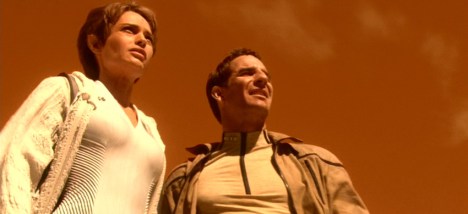
Under a not quite blood red sky...

Under a not quite blood red sky…

However, a large part of why this trilogy of episodes works better than the Borderland trilogy or the United trilogy is a simple piece of structuring. The Kir’Shara trilogy has a very clear and linear three-act structure, with each of the three episodes fitting comfortably together while doing their bit to advance and escalate the plot. There are no strange structural detours like the siege in Cold Station 12 or the visit to Andoria in The Aenar. Each of these three episodes is recognisable part of a singular larger story that builds to a crescendo.

The Forge does an excellent job setting up the arc, Awakening does an excellent job raising the stakes, and Kir’Shara does an excellent job tying it all together. The result is a satisfying two-hour television movie broadcast in three forty-minute chunks.
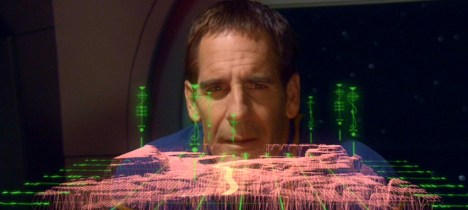
Mapping out an adventure...

Mapping out an adventure…

Continue reading

Star Trek: Enterprise – The Augments (Review)

This May, we’re taking a look at the fourth (and final) season of Star Trek: Enterprise. Check back daily for the latest review.

The fourth season of Star Trek: Enterprise is obsessed with continuity.

More than any other season of Star Trek, the fourth season drips with references and nods towards the franchise’s rich history. Nothing is off limits. The fourth season explains how the Klingons lost their ridges, what happened to the Defiant, how the Federation came to be, the origins of the Earth-Romulan War. It features prominent guest appearances from Brent Spiner, Jonathan Frakes and Marina Sirtis in roles explicitly tied to their part in the franchise. There are trips to Vulcan and the mirror universe, Romulus and Andoria.

Hitting rewind...

Hitting rewind…

This obsession with continuity is part of a double-edged sword. On the one hand, it arguably serves to make the show more insular and introspective at a point when the franchise was on the cusp of collapse. These references could distract from storytelling and feel like indulgence for the sake of indulgence. On the other hand, it is not as if a broader audience was watching Enterprise at this point. Pandering to the fanbase makes sense when the fans are the only ones left. More than that, if the franchise is dying, it makes sense to have its life flash before its eyes.

However, what is most striking about the nostalgia running through the final season of Enterprise is the way that it feels almost ahead of its time. In the way that fourth season looks backwards, it seems to almost be looking forwards.

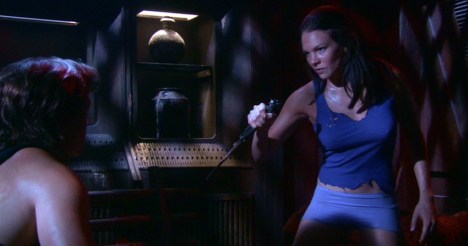
Obligatory sexy underwear fight, in case you forgot this is till airing on UPN.

Obligatory sexy underwear fight, in case you forgot this is till airing on UPN.

Continue reading

Star Trek: Enterprise – Borderland (Review)

This May, we’re taking a look at the fourth (and final) season of Star Trek: Enterprise. Check back daily for the latest review.

Borderland establishes the format that will come to define the fourth season of Star Trek: Enterprise; the mini-arc, a single story told over two or three episodes before moving along to the next adventure.

Technically speaking, Storm Front, Part I and Storm Front, Part II established the format for the season. However, the franchise had done multi-part season premieres before. Star Trek: Deep Space Nine was particularly fond of the format, seguing from a status quo altering season finale into a multi-part season opener; The Homecoming, The Circle, The Siege, The Search, Part I, The Search, Part II, The Way of the Warrior, Image in the Sand, Shadows and Symbols. This is to say nothing of the massive six episode arc that opened the sixth season.

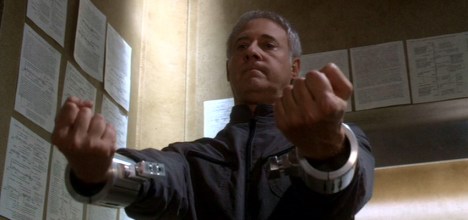
Put your hands together for Mister Brent Spiner.

Put your hands together for Mister Brent Spiner.

Borderland represents a departure because it signals that the fourth season of Enterprise will be comprised entirely of multi-episode stories. Historically, Star Trek shows had typically done one or two multi-part stories in a season, give or take a cliffhanger to bridge two years of the show. The fourth season of Enterprise would tell seven multi-part stories eating up seventeen episodes of the twenty-two episode season order. It was certainly a bold departure for the series and the franchise.

In fact, Borderland begins the franchise’s first three-part episode since the second season of Deep Space Nine. (Although determined fans could likely stretch logic a little to suggest that Tears of the Prophets or Zero Hour were season finales that formed a three-parter when tied into the two-part premieres that followed.) It is a curious departure, and one that immediately helps to establish the fourth season of Enterprise as something quite distinct.

A slave to continuity...

A slave to continuity…

Continue reading

Star Trek: Enterprise – Home (Review)

This May, we’re taking a look at the fourth (and final) season of Star Trek: Enterprise. Check back daily for the latest review.

If Storm Front, Part I and Storm Front, Part II represented a transition between Brannon Braga and Manny Coto, then Home marks the point at which Manny Coto assumes full control of Star Trek: Enterprise.

As befits a season so steeped in Star Trek nostalgia, Home fits a familiar template. Each of three live action spin-offs took a brief timeout after an epic fourth season opener to tell a smaller character-driven story about the response to life-altering trauma. Jean-Luc Picard processed the trauma of The Best of Both Worlds, Part I and The Best of Both Worlds, Part II through the quieter moments of Family. Jake Sisko confronted the loss of his father in The Visitor. Even Seven of Nine faced her disconnection from the Borg Collective in The Gift.

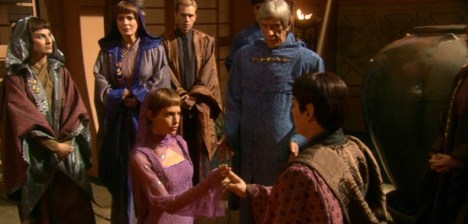
Marriage of inconvenience.

Marriage of inconvenience.

Home is clearly intended to allow the characters (and the show) to work through the issues generated by the epic third season arc, while also dutifully setting up plot threads that will play out across the rest of the season. Home might be a stand-alone episode in many ways, but it does serve to dovetail the third and fourth seasons of the show, working through character points that are hanging over from the show’s third year while also helping to establish elements that will become more important in the season ahead.

Home works rather well as a connecting structure, even if it lacks the raw emotional power of something like Family or The Visitor. It is well worth taking the time to focus upon (and flesh out) this cast. The biggest problem with Home is that so many of these characters feel underdeveloped, particularly compared to the casts of Star Trek: The Next Generation or Star Trek: Deep Space Nine. It is hard for those characters to carry an entire episode when they haven’t been properly developed.

"Go climb a rock!"

“Go climb a rock!”

Continue reading

Star Trek: Enterprise – Storm Front, Part II (Review)

This May, we’re taking a look at the fourth (and final) season of Star Trek: Enterprise. Check back daily for the latest review.

Storm Front, Part I and Storm Front, Part II arrive at a transitory time for Star Trek: Enterprise.

The fourth season was almost certain to be the end of the show, with Brannon Braga stepping back from the writers’ room to allow Manny Coto the chance to the take the reins. Coto would use the opportunity to more firmly connect the show to its franchise roots, constructing a final season that would serve as something of a bridge between this prequel series and the rest of the canon. However, there was just one problem. Coto inherited a cliffhanger from Zero Hour, the third season finale that stranded Archer in the past with some evil!alien!space!Nazis.

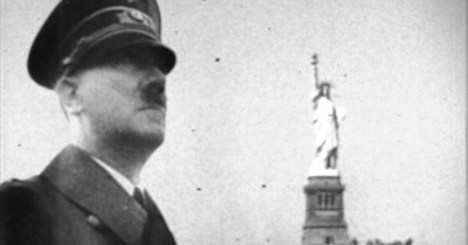
Into the sunset...

Into the sunset…

Although the fourth season of Enterprise is widely praised by the few fans who remained watching until the bitter end, Storm Front, Part I and Storm Front, Part II are often overlooked in discussions of the season. Much like These Are the Voyages… at the very end of the season, the opening two-parter is largely treated as a story foisted upon an incoming executive producer that does not reflect his own plans or desires for the season ahead. There is typically a sense of obligation to discussions of the two-parter as little more than a speed bump into the season.

This is a shame. Storm Front, Part I and Storm Front, Part II were both written by Manny Coto. Although the producer inherited the basic premise and the brief from his direct predecessors, how Coto chose to approach the material is quite insightful and informative. In that respect, Storm Front, Part I and Storm Front, Part II might be seen as an introduction to the Manny Coto era before it properly begins in Home.

"It's been a long road, gettin' from there to here... It's been a long time, but my time is finally near..."

“It’s been a long road, gettin’ from there to here…
It’s been a long time, but my time is finally near…”

Continue reading

Star Trek: Enterprise – Storm Front, Part I (Review)

This May, we’re taking a look at the fourth (and final) season of Star Trek: Enterprise. Check back daily for the latest review.

Storm Front, Part I and Storm Front, Part II arrive at a transitory time for Star Trek: Enterprise.

The third season of the show had wrapped on a somewhat unexpected cliffhanger, finding Archer confronted by an evil!alien!space!Nazi in the midst of what looked to be the Second World War. Given that the third season had been written as a single extended dramatic arc about Archer and his crew saving Earth from an alien threat, the twist seemed to come out of nowhere. Instead of allowing Archer and his crew to return home, Zero Hour threw out one final hurdle for the characters; a bump in the road home.

Ship shape.

Ship shape.

However, the episodes also marked a transition behind the scenes. This particular iteration of the Star Trek franchise was on borrowed time. There had been warning signs as early as the first season, but the massive reworking of the show in The Expanse suggested that the network had adopted a “do or die” approach to the future of this lucrative science-fiction franchise. The fact that the third season had its episode order cut and there were suggestions that a fourth season was unlikely suggested that the show had not “done.”

Even aside from all that, the start of the fourth season saw Rick Berman and Brannon Braga taking a step back from the franchise and handing the reins to executive producer Manny Coto. In that respect, Storm Front, Part I and Storm Front, Part II might be seen as the collective last gasp of the Berman and Braga era. Give or take These Are The Voyages…

Back to the future.

Back to the future.

Continue reading

Star Trek: Voyager – Season 2 (Review)

This February and March (and a little bit of April), we’re taking a look at the 1995 to 1996 season of Star Trek, including Star Trek: Deep Space Nine and Star Trek: Voyager. Check back daily for the latest review.

The second season of Star Trek: Voyager was a disaster.

There is no other way to describe it. The second season of Voyager is a messy run populated with malformed episodes and terrible creative decisions, compounded by the sense that the production team has turned upon itself and the network is feeling more and more uncomfortable with its flagship show. The first season of Voyager had debuted at the franchise’s cultural zenith, as the cast of Star Trek: The Next Generation transitioned to the big screen with Star Trek: Generations and as Paramount chose the franchise to be the cornerstone of its new network.

voy-basicspart1w

However, there was very clearly trouble in paradise. It could be argued that Voyager was in a large part the victim of the franchise’s success. Frustration over how Paramount chose to assign the writing duties for Generations led Michael Piller to divorce himself from the franchise to develop other ideas.While UPN was very lucky to have a show like Voyager, the network consciously pushed the production team away from narrative experimentation in favour of cookie-cutter plotting.

The basic premise of “Starfleet and Maquis find themselves roughing it in the Delta Quadrant” was eroded surprisingly quickly over the course of that first year. All the Maquis crew members were in Starfleet uniforms by the start of Parallax. Any hint of conflict between the two was downplayed with a joint Starfleet and Maquis mutiny in Prime Factors. Luxury items like the holodeck were able to run in episodes like Heroes and Demons and Cathexis. A Romulan guest starred in Eye of the Needle. So the first season betrayed a lot of what made the initial idea interesting.

voy-resolutions26a

Continue reading

Star Trek: Voyager – Remember (Review)

This February and March (and a little bit of April), we’re taking a look at the 1995 to 1996 season of Star Trek, including Star Trek: Deep Space Nine and Star Trek: Voyager. Check back daily for the latest review.

Much like The Chute before it, Remember is very much an attempt to do classic archetypal Star Trek.

Remember is an allegorical piece of social commentary that is as firmly rooted in the nineties as the prison politics that underpinned The Chute. As the name implies, Remember is a story fascinated with the idea of memory and legacy. In particular, it reflects the idea of cultural memory as construct that is shared from person to person and passed down from generation to generation. Touching on themes of Holocaust denial, Remember is a very potent piece of science-fiction allegory, one that treats cultural memory as something to be cultivated and maintained.

Whose (geno)cide are you on?

Whose (geno)cide are you on?

Remember is a good illustration of what the production team is trying to do as Star Trek: Voyager enters its third season. After a disastrous (and exhausting) sophomore year, it seems like the writing staff have opted against trying to give the show its own unique voice. Instead, the plan seems to be to craft the most archetypal approach to the franchise imaginable. From this point onwards, it becomes increasingly rare for the show to do episodes unique to its setting and premise, instead telling stories that would work with most iterations of the franchise.

This approach has its limitations, of course. By the time that the second season of Star Trek: Enterprise rolls around, even the most die-hard fans have had their fill of broadly-drawn mass-produced factory-setting Star Trek. While this approach could be argued to be a waste of an interesting premise and the betrayal of the show’s original promise, Remember makes a convincing argument that an archetypal Star Trek allegory can still work on its own terms. Remember is a powerful and effective piece of commentary in the classic Star Trek tradition.

Burning guilt...

Burning guilt…

Continue reading

Star Trek: Voyager – The Swarm (Review)

This February and March (and a little bit of April), we’re taking a look at the 1995 to 1996 season of Star Trek, including Star Trek: Deep Space Nine and Star Trek: Voyager. Check back daily for the latest review.

The Swarm helps to solidify the Jeri Taylor era, even as it is shuffled in among relics of Michael Piller’s tenure.

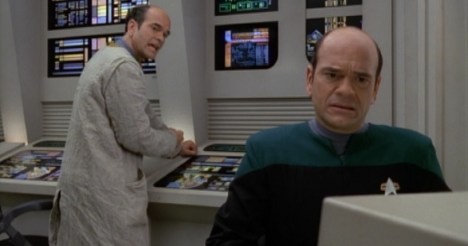
Much like The Chute before it, The Swarm has a great central premise built around the classic model of using the franchise to tell allegorical stories. The episode has a great hook and a great central performance, along with a strong sense of theme that makes it easier to relate to the whole thing. In The Chute, Kenneth Biller touched on issues of punishment and incarceration. In The Swarm, Mike Sussman tells a sweet story about caring for a loved one whose mental faculties are degrading. (This was a theme to which Sussman would return tangentially with Twilight.)

Talking to himself...

Talking to himself…

However, that strong central premise is also betrayed by several severe structural problems that hold the episode back from greatness. The Chute was a few rewrites away from greatness, its final act existing primarily to close out an hour of broadcasting rather than to tie together the preceding forty minutes of television. The Swarm grafts its emotionally compelling story of mental collapse onto a fairly generic “evil alien” narrative that somehow challenges to become the episode’s primary plot thread.

As with The Chute, there is a sense that The Swarm is codifying what will become standard practice for the series from this point forward. The biggest issue with The Swarm is the decision to undercut the episode’s emotional arc by having the series reset the EMH’s reset. In what arguably makes it the perfect example of the issues that will plague Star Trek: Voyager from here until Endgame, the show literally presses a reset button on a reset button. The Swarm is a meta-reset, if you will.

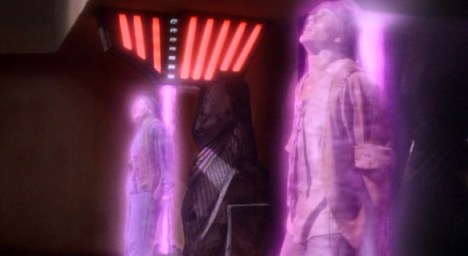
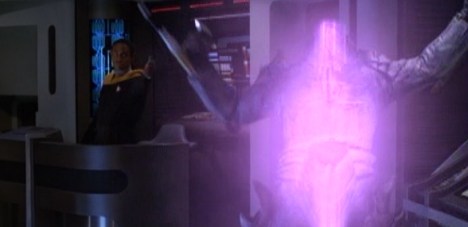
Purple haze...

Purple haze…

Continue reading

Star Trek: Voyager – Flashback (Review)

This February and March (and a little bit of April), we’re taking a look at the 1995 to 1996 season of Star Trek, including Star Trek: Deep Space Nine and Star Trek: Voyager. Check back daily for the latest review.

Flashback was largely advertised as Star Trek: Voyager‘s contribution to the thirtieth anniversary celebrations of the Star Trek franchise.

It featured guest appearances from three alumni of the original show. It was set during the events of Star Trek VI: The Undiscovered Country. It featured Tuvok and Janeway dressing up in movie-era uniforms. It was publicised as “a very special episode.” It aired only three days after the thirtieth anniversary, while Star Trek: Deep Space Nine waited nearly two months to broadcast Trials and Tribble-ations. Anybody would be forgiven for looking at Flashback as the obligatory nostalgic celebratory adventure to mark the thirtieth anniversary of the Star Trek franchise.

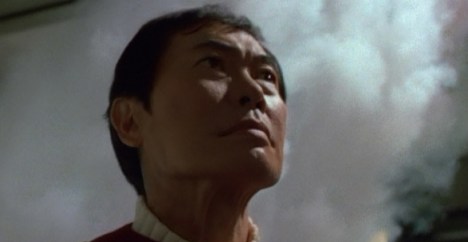
Hero shot.

Hero shot.

Put simply, Flashback does not work in that context. Although it features Captain Hikaru Sulu, the episode doesn’t actually allow him to accomplish anything. As far as “secret histories” go, the episode turns out to be a bit of a cul de sac. More to the point, the continuity is a mess, both in broad franchise terms and specifically with regards to the feature film it heavily references. Although it is great to see Grace Lee Whitney and George Takei back, the script only allows them to interact with Tim Russ and (fleetingly) Kate Mulgrew.

In fact, it could convincingly be argued that Future’s End, Part I and Future’s End, Part II do a much better job of filling the “celebratory thirtieth anniversary story” slot than Flashback, despite the notable absence of any actual characters from the original show. Future’s End, Part I and Future’s End, Part II feel like a gigantic (and enjoyable) homage to Star Trek IV: The Voyage Home, which is both hugely fun and also weirdly appropriate in a play-on-words sort of way. That is more in line with what fans were expecting for the anniversary: nostalgic fun.

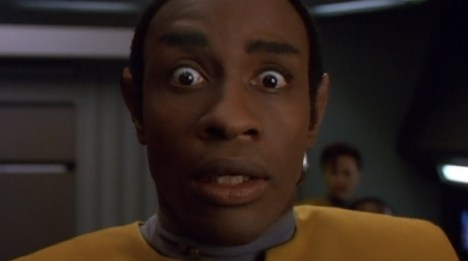
Tim Russ was as excited as anyone to get a Tuvok episode.

Tim Russ was as excited as anyone to get a Tuvok episode.

In contrast, Flashback is something altogether stranger. Brannon Braga had been working on the story before it was suggested that Voyager should do a thirtieth anniversary episode, and Flashback plays more as a Brannon Braga script that ties into an anniversary more than an anniversary episode that happens to be written by Brannon Braga. Despite its high-profile guest cast, Flashback has more in common with Braga’s mind-bending scripts for Frame of Mind or Projections than with Trials and Tribble-ations.

Nevertheless, there is something fascinating about Flashback, because it allows Braga to use the springboard of the thirtieth anniversary to talk about memory.

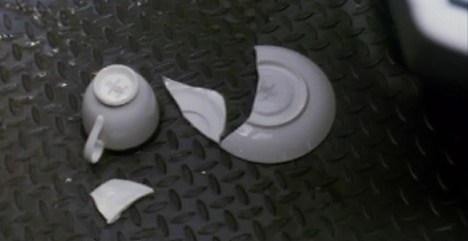
The teacup that he shattered didn't come together...

The teacup that he shattered didn’t come together…

Continue reading