• Following Us

  • Categories

  • Check out the Archives


  • Awards & Nominations

Star Trek (DC Comics, 1989) Annual #2 – Starfleet Academy!

This August, to celebrate the upcoming release of Star Trek: Into Darkness on DVD and blu ray, we’re taking a look at the Star Trek movies featuring the original cast. Movie reviews are every Tuesday and Thursday.

We’ll be supplementing our coverage of the movies with tie-ins around (and related to) the films. We’ll be doing one of these every week day. This is one such article.

Multimedia franchises tend to have very strange lives. These iconic pop culture characters rarely seem to ride off into the sunset in any real way. Their story might end, but there’s always a new beginning just waiting for them. When veteran Star Trek writer Ronald D. Moore took charge of the reboot of Battlestar Galactica, he even wove the idea into the fabric of the show. “All of this has happened before and will happen again,” the characters repeated.

It’s been a Hollywood fad for the last decade, with high-budget reboots like Batman Begins and The Amazing Spider-Man suggesting that icons never die, they just get reinvented. However, it has always been a feature of the pop culture landscape. Think of how many adaptations of Batman have run their course, or how many times in how many different media Sherlock Holmes has played out his game of wits. Life for these iconic properties is something of a spinning wheel. It seems that no sooner are you off one side than you are back on the other.

So, with the release of Star Trek: The Undiscovered Country in 1991, it seemed the ideal time for Star Trek author Peter David to venture back to the very beginning, and to explore Kirk’s time at Starfleet Academy!

"By the way, I like David as a name..."

“By the way, I like David as a name…”

Continue reading

Star Trek – Cast No Shadow by James Swallow (Review)

This August, to celebrate the upcoming release of Star Trek: Into Darkness on DVD and blu ray, we’re taking a look at the Star Trek movies featuring the original cast. Movie reviews are every Tuesday and Thursday.

We’ll be supplementing our coverage of the movies with tie-ins around (and related to) the films. We’ll be doing one of these every week day. This is one such article.

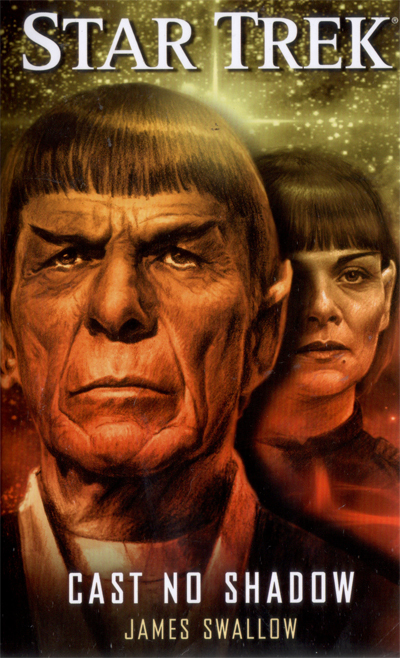
Valeris is a fascinating character who gets a bit lost in the scope of Star Trek VI: The Undiscovered Country. Given the film’s focus on bidding a fond farewell to the iconic crew of the Enterprise, it’s understandable that the newest addition to the crew should get pushed aside. It’s even more notable because Valeris is clearly a stand-in for the character of Saavik, another of Spock’s young female Vulcan protegés, making her not only a newer character, but a substitute for a newer character.

One of the most interesting things about Star Trek tie-in fiction is the scope afforded by the gigantic shared universe. Across the dozen movies and the seven-hundred episodes of television, there are countless supporting characters and concepts thrown out. Due to plotting necessities and the demands of particular stories, some of these ideas are never truly fleshed out. The sheer volume of tie-in material means that writers do get a chance to develop and expand upon these character which might otherwise be forgotten.

Writing a novel centred on Valeris is a very bold idea, but one which acknowledges just how intriguing the concept of Kim Cattrall’s Vulcan traitor is, despite the fact the film treats her as a minor character at best.

castnoshadow

Continue reading

Star Trek – Shadows on the Sun by Michael Jan Friedman (Review)

This August, to celebrate the upcoming release of Star Trek: Into Darkness on DVD and blu ray, we’re taking a look at the Star Trek movies featuring the original cast. Movie reviews are every Tuesday and Thursday.

We’ll be supplementing our coverage of the movies with tie-ins around (and related to) the films. We’ll be doing one of these every week day. This is one such article.

It almost feels like sacrilege to fill in the gap left at the end of Star Trek VI: The Undiscovered Country. The film was such a perfect send-off that picking up a novel directly after the end credits role feels like it might undermine the perfect farewell story for the veteran crew. After all, director Nicholas Meyer suggested that the film was an attempt to capture the spirit of Fukuyama’s “end of history”, representing the “end of history” for the original crew.

Except, of course, it wasn’t the end. In terms of internal Star Trek chronology, episodes of Star Trek: The Next Generation had picked up on the later adventures of Scotty and Spock. Star Trek: Voyager would flashback to a Sulu story unfolding concurrently with The Undiscovered Country. Scotty and Chekov would appear in Star Trek: Generations, which would also serve as a disappointing farewell to one James Tiberius Kirk. It seems bitterly appropriate (if far from fair) that Uhura should remain the only major player whose story actually ends with The
Undiscovered Country
.

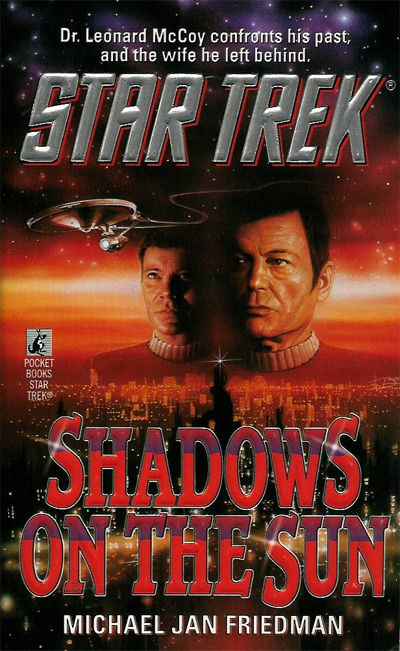
Still, despite his passing of the torch appearance in Encounter at Farpoint, you could make an argument that The Undiscovered Country was the end of the line for Leonard McCoy more than Kirk or Spock. And, as such, Michael Jan Friedman’s Shadows on the Sun serves as an effective (if flawed) reflection on the way that McCoy’s presence sort of faded from the 24th century spin-offs. startrek-shadowsonthesun

Continue reading

Star Trek: Excelsior – Forged in Fire by Michael A. Martin and Andy Mangels (Review)

This August, to celebrate the upcoming release of Star Trek: Into Darkness on DVD and blu ray, we’re taking a look at the Star Trek movies featuring the original cast. Movie reviews are every Tuesday and Thursday.

We’ll be supplementing our coverage of the movies with tie-ins around (and related to) the films. We’ll be doing one of these every week day. This is one such article.

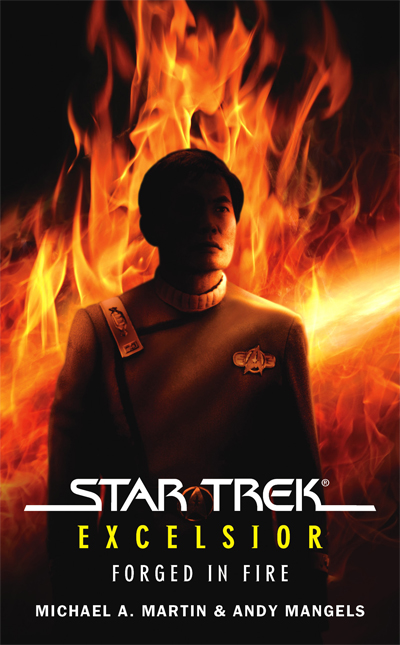
I have to admit, when I first saw Star Trek VI: The Undiscovered Country, I was a bit surprised to be introduced to Captain Hikaru Sulu. This was a character who didn’t even have a first name before The Undiscovered Country. The name chosen – “Hikaru” – was taken from Vonda N. McIntyre’s 1981 tie-in The Entropy Effect. Still, I suppose it could be worse. Uhura didn’t get a first name on screen until the release of Star Trek in 2009.

So it seemed strange that this supporting character should find himself the commanding officer of a starship, let alone a state-of-art ship of the line which opened the fond farewell to the original series crew. Still, the character of Captain Hikaru Sulu remains one of the most interesting branches sprouting off the trunk of Star Trek. Takei would reprise the role on Star Trek: Voyager, hold down a couple of Simon & Schuster audio adventures and even feature heavily in tie-in novels and comic books. Takei is quite fond of recounting his campaign to launch a television show centred around the character.

It’s quite remarkable, as Sulu is probably the only major character who could credibly “spin-off” from the original Star Trek show, which is remarkable for a supporting performer whose most iconic moment in the classic Star Trek show was waving a sword through the corridors while practically naked.

excelsior-forgedinfire

Continue reading

Star Trek – The Movies (Review)

This August, to celebrate the upcoming release of Star Trek: Into Darkness on DVD and blu ray, we’re taking a look at the Star Trek movies featuring the original cast. Movie reviews are every Tuesday and Thursday.

It’s interesting how radically different the Star Trek feature films were from the show that spawned them. All were anchored in the classic science-fiction series. Star Trek: The Motion Picture felt like it was heavily influenced by The Changeling. Star Trek II: The Wrath of Khan obviously drew on Space Seed. Star Trek III: The Search for Spock evoked The Menagerie. Star Trek IV: The Voyage Home featured the same plot device (and time travel technique) as Tomorrow is Yesterday. Star Trek V: The Final Frontier had Kirk defeating one final god-like being. Star Trek VI: The Undiscovered Country had the crew finally make peace with Klingons.

However, they were quite clearly a very different animal from the original television show. Which makes a great deal of sense. After all, there’s a world of difference between a fifty-minute adventure produced for weekly television and a big theatrical event. However, what’s interesting about these changes is that they weren’t necessarily in the direction you might expect. The television show was a collection of episodic adventures, but what’s really striking about the films is that most of them have a reasonably clear serialised arc.

startrek-themotionpicture

Continue reading

Non-Review Review: Star Trek VI – The Undiscovered Country

This August, to celebrate the upcoming release of Star Trek: Into Darkness on DVD and blu ray, we’re taking a look at the Star Trek movies featuring the original cast. Movie reviews are every Tuesday and Thursday.

Whatever its faults, Star Trek VI: The Undiscovered Country is a fond farewell to the original cast of Star Trek, giving the ensemble one last epic adventure before heading off into legend. Chancellor Gorkon suggests that the “the undiscovered country” that lends the movie its title is “the future.” Most Shakespearean scholars would argue that it is “death.” Perhaps they need to – as Gorkon argues – “experience” it in “the original Klingon”, or perhaps there’s more to it than that.

Perhaps the undiscovered country can be both – the death waiting for all of us eventually, the “chimes at midnight” that Chang alludes to after a disastrous diplomatic dinner. Probably not. Still, The Undiscovered Country does represent a death. It’s the end of an era, the extinguishing of a torch that had already been passed. It’s the last adventure of Kirk’s starship Enterprise, and it feels appropriate that it serves to end the Cold War raging between the Klingons and the Federation.

It’s a beautiful farewell to the crew, to the extent that even the actors’ decision to “sign” the closing credits doesn’t feel over saccharine or manipulative. The movie has more than its fair share of narrative flaws, neither as tight as Star Trek II: The Wrath of Khan nor as energetic as Star Trek IV: The Voyage Home. However, it hangs together remarkably well, in no small part thanks to a solid premise, a strange honesty and a deep affection for the cast and crew.

We're having some old friends for dinner...

We’re having some old friends for dinner…

Continue reading

Non-Review Review: Star Trek III – The Search for Spock

This August, to celebrate the upcoming release of Star Trek: Into Darkness on DVD and blu ray, we’re taking a look at the Star Trek movies featuring the original cast. Movie reviews are every Tuesday and Thursday.

I have a soft spot for Star Trek III: The Search for Spock. It’s a weird thing to admit, but it was really my first encounter with the crew of the original Star Trek television show. I was only eight or nine at the time, and I’d grown up watching and loving Star Trek: The Next Generation. Of course, this was in an era before DVD and blu ray made it feasible (and affordable) to collect the whole thing. So I branched out by trying the movies.

Being a young child in the era before the internet, I didn’t know that the second through fourth films formed a loose thematic trilogy. I just picked the film with the title that jumped out at me. Since “Spock” was an iconic part of Star Trek, and I knew him from his guest appearance on The Next Generation, The Search for Spock seemed the logical choice.

And it retains a special place in my heart.

"I have been, and always shall be, your friend..."

“I have been, and always shall be, your friend…”

Continue reading

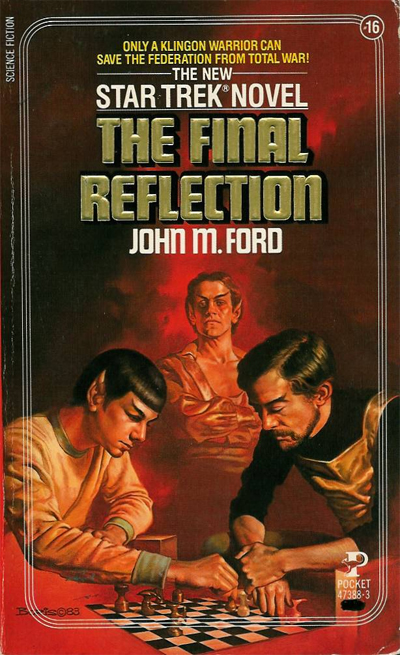
Star Trek – The Final Reflection by John M. Ford (Review)

To celebrate the release of Star Trek: Into Darkness this month, we’ll be running through the first season of the classic Star Trek all this month. Check back daily to get ready to boldly go. It’s only logical.

We’ll be supplementing our coverage of the episodes with some additional materials – mainly novels and comics and films. This is one such entry.

The Final Reflection was written in 1984. Development on Star Trek: The Next Generation would only be announced in 1986. Sure, there were a bunch of successful movies being produced, but these only amounted to a couple of hours of Star Trek once every few years. And, even then, the movies were aimed at a much broader audience, without the same development and continuity that a television show could offer. Not that Star Trek ever really had that tight a sense of continuity, of course, but it must have seemed unlikely that things could ever go back to the way they had been. Certainly, in 1984, nobody could have anticipated the eighteen-straight years of Star Trek running from Encounter at Farpoint to These Are the Voyages.

As a result, fans had to look to other avenues to expand and develop the rich Star Trek universe. The novels were one such avenue, although they developed slowly. Mission to Horatius had been published while the show was on the air, but it was very clearly aimed at a younger audience. Spock Must Die! would be published in 1970. However, the spin-off fiction developed relatively slowly. Star Trek had yet to become a massive franchise with tie-in multimedia commercial opportunities.

Perhaps because the Star Trek novels had not quite turned into a massive franchising opportunity, and they weren’t under the same level of publicity or scrutiny that they would be in the years to come, writer John M. Ford was able to do something quietly revolutionary with his first Star Trek novel, The Final Reflection. He was able to venture away from our core cast of iconic characters and instead develop the Klingon Empire.

More than that, though, he was able to paint the Klingons as the good guys.

tos-thefinalreflection5

Continue reading

Non-Review Review: Star Trek VI – The Undiscovered Country

On seeing the new Star Trek, I decided to dig into my old DVD’s and review my personal favourite of the Original Series movies. The cliched choice is The Wrath of Khan, and it is indeed awesome, but I’ve always had a soft spot for The Undiscovered Country, despite its abuse of Shakespeare. So, having just witnessed Kirk and Spock’s first voyage, what did I make of their last?

Continue reading