• Following Us

  • Categories

  • Check out the Archives


  • Awards & Nominations

Star Trek – The Corbomite Manoeuvre (Review)

To celebrate the release of Star Trek: Into Darkness this month, we’ll be running through the first season of the classic Star Trek all this month. Check back daily to get ready to boldly go. It’s only logical.

Again, The Corbomite Manoeuvre is one of those early episodes of Star Trek that was shuffled around in the broadcast order. Not that there’s too much internal continuity to mess up or anything like that, but it is particularly noticeable when episodes at the start of a television show get shuffled around. The writers are establishing characters and concepts, so it feels strange to watch the first episode written with McCoy after we’ve already seen him established as the ship’s doctor.

(The first episode aired, The Man Trap, centres around McCoy, which makes it strange when the ship suddenly has a different Chief Medical Officer in the Where No Man Has Gone Before.)

Fortunately though, The Corbomite Manoeuvre is the last time that this really becomes a concern, as Star Trek seems to iron out all the difficulties and the nuances on a new television show. Effectively the first regular episode of the show produced after two pilots, a large part of the charm of The Corbomite Manoeuvre is really watching it all come together.

What a dummy...

What a dummy…

Continue reading

Star Trek – Where No Man Has Gone Before (Review)

To celebrate the release of Star Trek: Into Darkness this month, we’ll be running through the first season of the classic Star Trek all this month. Check back daily to get ready to boldly go. It’s only logical.

In a way, there’s a very clear divide between The Cage and Where No Man Has Gone Before. It’s clearer than the strange new actor sitting in the middle of the Bridge or the fact that Spock is suddenly a lot less casual. In a way, each is perfectly positioned in popular consciousness. The Cage was produced in late 1964, but wouldn’t be shown on television until 1988, after spending years touring the fan circuit. It remains a strange bit of Star Trek history, sitting simultaneously outside any of the five television shows, and simultaneously a completely inexorable part of the franchise’s evolution. It’s where it all began, but not where the first Star Trek began.

In contrast, Where No Man Has Gone Before feels more like the pilot episode of Star Trek. Sure, the fashion changes a bit in the episodes to come, the entire cast has yet to be assembled, but this is recognisably the same ship and the same show as The Corbomite Manoeuvre or The Man Trap. It’s more than the actors filling roles, the consistent characterisation of Spock or the fact that it actually aired on television in September 1966. This is what the next three years of Star Trek will be like. It’s an aesthetic or an approach to storytelling that is markedly different to the way that The Cage tackled many of the same themes and ideas.

While The Cage laid down many of the philosophical underpinnings of the broader Star Trek universe – including the classic show – it is also a lot less physical and visceral than the classic Star Trek. Indeed, The Cage featured the Captain of the Enterprise reasoning with an advanced bunch of god-like aliens, appealing to human virtues. The action sequences felt a bit extraneous. In contrast, Where No Man Has Gone Before sees the Captain of the Enterprise punching a god-like being repeatedly in the face while hitting on the same themes.

I think that’s perhaps the most dynamic difference between not only The Cage and Where No Man Has Gone Before, but between Star Trek and its spin-offs.

All the old familiar faces...

All the old familiar faces…

Continue reading

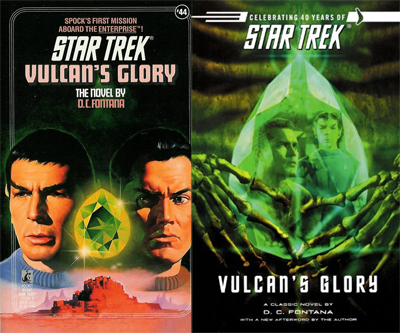
Star Trek – Vulcan’s Glory by D.C. Fontana (Review)

To celebrate the release of Star Trek: Into Darkness this month, we’ll be running through the first season of the classic Star Trek all this month. Check back daily to get ready to boldly go. It’s only logical.

We’ll be supplementing our coverage of the episodes with some additional materials – mainly novels and comics and films. This is one such entry.

I’ve never really felt too strongly one way or another about continuity. I never got too upset about Klingon forehead ridges, or the fact that Khan somehow remembered Chekov from an episode that took place before he joined the Enterprise. I’ve always found the use of the term “canon” to describe the shared continuity as more than a little indulgent or absurd. I consider some of the better tie-in novels I have read to be a worthy part of the Star Trek universe, regardless of the fact that they may not fit, or they may contradict what was depicted on-screen. I’ve never been too tightly tied to the notion that something is “important” or “in continuity” among this 700-episode franchise.

Still, I can’t help but feel like there’s something almost legitimate about Vulcan’s Glory. It is a novel from writer D.C. Fontana, who served as script editor and writer on the classic Star Trek show, and is regarded as one of the guiding lights of the franchise. She went on to write for both Star Trek: The Next Generation and Star Trek: Deep Space Nine. Given her importance to the show over its extended history, anything Fontana writes about it is worthy of note. Indeed, Vulcan’s Glory was originally published in 1989 and was reissued in 2006 for the franchise’s fortieth anniversary.

Even to somebody reluctant to consign “importance” or “worthy” to a tie-in based on outside factors, the story of Spock’s first mission on board the Enterprise, written by one of the strongest writers of the original Star Trek and a guiding influence on the franchise, still jumps out as a pretty important book.

vulcansglory

Continue reading

Look! Star Trek Reimagined in the Pixar Style!

The wonderful folks over at The Minion Factory have reimagined the classic Star Trek characters in the style of Pixar. It’s a fun collection of images (feel free to also check out the artist’s superhero gallery), and rendered with obvious affection for the show’s decidedly sixties aesthetic. I especially love the affection demonstrated in chosing the background images. Anyway, take a look and click to enlarge.

Star Trek: The Next Generation – Loud as a Whisper (Review)

To celebrate the twenty-fifth anniversary of Star Trek: The Next Generation, and also next year’s release of Star Trek: Into Darkness, I’m taking a look at the recent blu ray release of the first season (and a tiny bit of the second), episode-by-episode. Check back daily for the latest review.

At the very least, Loud as a Whisper has its heart in the right place. At least of most of its run time. Essentially an issue-driven (and guest-star-driven) show that is determined to prove to the audience that a disability need not define a person, it’s a little undermined by a subplot where Pulaski and Geordi discuss the possibility of making the Chief Engineer “normal” again. However, once you get past the earnestness of it all, Loud of a Whisper seems a little clunky as television drama, with all manner of potentially interesting ideas that are never really explored. The result is a massively disappointing story that feels a bit like a clumsy after-school special.

What goes around...

What goes around…

Continue reading

Star Trek: The Next Generation – The Outrageous Okona (Review)

To celebrate the twenty-fifth anniversary of Star Trek: The Next Generation, and also next year’s release of Star Trek: Into Darkness, I’m taking a look at the recent blu ray release of the first season (and a tiny bit of the second), episode-by-episode. Check back daily for the latest review.

Well, I’m not sure if you can call two solid episodes in succession a “streak” or a “roll”, but Where Silence Has Lease and Elementary, Dear Data were two hours of television that demonstrated how far the second season of Star Trek: The Next Generation had come since its rocky first season. However, it appears that the two very good episodes in a row did not represent a sudden change in direction and did not assure consistency. The Outrageous Okona is a bad episode, by just about any measure. It’s not necessarily as offensive as Angel One or Code of Honour, but it is quite painful to watch.

Unlike a lot of the bungled “message” shows in the first season that contained misjudged ideas or offensive elements, The Outrageous Okona is merely a terribly written and unfunny mess of an episode that simply gnaws at the viewer.

He works best Solo...

He works best Solo…

Continue reading

Star Trek: The Next Generation – Elementary, Dear Data (Review)

To celebrate the twenty-fifth anniversary of Star Trek: The Next Generation, and also next year’s release of Star Trek: Into Darkness, I’m taking a look at the recent blu ray release of the first season (and a tiny bit of the second), episode-by-episode. Check back daily for the latest review.

If you needed more evidence of the improvement of Star Trek: The Next Generation between the first and second seasons of the show, Elementary, Dear Data certainly provides it. Like Where Silence Has Lease directly before it, Elementary, Dear Data works so well because it takes a couple of ideas hinted at and teased in the first season and then develops them just a little bit further.

There’s a sense that the universe of The Next Generation is slowly expanding. While the first season treated our main characters as masters of all they surveyed, Elementary, Dear Data hints that the universe still has more to teach them and that they have a lot to learn.

Unfortunately, the trend would not continue into the next episode, but Elementary, Dear Data proves that the writing team (and the cast) are learning to play to the show’s strengths and that the pieces are all positioned to allow for a solidly entertaining hour of television.

Things take a turn for the better...

Things take a turn for the better…

Continue reading

Star Trek: The Next Generation – Season 1 (Review)

To celebrate the twenty-fifth anniversary of Star Trek: The Next Generation, and also next year’s release of Star Trek: Into Darkness, I’m taking a look at the recent blu ray release of the first season, episode-by-episode. Check back daily for the latest review.

Well, the video and sound quality on the blu ray are excellent. I feel the need to state that here, first, before I delve into the season as a whole. I jumped on board the recent high-definition re-release of Star Trek: The Next Generation, and the work done here by the production team is astounding. As I trawled through every episode from Encounter at Farpoint to The Neutral Zone, I was amazed and impressed at how much care had gone into restoring and renewing the show for high-definition. I can’t imagine how painstaking the work was – re-editing the original film stock, remastering old effects, remixing the sound. The team have made a believer out of me, and I am on board for pretty much any restored Star Trek boxset that CBS sees fit to release. (I can’t wait to see Deep Space Nine updated.)

I think it’s important to acknowledge the work that went into producing a set that looks and sounds fantastic. It made returning to the show a joy, even when I was (frequently) reminded of just how rocky that first season was.

tng-arsenaloffreedom4

Continue reading

Star Trek: The Next Generation – Conspiracy (Review)

To celebrate the twenty-fifth anniversary of Star Trek: The Next Generation, and also next year’s release of Star Trek: Into Darkness, I’m taking a look at the recent blu ray release of the first season, episode-by-episode. Check back daily for the latest review.

Conspiracy stands out from the first season of Star Trek: The Next Generation. In fact, it stands out from pretty much the majority of the Star Trek canon, feeling distinctly unpleasant and unnerving throughout. It is not just the gore – which remains one of the most weirdly graphic scenes in Star Trek history, to the point where it was edited out of the original BBC broadcast of the show.

There’s something more unnerving and uncomfortable about Conspiracy, as it represents the first time we’ve really seen the Federation and Starfleet so thoroughly corrupted and subverted. Sure, we’ve had rogue officials, obfuscating bureaucrats and meddling administrators, but Conspiracy represents a thoroughly cynical examination of some of the core concepts that Star Trek takes for granted.

It isn’t indicative of what The Next Generation would eventually evolve into, even seeming considerably darker than Star Trek: Deep Space Nine normally delved, but it does represent something bold and new, something that we never would have seen in the original Star Trek. I think that is what makes it such a fascinating episode in this rocky first season, even ignoring its sizeable flaws.

A can of worms...

A can of worms…

Continue reading

Star Trek: The Next Generation – We’ll Always Have Paris (Review)

To celebrate the twenty-fifth anniversary of Star Trek: The Next Generation, and also next year’s release of Star Trek: Into Darkness, I’m taking a look at the recent blu ray release of the first season, episode-by-episode. Check back daily for the latest review.

It’s hard to believe that we got this far into the show without a Picard-centred episode. Sure, the original Star Trek was reluctant to probe too deeply into Kirk’s background, but Star Trek: The Next Generation had already demonstrated that it was more willing to probe the histories of characters like Data (Datalore), Worf (Heart of Glory), Yar (Code of Honour and The Naked Now) and Troi (Haven). Star Trek shows, by they nature, tend to gravitate around their leading actor, and Patrick Stewart has been shown to hold the show together through sheer force of will at certain points. However, We’ll Always Have Paris marks the first time we’ve really delved that deeply into the character of Captain Jean-Luc Picard.

While we don’t peer nearly deeply enough, it’s fun to base an episode around Patrick Stewart, and time-travel was always a fun story-telling device on The Next Generation.

Picard's love life is solid as a rock...

Love on the rock…

Continue reading