• Following Us

  • Categories

  • Check out the Archives


  • Awards & Nominations

Star Trek – Unspoken Truth by Margaret Wander Bonanno (Review)

This August, to celebrate the upcoming release of Star Trek: Into Darkness on DVD and blu ray, we’re taking a look at the Star Trek movies featuring the original cast. Movie reviews are every Tuesday and Thursday.

We’ll be supplementing our coverage of the movies with tie-ins around (and related to) the films. We’ll be doing one of these every week day. This is one such article.

Saavik is an interesting character, for several reasons. Most obviously, there’s the behind the scenes manoeuvrings involving the new character. Everything from her origin to the recasting of the role between Star Trek II: The Wrath of Khan and Star Trek III: The Search for Spock. There’s the inclusion of a short scene in Star Trek IV: The Voyage Home, and the fact that the last time we see Saavik, she’s watching the reunited cast of the original Star Trek continue their galactic adventures.

There’s her complete absence from Star Trek V: The Final Frontier and then the weird pseudo-return of the character in Star Trek VI: The Undiscovered Country, where the role that would become Valeris was originally considered for Saavik, before being cast with Kim Cattrall, an actress who had originally been considered to play Saavik. It’s interesting to consider the conceptual history of the character, given what she was supposed to represent upon her introduction in The Wrath of Khan.

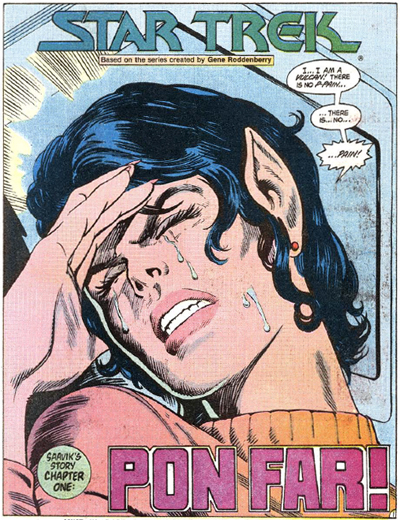
Margaret Wander Bonanno does an excellent job exploring Saavik’s life in the wake of her decision to remain on Vulcan in The Voyage Home, with Unspoken Truth doing an excellent job playing with the character in the grand scheme of the shared Star Trek universe.

startrek-unspokentruth

Continue reading

Star Trek Special #1 (1994) – The Needs of the One (Review)

This August, to celebrate the upcoming release of Star Trek: Into Darkness on DVD and blu ray, we’re taking a look at the Star Trek movies featuring the original cast. Movie reviews are every Tuesday and Thursday.

We’ll be supplementing our coverage of the movies with tie-ins around (and related to) the films. We’ll be doing one of these every week day. This is one such article.

In many ways, the Star Trek movies feature more character development and exploration for the cast than the entire three seasons of the television show. Star Trek III: The Search for Spock and Star Trek IV: The Voyage Home are true ensemble pieces, but there’s also more of a sense that this is a family rather than a bunch of people who just hang out together. I’d argue that the cast of Star Trek: The Next Generation remain the tightest ensemble that the franchise has ever produced, but the first six movies portray the crew of the original Enterprise as a bunch of people who have been to hell and back together.

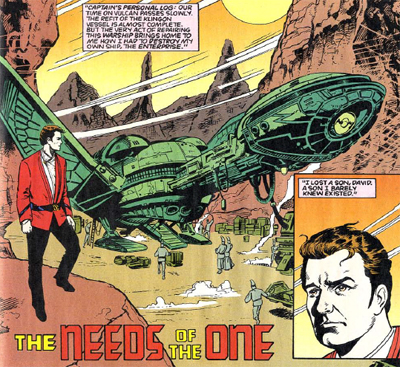
Michael Collins’ The Needs of the One represents a bit of an interlude between The Search for Spock and The Voyage Home, taking place during the crew’s three month “Vulcan exile.” While Collins’ script suffers from its inability to decide whether it’s a Spock-centric character drama or a day-in-the-life of the renegade crew, it’s a fascinating story situated in a lacuna of the movies’ chronology. It cements the idea that Spock has been radically altered over the course of the film series, and that his character arc spans the first four films.

Indeed, Collins’ opening sequence tying together his failure to achieve Kolinahr in Star Trek: The Motion Picture with his decision to once again rejoin the crew in The Voyage Home.

When all Kirk asked for was a tall ship, he probably should have been more specific...

When all Kirk asked for was a tall ship, he probably should have been more specific…

Continue reading

Star Trek (DC Comics, 1984) #28 – The Last Word (Review)

This August, to celebrate the upcoming release of Star Trek: Into Darkness on DVD and blu ray, we’re taking a look at the Star Trek movies featuring the original cast. Movie reviews are every Tuesday and Thursday.

We’ll be supplementing our coverage of the movies with tie-ins around (and related to) the films. We’ll be doing one of these every week day. This is one such article.

Star Trek II: The Wrath of Khan, Star Trek III: The Search for Spock and Star Trek IV: The Voyage Home form a trilogy that tells a single story, covering Spock’s death and resurrection, the loss of the Enterprise and the construction of its replacement and Kirk’s journey from washed-up old commander to saviour of the planet Earth. Although the three films weren’t planned as a single story, they worked out surprisingly well as a Star Trek epic told across three films and four years.

Four years is a remarkable turn-around for three franchise films, let alone three well-received franchise films. However, it’s worth conceding that the storyline had a fairly significant impact on the tie-in media. Books could be published set in the existing gaps in chronology, but DC’s plan for their first volume of Star Trek comics was to feature stories set in the contemporary film universe. Since that universe was in the middle of its own story, and the comic publishers had no idea how it would play out, the results are interesting.

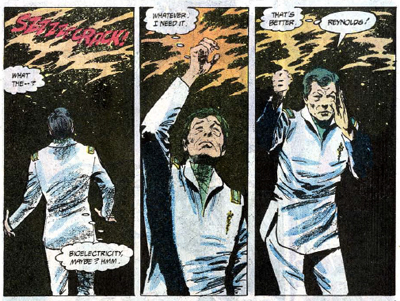
Lighten up...

Lighten up…

Continue reading

Star Trek: Myriad Universes – Echoes and Refractions: The Chimes at Midnight by Geoff Trowbridge (Review)

This August, to celebrate the upcoming release of Star Trek: Into Darkness on DVD and blu ray, we’re taking a look at the Star Trek movies featuring the original cast. Movie reviews are every Tuesday and Thursday.

We’ll be supplementing our coverage of the movies with tie-ins around (and related to) the films. We’ll be doing one of these every week day. This is one such article.

The death of Spock at the climax of Star Trek II: The Wrath of Khan is one of the definitive Star Trek moments. Pop culture has assimilated the moment, to the point where any half-decent nerd will identify “the needs of the many…” or “I have been and always shall be…” or maybe even “of all the souls I encountered…” It’s an absolutely massive moment for the franchise, where the film series dared to kill off the show’s most iconic and best-loved character.

It’s no wonder that the moment is such a strong focal point for those seeking to explore Star Trek. Star Trek: Into Darkness riffs mercilessly on that iconic scene, inverting it and counting on the iconography to generate enough emotional resonance for the film to get away with a fairly half-hearted homage. (The effects of The Wrath of Khan last until Star Trek III: The Search for Spock, while the consequences of the climax of Into Darkness don’t even last until the closing credits.)

So that famous sequence serves as an effective focal point of Geoff Trowbridge’s The Chimes at Midnight, which offers a parallel continuity of the Star Trek films in a universe where Spock died after the events of Yesteryear.

st-myriaduniverses

Continue reading

Non-Review Review: Star Trek III – The Search for Spock

This August, to celebrate the upcoming release of Star Trek: Into Darkness on DVD and blu ray, we’re taking a look at the Star Trek movies featuring the original cast. Movie reviews are every Tuesday and Thursday.

I have a soft spot for Star Trek III: The Search for Spock. It’s a weird thing to admit, but it was really my first encounter with the crew of the original Star Trek television show. I was only eight or nine at the time, and I’d grown up watching and loving Star Trek: The Next Generation. Of course, this was in an era before DVD and blu ray made it feasible (and affordable) to collect the whole thing. So I branched out by trying the movies.

Being a young child in the era before the internet, I didn’t know that the second through fourth films formed a loose thematic trilogy. I just picked the film with the title that jumped out at me. Since “Spock” was an iconic part of Star Trek, and I knew him from his guest appearance on The Next Generation, The Search for Spock seemed the logical choice.

And it retains a special place in my heart.

"I have been, and always shall be, your friend..."

“I have been, and always shall be, your friend…”

Continue reading

Star Trek – The Pandora Principle by Carolyn Clowes (Review)

This August, to celebrate the upcoming release of Star Trek: Into Darkness on DVD and blu ray, we’re taking a look at the Star Trek movies featuring the original cast. Movie reviews are every Tuesday and Thursday.

We’ll be supplementing our coverage of the movies with tie-ins around (and related to) the films. We’ll be doing one of these every week day. This is one such article.

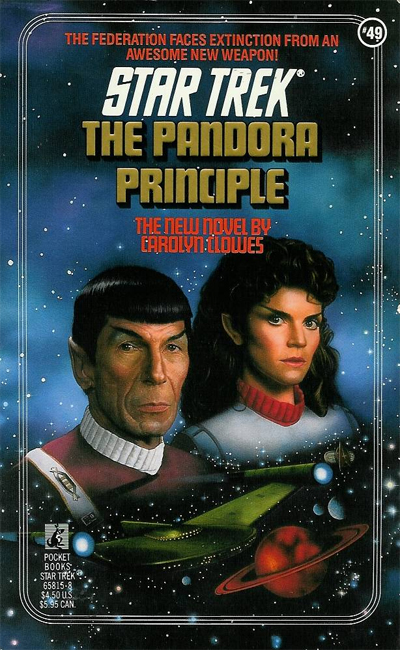
It’s amazing to think how much tie-in material the character of Saavik has generated, considering that she only appeared in three Star Trek films. There are regular characters who have never attracted the same degree of attention as Saavik. There’s probably a reason for this. After all, Saavik was introduced as an important character in Star Trek II: The Wrath of Khan. There’s even some speculation that she might have been originally intended as a replacement for Spock, had Leonard Nimoy decided not to return to the franchise. As such, she was introduced as a surprisingly developed character with a background rife with storytelling potential.

It’s a bit of a disappointment, then, that she was first re-cast as Robin Curtis in Star Trek III: The Search for Spock and then she was quietly shuffled off-stage at the start of Star Trek IV: The Voyage Home, never to be seen again. Perhaps that squandered potential is at the root of the fascination with Saavik. The Pandora Principle, the only Star Trek novel from author Carolyn Clowes, offers us an origin and a history for the character, building off hints and character attributes that were never even mentioned on-screen.

startrek-thepandoraprinciple

Continue reading

Star Trek (DC Comics, 1984) #7-8 – Saavik’s Story (Review)

This August, to celebrate the upcoming release of Star Trek: Into Darkness on DVD and blu ray, we’re taking a look at the Star Trek movies featuring the original cast. Movie reviews are every Tuesday and Thursday.

We’ll be supplementing our coverage of the movies with tie-ins around (and related to) the films. We’ll be doing one of these every week day. This is one such article.

Star Trek comics are an interesting way of catching a glimpse at the franchise one-step away from the heart of production. While there are other forms of tie-in media, comics are produced on a monthly schedule. While scripts need to be written and art needs to be drawn, there’s less lead-in time required, meaning that contemporary Star Trek comics are often able to react dynamically to on-screen events. While novels might take up to a year from original pitch to the time they hit the stands, there’s something rather more urgent about tie-in comic books.

This is an issue for many tie-ins comics. For example, the syndicated Star Trek newspaper strip launched shortly before the release of Star Trek: The Motion Picture made a point to feature Ilia as a bridge officer on a relaunched USS Enterprise. She rather suddenly disappeared after those involved actually saw the movie and realised that she didn’t quite survive the adventure. Similarly, when it came to detailing the adventures of Kirk and company in the wake of Star Trek III: The Search for Spock, writer Mike W. Barr moved the crew over to the USS Excelsior, in accordance with writer Harve Bennett’s original plan.

That said, Mike W. Barr’s comic book origin story for Lt. Saavik holds up rather well, fitting quite comfortably with Carolyn Clowes’ origin for the character offered in the superb 1990 book The Pandora Principle. Of course, Barr’s origin sketches the broadest of outlines, and is clearly more preoccupied with crafting a pulpy space opera adventure.

Saving Saavik!

Saving Saavik!

Continue reading

Star Trek – Crucible: Spock – The Fire and the Rose by David R. George III (Review)

This August, to celebrate the upcoming release of Star Trek: Into Darkness on DVD and blu ray, we’re taking a look at the Star Trek movies featuring the original cast. Movie reviews are every Tuesday and Thursday.

We’ll be supplementing our coverage of the movies with tie-ins around (and related to) the films. We’ll be doing one of these every week day. This is one such article.

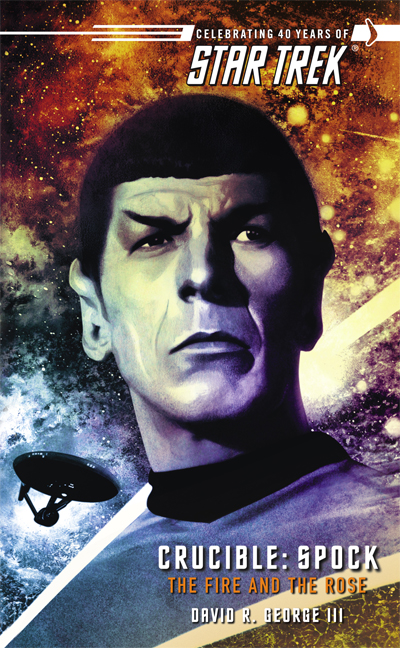
The second part of David R. George II’s epic Crucible trilogy, The Fire and the Rose, can’t quite measure up to the charm and warmth of the first instalment in the series, Provenance of Shadows. George’s Crucible trilogy is a breathtakingly ambitious piece of work. Celebrating the fortieth anniversary of Star Trek with a trilogy of novels, each grounded in The City on the Edge of Forever and each based around a different member of the show’s leading trinity. The Fire and the Rose is still a very smart and well-constructed read, but it stands in the shadow of the first of George’s three books.

I suspect that at least part of the reason The Fire and the Rose doesn’t work as well is down to the subject. Leonard McCoy is a vitally important Star Trek character, but he was also a relatively under-developed one. While he was one of the leading trio on the original show, he was never as popular as Kirk and Spock, and never garnered the same amount of attention. (Notwithstanding solid work done by writers like Diane a Duane.) So McCoy was a relatively blank canvas for George to develop.

In contrast, Spock is the face of Star Trek. He was part of the first episode of Star Trek ever produced. He appeared in the most recent film released. Although DeForest Kelley christened Star Trek: The Next Generation with a cameo in Encounter at Farpoint, Leonard Nimoy’s visit to the spin-off earned a full two-parter in Unification. As such, Spock is a character who has been developed and explored and expanded by countless writers over the franchise’s long history.

Quite frankly, it’s hard to imagine there’s too much left to say about him. George tries quite hard, and find a nuance or two, but The Fire and the Rose feels more like an attempt to consolidate what we already know of Spock.

cruciblespock

Continue reading

Non-Review Review: Star Trek – The Motion Picture

This August, to celebrate the upcoming release of Star Trek: Into Darkness on DVD and blu ray, we’re taking a look at the Star Trek movies featuring the original cast. Movie reviews are every Tuesday and Thursday.

Star Trek: The Motion Picture has a lot to recommend it. It’s big, thoughtful science-fiction, ripe with ideas and high-concepts tying directly into the root of the franchise. It gives both Kirk and Spock clear character arcs. It looks and sounds amazing, demonstrating just how far special effects had evolved in the decade since the show went off the air. However, it suffers from a pace that might best be described as “glacial”, and a sense that – for all the grand ideas – we aren’t really boldly going anywhere that new. Elements of the film can’t help but recall both the 1968 science-fiction classic 2001: A Space Odyssey and even the show’s own episode The Changeling.

While it’s easy to admire The Motion Picture, it’s a lot harder to enjoy it.

Strange new worlds...

Strange new worlds…

Continue reading

Star Trek – The Final Reflection by John M. Ford (Review)

To celebrate the release of Star Trek: Into Darkness this month, we’ll be running through the first season of the classic Star Trek all this month. Check back daily to get ready to boldly go. It’s only logical.

We’ll be supplementing our coverage of the episodes with some additional materials – mainly novels and comics and films. This is one such entry.

The Final Reflection was written in 1984. Development on Star Trek: The Next Generation would only be announced in 1986. Sure, there were a bunch of successful movies being produced, but these only amounted to a couple of hours of Star Trek once every few years. And, even then, the movies were aimed at a much broader audience, without the same development and continuity that a television show could offer. Not that Star Trek ever really had that tight a sense of continuity, of course, but it must have seemed unlikely that things could ever go back to the way they had been. Certainly, in 1984, nobody could have anticipated the eighteen-straight years of Star Trek running from Encounter at Farpoint to These Are the Voyages.

As a result, fans had to look to other avenues to expand and develop the rich Star Trek universe. The novels were one such avenue, although they developed slowly. Mission to Horatius had been published while the show was on the air, but it was very clearly aimed at a younger audience. Spock Must Die! would be published in 1970. However, the spin-off fiction developed relatively slowly. Star Trek had yet to become a massive franchise with tie-in multimedia commercial opportunities.

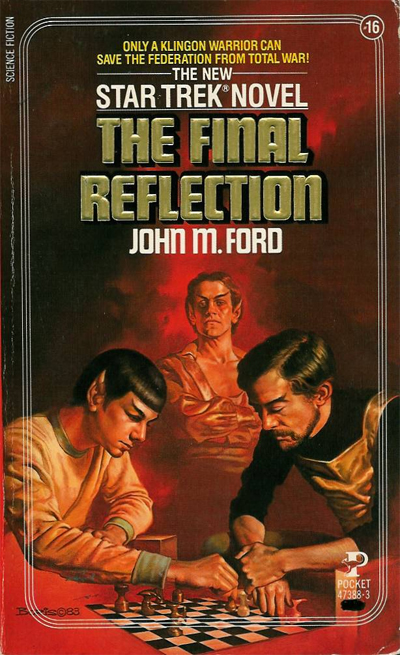
Perhaps because the Star Trek novels had not quite turned into a massive franchising opportunity, and they weren’t under the same level of publicity or scrutiny that they would be in the years to come, writer John M. Ford was able to do something quietly revolutionary with his first Star Trek novel, The Final Reflection. He was able to venture away from our core cast of iconic characters and instead develop the Klingon Empire.

More than that, though, he was able to paint the Klingons as the good guys.

tos-thefinalreflection5

Continue reading