• Following Us

  • Categories

  • Check out the Archives


  • Awards & Nominations

Star Trek: Deep Space Nine – Cardassians (Review)

Star Trek: Deep Space Nine is twenty years old this year. To celebrate, I’m taking a look at the first and second seasons. Check back daily for the latest review or retrospective.

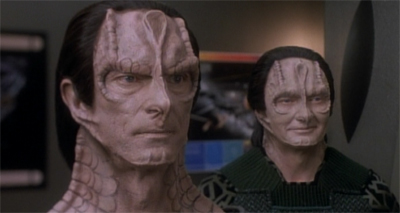
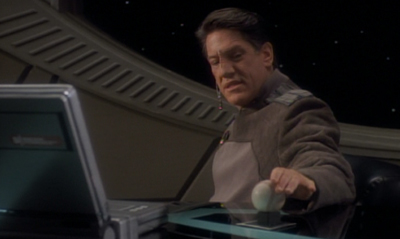
Cardassians suffers a bit from the same problems that haunt Invasive Procedures. Here’s another solidly constructed piece of world-building featuring a wonderful guest cast and an intriguing high concept. However, in the midst of all this, it seems like the human (er, Cardassian) element gets a bit lost. It’s great to have Garak and Dukat back on the show, and it’s great to deal with more fallout from the Occupation, but Cardassians never makes the emotional connection that a story about war orphans probably should.

Keeping up with the Cardassians...

Keeping up with the Cardassians…

Continue reading

Star Trek – Worlds of Deep Space Nine: Unjoined (Trill) by Michael A. Martin and Andy Mangels (Review)

Star Trek: Deep Space Nine is twenty years old this year. To celebrate, I’m taking a look at the first and second seasons. Check back daily for the latest review or retrospective.

We’ll be supplementing our coverage of the episodes with some additional materials – mainly novels and comics and films. This is one such entry.

Worlds of Deep Space Nine was an ambitious project, but one that existed as a testament to the world-building that defined Star Trek: Deep Space Nine. A series of six novellas published in three books, each covering one of five planets associated with the television show (plus Andor), the book series was intended to launch the unofficial “ninth season” of the show. Beginning unofficially with The Lives of Dax and A Stitch in Time, the idea was for the spin-off novels to continue to develop and expand the series’ loose threads.

It’s quite something that Deep Space Nine left enough fertile ground to support a relaunch that ran so long, covering story beats that couldn’t necessarily be included in the television show – Bajor’s admittance to the Federation, the rebuilding of Cardassia, the aftermath of the war. Unjoined builds off the Trill storylines running through Deep Space Nine, using the events from the “eighth season” (the books through Unity) as a stepping stone to explore Trill culture.

ds9-unjoined

Continue reading

Star Trek: Deep Space Nine – Invasive Procedures (Review)

Star Trek: Deep Space Nine is twenty years old this year. To celebrate, I’m taking a look at the first and second seasons. Check back daily for the latest review or retrospective.

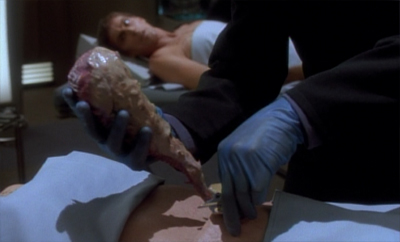
Invasive Procedures is an interesting episode. It has a great high concept, some nice character beats, and offers an inside glimpse at an astonishingly interesting alien culture. Verad is a compelling guest character and Sisko gets to be pretty badass, continuing the presentation of the character as some weird composite of James T. Kirk and Jean-Luc Picard.

There are however, a number of very sizeable flaws. The most obvious being that – despite this is nominally a “Dax” story – Dax winds up feeling more like a plot point than a character in her own right.

Slugging it out...

Slugging it out…

Continue reading

Star Trek: Deep Space Nine – The Lives of Dax: Reflections (Jadzia) by L.A. Graf

Star Trek: Deep Space Nine is twenty years old this year. To celebrate, I’m taking a look at the first and second seasons. Check back daily for the latest review or retrospective.

We’ll be supplementing our coverage of the episodes with some additional materials – mainly novels and comics and films. This is one such entry.

The Trill are an absolutely fascinating species, arguably much more so on Star Trek: Deep Space Nine than they were on Star Trek: The Next Generation. They were introduced in The Host as a race that was relatively straightforward – a bunch of symbionts living inside humanoid bodies. There was no indication that the host was anything but a blank slate for the organism inside to overwrite and control.

On Deep Space Nine, they became much more complex. The show’s first Trill-centric episode, Dax, pondered if it was possible to divorce the actions of the host from those of the symbiont, or vice versa. Though the episode in question wimped on giving a definitive answer one way or the other, the implication is that each Trill is a fusion of host and symbiont, rather than one dominating the other. Because of that, it seemed like the show always had trouble defining Jadzia (the character on the show) relative to Dax (the sum of lifetimes of experience).

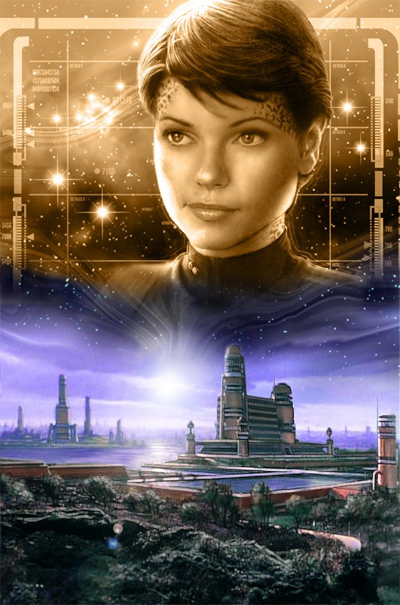
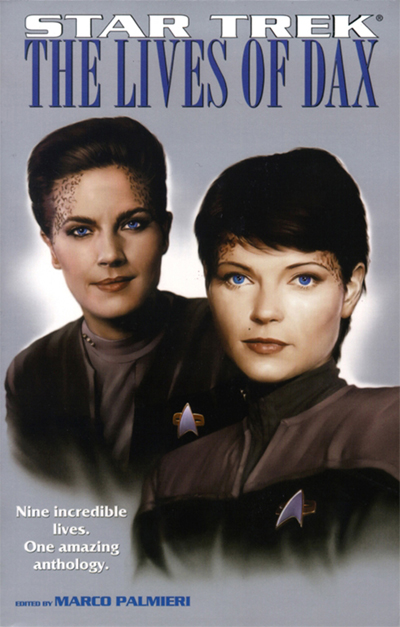
As such, it’s hard not to pity veteran writers Julia Ecklar and Karen Rose Cercone (writing as “L.A. Graf”) for drawing the short straw and winding up writing the story from the anthology The Lives of Dax focusing on Jadzia.

ds9-thelivesofdax1

Continue reading

Star Trek: Deep Space Nine – The Siege (Review)

Star Trek: Deep Space Nine is twenty years old this year. To celebrate, I’m taking a look at the first and second seasons. Check back daily for the latest review or retrospective.

The Siege wraps up the first ever three-part episode of Star Trek in a surprisingly efficient manner. There are a few missteps, a lack of nuance and an over abundance of convenience and simplicity. However, it succeeds in doing what this opening three-parter set out to do. It tells a single story which could only ever have been told on Star Trek: Deep Space Nine. It gives a sense of scale to the show which is unique to the series, and it creates a palpable sense of uncertainty about the Federation’s mission to Bajor.

"He's letting me know, he'll be back..."

“He’s letting me know, he’ll be back…”

Continue reading

Star Trek: Myriad Universes – Echoes and Refractions: A Gutted World by Keith R. A. DeCandido (Review)

Star Trek: Deep Space Nine is twenty years old this year. To celebrate, I’m taking a look at the first and second seasons. Check back daily for the latest review or retrospective.

We’ll be supplementing our coverage of the episodes with some additional materials – mainly novels and comics and films. This is one such entry.

“What if” stories are inherently fascinating. Naturally, they are predicated on investment in the original story, but it’s always fascinating to imagine the branching possibilities, the ripples in the stream. Sometimes, these are used to explore the grand philosophical questions of Star Trek in a new light; to imagine how, were you to change one variable in a complex formula, the answer might be radically different.

However, Keith R. A. DeCandido’s A Gutted World feels different. It is a massive story, spanning a huge amount of time and space, drawing in a massive ensemble cast and gently probing the politics of five or six different Star Trek culture, as DeCandido explores what might have happened if the Cardassians never withdrew from Bajor, if Terok Nor never became Deep Space Nine.

To put it more succinctly, if the show never happened, but its central storyline still did.

st-myriaduniverses

Continue reading

Star Trek: Deep Space Nine – The Circle (Review)

Star Trek: Deep Space Nine is twenty years old this year. To celebrate, I’m taking a look at the first and second seasons. Check back daily for the latest review or retrospective.

Drama naturally lends itself to a neat three-act structure. At the most basic level, it’s as simple as beginning, middle and end. However, it’s also a format taught in just about every screenwriting course, and it’s even used as the conventional model for those with more innovative approaches. With that in mind, it’s interest that Star Trek has done relatively few three-part stories. The Circle sits in the middle of the first such attempt, in the second season of the second spin-off. The format would not see use again for over a decade, when it would become a feature of the final season of Star Trek to air on television.

Given the franchise is relatively fond of two-parters, it seems strange that there haven’t been more attempts to extend that out an episode. Perhaps the reason is obvious. Of the three acts, the beginning and the end are the most essential. Both come with a certain in-built amount of energy. The first part introduces the problem, while the conclusion deals with it. However, it’s the middle which proves problematic. It’s the point in the story after you’ve set up the conflict, but before you resolve it. Given how much difficulty Star Trek: The Next Generation had with conclusions, imagine how difficult the second part of a three-parter would be.

Even when Star Trek: Enterprise adopted the three-parter format it ran into basic structural difficulties, with a couple feeling like a two-part episode with an additional prologue or epilogue added on. The Circle isn’t a terribly flawed piece of television, but it suffers from the fact that Star Trek has never really tried storytelling in this mode before.

The writing's on the wall...

The writing’s on the wall…

Continue reading

Star Trek: Deep Space Nine – The Homecoming (Review)

Star Trek: Deep Space Nine is twenty years old this year. To celebrate, I’m taking a look at the first and second seasons. Check back daily for the latest review or retrospective.

The Homecoming is notable for a number of reasons. It kicks off the franchise’s first three parter. Sure, Family provided a nice epilogue to The Best of the Both Worlds, but The Homecoming, The Circle and The Siege represents the first explicit three-part story in the history of the franchise. Star Trek: Enterprise would develop a fondness for the format in its final season and one of those three-parters (The Forge, The Awakening and Kir’Shara) would owe a conscious debt to this opening trilogy.

It also pretty much sets the tone of season premieres on Star Trek: Deep Space Nine. Star Trek: The Next Generation and Star Trek: Voyager would both display a fondness for bridging their seasons with two-part adventures. The opening episode would air as a season finalé, with the resolution airing as the opening episode of the following season. Deep Space Nine was not so literal minded. While each season premiere was informed by the themes and events of the last season’s closing episode, Deep Space Nine tended to favour opening with multi-part episodes rather than conclusions to narrative hooks.

Rather than wrapping up the threads hinted at in In the Hands of the Prophets, The Homecoming only builds on them. It suggests that the problems and the difficulties facing Bajor won’t magically disappear because ninety minutes of screen time have elapsed.

Dynamic Kira action pose!

Dynamic Kira action pose!

Continue reading

Star Trek: Deep Space Nine – Season 1 (Review)

Star Trek: Deep Space Nine is twenty years old this year. To celebrate, I’m taking a look at the first season. Check back daily for the latest review or retrospective.

Well, that was actually pretty satisfying. Star Trek: Deep Space Nine has probably the most satisfying debut season of any of the Star Trek spin-offs. While the show’s first year can’t quite measure up to the very first season of Star Trek ever produced, it can hold its head high among the spin-offs. Although I will concede that the bar isn’t exactly high when it comes to measuring the first year of the tie-in television shows.

When I began a recent re-watch of Star Trek: The Next Generation, I was glad to finish the show’s rocky first season. It was a slog, like the work one has to put in before delving into “the good stuff.” I recently picked up the blu ray of the first season of Star Trek: Enterprise. While there are a couple of nice episodes, there are quite  a few I’d forgotten entirely because they were so bland. There are more I would like to forget. Star Trek: Voyager‘s first season is the single largest missed opportunity in the history of the franchise.

So Deep Space Nine‘s first year doesn’t have to do that much beyond “not sucking” in order to earn the coveted title of “best pilot season of a Star Trek spin-off.” However, as I watched the season, I was continually impressed with the quality of work done. There are a few duds (and a few classics), but the first year demonstrates remarkable insight into what is unique about the show’s premise. It doesn’t always have the courage to follow through on that promise, but it at least acknowledges it.

ds9-season1a

Continue reading

Star Trek: Deep Space Nine – In the Hands of the Prophets (Review)

Star Trek: Deep Space Nine is twenty years old this year. To celebrate, I’m taking a look at the first season. Check back daily for the latest review or retrospective.

Both Star Trek and Star Trek: The Next Generation allowed their first seasons to run an episode too long. The City on the Edge of Forever, the penultimate episode of the first ever season of Star Trek, is a genuine classic. I don’t envy any story that has to follow it, especially not something as mediocre as Operation — Annihilate! While Conspiracy, the second-to-last episode of the first season of The Next Generation, is hardly a classic in the same league, it does up the stakes on the show’s first year, and tie up a dangling plot thread. The Neutral Zone, on the other hand, is a bland return to form, with a particularly insufferable b-plot.

So the excellence of Duet might offer the viewer cause to worry. A penultimate first-season episode which is significantly above average? One would be forgiven for wondering if the first season might have been best served to wrap itself up at that point, going out in a high, safe in the knowledge that it had contributed one classic episode to the Star Trek mythos and with the potential to offer quite a few more. Quit while you’re winning, and don’t tempt fate with another superfluous episode.

In the Hands of the Prophets, however, puts those fears to rest. Serving as a companion piece to Duet, it’s another one of those “only on Deep Space Nine stories, closing out the first season with a reminder of what makes the show unique. In the Hands of the Prophets is another classic piece of Deep Space Nine. It might not pack quite the punch that Duet did, but it’s a compelling piece of drama which demonstrates just how much Deep Space Nine has to offer the Star Trek mythos.

Beyond belief...

Beyond belief…

Continue reading