• Following Us

  • Categories

  • Check out the Archives


  • Awards & Nominations

The X-Files: Season One (Topps) #6 – Space (Review)

This May and June, we’re taking a trip back in time to review the fifth season of The X-Files and the second season of Millennium.

If the jump to Ice suggested that the Season One line would only be covering the “highlights” of the first season of The X-Files, then the decision to immediately follow with an adaptation of Space puts paid to that theory.

Ice is generally regarded as one of the strongest stories of the first season. It is moody and atmospheric, tense and claustrophobic. It shines a light on the characterisation of Mulder and Scully, while also offering a particularly memorable (and unsettling) monster of the week. In contrast, Space is generally regarded as one of the weakest stories of the first season. It is clumsy and muddled, slow and dreary. The episode’s direction is bland and the special effects are woeful. On paper, it is probably the least likely choice for a Season One adaptation.

Face the future...

Face the future…

However, Space ultimately lends itself to a comic book adaptation. The story finds itself well-suited by the transition from live action footage to comic book page. there are a number of different reasons for this, but the truth is that the story is simply better suited to this format. That applies to the technical limitations imposed on film, but also to the storytelling conventions associated with comic books as opposed to live action television. It is a startling result, and arguably the biggest success of the entire Season One line.

Although it is a qualified accomplishment at best, Space is the first Season One comic that manages to surpass its source material.

Is there life on Mars?

Is there life on Mars?

Continue reading

Space: Above and Beyond (Review)

This November (and a little of December), we’re taking a trip back in time to review the third season of The X-Files and the first (and only) season of Space: Above and Beyond.

It is very hard to judge a series based on the first season alone. After all, many long-running series evolve quickly and radically from their debut year. In many cases, the first season is about desperately trying to find a footing as everybody gets used to the realities of producing a television show. Assessing a first season is often an exercising in gauging potential, which makes it a risky proposition when trying to evaluate the first and only season of a cancelled television show.

Space: Above and Beyond contains its fair share of clunkers, as does any first season with twenty-odd episodes. There are episodes that seem at odds with the premise and mood of the show, being written by staff writers before the show went to air or simply trying to do something with which the show isn’t comfortable. There are episodes that have interesting ideas, but don’t place emphasis on the show’s strengths.

spaceaboveandbeyond-pilot32

However, this is all but expected for a first season. A first season is a learning experience for all involved. After all, the first season of The X-Files was packed with episodes like Shadows, Fire, Lazarus, Young at Heart and Born Again. It is very rare for the first season of any show – particularly a genre show – to be the strongest. There are rules to be learned, beats to be established, foundations to be laid. If shows are lucky, that work gets to pay off in later seasons, as everybody gets more comfortable.

Space: Above and Beyond never got that chance, which is a shame. Because there is a phenomenal amount of potential on display here.

spaceaboveandbeyond-thefarthestmanfromhome24

Continue reading

Space: Above and Beyond – And If They Lay Us Down to Rest… (Review)

This November (and a little of December), we’re taking a trip back in time to review the third season of The X-Files and the first (and only) season of Space: Above and Beyond.

The last stretch of episodes of Space: Above and Beyond are quite mournful and introspective.

It is very difficult to tell a war story. There are a host of tightropes that any writer has to navigate. After all, it is very easy for a story about the bonds of warfare and humanity in wartime to be interpreted as militaristic or fascistic. At the same time, it is very easy for an anti-war parable to seem critical of the soldiers fighting the war, to dismiss the bravery and courage on display in that most horrific of environments.

Seeing eye-to-eye...

Seeing eye-to-eye…

With its futuristic tech and gigantic guns, as well as its fascination with the military apparatus, it is easy to read Space: Above and Beyond as a pro-military piece. Given how much pride it takes in the way that it presents military life, or how much it wallows in the military setting, a casual viewer might be forgiven for assuming the it glorifies warfare. However, this is the most superficial of readings. It ignores a lot of what the show actually has to say about combat and warfare.

Space: Above and Beyond is by turns cynical and romantic in its portrayal of this futuristic conflict – it clearly respects and appreciates the sacrifices made by those in service of mankind, but is also wary about the motivations of those ordering the sacrifices. It is a very delicate balance to maintain. However, And If They Lay Us Down to Rest… and … Tell Our Moms We Done Our Best seem to lay the cards out on the table, once and for all. This is as anti-war as the show ever gets.

Face of the enemy...

Face of the enemy…

Continue reading

Space: Above and Beyond – Sugar Dirt (Review)

This November (and a little of December), we’re taking a trip back in time to review the third season of The X-Files and the first (and only) season of Space: Above and Beyond.

The end is nigh.

There is a generally funereal atmosphere to the last few episodes of Space: Above and Beyond, creating the sense that the show was well aware of – and had perhaps come to terms with – its own inevitable cancellation. Stardust had assured viewers (and the show itself) that the dead can be heroes too. Sugar Dirt seems a lot angrier about the series’ situation. It is the story of our heroes surrounded and outgunned on all sides; abandoned to their fate by those in authority.

Sadly, McQueen couldn't quite save the show...

Sadly, McQueen couldn’t quite save the show…

Continue reading

Space: Above and Beyond – Stardust (Review)

This November (and a little of December), we’re taking a trip back in time to review the third season of The X-Files and the first (and only) season of Space: Above and Beyond.

Stardust was the second episode of Space: Above and Beyond to air on a Friday, as had originally been planned.

Of course, it was too late to help the show. By this point in its run, Space: Above and Beyond was a dead show walking. Stardust seems to wryly acknowledge as much. It opens with an inmate on death row, watching the clock tick down to midnight. The show is essentially about sacrifices made by the already-dead, and it’s hard not to get a sense that it captured the mood of the staff on the show as well. A wry wink at the audience, like all the introspective reflection in the earlier episodes.

Cold wars...

Cold wars…

It is also interesting how Stardust positions itself as a possible companion piece to The X-Files. The X-Files casts a pretty significant shadow over Space: Above and Beyond. It was very much an attempt by Fox to capitalise on the success of The X-Files as a genre show. It drafted in two of the most reliable executive producers working on The X-Files. The first two episodes were directed by a veteran of The X-Files. David Duchovny had popped by R & R as something of a goodwill ambassador.

Space: Above and Beyond had played with these comparisons before. The Farthest Man From Home had teased a conspiracy narrative about alien and government cover-ups. Level of Necessity featured a riff on Mulder, with a tall dark-haired paranormal investigator wandering into the show. Stardust makes the connection more explicit, riffing on some of the themes that The X-Files had pushed to the fore at the end of its second season and into the third, exploring links between Native Americans and extraterrestrials.

The honoured dead...

The honoured dead…

Continue reading

Space: Above and Beyond – Pearly (Review)

This November (and a little of December), we’re taking a trip back in time to review the third season of The X-Files and the first (and only) season of Space: Above and Beyond.

Richard Whitley is one of the more promising writers on Space: Above and Beyond.

While Pearly does not benefit (and indeed actively suffers) from the same loose structure that made Dear Earth work so well, it is an episode very much in touch with what the show wants to be about. It is very much a science-fiction version of a classic Second World War story, to the point where Whitley himself has described it as an adaptation of the classic Humphrey Bogart movie Sahara. It is a nice glimpse at several facets of the conflict that we have not seen yet, but which make sense in context.

Canned ham...

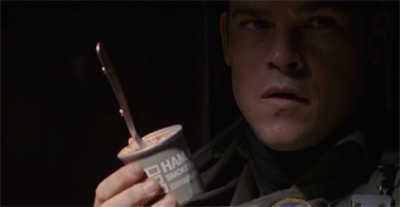
Canned ham…

That said, there are serious problems with Pearly. It is very clear that the production managed to get ahold of a tank for filming, and sought to capitalise on that. The episode’s structure feels rather forced and unstructured in places, full of contrived coincidences that seem a little strange when considered as a whole. Not all of the character interactions feel genuine, and not all the episode’s big moments feel entirely earned. These are legitimate problems, and they do hold Pearl back.

At the same time, Pearly is an episode simmering with potential and ambition. It is hard to hate.

Crossed wires...

Crossed wires…

Continue reading

Space: Above and Beyond – The Angriest Angel (Review)

This November (and a little of December), we’re taking a trip back in time to review the third season of The X-Files and the first (and only) season of Space: Above and Beyond.

Existentialism is something of a recurring theme in the work of Glen Morgan and James Wong.

It echoes through their work. Mulder’s choice of action ultimately serves to define him in One Breath, in contrast to the other more senior male characters in the narrative. The duo’s second script for Millennium, 5-2-6-6-6, opens with a quote from existentialist philosopher Jean Paul Sartre. Even the pair’s feature film work – The One and the Final Destination films – touch broadly on existentialist themes.

Pressed (up) on the issue...

Pressed (up) on the issue…

However, The Angriest Angel is perhaps the most candid of their scripts, with McQueen explicitly explaining how his actions are serving to define his identity. In his power-house opening monologue, McQueen describes these defining moments as make-or-break points. “Everyone, everyone in this life knows when the moment is before them. To turn away is simple. To ignore it assures survival. But it is an insult to life. Because there can be no redemption.”

This is perhaps the most elegant and effective summary of Morgan and Wong’s approach to character development. McQueen articulates it clearer than any of their characters, but the philosophy applies just as much to Scully in Beyond the Sea or Never Again as it does to Tyrius Cassius McQueen. Indeed, it would come to define their work on Millennium, with the second season repeatedly suggesting that the end of the world was as much a personal event as a massive social occurrence.

Slice of life...

Slice of life…

Continue reading

Space: Above and Beyond – Never No More (Review)

This November (and a little of December), we’re taking a trip back in time to review the third season of The X-Files and the first (and only) season of Space: Above and Beyond.

On the surface, Never No More and The Angriest Angel feel like a companion piece to Hostile Visit and Choice or Chance. Both are two-part episodes airing around sweeps, almost in step with the equivalent two-part episodes of The X-Files. Both push the show’s story arcs forward. Both also draw in recurring guest stars Doug Hutchinson and Michael Mantell, last seen during Choice or Chance. In many respects, Never No More and The Angriest Angel could be seen as a follow-up to that earlier two-part adventure.

However, there are a number of subtle differences that help Never No More and The Angriest Angel feel like a series highpoint – rather than another ambitious misfire. Hostile Visit and Choice or Chance seemed like episodes trying to do too much, and straying into areas where Space: Above and Beyond had always faced difficulty. They were high-concept science-fiction epic adventures that also tried to work in character arcs for the entire ensemble, set against a truly epic story about an ambitious suicide mission and subsequent rescue attempt.

It's only a paper moon...

It’s only a paper moon…

In a way, Never No More and The Angriest Angel are a lot more modest in their scope. There are big revelations here, and plot points that push the show’s arc forwards. However, these elements are not foregrounded. Never No More and The Angriest Angel are not episodes that aspire to be all things to all people. Instead, they are two character studies centred on the two strongest characters (and actors) in the cast, filling in other details as a secondary concern.

Space: Above and Beyond always worked better as a war show than as a science-fiction drama, and Never No More and The Angriest Angel seem to realise this. The two episodes play as an extended homage to the tropes and conventions of classic war stories. Never No More is the story of love divided by conflict, and The Angriest Angel is a tale of personal discovery set against the backdrop of a larger war. They combine to produce a highlight of the entire Space: Above and Beyond run.

Not a patch on his original squadron...

Not a patch on his original squadron…

Continue reading

Space: Above and Beyond – Level of Necessity (Review)

This November (and a little of December), we’re taking a trip back in time to review the third season of The X-Files and the first (and only) season of Space: Above and Beyond.

Coming hot on the heels of Who Monitors the Birds?, Level of Necessity was almost destined to be a little disappointing. Who Monitors the Birds? is perhaps the quintessential episode of Space: Above and Beyond, encapsulating the show’s core themes and utilising its world in a clever and constructive manner. In contrast, Level of Necessity seems almost rote. It is an episode that might have been written for any other nineties science-fiction show.

There are some nice ideas here, but Level of Necessity feels far too generic. In fact, it seems like the episode is centred around Damphousse not because the story makes any more sense for her than it does for any other character, but because she is the only character who has yet to occupy the centre of a story. Thomas J. Wright directs quite well, and Richard Kind makes for a solid guest star. However, Level of Necessity suffers from the fact that it could be an episode of any other show.

Stars in his eyes...

Stars in his eyes…

Continue reading

Space: Above and Beyond – Who Monitors the Birds? (Review)

This November (and a little of December), we’re taking a trip back in time to review the third season of The X-Files and the first (and only) season of Space: Above and Beyond.

Who Monitors the Birds? is a phenomenal piece of television.

Space: Above and Beyond is a show that only ran one season, languishing on Sunday nights before Fox decided to just scrap the idea of consistently scheduling it and just bounced it around the network timetable. It was not a breakout hit. It did not inspire a revival or resurrection in the way that other science-fiction properties have done. It has a very devoted and strong cult following, but its name is more likely to evoke a vague remembrance than anything more concrete.

spaceaboveandbeyond-whomonitorsthebirds13

And yet, despite that, Space: Above and Beyond was still a massively influential piece of television. Despite the fact that it was structured as a throwback to classic war movies, it was also a very progressive piece of television. The influence of Space: Above and Beyond can be keenly felt on Ronald D. Moore’s Battlestar Galactica, even though the show seldom gets any real credit for that influence. In some respects, Space: Above and Beyond was well ahead of its time.

Who Monitors the Birds? is put together with incredible skill and confidence. It is an episode that holds up fantastically, and which serves as a demonstration of the series’ lost potential.

spaceaboveandbeyond-whomonitorsthebirds3


Continue reading