• Following Us

  • Categories

  • Check out the Archives


  • Awards & Nominations

The X-Files – Memento Mori (Review)

This February and March, we’re taking a trip back in time to review the fourth season of The X-Files and the first season of Millennium.

It is easy to see why Scully’s cancer arc is so fondly remembered.

It arrived at a point where the show was at the very top of its game. Scully’s cancer arc comes amid a slew of beloved and classic episodes, in the middle of a season that contains Home, Unruhe, Paper Hearts and many more. It is the defining mythology plot point for the show’s fourth season, which was the point at which The X-Files just exploded into the centre of popular consciousness. More than that, the episode introducing Scully’s cancer – Leonard Betts – was the most-watched episode of The X-Files ever broadcast.
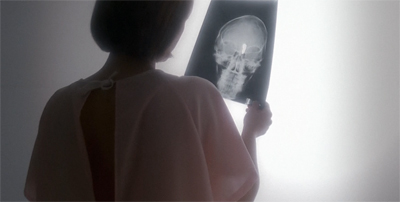
What's in your head?

What’s in your head?

Memento Mori has its own endearing aspects. If Leonard Betts was the show’s highest profile and most populist success, Memento Mori counts as one of the show’s biggest critical successes. The episode is largely responsible for winning Gillian Anderson her Primetime Emmy Award for Outstanding Lead Actress in a Drama Series. It also took home the Primetime Emmy Award for Outstanding Art Direction for a Series and received a nomination for Outstanding Writing for a Drama Series. It is perhaps the most prestigious episode of the fourth season.

However, in spite of all of that, Memento Mori remains something of a mess. It feels like a clumsy retread of One Breath, a story that worked much better in the show’s second season.

Send in the clones...

Send in the clones…

Continue reading

The X-Files – Pusher (Review)

This November (and a little of December), we’re taking a trip back in time to review the third season of The X-Files and the first (and only) season of Space: Above and Beyond.

Pusher is perhaps one of the most effective stand-alone “monster of the week” stories that the show ever did.

It is no wonder that the episode is frequently cited among the best episodes of The X-Files ever produced, but it is telling that it was identified by Slate as the perfect “gateway” episode of the show. If you want to give someone a taste of The X-Files without burdening them with continuity or back story, this is a good choice. It may not be the best episode that Vince Gilligan ever wrote, and it may not even be the best episode of the third season, but it is one the strongest demonstrations of what the show does on a weekly basis.

Mano a mano...

Mano a mano…

Pusher is the first episode that Vince Gilligan wrote after joining The X-Files writing staff. It is the only episode credited to Gilligan in the show’s third season. He had been offered a position on staff after turning in Soft Light at the end of the second season, but had hesitated before accepting the job. When he did accept the job, he came down with a dose of infectious mononucleosis. As a result, Gilligan only wrote one script for the third season, despite becoming one of the show’s most prolific writers.

Pusher is a pulpy delight, a spectacularly constructed standalone that perhaps points the way to Gilligan’s later work.

Gift of the gab...

Gift of the gab…

Continue reading

‘Ship Shape or Ex-Files? Mulder, Scully and Paranormal Romance

This November (and a little of December), we’re taking a trip back in time to review the third season of The X-Files and the first (and only) season of Space: Above and Beyond.

It is very hard to talk about The X-Files without talking about the relationship between Mulder and Scully.

This goes without saying. After all, David Duchovny was a regular for seven years of the show, making a few appearances across the final seasons. Gillian Anderson was in the primary cast for all nine seasons. Both movies have centred around the characters. The recent comic book “Season Ten” returns to the classic Mulder and Scully dynamic. It is impossible to imagine The X-Files without Fox Mulder and Dana Scully.

xfiles-pilot8

Given how frequently the possibility of a revival comes up, one suspects that the biggest problem with potentially rebooting or relaunching the series is the fact that it would be impossible to book Duchovny and Anderson for twenty-odd episodes in a given year. Surely some enthusiastic executive has pitched a new X-Files show (“the neXt files”, perhaps?), only to have the idea shot down because it fails to consider how big a deal Mulder and Scully are to the show.

Indeed, given how important Mulder and Scully are to the show, it seems inevitable the discussion would turn towards the possibility of a romantic relationship between the two. They are two very attractive straight people of opposite genders with great chemistry. Romance seems all but assured between the two. Of course the possibility of a romance between Mulder and Scully became a fault line in X-Files fandom.

xfiles-endgame3

Continue reading

The X-Files – Syzygy (Review)

This November (and a little of December), we’re taking a trip back in time to review the third season of The X-Files and the first (and only) season of Space: Above and Beyond.

On original broadcast, Syzygy and War of the Coprophages were separated by three weeks, airing either end of January.

That probably helps to make Syzygy seem like less of a disappointing retread on initial broadcast, but it doesn’t help on modern binge re-watches. Even allowing for the three weeks between the episodes, Syzygy was always going to suffer in comparison its direct predecessor. If War of the Coprophages was Darin Morgan affectionately mimicking Chris Carter’s style, then Syzygy feels like Carter’s attempt to write a script in a voice quite close to that of Darin Morgan.

The horny beast...

The horny beast…

Structurally, the third season is constructed quite cleverly – and Syzygy is a massive part of that. The third season seems to fold in on itself, which means it makes sense for Syzygy to serve as a fun house mirror War of the Coprophages from a purely structural perspective. The problem is that this decision adds a lot to the third season of the whole while undermining Syzygy itself. It feels like an unsatisfactory decision.

However, even divorced from context, Syzygy is still a mess of an episode. Carter would go on to provide some of the show’s most comedic hours in later seasons, and Syzygy marks a starting point of that trend. It is not an auspicious beginning.

Reading the signs...

Reading the signs…

Continue reading

The Flash (1987-2009) #12-14 – Velocity 9/Savage Vandalism/Wipe Out (Review)

So, I’m considering reviewing this season of The Flash, because the pilot looks interesting and I’ve always had a soft spot for the Scarlet Speedster. I’m also considering taking a storyline-by-storyline trek through the 1987-2009 Flash on-going series as a companion piece. If you are interested in reading either of these, please let me know in the comments.

Does anything date a mainstream superhero comic worse than the almost obligatory anti-drug issue?

In the wake of Crisis on Infinite Earths, DC made a rather conscious effort to engage with younger readers. Some of these worked, but quite a few were cringe-induncing in execution. On paper, introducing more diversity into the shared universe via New Guardians was a good idea; in practice, these diverse characters were little more than stereotypes. On paper, killing Barry Allen and replacing him with the younger Wally West was worth doing; in practice, it seemed like the company had no idea how to make him relatable.

Drugs are bad, m'kay?

Drugs are bad, m’kay?

Quite a few of the comics published around this time have dated poorly. They seem like awkward attempts to reengage with the cultural zietgeist, without understanding that zietgeist at all. Mike Baron had given fans a younger and more grounded version of the Flash, but immediately had the character win the lottery and move to the Hamptons. There was a sense that the comic wanted to dispel criticisms that DC was old-fashioned or stuffy, but had no idea of how to actually go about that.

This leads to stories like Velocity 9, the obligatory “winners don’t use drugs” story that tries to be timely and cutting edge, but simply doesn’t work.

Tripping himself up...

Tripping himself up…

Continue reading

Space: Above and Beyond – The Farthest Man From Home (Review)

This November (and a little of December), we’re taking a trip back in time to review the third season of The X-Files and the first (and only) season of Space: Above and Beyond.

Due to network anxiety about the investment in Space: Above and Beyond, The Pilot had a very clear three-act structure building to a very explicit resolution. Not only did The Pilot figure the beginning of the war with the aliens, it also featured a crucial moral-boosting victory. It ended with the squad fully-formed and ready for action. It packed a lot of stuff in, and worked quite well as its own self-contained story; even if it left a host of broad narrative threads for the rest of the series to follow.

The Farthest Man From Home is pretty solid as far as first standalone episodes go. Free from the constraints of having to work as a potential movie-of-the-week, The Farthest Man From Home is free to do a little development and foreshadowing, but doesn’t have to wrap up everything in a neat bow by the time that the closing credits role. It’s also spared a lot of the exposition that made The Pilot feel so heavy – Hawkes’ status as an InVitro is fleetingly mentioned, and the Silicates don’t come up.

It's a wasteland out there...

It’s a wasteland out there…

Instead, The Farthest Man From Home is free to focus on the story that it wants to tell, and in marking out narrative space  for the development of both the larger war arc and West’s own personal journey. The Farthest Man From Home is a rather loose episode, but it’s loose in a way that makes sense for a second episode. It eases the audience into the world of Space: Above and Beyond a lot more fluidly than The Pilot did.

That said, there’s still an awkwardness here as Morgan and Wong struggle to figure out what the show is about and the form that it will eventually take. Examined in hindsight, while The Farthest Man From Home establishes a lot of important stuff for the show, it is also clearly a work in progress for the series – an early iteration of a show that would grow and change over the course of its first season. This is perhaps the second draft of Space: Above and Beyond, a solid base to build on for what lies ahead.

Tag it and move on...

Tag it and move on…

Continue reading

Star Trek: Voyager – Elogium (Review)

This September and October, we’re taking a look at the jam-packed 1994 to 1995 season of Star Trek, including Star Trek: Deep Space Nine and Star Trek: Voyager. Check back daily for the latest review.

Elogium is the first script from writer Kenneth Biller, even if it was his second script produced and his third script to air. Adapted from a script by Jeri Taylor from a freelance pitch from Jimmy Diggs, Elogium has gone through quite a few sets of hands before reaching the screen. In many respects, Biller’s script went through the opposite approach of many writers working on Star Trek for the first time.

Ronald D. Moore’s script for The Bonding and René Echevarria’s teleplay for The Offspring both went through story editor Melinda Snodgrass and executive producer Michael Piller for varying amounts of re-writes before their ideas reached the screen. In contrast, Biller’s début assignment is re-writing a script written by an executive producer from a freelance pitch. It’s no wonder that Elogium turned into such a mess.

Love in a turbolift...

Love in a turbolift…

The episode was produced towards the tail end of the first season of Star Trek: Voyager, and it’s almost a shame that it was held back into the second season. While hardly an episode deserving of repeat airing over the summer, it was also a pretty poor way of welcoming viewers into the show’s second season. It’s a problem with all of the hold-overs, except for Projections. The other three episodes carried over are among the weakest episodes of a troubled season. Elogium might not be quite as dull as Twisted or as unfocused as The 37’s, but it is a deeply creepy episode of television.

The two episodes produced during the second season to air in the first six weeks – Initiations and Non Sequitor – might not represent franchise high-points, but they are well-produced hours of television that suggest Voyager might be finding its feet. The hold-overs from the first season undermine that sense of progress.

Neelix was shocked to discover that Ocampan children were not found under cabbage patches...

Neelix was shocked to discover that Ocampan children were not found under cabbage patches…

Continue reading

Star Trek: Deep Space Nine – Family Business (Review)

This September and October, we’re taking a look at the jam-packed 1994 to 1995 season of Star Trek, including Star Trek: Deep Space Nine and Star Trek: Voyager. Check back daily for the latest review.

Family Business is surprisingly good, standing as one of the strongest Ferengi-centric episodes produced during the run of Star Trek: Deep Space Nine. This is largely down to how Family Business treats its central characters. While still broadly played as a farce, Family Business is rooted in character. Like House of Quark (and unlike Prophet Motive), the episode takes care to treat its characters with a great deal of respect.

This isn’t an episode constructed around stock comedy tropes and trying to get the audience to laugh at one-note caricatures. Instead, it’s an episode firmly built around exploring Quark as a character in his own right. Family Business makes the decision to treat Quark (and its other Ferengi characters) with respect, and it’s a decision that ultimately pays dividends.

Naked ambition...

Naked ambition…

Continue reading

Non-Review Review: The Best of Me

As with a lot of Nicholas Sparks adaptations, there’s something inherently reductive about The Best of Me. The film would suggest that characters are either inherently good or inherently bad, with several members of the cast existing as nothing more than roadblocks serving to keep the film’s central couple apart. The Best of Me is not set in the real world; it makes no allowance for the nuanced complexities of human emotions and relationships.

Instead, The Best of Me unfolds in a weird parallel world, a world where all human interactions and feelings are clear-cut and simple. It is easy to see the appeal of this world. It is a realm of romantic fantasy, where probability and chance are simply the tools of dramatic irony; where obvious twists are not only expected, they are obligatory. The Best of Me introduces its male lead, Dawson, reading Stephen Hawking as lazy shorthand for how smart he is. He can’t be that smart, or he’d understand this world doesn’t follow anything as bland as physics.

thebestofme5

Throughout The Best of Me, characters ruminate on the machinations of fate and destiny. We are told that mankind has always looked to the stars to guide them. However, this metaphysical musing is not so much a thematic statement as preemptive justification for a contrived (and entirely predictable) final act. The Best of Me is very much a twist in search of a movie. It is a tire-and-tested twist, at that.

However, the characters in The Best of Me don’t seem to realise that there is a difference between fate and hackneyed writing.

thebestofme4

Continue reading

Star Trek: Deep Space Nine – House of Quark (Review)

The September and October, we’re taking a look at the jam-packed 1994 to 1995 season of Star Trek, including Star Trek: Deep Space Nine and Star Trek: Voyager. Check back daily for the latest review.

House of Quark is a delightful episode that probably does a better job of setting the tone for the third season of Star Trek: Deep Space Nine than The Search. As much as the Dominion were introduced as “a big deal” and clearly intended to change the show’s status quo, the third season does very little with them. There are a few mentions here and there, a late-season two-parter, two scattered episodes looking at aspects of the Dominion, and a series finalé, but they don’t drive the third season as much as one might expect, or as much as they drive the fifth through seventh seasons.

In contrast, House of Quark is a decidedly irreverent look at the world of Star Trek, a decidedly cynical perspective on one of the franchise’s sacred cows – a downright subversive exploration of something that the franchise takes for granted.

A knife story, there, Quark...

A knife story, there, Quark…

Continue reading