• Following Us

  • Categories

  • Check out the Archives


  • Awards & Nominations

Star Trek: The Next Generation – The Hunted (Review)

This January and February, we’ll be finishing up our look at the second season of Star Trek: The Next Generation and moving on to the third year of the show, both recently and lovingly remastered for high definition. Check back daily for the latest review.

The Hunted is a piece of allegorical Star Trek. Like The Defector before it, there’s a sense that the show is a little behind the curve – that it’s really dealing with issues that aren’t at the peak of their relevance. The Cold War with the Romulans felt like a bit of a throwback in the era of glasnost, and the ghosts of Vietnam raised by The Hunted feel like echoes of a national debate that had already taken place in the mid- to late-eighties.

And yet, despite that, it works. Like The Defector, there’s a sense that The Next Generation is distant enough from the issue that it can engage objectively. The treatment of Jarok in The Defector or Roga Danar in The Hunted feels infinitely more nuanced and sophisticated than the portrayal of Finn in The High Ground, when The Next Generation was rather consciously trying to engage with a more relevant and topical issue.

Effectively The Next Generation‘s Vietnam story, The Hunted serves as a startlingly effective piece of television. It might be the best action-driven episode of the show to date.
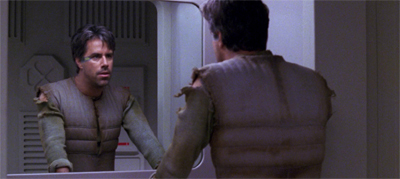
Keep soldiering on...

Keep soldiering on…

Continue reading

Star Trek: The Next Generation – The Enemy (Review)

This January and February, we’ll be finishing up our look at the second season of Star Trek: The Next Generation and moving on to the third year of the show, both recently and lovingly remastered for high definition. Check back daily for the latest review.

The Enemy is just a fantastic piece of television. The third season of Star Trek: The Next Generation has maintained an impressive consistency up to this point, despite all the difficulties bubbling away behind the scenes. However, The Enemy is the point where everything seems to have finally settled down and the show is truly comfortable churning out episodes of this sort of quality.

It’s a very typical Star Trek plot, with one of our leads trapped on the planet surface and forced to team up with an enemy soldier in order to survive. It’s a very standard morality tale about how the enemy is not as different as we might like to think; it’s an exploration – in a very Star Trek style – of how two people can overcome their differences in order to survive  a suitably desperate situation.

The Enemy is a demonstration of just how well-oiled The Next Generation had become at this point in time, and how even the most standard of plots could be executed with considerable skill.

The show's quality is climbing...

The show’s quality is climbing…

Continue reading

Star Trek: The Next Generation – Evolution (Review)

This January and February, we’ll be finishing up our look at the second season of Star Trek: The Next Generation and moving on to the third year of the show, both recently and lovingly remastered for high definition. Check back daily for the latest review.

Evolution kicks off the third season of Star Trek: The Next Generation, and marks the point at which the spin-0ff really comes into its own. It’s remarkable how consistent in quality the third season is, despite the trouble brewing behind the scenes. It’s also remarkable how quickly the show finds its footing after two years of stumbling clumsily in the right direction. Within the first five episodes of the third season, The Next Generation has clearly found its voice.

However, a change is obvious even from Evolution. Michael Piller would take over the reigns four episodes into the season, but he also co-wrote the script to the season premiere. While Piller polished quite a few of the scripts passing through The Next Generation‘s third season, it is interesting that his credited work book-ends the season, setting the tone and leaving a clear impression.

While Evolution is not the strongest episode of the season to come, it does have a much stronger sense of self and purpose than anything that has really come before. It isn’t a bold or ground-breaking script by any measure; it’s actually a relatively simple story. It just tells that story with a wonderful resonance, clarity and efficiency, commodities that have been sorely lacking from The Next Generation to date.

Hold on, it's time for a change...

Hold on, it’s time for a change…

Continue reading

Star Trek: The Next Generation – Season 2 (Review)

This January and February, we’ll be finishing up our look at the second season of Star Trek: The Next Generation and moving on to the third year of the show, both recently and lovingly remastered for high definition. Check back daily for the latest review.

Although, as Rick Berman argues in the documentary Making It So, the first season of Star Trek: The Next Generation “was at least in syndicated ratings terms, extremely successful”, there was trouble brewing behind the scenes. The show lost two-thirds of its regular female cast members, and the season ended with a whimper rather than a bang as the 1988 Writers’ Strike cutting into the development of the final couple of scripts.

The second season was no less plagued by problems, even as the show proved a ratings and commercial success. The show’s writers’ room was in disarray, with conflicts erupting between Tracy Tormé and Maurice Hurley over scripting for the show – leading to the use of both of Tormé’s WGA-approved pseudonyms on consecutive scripts from the writer. Episodes were coming over budget and behind schedule, necessitating a clip show to round out the season.

tng-qwho17

Even on the set itself, new cast member Diana Muldaur had difficulty fitting in the cast, and did not wish to return after the second season. Katherine Pulaski would disappear from the show (and the franchise) with little fuss – her last appearance being in the rather disappointing Shades of Grey. While The Next Generation was successful by just about any objective external measure, it had yet to really find its own internal balance.

Still, the second season of The Next Generation did show hints of improvement. The show was finding its feet. While the average quality of the episodes was nothing like what it would become in the show’s third season, even the more middling instalments of the show’s second season (like Contagion or Where Silence Has Lease or Peak Performance) were leaps and bounds ahead of where the show had been in the first season. It was getting where it needed to go, but not nearly fast enough.

tng-timesquared19

Continue reading

Star Trek: Deep Space Nine – The Forsaken (Review)

Star Trek: Deep Space Nine is twenty years old this year. To celebrate, I’m taking a look at the first season. Check back daily for the latest review or retrospective.

Following on directly from If Wishes Were Horses…, The Foresaken combines another bunch of familiar Star Trek clichés into a plot that fells like it has been elsewhere. To be fair, the “malfunctioning computer” plot is a plot that lends itself to a Star Trek setting, and the key is the execution of that most familiar set up. The franchise has done it quite well in the past. I’m fond of Star Trek: The Next Generation‘s foray into the subgenre with Disaster. Even Star Trek: Deep Space Nine would do a number of later episodes working quite well from this starting point – Civil Defense and Starship Down ranking quite highly.

The problem with The Foresaken, then, isn’t the fact that it falls back on a bunch of familiar Star Trek clichés, but it fails to use them to tell an especially compelling story.

Oh, what a world!

Oh, what a world!

Continue reading

Star Trek: Deep Space Nine – The Storyteller (Review)

Star Trek: Deep Space Nine is twenty years old this year. To celebrate, I’m taking a look at the first season. Check back daily for the latest review or retrospective.

The Storyteller should not work half as well as it does. While some episodes this season (notably The Passenger and Battle Lines) feel like they were simply lifted directly from the “reject” pile within the writers’ room on Star Trek: The Next Generation, The Storyteller is actually a rejected pitch from that show’s first season. Written by Kurt Michael Bensmiller, the writer responsible for Time Squared, one of the stronger installments of the show’s first two years, it was also written late in 1992, about a month before Star Trek: Deep Space Nine would actually air.

And yet, despite that, The Storyteller really feels like a show that wouldn’t work on any of the other Star Trek spin-offs. A lot of that seems to be down to the work by Ira Steven Behr to polish up Bensmillers’ draft and to add a lot of character work and development to what is a decidedly high concept. As producer Michael Piller confessed in Captains’ Logs Supplemental – The Unauthorized Guide to the New Trek Voyages, “Ira did a lot of work on that script.”

O'Brien's mind is a bit clouded right now...

O’Brien’s mind is a bit clouded right now…

Continue reading

Non-Review Review: Star Trek – Generations

This August, to celebrate the upcoming release of Star Trek: Into Darkness on DVD and blu ray, we’re taking a look at the Star Trek movies featuring the original cast. Movie reviews are every Tuesday and Thursday.

There are lots of problems with Star Trek: Generations. It feels too much like a two-parter from the television show. It tries to fit in a laundry list of demands from the studio. It wastes Malcolm McDowell. It decides that the only part of the original series deserving a send-off is James T. Kirk, and then pushes him off-screen for an hour before dragging him back into the movie to kill him off in the most ironic and anti-climactic manner possible.

Yet, despite these considerable flaws, Generations also has a lot to recommend it. Although the script occasionally feels a little overcooked, the themes concerning mortality lend it a serious amount of weight. Director David Carson demonstrates that he can work wonders on a tiny budget. Cinematographer John A. Alonzo finds a way to shoot familiar sets in a way that makes them look incredibly beautiful. None of these strengths can fully compensate for the very fundamental flaws with the seventh Star Trek cinematic outing, but they do mitigate them somewhat.

Generations isn’t a great Star Trek film, and it isn’t even the best odd-numbered Star Trek film, but it is far from an unmitigated disaster. Well, except for the way it treats Kirk.

Riding the wave...

Riding the wave…

Continue reading

Star Trek: The Next Generation – The Last Outpost (Review)

To celebrate the twenty-fifth anniversary of Star Trek: The Next Generation, and also next year’s release of Star Trek: Into Darkness, I’m taking a look at the recent blu ray release of the first season, episode-by-episode. Check back daily for the latest review.

You know, a lot of people would argue that Star Trek is about understanding. That it’s about embracing and respecting cultures, even when they hold values different than your own. Sometimes that is to a fault, like in the last episode (Code of Honour) where Picard allowed his Chief of Security to engage in a fight to the death to avoid violating local custom. (Which he then violated by reviving the loser.) However, it appears that such open-mindedness only applies when you look and act appropriately human enough.

If you are a Ferengi, then your culture shouldn’t be respected and acknowledged. It should be mocked and ridiculed.

He’s all ears…

Continue reading