• Following Us

  • Categories

  • Check out the Archives


  • Awards & Nominations

Non-Review Review: The Man Who Knew Infinity

It takes a lot of skill to make mathematics seem beautiful. It is enough work to render those complex equations that mash together numbers and greek letters as something profound and understandable to contemporary audiences. After all, maths is static at best. When it comes to the kind of mathematical genius that inspires these sorts of biographies, the math tends towards the abstract. When The Man Who Knew Infinity works best, it manages to capture just some of the romance trapped between those braces.

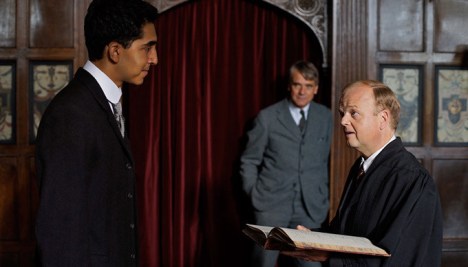
Of course, there are points at which The Man Who Knew Infinity threatens to get too romantic. Writer and director Matthew Brown has an obvious (and infectious) enthusiasm for his subject, Indian mathematician Srinivasa Ramanujan. The Man Who Knew Infinity works best when it expresses this affection through its leads. Jeremy Irons makes a surprisingly convincing evangelist for abstract mathematics, and Dev Patel offers utter conviction in the lead role. However, there are points at which Brown seems unwilling or unable to trust his actors or his audience.

What a nice fellow...

What a nice fellow…

Continue reading

Non-Review: Eye in the Sky

Eye in the Sky is a powerful contemporary morality play.

Eye in the Sky feels a lot like an old-style “television play.” It recalls the sorts of stories from the period when television was trying figure out its relationship between film and stage. The action unfolds in a number of relatively confined locations with a relatively modest cast. This cast is then presented with a moral dilemma, which the script spends most of its one-hundred-minute runtime carefully twisting and unpacking. Even today, it is not too difficult to imagine an event “live” broadcast on a smaller broadcaster working from the same premise.

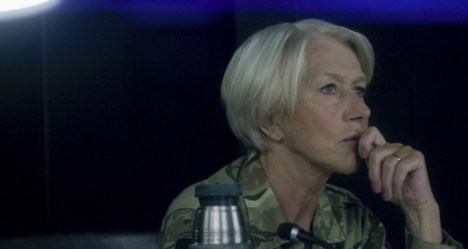
Mirr(en)ed in doubt...

Mirr(en)ed in doubt…

That is not to suggest that Eye in the Sky is cheap or uncinematic. Director Gavin Hood imbues the story with a lush cinematic style that feels a lot bigger than the moral drama playing out between the characters. Hood gives Eye in the Sky a sense of scale and heft that belies any formal similarities of classic television productions. At times, Hood is a little too cinematic, the hand of the director feeling a little too heavy in a morality play that takes great pains to be even-handed and complex.

However, these moments are fleeting; the film’s power lingers longer.

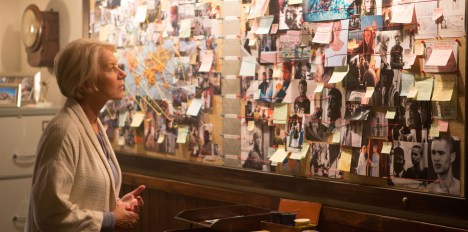
Eye see all...

Eye see all…

Continue reading

Non-Review Review: Batman vs. Superman – Dawn of Justice

Batman vs. Superman is a curiosity, a fascinating mess of a film that doesn’t really work but which constantly teases its audience with the idea that it might work in a variety of intriguing way.

Batman vs. Superman is certainly ambitious. Although the story about a persecuted alien immigrant obviously comes with no small amount of political subtext that feels applicable at a time of resurgent nationalist sentiment, the most remarkable thing about Batman vs. Superman is the way that the script is very consciously and awkwardly attempting to get at bigger underlying themes. Whereas Christopher Nolan tailored his impressive Batman trilogy for the realities of twenty-first century America, Batman vs. Superman is attempting something greater.

batmanvssuperman8

Of course, what it is actually attempting is hugely contradictory. It occasionally seems like director Zack Snyder is working at cross purposes with writers Chris Terrio and David S. Goyer. Appropriately enough for a director who recently announced plans to adapt The Fountainhead, Snyder is trying to construct a Randian power fantasy about the moral authority that rests with exceptional people like Superman. In contrast, Terrio and Goyer want to construct a fable about Superman as an embodiment of hope for a sinful Earth.

While Snyder seems at times to wrestle against the script, Terrio and Goyer face their own issues. While Batman vs. Superman is thematically ambitious and philosophically rich, it is also positively abstract in its plotting. Events occur for no reason beyond plot necessity, while character motivation is delivered through dreams and metaphor. Contrivances and illogicalities abound, to the point where any number of plot developments might have easily been avoided if characters simply talked to one another about what exactly they thought was going on in a given moment.

batmanvssuperman3

There are no shortage of issues with Batman vs. Superman, issues so fundamental that it is hard to imagine how an extended cut will do anything but deepen them. There are points at which the movie’s attempts to fashion a pop mythology are so dense as to suggest a required reading list, saturating with knowing references to everything from Lolita to A Streetcar Named Desire to Final Crisis. There is an argument to be made that Batman vs. Superman is not only illogical, but unapologetically (and perhaps unforgivably) pretentious.

And, yet, acknowledging all of these flaws, there is something strangely compelling about the muddled spectacle of it all. There is a sense that Snyder and Terrio and Goyer are really trying to do something in a manner that is bold and ambitious. (Just not necessarily the same things.) As crazy as it sounds – and it sounds crazy – Batman vs. Superman is the result of the same style of Warner Brothers movie-making that led to the infinitely superior Mad Max: Fury Road and The Dark Knight. There is a willingness to let artists take massive risks with significant budgets.

batmanvssuperman4

Warner Brothers has a track record of supporting and encouraging these gambles. Sometimes these gambles pay off. No other major studio would have signed off on Mad Max: Fury Road, to pick an example. Christopher Nolan produced a trilogy of engaged and exciting blockbusters built around a character most had written off in live action. Sometimes this big budget auteur model doesn’t pay off. Say what you might about Cloud Atlas and Man of Steel, but they are indisputably unique and distinct visions of their creative architects.

In its abstraction, its tone and its aesthetic, Batman vs. Superman has the look and feel of a two-hundred-and-fifty million dollar indie feature. It might lack the polish and finesse (and, to be frank, cohesion and internal logic) of other major superhero films. However, it has a weirdly compelling spark and ambition that is lacking from the more standardised model of Marvel Studios blockbuster. The result is deeply unsatisfying, yet strangely compelling.

batmanvssuperman1

Continue reading

Non-Review Review: 10 Cloverfield Lane

10 Cloverfield Lane is a beautiful piece of speculative paranoid horror.

The plot follows Michelle, a young woman who is involved in a car crash. She wakes up to find herself in a strange concrete bunker, under the care of the mysterious (and more-than-slightly sinister) Howard. As she comes to her senses, Howard advises her that something horrible has happened; the world has ended outside and they are sealed safely inside an air-tight self-sustaining bunker. However, Michelle has a healthy degree of skepticism about Howard’s claims, wondering what exactly is going on and just how trustworthy Howard actually is.

At home at the end of the world. Maybe.

At home at the end of the world.
Maybe.

To reveal any more would be to spoil the film. 10 Cloverfield Lane is very much a “mystery box” production, in keeping with various other JJ Abrams projects from Cloverfield to Super 8 to Star Trek Into Darkness. Although Abrams is not directing, 10 Cloverfield Lane retains a lot of the director’s aesthetic. It is a film that is designed to be seen with the bare minimum of information, to the point where the unveiling of the movie’s title came surprisingly late in the release process.

However, writers Drew Goddard and Daniel Casey (working from a story by Matthew Stuecken and Josh Campbell) and director Dan Trachtenberg use that mystery box structure in a manner distinct from Abrams’ blockbuster sensibilities. 10 Cloverfield Lane plays like a feature-length high-budget episode of The Twilight Zone, a story that looks and sounds great but would (mostly) lend itself to a stage play adaptation. 10 Cloverfield Lane feels very much like a classic high-concept science-fiction horror, in the best possible way.

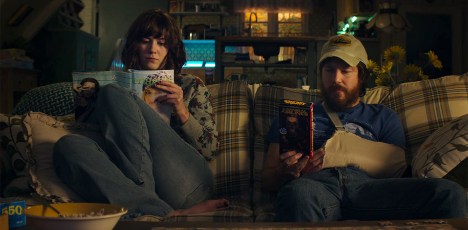
Music to his ears...

Music to his ears…

Continue reading

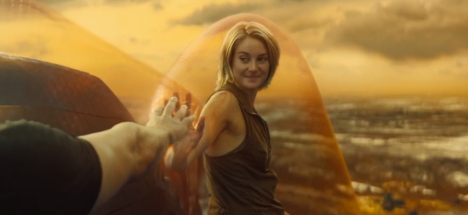
Non-Review Review: Divergent – Allegiant

In terms of dystopian young adult science-fiction/fantasy franchises, Divergent is solidly mid-tier. It is in technical and production terms superior to The Maze Runner, but markedly inferior to The Hunger Games. It lacks the sort of spectacular camp that made The Mortal Instruments stand out, for better or worse. It is a reasonable execution of a fairly reliable (although also heavily problematic) central concept, but without anything that really elevates it above its competitors.

Allegiant is the first part of a two-part finalé to the series, as has become the norm for these types of films. However, it all feels rather rote. Allegiant does not feel like the first part of a two-parter, instead feeling like its own story that could support a sequel but alternatively would be a perfectly fine place to wrap up if the studio decide to all it a day. The fact that it is the first of a two-part adaptation of a source material feels like a decision that was made because that is just how you adapt young adult franchises at this point in time.

Hate to burst your bubble...

Hate to burst your bubble…

Continue reading

Non-Review Review: Midnight Special

Midnight Special is a lot of things.

It is a meditation on faith. It is a road movie. It is an indie superhero movie. It is a Spielbergian science-fiction adventure. It is a coming of age tale. It is a film fundamentally about awe and wonder. It is a spectacle that nevertheless remains firmly rooted in the ground even as it looks upwards. It is a tribute to the “lay lines” that serve to tie the United States together, from the dark country roads to the shady motels. Midnight Special is a lot of things, and it is very good at being all those things.

However, Midnight Special is fundamentally a movie about parenting. It is a movie about the unquestioning hope that a parent might be responsible for something that is ultimately more than they were.

Son rising.

Son rising.

Continue reading

Non-Review Review: Zootropolis (aka Zootopia)

This film was seen as part of the Audi Dublin International Film Festival 2016.

Zootropolis is a solidly entertaining family film that strains under the weight of its core premise.

There is a great idea in here, a detective film set in an anthropomorphised world featuring a rabbit and fox who must team up to solve a number of mysterious disappearances. Along the way, writers Jared Bush and Phil Johnston fashion the story into an allegory rich with social commentary about race and class issues in American cities. It helps that the script is light on its feet and packed with enough fast gags that it breezes along without ever getting stuck in the same place for too long.

zootopia4

However, this becomes a problem in and of itself. There is a sense that Zootropolis struggles to do too much in the space afforded to it. The plot covers quite a lot of ground as our plucky heroes embark on their investigation, including extended (and overt) riffs on pop culture standards like The Godfather and Breaking Bad. There are points at which it feels like Zootropolis might be a much stronger film if it slowed down a bit, instead of hopping from one set-up to the next in the style of its rabbit protagonist.

Zootropolis largely works, but it never comes together in the way that the best Disney outings do. There are points at which Zootropolis feels more like a turducken than a chimera.

zootopia5

Continue reading

Non-Review Review: Whiskey Tango Foxtrot

This film was seen as part of the Audi Dublin International Film Festival 2016.

It can be difficult to balance tone when setting a comedy inside a warzone.

That difficulty only increases when setting that comedy in the aftermath of the United States invasion of Afghanistan. America’s military intervention in Iraq and Afghanistan remains a defining moment in twenty-first century history; although the Obama administration might have worked hard to reduce commitment to the region, the conflicts remain divisive and controversial. As such, setting a comedy drama against the backdrop of the Afghan conflict is a dicey proposition.

whiskeytangofoxtrot6

Whiskey Tango Foxtrot struggles to pitch itself at the right tone, unsure whether it is an absurdist comedy about the excesses of modern war or a character study of what it must be like to live in such an environment or whether it is a more mature reflection on life during wartime. Whiskey Tango Foxtrot tries to have the best of all possible world, which leaves the film bouncing between extremes. There are moments of irreverent irony followed by earnest sincerity. The movie alternates between bitter cynicism and saccharine optimism.

The result is a movie that feels uneven and unfocused, tonally lost and wildly variable. And not in a way that reflects the conflict unfolding in the background.

whiskeytangofoxtrot5

Continue reading

Non-Review Review: Hitchcock/Truffaut

This film was seen as part of the Audi Dublin International Film Festival 2016.

Hitchcock/Truffaut is incredibly light and fluffy.

In many respects, Kent Jones’ documentary about the eponymous piece of classic film literature plays like something of a late night infomercial populated with nerdiest film endorsements imaginable. Hitchcock/Truffaut is not so much interested in exploring and expanding its source text, instead settling for celebration. Wes Anderson boasts that his copy of the book is so well-used that it is held together by rubber bands; Kiyoshi Kurosawa explains that the only thing holding him back from blatantly stealing from the book is a promise to himself.

hitchcocktruffaut

There is not anything particularly wrong with this. There is something quite fun in watching film-makers get evangelical about their craft. All of the talking heads offer some insight into their own work when they expand upon what Alfred Hitchcock means to them. Martin Scorsese’s joy as he journeys shot-by-shot into Psycho is infectious, and it is clear that everybody involved with the project holds Hitchcock in the highest possible regard and embraces him as a cornerstone of modern movie-making.

Hitchcock/Truffaut‘s biggest issue is also its strongest virtue; this is a cheerful and superficial acknowledgement of its subject, one that decides particularly in-depth coverage of the auteur is secondary to rendering the material accessible to neophytes.

hitchcocktruffaut5

Continue reading

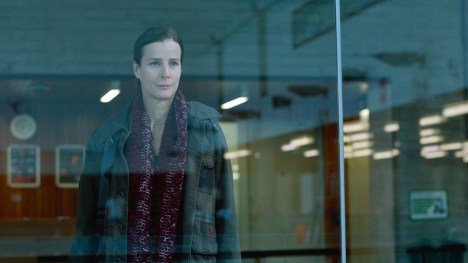
Non-Review Review: Mammal

This film was seen as part of the Audi Dublin International Film Festival 2016.

Mammal is a psychosexual exploration of grief with a strong sense of direction and two strong central performances, albeit one that manages the rare feat of feeling both sensationalism and lifeless in the same instant.

Writer and director Rebecca Daly has a strong sense of tone, creating a palpable uncertainty and anxiety that pervades the first half of the film. Daly crafts an engaging sense of ambiguity, allowing tensions and uncertainties to simmer beneath the surface of the relationship between her two central characters. The performances help a great deal, with Rachel Griffiths doing great work as the divorced and isolated Margaret and Barry Keoghan offering strong support as the mysterious Joe. Mammal is filled with awkward silences and tense foreboding.

mammal

Unfortunately, all of those tension and anxiety has to build to something, and Mammal suffers in how it decides to deliver upon and follow through on all that suspense and ambiguity. Mammal really struggles during its second act, offering twists that should be shocking but are ultimately entirely predictable. Mammal seems to try to escalate in its final act, but the film suffers quite a bit from its own efficiency at setting the mood. In its last forty minutes, the film is left nowhere to go but the most expected directions, the blows softened by the fact they’ve been awkwardly signposted.

Mammal works best when it focuses on the interiority of its characters, but struggles when it asks them to act upon one another.

mammal2

Continue reading