• Following Us

  • Categories

  • Check out the Archives


  • Awards & Nominations

Non-Review Review: The Sisters Brothers

This film was seen as part of the Virgin Media Dublin International Film Festival 2019. Given the high volumes of films being shown and the number of reviews to be written, these may end up being a bit shorter than usual reviews.

The Sisters Brothers is a charming and deeply unfocused modern western.

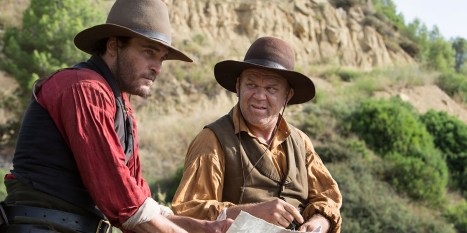
Adapted from Patrick deWitt’s novel of the same time, The Sisters Brothers is a tale of two bounty hunters at work on the frontier. Working for the mysterious (and ominous) “Commodore”, Charlie and Eli Sisters are men of violence who stalk the wilderness in search of those who have wronged (or, to quote Charlie, “victimised”) their employer. However, the film is about more than just that. As with so many westerns, it is a story of encroaching modernity and civilisation atop a foundation of brutality and violence, and efforts to navigate the liminal space between the two.
Brothers’ keepers.

The Sisters Brothers works best when it focuses on its core cast, especially the eponymous murderous siblings played by Joaquin Phoenix and John C. Reilly. There is an appealing tragedy to these two men and how they face the changing times. Charlie seems unwilling to acknowledge civilisation and society, revelling in debauchery and indulgence. Eli imagines himself capable of the sort of change that such a transition would demand from him. Pheonix and Reilly layer their performances in contradictions and nuance, suggesting life beneath the archetypes.

However, The Sisters Brothers is simply too unfocused and too meandering to completely work. This is particularly apparent when the film indulges in any number of narrative diversions, or when the film eschews its core narrative altogether to embrace a more philosophical perspective. The Sisters Brothers has great ideas, but those ideas tend to diffuse without a strong narrative structure around them. The Sisters Brothers often feels in need of a tighter edit and a strong script polish, which is a shame considering the strengths that it demonstrates otherwise.

Shore thing.

Continue reading

Non-Review Review: Loro

This film was seen as part of the Virgin Media Dublin International Film Festival 2019. Given the high volumes of films being shown and the number of reviews to be written, these may end up being a bit shorter than usual reviews.

Loro is certainly a Paolo Sorrentino film.

Loro is an interesting watch removed from its original context. It is nominally a biographical film covering the most defining Italian politician of the twenty-first century, Silvio Berlusconi. In reality, it feels like an attempt at something broader, a sweeping commentary on corruption and moral decay that just happens to exist (like so much of contemporary Italian culture, the film suggests) in the orbit of that towering figure. The film was originally released in Italy as a duology running a total of three-hours-and-one-quarter, Sorrentino combined both halves and cut forty-five minutes from the total runtime for international distribution.

It is a difficult film to parse outside of that context. It is difficult to tell if some of the gaps and hiccups in the film are down to the necessity of trimming a quarter of the runtime or simply due to the “inside baseball” nature of a film based around the national politics of a different country. This is not to suggest that Loro is impenetrable or nonsensical without any background knowledge. Indeed, Sorrentino goes out of his way to frame Loro as a universal story about concepts like sex, power, desire, and age. However, watching the film, it feels like there are gaps and lacunas in the narrative. Despite its extended runtime, Loro feels truncated.

And yet, in spite of these gaps, Loro has an incredible infectious energy that sustains it. While perhaps a little too unfocused and perhaps a little too simplistic, it is never anything less than compelling in its absurd study of power and corruption. Loro doesn’t necessarily have a lot to say, but it makes a point to say it all very well.

Continue reading

Non-Review Review: The Aftermath

This film was seen as part of the Virgin Media Dublin International Film Festival 2019. Given the high volumes of films being shown and the number of reviews to be written, these may end up being a bit shorter than usual reviews.

The Aftermath starts with a fascinating premise.

Unfolding in the immediate wake of the Second World War, The Aftermath finds Rachael Morgan joining her husband Lewis Morgan in Hamberg for the British Occupation of the city. Tensions are running high. Most of the city lies in ruins, bodies still being pulled from the rubble. Both sides are nursing old wounds that threaten to fester. Rachel finds herself confronting these wounds even more acutely than she expected. When the Morgans move into a stately home on the outskirts of the city, Lewis suggests that the German family might remain there rather than being relocated to “the camps.” As a result, the two sides find themselves living under the same roof; British and German, occupied and occupier, winner and loser.

This is an intensely charged set-up, and one with a lot of potential. It is one thing to fight a war, it is another to end it. Reconciliation is always a challenge, particularly when dealing with a catastrophe on the scale of the Second World War. Given the trauma that both sides inflicted upon one another and the scars that still sting, forcing a British and German family to live in close proximity while those wounds are still fresh should lead to incredible drama. What is it like to surrender one’s home to an occupying force, but to linger there as a guest – or maybe a ghost? What is like to be surrounded by a people who were once bent on conquest and domination, but now find themselves at the mercy of the nations they tried to subjugate?

The Aftermath doesn’t really answer these questions. Indeed, it often struggles to articulate them. Instead, it offers a clichéd romantic triangle melodrama against this backdrop, offering a decidedly trashy narrative within the trappings of prestige. The Aftermath has an engaging central performance from Keira Knightley, but it suffers from a lack of chemistry between its three leads and a truly terrible management of tone. The Aftermath aspires to be a story of a simmering cold war, but is completely lacking any spark.

Continue reading

Non-Review Review: Happy as Lazzaro

This film was seen as part of the Virgin Media Dublin International Film Festival 2019. Given the high volumes of films being shown and the number of reviews to be written, these may end up being a bit shorter than usual reviews.

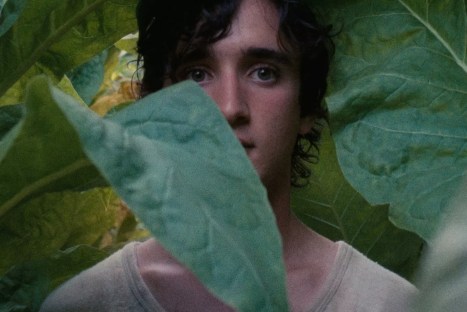
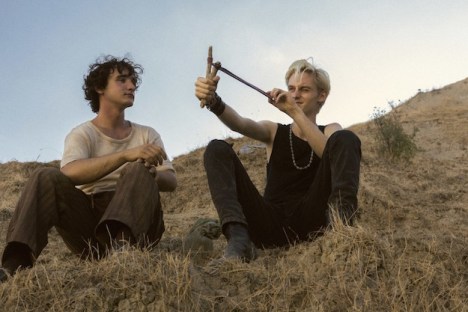
Happy as Lazzaro meditates profoundly on the modern world, and reaches the important and timely conclusion that maybe slavery is bad and maybe capitalism is not all that it is cracked up to be.

Alice Rohrwacher structures Happy as Lazzaro as an Italian neo-realist fable, a fairy tale for the modern world evoking both the Brothers Grimm and the Holy Bible. Its title character is a martyr who dies (or at the very least suffers terribly) repeatedly for the sins of the fallen world around him, wandering with wide-eyed innocence through a landscape that is ground beneath the heel of market forces. Happy as Lazzaro offers a happy-go-lucky protagonist who wanders listlessly from one event to another without any guile or ambition to cloud is judgement, affording him a purity that allows Rohrwacher to make her commentary on the various ills of contemporary society.

However, the biggest problem with Happy as Lazzaro is the eponymous character, the dim-witted and perpetually good-natured farmhand who provides both the narrative engine and the central perspective of the film. The issue is not actor Adriano Tardiolo, who does the best that he can with the material afforded to him, his face a perpetual blend of innocent optimism and mild confusion at even the most mundane of situations. The issue is the character himself, who exists as a moral and social vacuum at the heart of film. Happy as Lazzaro expects the audience to treat its central character as a paragon of virtue untouched by the sinful materialist world in which he finds himself. Instead, he comes across as a character completely devoid of any weight.

There is something to be said for using a character like that as a vehicle for social commentary. Narratives like Being There, Twin Peaks: The Return and Forrest Gump have employed the “guileless fool” as a protagonist to varying degrees of success. The issue with Happy as Lazzaro is that it is not content to simply use its central character as a leaf caught in a wind, but instead insists upon his purity and sanctity. Happy as Lazzaro is a film that constantly confuses the lack of any moral agency whatsoever with something approaching moral superiority.

Continue reading

Non-Review Review: Dragged Across Concrete

This film was seen as part of the Virgin Media Dublin International Film Festival 2019. Given the high volumes of films being shown and the number of reviews to be written, these may end up being a bit shorter than usual reviews. This was the Surprise Film.

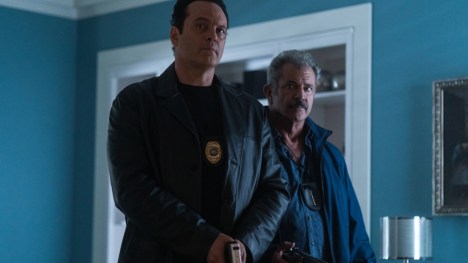
Dragged Across Concrete is weird, unpleasant, mean-spirited and vindictive.

It is all of these things in a very knowing manner. This both adds to and detracts from its attempts to get under its audience’s skin. There can be something charming in a provocateur who needles the audience in an interesting or compelling way, who pushes the audience outside of their comfort zone. However, there is also something very tiring in a filmmaker who is only doing that for the sake of pushing the audience outside their comfort zone. Call it the Jurassic Park paradox; just because something is possible does not mean it is valid or necessary.

Indeed, the most frustrating part of Dragged Across Concrete is how much time and energy it devotes to being frustrating without any greater purpose. It is a film that is very consciously designed to push certain buttons, but without any really sense of why it would want to. Dragged Across Concrete is a deeply frustrating piece of cinema, and that frustration is only deepened by a hefty two-hour-and-fifty minute runtime. Watching Dragged Across Concrete, it can be hard to tell whether that frustration is more or less pure for its clarity of purpose.

However, it is abundantly clear that it does not make for a good film.

Continue reading

Non-Review Review: Ying (“Shadow”)

This film was seen as part of the Virgin Media Dublin International Film Festival 2019. Given the high volumes of films being shown and the number of reviews to be written, these may end up being a bit shorter than usual reviews.

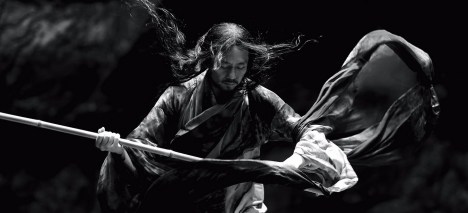
Shadow is a mess.

Shadow aims for opera, but winds up in soap opera. The film’s plotting is a mess of internal contradictions grasping desperately at pseudo-profundity. The film’s structure is completely chaotic, with what should be the climax of the third act coming about a half-an-hour before the end credits in order to make room for even more plot twists and betrayals and reversals. Shadow simply does not work on a number of fundamental levels.

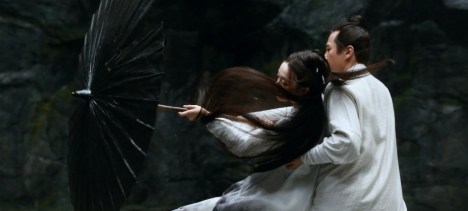
And yet, in spite of that, there’s an incredible charm to the film. Director Zhang Yimou commits wholeheartedly and unquestioningly to his premise, right down to the heavily desaturated-to-the-point-of-almost-being-black-and-white colour scheme. Shadow never seems to have any hesitation or self-doubt as it commits to an increasingly convoluted plot and a series of increasingly absurd visual flourishes. It is as exhilarating as it is infuriating.

Shadow is a movie in which an invading army cocks their razor umbrellas before riding said umbrellas through the streets of a city under assault. It’s completely off the wall, but also impossible to completely resist.

Continue reading

Non-Review Review: Wilkolak (“Werewolf”)

This film was seen as part of the Virgin Media Dublin International Film Festival 2019. Given the high volumes of films being shown and the number of reviews to be written, these may end up being a bit shorter than usual reviews.

Werewolf is pretty solid “Nazisploitation”, those sorts of genre (usually horror) pieces that play off the imagery and reality of the Second World War.

Werewolf is certainly stronger than other recent examples of the genre, such as Overlord. Focusing on a group of children Holocaust survivors who find themselves menaced by a pack of feral dogs from the camp, Werewolf is a story about trauma, violence and victimhood. It is a film about how these things self-perpetuate, and how these cycles of abuse need to be broken. Writer and director Adrian Panek frames this story through the lens of horror.

This certainly makes sense. The Second World War and the Holocaust were a trauma on a global scale, but most obviously on the European continent. The concentration camps were build outside of Germany, spreading the horror across the region. Poland was home to six extermination camps, something that leaves an indelible mark on a region. Werewolf navigates this trauma through  familiar horror movie staples; the orphans in the gothic mansion, the haunted woods, the allegorical monster, the group that threatens to fracture and fray under pressure.

The only real problem with Werewolf is that it’s simply not scary enough to work as a horror movie.

Continue reading

Non-Review Review: A Girl From Mogadishu

This film was seen as part of the Virgin Media Dublin International Film Festival 2019. Given the high volumes of films being shown and the number of reviews to be written, these may end up being a bit shorter than usual reviews.

One of the most striking aspects of discussing a biographical film is separating the biography from the film.

Ifrah Ahmed is a truly spectacular human being, with a truly incredible story. More than that, Ahmed is a hugely influential figure who has done an impressive amount of work to draw public attention to a very important cause. Ahmed is an inspiring figure, and very much worthy of all the praise and publicity that she has received. Her advocacy for women affected by female genital mutilation is a cause that merits support and encouragement. More than that, there is probably a great movie to be made about Ahmed’s story.

Unfortunately, A Girl From Mogadishu is not that story. The film is a disaster on a spectacular scale. The issue is certain not its choice of subject or subject matter; in the hands of a competent production team, those two elements could combine to create a truly engaging and exciting piece of film. The problem with A Girl From Mogadishu is the sheer level of creative incompetence involved. This is a film that often seems like it was assembled by a director who had only ever heard films described, rather than actually watched any of them.

A Girl From Mogadishu is cinematically illiterate, which is massively disappointing on a number of level. It betrays a talented international cast, an audience hungry for good stories told well, and a subject who is arguably one of the most important Irish social figures of the past decade and who very much deserves a much better spotlight.

Continue reading

Non-Review Review: Rafiki

This film was seen as part of the Virgin Media Dublin International Film Festival 2019. Given the high volumes of films being shown and the number of reviews to be written, these may end up being a bit shorter than usual reviews.

Rafiki is a sweet and tender love story, and well worth seeking out.

Writer and director Wanuri Kahiu is part of an artistic movement that brands itself “Afrobubblegum.” A collective of artists working together to redefine what Africa looks and feels like on screen, the “Afrobubblegum” movement is dedicated to breaking away from many of the clichés and conventions associated with continent to provide a much broader perspective of twenty-first century Africe. Rafiki is very much a part of that movement. It is a story of teen love, of the simmering attraction between two young women on the cusp of adulthood within a reactionary society that would crush such love underneath its heel. It’s a familiar set-up, evoking any number of coming-of-age same-sex love stories, the obvious (and perhaps lazy) comparison being Moonlight.

Rafiki is a fairly conventional narrative in these in terms. Indeed, the audience has a fairly good idea of where the film is going from the opening scenes that establish the realities with which Kena lives before also suggesting her strong attraction to Ziki. However, Rafiki is elevated by a number of factors. Most obviously, there are the winsome performances from young leads Samantha Mugatsia and Sheila Munyiva, who bring a very naturalistic vulnerability to their roles. However, there’s also the sheer charm of the script and the direction, which beautifully captures the feeling of young love from moment to moment, without recourse to exposition or purple prose or heavy-handed soliloquies. Rafiki feels like a movie that knows love, in a very personal and intimate way.

Rafiki is perhaps a little unpolished around the edges, but works well where it matters. It is a movie that understands the trepidation, the excitement, the longing, the fear, the passion, and the power of what it is to want another person, even (and especially) when there are so many reasons not to. There is a simple and convincing beauty in that.

Continue reading

Non-Review Review: Her Smell

This film was seen as part of the Virgin Media Dublin International Film Festival 2019. Given the high volumes of films being shown and the number of reviews to be written, these may end up being a bit shorter than usual reviews.

Put frankly, Her Smell stinks.

To be fair, there’s some interesting material here. film has long been obsessed with stories about fame and celebrity, particularly when filtered through the lens of tragedy and recovery. After all, A Star is Born roared to life as the early frontrunner in this year’s awards race, while Vox Lux provided a darker and weirder meditation on similar themes. Her Smell is very much a companion piece to these other films, a meditation on what fame does to a person, how strange it is. Her Smell is the story of a washed up punk rocker who inevitably collides with rock bottom, and yet somehow finds a way to keep going despite (or perhaps because of) the love of the people around her.

It is interesting to note that “Becky She” hits rock bottom and just keeps going, because this feels like an adequate assessment of Her Smell. Alex Ross Perry’s latest film is two hours and fifteen minutes long, and feels every single one of them. The movie has one single point that it keeps hammering again and again and again, one particular rhythm that it keeps playing again and again and again. Scenes within the film are interminable of themselves, but somehow repeated again and again and again. However, this shallow repetition is not the biggest problem with Her Smell, it’s the combination of that shallow repetition with a smug satisfaction, the cocky assuredness that underscores every single moment.

Her Smell is a dull and lifeless movie convinced of (and insistent upon) its own profundity. Roger Ebert famously argued that no good movie is too long and no bad movie is too short. One could cut two hours from Her Smell and it would still be fifteen minutes too long.

Continue reading