• Following Us

  • Categories

  • Check out the Archives


  • Awards & Nominations

Doctor Who: The Robot Revolution (Review)

“I’m saying no.”

“With regret, your powers are only nominal.”

“Why is it all so mad? Why is everything on this planet so stupid?”

One of the interesting consequences of the relatively compressed modern season of Doctor Who is the way that it collides episodes into one another.

With only eight episodes in a given season, there isn’t room for the sort of structure that Davies brought to his first four years overseeing Doctor Who, when he would reintroduce the show to audiences each year with a triptych that opened in the present and followed with a celebrity historical and a futuristic science-fiction episode. Rose gave way to The End of the World and The Unquiet DeadSmith and Jones led into The Shakespeare Code and Gridlock. Partners in Crime fed into The Fires of Pompeii and Planet of the Ood. Davies’ second season was the exception, opening with New Earth and Tooth and Claw, but that was notably the only one of Davies’ four seasons that didn’t have to open with the introduction of a new companion, with The Christmas Invasion having introduced the Tenth Doctor.
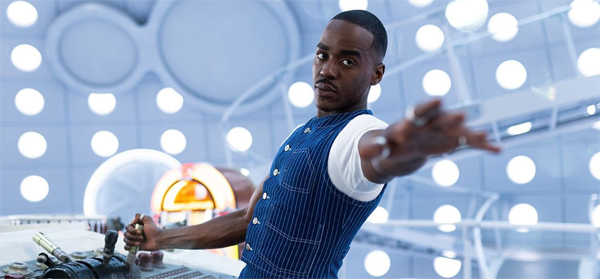
Extending its reach.

The Robot Revolution is put in the awkward position of having to combine the typical Davies season opener that introduces Belinda Chandra as a companion but also being Davies’ big high-concept pseudo-political idiosyncratic science-fiction story like Gridlock or Planet of the Ood. The result is a strange cocktail, that doesn’t quite cohere but is nevertheless compelling. For all the criticism of Davies’ return as showrunner, his second tenure does not lack for ambition and ideas. The Robot Revolution is bursting with concepts and thoughts, with Davies eager to scream his ideas at the loudest possible volume. The Robot Revolution is, in typical Davies style, incredibly maximalist in its storytelling. It brushes past plot points and ideas with reckless abandon and breathless enthusiasm.

Whatever the episode’s flaws, it’s certainly not the product of assembly line production.

The march of progress…

Continue reading

New Escapist Column! On “Andor” as an Embrace of 1970s Retrofuturism…

I published a new In the Frame piece at The Escapist last week. With Andor continuring to be very good, it seemed as good an opportunity as any to talk about the show’s unique aesthetic, and how that relates to the original Star Wars.

Andor manages to thread a very fine line. It takes the audience to places that were largely unseen in the original trilogy, from prison planets to remote highlands to sprawling urban centres. However, it does this in a way that manages to feel faithful to the aesthetic of the original films. It does this by embracing the culture and aesthetics of the era around those movies, embracing a version of the science-fiction world that feels very much in step with seventies cinema. The result is something that manages to feel both part of the larger Star Wars universe and also something new to it, while remaining very contemporary.

You can read the piece here, or click the picture below.

Star Trek: Voyager – Bride of Chaotica! (Review)

Bride of Chaotica! is an enjoyable mess.

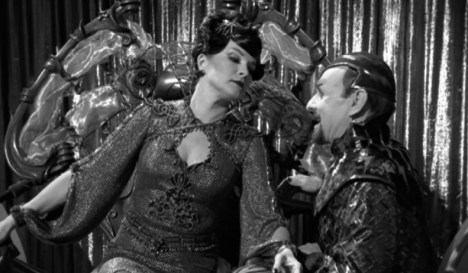
As its title implies, Bride of Chaotica! is a celebration of nostalgic futurism. It is a culmination of a number of themes running through the series. Most obviously, this particular brand of retrofuturism has been a recurring gag since Night at the start of the fifth season, but it fits within a broader context. From the outset, Star Trek: Voyager has been engaged with a more nostalgic sci-fi aesthetic than Star Trek: The Next Generation or Star Trek: Deep Space Nine.

Bride of evil.

Voyager‘s retrofuturism has taken various forms; the old school “space western” tone established by Caretaker, the retro sci-fi trappings of episodes like Innocence or Rise, the monster mayhem of episodes like Phage or Macrocosm, the Cold War paranoia of Cathexis or In the Flesh, Tom Paris’ nostalgic holoprograms in Lifesigns or Vis á Vis, the abductees from the early twentieth century in The 37’s. However, perhaps the most basic is baked into the concept of the show. Voyager is literally a series about the desire to return to a safer and more familiar time.

In some ways, Bride of Chaotica! cements this nostalgia in the context of the larger Star Trek canon, embracing the anxiety that has become increasingly apparent in the years since the thirtieth anniversary. After all, the surrounding feature films all literalise the pull of the past. Star Trek: First Contact has Jean-Luc Picard literally journey back to twenty-first century Earth while revisiting his most iconic moment. Star Trek: Insurrection has the crew discover the fountain of youth. Star Trek: Nemesis confronts Picard with a younger clone of himself.

Radio Chaotica!

It is perhaps telling that Voyager was the moment at which the Star Trek franchise stopped pushing forward. During and after Voyager, the franchise would become increasingly backwards-looking. Star Trek: Enterprise would invite the audience to meet James T. Kirk’s childhood era, trying to recapture that old magic. JJ Abrams’ Star Trek reboot would focus on a young version of Kirk and Spock. Star Trek: Discovery will feature a central character who is something close to Spock’s sister. There is a conscious pull of nostalgia.

Perhaps the future was better yesterday.

Never too far afield.

Continue reading