• Following Us

  • Categories

  • Check out the Archives


  • Awards & Nominations

Star Trek: Deep Space Nine – Invasive Procedures (Review)

Star Trek: Deep Space Nine is twenty years old this year. To celebrate, I’m taking a look at the first and second seasons. Check back daily for the latest review or retrospective.

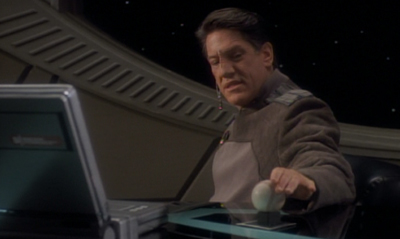
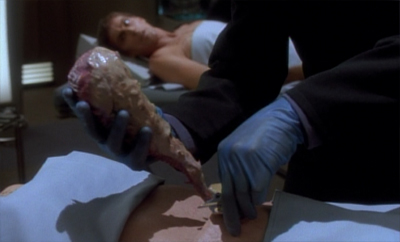
Invasive Procedures is an interesting episode. It has a great high concept, some nice character beats, and offers an inside glimpse at an astonishingly interesting alien culture. Verad is a compelling guest character and Sisko gets to be pretty badass, continuing the presentation of the character as some weird composite of James T. Kirk and Jean-Luc Picard.

There are however, a number of very sizeable flaws. The most obvious being that – despite this is nominally a “Dax” story – Dax winds up feeling more like a plot point than a character in her own right.
Slugging it out...

Slugging it out…

Continue reading

Star Trek: Deep Space Nine – The Siege (Review)

Star Trek: Deep Space Nine is twenty years old this year. To celebrate, I’m taking a look at the first and second seasons. Check back daily for the latest review or retrospective.

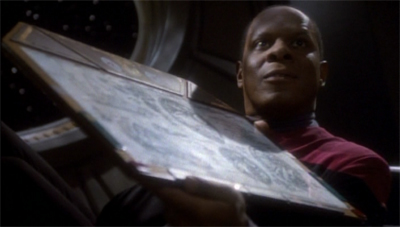
The Siege wraps up the first ever three-part episode of Star Trek in a surprisingly efficient manner. There are a few missteps, a lack of nuance and an over abundance of convenience and simplicity. However, it succeeds in doing what this opening three-parter set out to do. It tells a single story which could only ever have been told on Star Trek: Deep Space Nine. It gives a sense of scale to the show which is unique to the series, and it creates a palpable sense of uncertainty about the Federation’s mission to Bajor.

"He's letting me know, he'll be back..."

“He’s letting me know, he’ll be back…”

Continue reading

Star Trek: Deep Space Nine – The Circle (Review)

Star Trek: Deep Space Nine is twenty years old this year. To celebrate, I’m taking a look at the first and second seasons. Check back daily for the latest review or retrospective.

Drama naturally lends itself to a neat three-act structure. At the most basic level, it’s as simple as beginning, middle and end. However, it’s also a format taught in just about every screenwriting course, and it’s even used as the conventional model for those with more innovative approaches. With that in mind, it’s interest that Star Trek has done relatively few three-part stories. The Circle sits in the middle of the first such attempt, in the second season of the second spin-off. The format would not see use again for over a decade, when it would become a feature of the final season of Star Trek to air on television.

Given the franchise is relatively fond of two-parters, it seems strange that there haven’t been more attempts to extend that out an episode. Perhaps the reason is obvious. Of the three acts, the beginning and the end are the most essential. Both come with a certain in-built amount of energy. The first part introduces the problem, while the conclusion deals with it. However, it’s the middle which proves problematic. It’s the point in the story after you’ve set up the conflict, but before you resolve it. Given how much difficulty Star Trek: The Next Generation had with conclusions, imagine how difficult the second part of a three-parter would be.

Even when Star Trek: Enterprise adopted the three-parter format it ran into basic structural difficulties, with a couple feeling like a two-part episode with an additional prologue or epilogue added on. The Circle isn’t a terribly flawed piece of television, but it suffers from the fact that Star Trek has never really tried storytelling in this mode before.

The writing's on the wall...

The writing’s on the wall…

Continue reading

Star Trek: Deep Space Nine – Dramatis Personae (Review)

Star Trek: Deep Space Nine is twenty years old this year. To celebrate, I’m taking a look at the first season. Check back daily for the latest review or retrospective.

Dramatis Personae tends to get lost in the shuffle at the end of Star Trek: Deep Space Nine‘s first season. Sitting between two of the season’s most generic Star Trek stories (If Wishes Were Horses… and The Forsaken) and two distinctly Deep Space Nine classics (Duet and In the Hands of the Prophets), it’s easy to see why Joe Menosky’s tale of repeated history tends to get overlooked. It manages to sit quite neatly in both camps, as a generic Star Trek tale and as something more specific to Deep Space Nine.

After all, possession stories are scattered throughout the Star Trek mythos. Star Trek: The Next Generation was quite fond of have various members of the crew impersonated or doubled or controlled by a variety of alien influences. Dramatis Personae also feels like a very Joe Menosky script, linked by various thematic connections to the writer’s work on both The Next Generation and later on Star Trek: Voyager.

And yet, despite all those links, Dramatis Personae feels quite anchored to Deep Space Nine. It’s hard to imagine the dynamic working with any other Star Trek cast, even Voyager‘s Maquis and Starfleet ensemble. There’s also the sense that the episode’s pattern of repeated history feels more in keeping with Deep Space Nine‘s perception of history than any other Star Trek show’s.

The man with the plan...

The man with the plan…

Continue reading

Star Trek: Deep Space Nine – The Forsaken (Review)

Star Trek: Deep Space Nine is twenty years old this year. To celebrate, I’m taking a look at the first season. Check back daily for the latest review or retrospective.

Following on directly from If Wishes Were Horses…, The Foresaken combines another bunch of familiar Star Trek clichés into a plot that fells like it has been elsewhere. To be fair, the “malfunctioning computer” plot is a plot that lends itself to a Star Trek setting, and the key is the execution of that most familiar set up. The franchise has done it quite well in the past. I’m fond of Star Trek: The Next Generation‘s foray into the subgenre with Disaster. Even Star Trek: Deep Space Nine would do a number of later episodes working quite well from this starting point – Civil Defense and Starship Down ranking quite highly.

The problem with The Foresaken, then, isn’t the fact that it falls back on a bunch of familiar Star Trek clichés, but it fails to use them to tell an especially compelling story.

Oh, what a world!

Oh, what a world!

Continue reading

Star Trek: Deep Space Nine – If Wishes Were Horses… (Review)

Star Trek: Deep Space Nine is twenty years old this year. To celebrate, I’m taking a look at the first season. Check back daily for the latest review or retrospective.

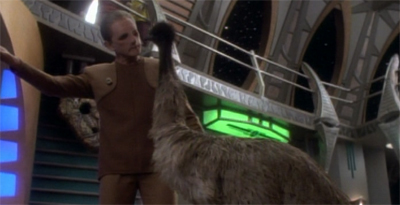
And after Progress gives us the most Deep-Space-Nine-y” episode yet, If Wishes Were Horses… offers the most generic Star Trek episode this side of The Passenger. The plot here should be very familiar. Like in Imaginary Friend or Shore Leave, the characters find their imaginations seem to be bringing things to life. Of course, it turns out to be an advanced alien intelligence that really just wants to study our crew, like in The Observer Effect or Scientific Method or even Schism. What I’m getting at here is that there’s really very little in this premise which hasn’t been done before or since on Star Trek, and nothing which wouldn’t feel more at home on Star Trek: The Next Generation or Star Trek: Voyager.

While it’s not as bad as The Passenger or Move Along Home, it is terribly generic and it feels like a waste of an episode in an already truncated season.

If wishes were emus...

If wishes were emus…

Continue reading

Star Trek: Deep Space Nine – Progress (Review)

Star Trek: Deep Space Nine is twenty years old this year. To celebrate, I’m taking a look at the first season. Check back daily for the latest review or retrospective.

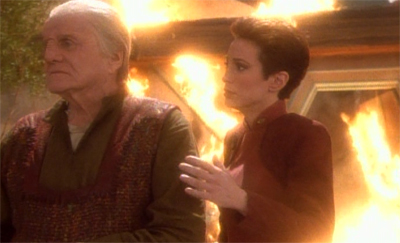
Progress is the best episode of Star Trek: Deep Space Nine‘s first season to date. Of course, there are better episodes ahead – two of them clustered at the end of the show’s truncated first year – but Progress still represents a considerable improvement over anything that has come before. It isn’t quite perfect, but it does have a nice character focus and takes advantage of the show’s unique perspective and position. It’s evidence that the writing staff were at least engaging with the show’s status quo and trying to work with it to tell interesting stories, with Progress offering an early pure example of what Deep Space Nine story should probably look like.

While the first season has been quite bumpy (although notably less bumpy than any of the opening seasons of the other three Star Trek spin-offs), Progress offers a demonstration that we are getting somewhere. The title might apply as much to the status of the show itself as to the themes of the episode.

Burning down the house...

Burning down the house…

Continue reading

Star Trek: Deep Space Nine – Vortex (Review)

Star Trek: Deep Space Nine is twenty years old this year. To celebrate, I’m taking a look at the first season. Check back daily for the latest review or retrospective.

Something very interesting happens in the second half of Star Trek: Deep Space Nine‘s first season. It seems like the writers and producers are making a conscious effort to develop the show’s characters, themes and the world that these inhabit. Plot threads are hinted at, only to be left dangling. Ideas are broached, and tucked away for another day. Given that Star Trek: The Next Generation waited until the third season to broach serialisation in Sins of the Father, the approach taken here is quite striking.

These three episodes are more notable for what they set up rather than what they actually accomplish on their own terms. These adventures lay groundwork, or at least hint at laying groundwork, that will pay off throughout the show’s extended seven-year run. Okay, not exactly. There are some redundant elements here that never actually pay off, but Vortex, Battle Lines and The Storyteller all play into the show’s bigger story arc, even if it seems the writers aren’t entirely sure what those story arcs are.

It's murky out there...

It’s murky out there…

Continue reading

Star Trek: Deep Space Nine – The Nagus (Review)

Star Trek: Deep Space Nine is twenty years old this year. To celebrate, I’m taking a look at the first season. Check back daily for the latest review or retrospective.

The Nagus starts what turns out to be an annual tradition for Star Trek: Deep Space Nine. It introduces the concept of a “Ferengi” episode, where once (or twice) a year, the show would take time out from other on-going concerns to focus on the state of affairs in the Ferengi Alliance. In a way, it’s quite like what Star Trek: The Next Generation did for the Klingons, taking an episode every once in a while to delve into the alien culture and offer a bit of exploration of a species originally created as a two-dimensional cardboard stand-in for a philosophy the franchise found unappealing.

Starting with Heart of Glory, The Next Generation developed Klingons from “those bad guys with the ridges” into a fully functioning and multi-faceted culture, largely driven by writer Ronald D. Moore from the third season. Deep Space Nine did largely the same thing with the Ferengi, largely spearheaded by producer Ira Steven Behr. Although, given the fact that the episodes concerned amoral capitalists instead of imposing warriors, Deep Space Nine opted for comedy as the genre of choice when developing the Ferengi.

He's got the lobes for business...

He’s got the lobes for business…

Continue reading

Star Trek: Deep Space Nine – Move Along Home (Review)

Star Trek: Deep Space Nine is twenty years old this year. To celebrate, I’m taking a look at the first season. Check back daily for the latest review or retrospective.

And here we hit what is commonly agreed to be the nadir of Star Trek: Deep Space Nine‘s rocky first season. Even the production staff seemed to acknowledge the problems with Move Along Home. Director David Carson conceded that it was “disappointing”, while future writer Ronald D. Moore could help  “wondering if everyone had lost their minds.” And there’s no way of getting around it. Move Along Home is a stinker in virtually every way that counts. It’s messy, contrived, confused, but without the wit to pull off the surreality of the set-up. There are no stakes, and the only way the episode can generate suspense is by lying to the audience.

And yet, despite that, I am actually much fonder of Move Along Home than I am of The Passenger. Don’t get me wrong, I don’t like either very much, but I’m more forgiving of the problems with Move Along Home, which stem from the episode’s ambition. There’s a sense that at least the episode was trying to do something a bit novel, even it backfired spectacularly. If I have to choose between flawed ambition and bland mediocrity, I’ll choose flawed ambition every time. Move Along Home might be a pretty dodgy episode, but at least its less generic than The Passenger.

A piece of the action...

A piece of the action…

Continue reading