• Following Us

  • Categories

  • Check out the Archives


  • Awards & Nominations

Star Trek: The Next Generation – The Measure of a Man (Review)

This January and February, we’ll be finishing up our look at the second season of Star Trek: The Next Generation and moving on to the third year of the show, both recently and lovingly remastered for high definition. Check back daily for the latest review.

Ah, The Measure of a Man.

It’s the first point in the run of Star Trek: The Next Generation where we’ve reached an episode that could legitimately be ranked as one of the best that the show would ever produce. Even today, the episode remains a favourite of Star Trek fans around the world, and a superb demonstration of what the series is capable of. Almost half-way into the second season, we get a glimpse of what The Next Generation could be, and how it balance its own identity against the proud philosophical traditions of its parent series.

It’s also quite brilliant.

A Data with destiny...

A Data with destiny…

Continue reading

Star Trek: The Next Generation – A Matter of Honour (Review)

This January and February, we’ll be finishing up our look at the second season of Star Trek: The Next Generation and moving on to the third year of the show, both recently and lovingly remastered for high definition. Check back daily for the latest review.

The second season of Star Trek: The Next Generation might be a bit rough around the edges (among other places), but there’s still a sense that the show is trying to improve itself, struggling to find its own voice. Most of the first season seemed content to offer a pale imitation of the classic Star Trek show, ignoring the fact that a lot had changed in the two decades since Kirk and Spock took to the air.

A Matter of Honour is an example of The Next Generation engaging the late eighties instead of trying to evoke the lost spirit of the sixties. Taking the “Klingons as Communists” metaphor as far as it could logically go, and serving as a companion piece to Star Trek VI: The Undiscovered Country, A Matter of Honour is a tale of deep space détente.

Guess who's going to dinner where?

Guess who’s going to dinner where?

Continue reading

Star Trek: The Next Generation (DC Comics, 1988) (Review)

This January and February, we’ll be finishing up our look at the second season of Star Trek: The Next Generation and moving on to the third year of the show, both recently and lovingly remastered for high definition. Check back daily for the latest review.

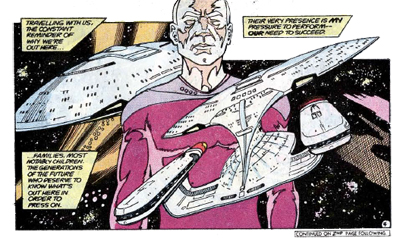
We’ll be supplementing our coverage of the episodes with some additional materials – mainly novels and comics and films. This is one such entry. This is actually supplementary to the first season of the Next Generation, specifically the episode Encounter at Farpoint.

When Malibu comics launched their Star Trek: Deep Space Nine comic in 1993, the first season of the show had concluded. Due to licensing issues, Marvel Comics published the first Star Trek: Voyager tie-in comic in late 1996, after the show’s second season had concluded. The notoriously dodgy Gold Key Star Trek comics did run alongside the classic television show, but at least waited until 1967 to begin getting the details horribly wrong.

So publishing a tie-in to Star Trek: The Next Generation in early 1988 was an ambitious move by DC comics. By that point, the show’s first season was an ambitious prospect. The six issue miniseries was launched as part of a big publicity push at the start of The Next Generation, with editor Robert Greenberger explaining in the afterword to the first issue that Paramount had approached them “sometime early this year” to write the series.

This means that the comic was being written before Encounter at Farpoint was even finished. In the letters section in the second issue, Greenberger concedes, “As I write this, it’s mid-September and Star Trek: The Next Generation has yet to debut anywhere in America.” It’s no wonder that Michael Carlin’s series wound up so inconsistent and so decidedly strange. While it’s an interesting demonstration of just how firmly Paramount were pushing their new show, it’s hardly a triumph of tie-ins.

These are the voyages...

These are the voyages…

Continue reading

Star Trek: The Lost Era – The Buried Age by Christopher L. Bennett (Review)

This January and February, we’ll be finishing up our look at the second season of Star Trek: The Next Generation and moving on to the third year of the show, both recently and lovingly remastered for high definition. Check back daily for the latest review.

We’ll be supplementing our coverage of the episodes with some additional materials – mainly novels and comics and films. This is one such entry. This is actually supplementary to the first season of the Next Generation, specifically the episode Encounter at Farpoint.

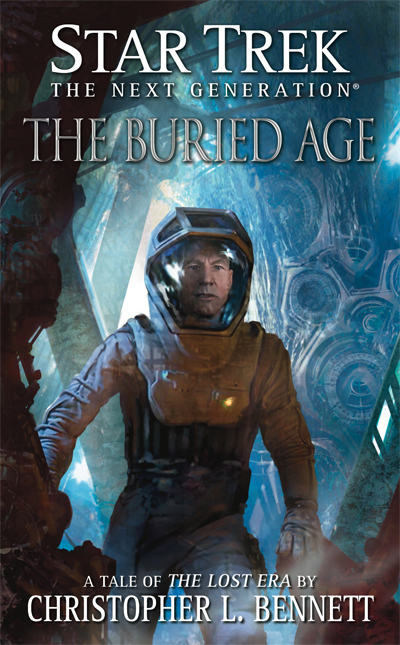
“I’m offering the chance to find something entirely new,” Picard teases at one point in The Buried Age. “To begin filling in a tremendous gap in our understanding of galactic history.” In a way, Picard might as well be addressing the reader, explaining one of the many joys of Christopher L. Bennett’s The Buried Age. It is a chance to delve into the world of Star Trek, exploring the lacuna that exists leading directly into Encounter at Farpoint.

tng-theburiedage

Continue reading

Star Trek: The Next Generation – Dark Mirror by Diane Duane (Review)

Star Trek: Deep Space Nine is twenty years old this year. To celebrate, I’m taking a look at the first and second seasons. Check back daily for the latest review or retrospective.

We’ll be supplementing our coverage of the episodes with some additional materials – mainly novels and comics and films. This is one such entry.

Dark Mirror was released a few mere months before Crossover was broadcast – one of those moments of pop culture synergy where it turns out that two different individuals can have the same idea, but with infinitely different nuance or emphasis. Indeed, the timing syncs up so well that Crossover actually aired between the hardcover and soft cover printings of Dark Mirror, suggesting that a return to the mirror universe was something of an inevitability for Star Trek, in one form or another.

Duane’s approach to the mirror universe is markedly different to that of writers Michael Piller and Peter Allan Fields, with both Dark Mirror and Crossover taking the ending of Mirror, Mirror and running with it in opposite directions. Piller and Fields used the aftermath of Kirk’s meddling as a means to explore the consequences of interference in a culture that Kirk didn’t quite understand – a mechanism to explore the way that the original Star Trek didn’t seem to grasp moral relativity, and to explore political complexities outside Kirk’s value system.

In contrast, Dark Mirror is a more philosophical meditation on the nature of good and evil, a more metaphysical exploration of a fictional world built around the concept of selfishness and strength, and how such a universe would have to work on different physical laws than that of Star Trek: The Next Generation.

tng-darkmirror

Continue reading

Star Trek: Deep Space Nine – Q-Less (Review)

Star Trek: Deep Space Nine is twenty years old this year. To celebrate, I’m taking a look at the first season. Check back daily for the latest review or retrospective.

And the first season of Deep Space Nine continues its trend towards mediocrity. I feel I should qualify that. The first season of Deep Space Nine is never truly terrible. Even the (very) dodgy Move Along Home is superior to any number of episodes from the first season of Star Trek: The Next Generation, like Code of Honour or Angel One. The first season of Deep Space Nine just winds up feeling like it’s treading water, as if it is trying too hard to emulate The Next Generation, instead of exploring the unique storytelling opportunities offered by the show’s setting.

Q-Less is arguably the most obvious example of these attempts at imitation. While episodes like Babel and The Passenger could have been reworked as episodes of The Next Generation with a minimum of fuss, Q-Less rather cynically takes two recurring guest stars from The Next Generation and allows them to steal focus from an ensemble that is still finding its feet. It feels not only a little ill-judged, but also a bit rude.

Guess Q...

Guess Q…

Continue reading

Star Trek: Deep Space Nine – Emissary (Review)

Star Trek: Deep Space Nine is twenty years old this year. To celebrate, I’m taking a look at the first season. Check back daily for the latest review or retrospective.

Star Trek: Deep Space Nine is a phenomenal piece of television. It’s often a bit overlooked because of its unique setting. After all, the words Star Trek evoke space ships and new worlds – “new life forms and new civilisations.” As such, a Star Trek series about a space station feels counter-intuitive. “To boldly sit” is the hardly the most dynamic premise. And yet, despite that, there’s a very serious argument to be made that Deep Space Nine is the crowning accomplishment of television Star Trek. It’s certainly the last great attempt to boldly push the franchise forward, with Star Trek: Voyager and Star Trek: Enterprise feeling just a tad regressive and conservative in comparison.

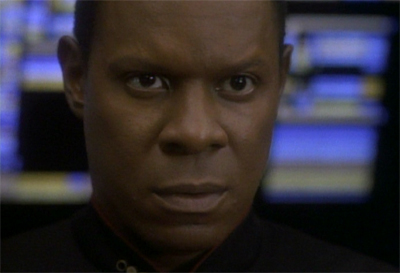
Indeed, Deep Space Nine represents a massive narrative leap forward from the success of Star Trek: The Next Generation, which remains one of the greatest science-fiction shows ever produced. For better or worse, Emissary makes it quite clear that Deep Space Nine is not an attempt to copy its direct predecessor, even if some of the other episodes in the first season might back-pedal a bit. In fact, it’s surprising just how well the pilot for this strangest of Star Trek shows holds up, suggesting a firmer grasp of its own identity than a few of the subsequent episodes could claim.

A Commanding presence...

A Commanding presence…

Continue reading

Star Trek: The Next Generation – Requiem by Michael Jan Friedman & Kevin Ryan (Review)

To celebrate the release of Star Trek: Into Darkness this month, we’ll be running through the first season of the classic Star Trek all this month. Check back daily to get ready to boldly go. It’s only logical.

We’ll be supplementing our coverage of the episodes with some additional materials – mainly novels and comics and films. This is one such entry.

At the risk of stating the obvious, Star Trek is a franchise spanning almost half-a-century with six leading actors and five different television shows. Due to its nature, one of the more enjoyably fanboy-ish pastimes is attempting to reimagine various confrontations and encounters, swapping out the characters involved. How would Kirk have responded to the Borg? Would Sisko have been ideally suited to dealing with the Xindi threat? What if Janeway faced the Doomsday Machine? Different characters have different defining moments, and those moments often play to their particular strengths. It might be fun to watch Khan spar with Picard, but it probably wouldn’t work as well as it did with Kirk. Q and Kirk would probably have difficulty striking it off.

Still, Kirk’s confrontation with the Gorn in Arena stands as one of the most iconic moments in the whole of the franchise, to the point where the weird toga-wearing god-like being at the end barely gets a look-in. Indeed, based on Sisko’s fanboy gushing in Trials and Tribble-ations, it seems to be one of Kirk’s defining moments within the shared Star Trek universe. So it might be fun to take Captain Jean-Luc Picard, and put him through that same sort of confrontation.

tng-requiem

Continue reading

Star Trek: The Next Generation – The Outrageous Okona (Review)

To celebrate the twenty-fifth anniversary of Star Trek: The Next Generation, and also next year’s release of Star Trek: Into Darkness, I’m taking a look at the recent blu ray release of the first season (and a tiny bit of the second), episode-by-episode. Check back daily for the latest review.

Well, I’m not sure if you can call two solid episodes in succession a “streak” or a “roll”, but Where Silence Has Lease and Elementary, Dear Data were two hours of television that demonstrated how far the second season of Star Trek: The Next Generation had come since its rocky first season. However, it appears that the two very good episodes in a row did not represent a sudden change in direction and did not assure consistency. The Outrageous Okona is a bad episode, by just about any measure. It’s not necessarily as offensive as Angel One or Code of Honour, but it is quite painful to watch.

Unlike a lot of the bungled “message” shows in the first season that contained misjudged ideas or offensive elements, The Outrageous Okona is merely a terribly written and unfunny mess of an episode that simply gnaws at the viewer.

He works best Solo...

He works best Solo…

Continue reading

Star Trek: The Next Generation – Elementary, Dear Data (Review)

To celebrate the twenty-fifth anniversary of Star Trek: The Next Generation, and also next year’s release of Star Trek: Into Darkness, I’m taking a look at the recent blu ray release of the first season (and a tiny bit of the second), episode-by-episode. Check back daily for the latest review.

If you needed more evidence of the improvement of Star Trek: The Next Generation between the first and second seasons of the show, Elementary, Dear Data certainly provides it. Like Where Silence Has Lease directly before it, Elementary, Dear Data works so well because it takes a couple of ideas hinted at and teased in the first season and then develops them just a little bit further.

There’s a sense that the universe of The Next Generation is slowly expanding. While the first season treated our main characters as masters of all they surveyed, Elementary, Dear Data hints that the universe still has more to teach them and that they have a lot to learn.

Unfortunately, the trend would not continue into the next episode, but Elementary, Dear Data proves that the writing team (and the cast) are learning to play to the show’s strengths and that the pieces are all positioned to allow for a solidly entertaining hour of television.

Things take a turn for the better...

Things take a turn for the better…

Continue reading