• Following Us

  • Categories

  • Check out the Archives


  • Awards & Nominations

Star Trek: The Next Generation (DC Comics, 1989) #59-61 – Children of Chaos/Mother of Madness/Brothers in Darkness (Review)

This January and February, we’ll be finishing up our look at the second season of Star Trek: The Next Generation and moving on to the third year of the show, both recently and lovingly remastered for high definition. Check back daily for the latest review.

We’ll be supplementing our coverage of the episodes with some additional materials – mainly novels and comics and films. This is one such entry. This is actually supplementary to the first season of the Next Generation, specifically the episode The Battle.

Continuity is a funny thing. Star Trek: The Next Generation would develop its own internal continuity as it went along. The  episodes featuring the Klingons and the Romulans (and the Borg) all fit together in a somewhat logical and progressive pattern, even if the show lacked the clear story arc structure of Star Trek: Deep Space Nine. While the show did offer background information on the members of the Enterprise crew, it never felt particularly beholden to them.

Picard’s time commanding the Stargazer was one of the earliest parts of his history to be established, in the first season episode The Battle. Picard’s tenure on the ship is alluded to several times over the course of the series, and there’s a sense that it was a formative experience for the commander. While it’s never stated outright, it’s suggested that the death of Jack Crusher and the loss of the Stargazer may have turned him into the somewhat aloof and distant superior we met in Encounter at Farpoint.
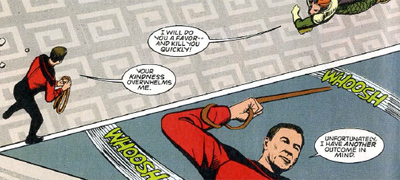
The slingshot manoeuvre...

The slingshot manoeuvre…

And yet, despite that, The Next Generation never delves too deeply into Picard’s past. There’s the occasional reference to his time serving on the Stargazer, or a reminder of his complicated relationship with Wesley and Beverly Crusher, but The Next Generation is a television show that seems to move forwards. Even the events that happen to Picard in the context of the show – his abduction by the Borg in The Best of Both Worlds or his alternate life in The Inner Light – don’t seem to have affected Picard too much.

So it seems appropriate that this bit of future history should become fodder for the comic books and tie-in materials, delving mroe deeply into the history of The Next Generation than was possible (or even desired) on screen.
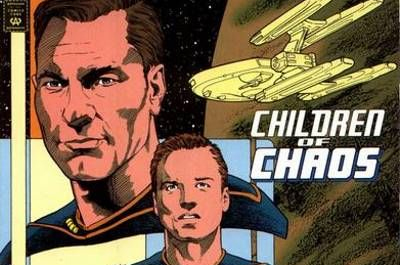
Stargazing...

Stargazing…

Continue reading

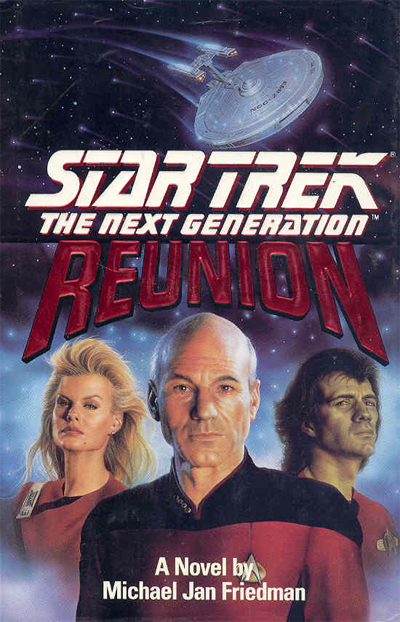
Star Trek: The Next Generation – Reunion by Michael Jan Friedman (Review)

This January and February, we’ll be finishing up our look at the second season of Star Trek: The Next Generation and moving on to the third year of the show, both recently and lovingly remastered for high definition. Check back daily for the latest review.

We’ll be supplementing our coverage of the episodes with some additional materials – mainly novels and comics and films. This is one such entry. This is actually supplementary to the first season of the Next Generation, specifically the episode The Battle.

The Star Trek expanded universe is so large and so expansive that it has its own particular phases of history, its own important and divisive figures, its own grand context for things. With the announcement of Star Trek: The Next Generation in the late eighties, the focus of expanded universe shifted a bit. Ever since the original Star Trek had gone off the air, novelists like John Ford, Vonda McIntyre, Diane Carey and Diane Duane had been free to carve out their own little corners of the shared universe.

There was a sense that the novels existed to expand the Star Trek universe outwards, with certain authors even developing their own recurring casts and delving into the history and culture of various fictional races in a way that simply wasn’t possible as part of a television episode or feature film. In the late eighties, this changed rather dramatically, with Richard Arnold becoming something of a “gate-keeper” of the expanded universe.

Although Diane Carey would write the first Next Generation tie-in novel, Ghost Ship, this represented something of a changing of the guard. The focus of the novels became a bit different, and the authors driving the line began to change. Michael Jan Friedman’s first published Star Trek novel was Double, Double in April 1989. Since than, he has written more than thirty different Star Trek tie-in novels, a few short stories and ninety-one issues (including annuals and specials) of the nineties Next Generation tie-in comic.

In terms of influence in the Star Trek expanded universe of the nineties, Michael Jan Friedman is a defining figure.

tng-reunion

Continue reading

Star Trek: The Next Generation – Samaritan Snare (Review)

This January and February, we’ll be finishing up our look at the second season of Star Trek: The Next Generation and moving on to the third year of the show, both recently and lovingly remastered for high definition. Check back daily for the latest review.

To describe Samaritan Snare as a step down from Q Who? feels like an understatement. Q Who? was Star Trek: The Next Generation realising that it needed to improve its game if it ever wanted to measure up to its predecessor, interrogating some aspects of the series that had been taken for granted, calling the crew out on their arrogance and offering an opponent that could really push the Enterprise crew for all that they are worth.

It was really the logical culmination of themes running through the second season, themes that seem to faintly echo into Samaritan Snare, another story about the arrogance and ego of the Enterprise crew. Unfortunately, while it does seem to acknowledge many of the same weaknesses and flaws that Q Who? hit upon, it can’t help but seem a little disappointing. Here, the Enterprise are not thrown against an impossible-to-defeat adversary. Instead, their arrogance turns them into interstellar marks.

His heart just isn't in it...

His heart just isn’t in it…

Continue reading

Star Trek: The Next Generation – Q Who? (Review)

This January and February, we’ll be finishing up our look at the second season of Star Trek: The Next Generation and moving on to the third year of the show, both recently and lovingly remastered for high definition. Check back daily for the latest review.

Q Who? throws down the gauntlet for Star Trek: The Next Generation. It serves as a fitting reminder that Picard and his crew are still amateurs when it comes to space exploration. They don’t even win the day – they suffer “a bloody nose” before limping away from their strange new opponents to lick their wounds. For a crew that never seemed to sweat before, who never seemed like they were under pressure, this is a shocking development.

More interestingly, it’s something unknown in a universe that has become far too familiar. Three of the four episodes leading into Q Who? ended with the crew accepting that there were some things they’d never fully understand or comprehend, and – while it’s unlikely this was intentional – it seems like a nice bit of thematic foreshadowing rather than haphazard plotting. For the first season-and-a-half of the show, it seemed like the Enterprise was always dealing with the familiar, always in control of the situation.

With Q Who?, everything is put into perspective.

Borg to death...

Borg to death…

Continue reading

Star Trek: The Next Generation – Pen Pals (Review)

This January and February, we’ll be finishing up our look at the second season of Star Trek: The Next Generation and moving on to the third year of the show, both recently and lovingly remastered for high definition. Check back daily for the latest review.

Pen Pals is a pretty mediocre episode of Star Trek: The Next Generation, one with a lot more potential than the episode actually delivers upon. Centring around Data’s unilateral decision to violate the Prime Directive and the consequences stemming from that decision, there’s a sense that Pen Pals might have been a lot more incisive in earlier version – a lot more willing to ask tough questions about the rules and regulations that our heroes uphold.

Sadly, Pen Pals instead ends with a massive cop out and an unwillingness to really commit to any big idea or to interrogate any of the show’s core concepts.

Everything burns...

Everything burns…

Continue reading

Star Trek: The Next Generation (DC) Annual #2 – Thin Ice (Review)

This January and February, we’ll be finishing up our look at the second season of Star Trek: The Next Generation and moving on to the third year of the show, both recently and lovingly remastered for high definition. Check back daily for the latest review.

We’ll be supplementing our coverage of the episodes with some additional materials – mainly novels and comics and films. This is one such entry.

Riker is a character caught between a rock and a hard place. According to the series bible, Riker was imagined as one of the “dual lead characters” for the show and clearly envisioned as an impulsive and brilliant Kirk to Picard’s more rational and stoic Spock. However, it didn’t quite work out that way, for a number of reasons. For one thing, the writing on the early years of Star Trek: The Next Generation tended to be a bit more sterile and bland, so Riker was never really allowed to step too far out of Picard’s shadow.

Instead, we got lots of characters talking about how ambitious Riker was, without seeing it for ourselves. It’s implied that Riker’s career led him to separate from Troi, something Peter David ran with in Imzadi. Everybody is constantly telling everybody else how Riker desperately wants to be a starship commander. And yet, when it come to the actual characterisation of Riker on the show, none of this shines through.

Due to the constraints imposed on the early years, interpersonal conflict was impossible in early Next Generation scripts, putting Riker in a paradoxical position as a character. We’re repeatedly told how ambitious and career-orientated he is, but none of that shines through.

Dead space...

Dead space…

Continue reading

Star Trek: The Next Generation – Time Squared (Review)

This January and February, we’ll be finishing up our look at the second season of Star Trek: The Next Generation and moving on to the third year of the show, both recently and lovingly remastered for high definition. Check back daily for the latest review.

Time Squared is an intriguing little episode, if not entirely satisfying. Like The Royale before it, it features the Enterprise stumbling across a phenomenon that it can’t explain. Also like The Royale, the episode presents an existential horror to the crew. Time Squared is significantly stronger as a character piece, forcing Picard to confront a potential future version of himself that he can’t reconcile with his own expectations and self-image. Unfortunately, the open-ended mystery of the episode lacks the bizarre charm of the unresolved questions dangling at the end of The Royale.

"I never noticed before, but the Captain has pretty spectacular bone structure..."

“I never noticed before, but the Captain has pretty spectacular bone structure…”

Continue reading

Star Trek: The Next Generation – The Sky’s The Limit: Meet with Triumph and Disaster & Trust Yourself When All Men Doubt You by Michael Schuster & Steve Mollmann (Review)

This January and February, we’ll be finishing up our look at the second season of Star Trek: The Next Generation and moving on to the third year of the show, both recently and lovingly remastered for high definition. Check back daily for the latest review.

We’ll be supplementing our coverage of the episodes with some additional materials – mainly novels and comics and films. This is one such entry. This is actually supplementary to the first season of the Next Generation, specifically the episode Encounter at Farpoint.

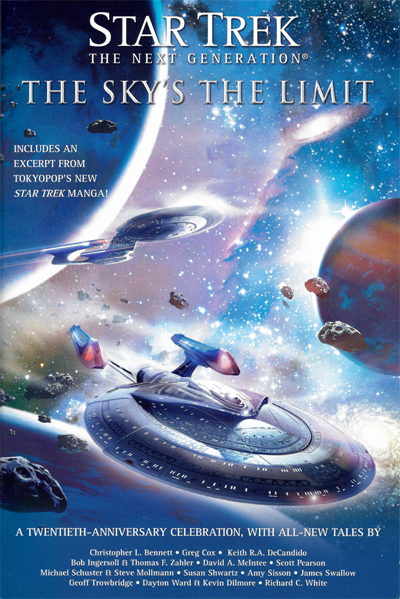
The Sky’s the Limit was an anthology released to celebrate the twentieth anniversary of Star Trek: The Next Generation in 2007. It was a bit of a no brainer, edited by the wonderful Marco Palmieri in the style of anthologies like The Lives of Dax or Prophecy and Change. The goal was to draw together a bunch of talented writers to fashion stories involving the crew and the ship at various stages in the life cycle of the Enterprise. There is a short story for every season of the show, save the fourth, and between each of the movies.

tng-theskysthelimit

Continue reading

Star Trek: The Next Generation – Masks by John Vornholt (Review)

This January and February, we’ll be finishing up our look at the second season of Star Trek: The Next Generation and moving on to the third year of the show, both recently and lovingly remastered for high definition. Check back daily for the latest review.

We’ll be supplementing our coverage of the episodes with some additional materials – mainly novels and comics and films. This is one such entry.

Generally, I’ve been looking at novels and tie-ins that are specifically or thematically related to specific episodes of Star Trek: The Next Generation. It’s a valid approach to writing about the show, searching out material that expands or develops themes and concepts and characters lightly touched upon during the episode in question. However, some times it is also worth taking time out to look at what was happening in tie-in fiction at approximately the same time.

Obviously, the scripts written by writers working on the show were the result of a careful creative process drawing input from the writers in general, the producers and the studio. They were crafted with a key eye to shaping the future direction of the show, by the people working on the show. Looking at official tie-in material from the same time allows us to venture a bit outside that circle, and to get a glimpse of what The Next Generation might have looked like to a creator outside the writers’ room as it was going to air.

Masks was published in July 1989, after Shades of Grey had aired and the second season had limped off the screen. While author John Vornholt obviously could not have seen the whole season on submitting his novel, it is interesting to get his view of the sci-fi spin-off in its sophomore season.

tng-masks

Continue reading

Star Trek: The Next Generation – The Measure of a Man: Extended Cut (Review)

This January and February, we’ll be finishing up our look at the second season of Star Trek: The Next Generation and moving on to the third year of the show, both recently and lovingly remastered for high definition. Check back daily for the latest review.

We’ll be supplementing our coverage of the episodes with some additional materials – mainly novels and comics and films. This is one such entry.

This is a rare treat.

The Measure of a Man is generally regarded as one of the best episodes that Star Trek: The Next Generation ever produced, and a crown jewel in the entire Star Trek franchise. As such, it’s a prime candidate for this sort of lavish restoration treatment, with the blu ray collection featuring not only the televised version of the episode, but a special extended edition.

This extended edition was the version originally filmed and edited together, until the production team realised that it ran almost a quarter-of-an-hour over the slot allocated to the show on syndicated airing.

tng-themeasureofaman23

Continue reading