• Following Us

  • Categories

  • Check out the Archives


  • Awards & Nominations

The X-Files – William (Review)

This December, we’re taking a trip back in time to review the ninth season of The X-Files.

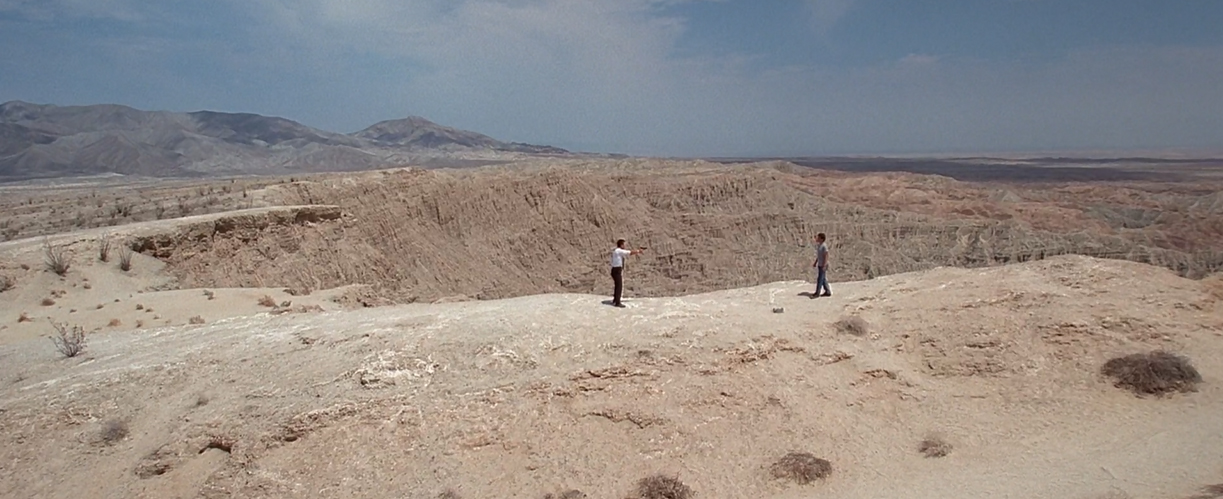
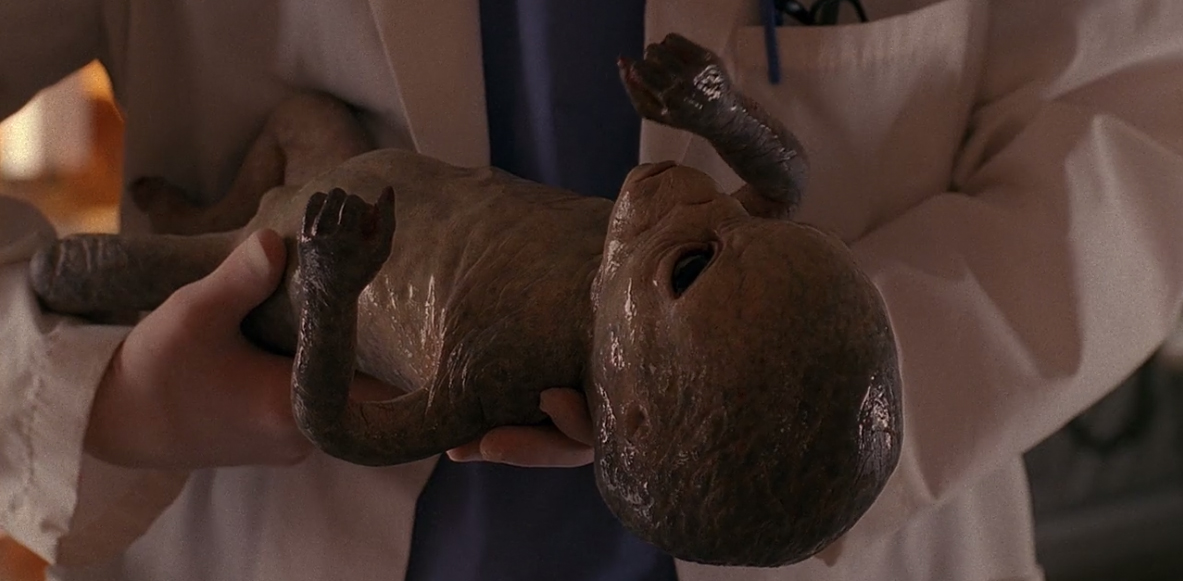
William was supposed to make things simpler for The X-Files going forward.

Although the pregnancy narrative of the eighth season had provided a solid arc across the year, it seemed like the production team had no idea what to do with William once the child actually arrived. Despite the fact that Essence and Existence insisted that William was a miracle completely unrelated to the alien colonists, Nothing Important Happened Today I and Nothing Important Happened Today II tried to tie William back into the mythology. Trust No 1 suggested William was part of prophecy. Provenance and Providence had the baby kidnapped.

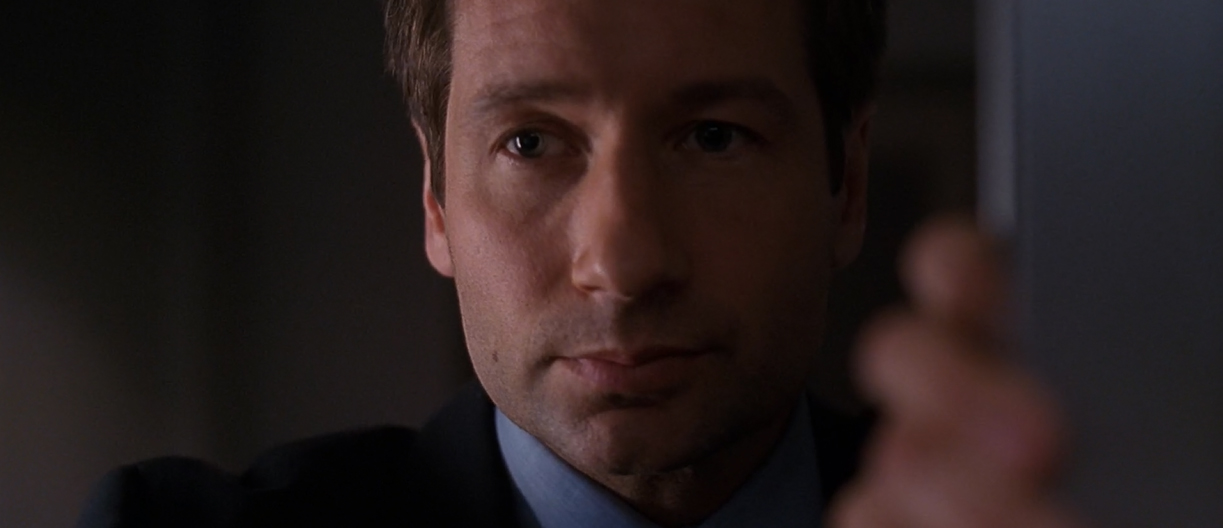
Mulder cameo.

Mulder cameo.

One of the more frequent criticisms of the ninth season is that William served to handicap Scully as a character. Scully was suddenly relegated to the role of mother, with the scripts and the fans constantly wondering why Scully wasn’t spending more time with the baby. The mythology suggested that Scully was only relevant because of her connections to William and Mulder. Although William and Mulder were subject to a colonist prophecy, Scully was not mentioned. She was just a tether connecting the two, accessible because Gillian Anderson was still in the show.

The fact that the series was ending provided the perfect opportunity to clear William away. William is clearly designed to declutter the narrative of the show by disposing of a dangling loose end. Ironically, it only serves to create a whole lot more.

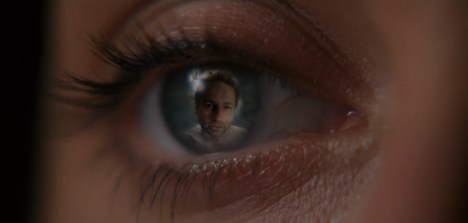
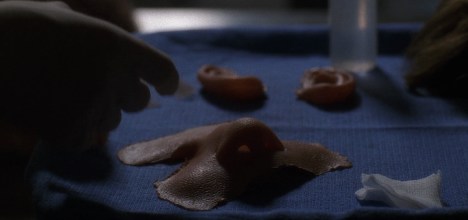
Taking his face... off.

Taking his face… off.

Continue reading

The X-Files – Provenance (Review)

This December, we’re taking a trip back in time to review the ninth season of The X-Files.

Provenance and Providence are a landmark moment for The X-Files. They represent the last mid-season two-parter.

The mid-season two-parter has been an institution since the early second season, when external factors forced the production team to improvise around Gillian Anderson’s pregnancy. It was decided that the character of Scully would marginalised and written out so as to avoid dealing with the pregnancy, and the centre-piece of that plan was an epic two-parter that would air during in October 1994. Duane Barry and Ascension were such a big hit that the production team opted to do a second mid-season two-parter in February 1995, with Colony and End Game.

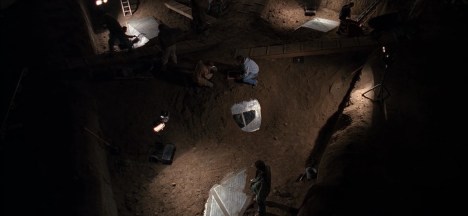
The Truth will not be buried...

The Truth will not be buried…

The show never looked back. Those episodes quickly codified the mythology, becoming a highlights in the season schedule. The two-parters typically aired during Sweeps and occasionally managed to garner press and media attention. They featured bigger budgets and impressive scale, with many of those two-parters standing out as prime examples of The X-Files as “event” television. The submarine in the ice in End Game, the leap to the train in Nisei, the mid-air alien abduction in Max. These were blockbuster moments.

Provenance and Providence would mark the end of this rich tradition. Sadly, they do not embody the finest attributes of the form.

Burnt notice.

Burnt notice.

Continue reading

The X-Files 102: Ten “Mythology” Episodes

Next week sees the release of The X-Files on blu ray for the first time, just over a month before the new six-episode series premieres on Fox in January. We’re running daily reviews of the show (and its spin-offs) between now and the end of the year, but we thought it might be worth compiling some guides for newer viewers who are looking to experience the length and breadth of what The X-Files has to offer. Every day this week, we’ll be publishing one quick list of recommended episodes every day, that should offer a good place to start for those looking to dive into the show.

There is no getting around the shadow of the “mythology”, the serialised central narrative of The X-Files which explored a sinister conspiracy between the United States government and alien forces building towards a sinister end. While the show was on the air, the mythology was a focal point for discussion and debate around the show, with many viewers speculating about the particulars of the allegiance between the shadowy syndicate and the mysterious visitors from outer space. It was one of the boldest and most distinctive features of the show.

xfiles-oneson4

Continue reading

The X-Files – Season 8 (Review)

This October/November, we’re taking a trip back in time to review the eighth season of The X-Files and the first (and only) season of The Lone Gunmen.

The eighth season of The X-Files would be the perfect last season of the show, and a pretty solid first season of a new show born from the ashes.

In many ways, television is a conservative medium – more in an artistic sense than a political one. Network television is largely built around churn, a conveyor belt model that is designed to generate product according to tight schedules and oppressive deadlines. Routine and familiarity make the production schedule easier to manage, particularly for shows with large season orders. More than that, if a show has figured out an approach that has worked, it makes no sense to deviate from that pattern.
xfiles-deadalive33a

Why risk changing something that has been proven to work and to which the audience has responded? For all the (deserved) praise The X-Files gets for popularising (or repopularising) serialised storytelling in prime-time television, it was just as conservative as any other show. The production team were working under incredible pressure, so it makes sense they would not want to change a formula that made sense. As such, the really big changes to the show were largely driven by external factors.

The mythology largely developed from Scully’s abduction in Duane Barry and Ascension, an attempt by the writers to work around Scully’s abduction. The decision to film The X-Files: Fight the Future between the fourth and fifth seasons was at the behest of Fox rather than the production team. David Duchovny forces the move to Los Angeles in the sixth season. The eighth season represents the most seismic shift in the creative life of The X-Files, and – as with those other big decisions – it was largely driven by choices outside the production team.

xfiles-thisisnothappening13a

In hindsight, it seems obvious that the show could not continue forever. Duchovny and Anderson were headlining a show that filmed twenty-odd episodes a season. The show had begun diffusing its focus in the fourth and fifth seasons by focusing on members of the supporting cast, but it was still effectively a two-lead show. That is a tremendous strain. Something had to give. It turned out that something was Duchovny. At the end of the seventh season, with everything coming down to the wire, Duchovny made it clear he would not appear in a full eighth season.

This forced the show to change, but in a way that afforded some measure of stability. The idea of doing The X-Files without either Mulder or Scully was horrifying to the production team and horrifying to certain sections of fandom, but Duchovny’s willingness to stick around for half of the eighth season afforded some measure of compromise. The change did not need to be jarring. Easing David Duchovny out of the show would allow for a smoother transition. It would allow the show to say a proper (and extended) farewell to Mulder.

xfiles-empedocles23a

This is perhaps the strongest aspect of the eighth season, the sense that it has a certainty and finality that the seventh season lacked. Even during the post-production of Requiem, the production team had no idea whether the seventh season would be the final season of the show. As a result, the seventh season is decidedly non-committal on the issue of closure. The eighth season is a lot more enthusiastic about the prospect of wrapping things up, once and for all. There is a sense that this is the final season of a version of the show, at the very least.

The eighth season finds itself in the impossible position of having to imagine The X-Files without Mulder. The only real issue is that it succeeds all too well. The biggest problem with the eighth season is that it is followed by a ninth season.

xfiles-without2a Continue reading

The X-Files – Essence (Review)

This October/November, we’re taking a trip back in time to review the eighth season of The X-Files and the first (and only) season of The Lone Gunmen.

The mythology of The X-Files is a strange beast.

In the show’s declining years, it frequently became a stick with which the show might be beaten by critics and fans who had grown exhausted of ambiguity and labyrinthine plotting. Steven King lamented the fact that the show “blundered off into a swamp of black oil, and in that swamp it died.” In assessing the impact of the series, Joyce Millman described the mythology as a “sadistically convoluted plot line.” Juliette Harrisson complained that the entire mythology ended up “so twisted and incomprehensible by the end.”

Oh, baby.

Oh, baby.

In hindsight, it seems like history has not been kind to the mythology. In the years since the show went off the air, it seems that fans have come to value the episodic “monster of the week” stories ahead of the central story arc about aliens plotting to colonise the planet. This is ironic, given the attention devoted to the mythology while the show was on the air. The mythology dominated season premieres and finalés, taking the limelight during Sweeps and commanding impressive production values.

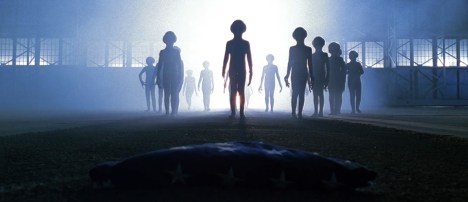
This assessment of the mythology is at once fair and unfair. Examined from far enough away, the mythology was linear and logical: alien colonists were coming back to reclaim the planet and enslave (or exterminate) mankind. Everything else was just window-dressing, with the mythology exploring the compromise and collaboration that facilitated this plan. The mythology was, at its best, an exploration of human weakness and the corruption of authority; a timeless (and almost Shakespearean) tragedy. From a sufficient distance, it was not hard to follow.

Oh, alien baby.

Oh, alien baby.

However, the details tend to create confusion, with everything getting a little muddled as The X-Files piles compelling and memorable visuals on top of one another. Are the bees intended to spread smallpox to thin the population as Zero Sum suggests, or to spread the black oil to aid in repopulation as The X-Files: Fight the Future implies? Is the black oil a sinister body-hopping parasite as suggested in Piper Maru and Vienen, or is it an organism that turns the body into a host for a gestating alien organism like in Fight the Future or The Beginning?

The eighth season does a lot to simplify the mythology by stripping out the conspirators and the vaccine and the rebels and the hybrids, replacing them with a more blunt central narrative about “alien replicants” mounting a stealth invasion. That said, things begin to get a bit cluttered and crowded as the season reaches its conclusion. Essence and Existence have a very clear structure and clear objectives, but there is a sense that that the narrative could still be streamlined a bit.

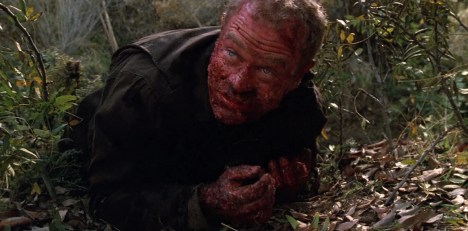
Oh, blood-splattered alien babies...

Oh, blood-splattered alien babies…

Continue reading

The X-Files – DeadAlive (Review)

This October/November, we’re taking a trip back in time to review the eighth season of The X-Files and the first (and only) season of The Lone Gunmen.

The X-Files is dead. Long live The X-Files.

What is dead may never die...

What is dead may never die…

Continue reading

The X-Files – Per Manum (Review)

This October/November, we’re taking a trip back in time to review the eighth season of The X-Files and the first (and only) season of The Lone Gunmen.

Per Manum marks a very serious shift in the eighth season of The X-Files.

It marks the point at which the show becomes more serialised and more tightly interwoven on an episode-to-episode basis than it had been at any point in the past. There are several “monster of the week” stories populating the final third of the eighth season (most obviously Vienen, Empedocles and Alone), but the last eight episodes of the season are more tightly interlocked than any other eight episodes of the show. Perhaps the closest comparison is to the opening nine episodes of the second season, but even the majority of those were stand-alones in a new status quo.

Things past...

Things past…

With Per Manum, the show reengages with the two big central mysteries driving the mythology of the eighth season. The closing moments of Requiem featured the disappearance of Mulder and the revelation of Scully’s pregnancy, establishing them as a driving force for the future of the show. Of course, nobody knew what form that future would take when Requiem was written and filmed. However, it is interesting how little forward momentum the eighth season has on these plot points. Two-thirds of the way through the season, neither is closer to resolution.

Of course, that is not to suggest that the production team have forgotten about Scully’s pregnancy or Mulder’s disappearance. One of the stronger aspects of the eighth season is the way that these details are woven into the plots of episodes where they are not even explicitly acknowledged. Mulder’s disappearance informs Scully’s unspoken reluctance to trust Doggett in Roadrunners; Scully’s pregnancy explains her decision not to go into the subway tunnels with Doggett in Medusa. Still, there is no linear sense of progress by this point of the year.

Hold it there...

Hold it there…

This is probably because these two plot threads cannot necessarily be explored in increments. Within and Without suggested that Mulder was being experimented upon from the comfort a spaceship; short of Scully and Doggett hijacking a space-shuttle, there is little they can do to affect his return but wait. Similarly, Scully’s pregnancy has a natural time limit imposed upon it; short of inducing labour, there is little she can do to affect the outcome but wait. As such, these are not the most dynamic plot points, but they work quite well in the context of the eighth season.

The first two thirds of the eighth season are spent waiting and anticipating, reflecting on strange absences and unexpected presences. The final third is spent rushing towards the finish line. Per Manum marks the transition point.

Don't turn this into a competition, Doggett...

Don’t turn this into a competition, Doggett…

Continue reading

The X-Files – En Ami (Review)

This September, we’re taking a trip back in time to review the seventh season of The X-Files and the first (and only) season of Harsh Realm.

The seventh season mythology has a weird hazy feeling to it. It feels almost like a postscript.

It is hard to explain what is happening with the mythology at this point. Two Fathers and One Son had promised an end to the over-arching conspiracy narrative, but it felt like something of a half-measure. The First Elder and the Second Elder were killed off, but most of the other major players remained. Although Scully congratulated Mulder on toppling the conspiracy in Biogenesis, the same episode seemed to off-handedly suggest that the Cigarette-Smoking Man was still working on it. He was still talking hybrids in The Sixth Extinction II: Amor Fati.

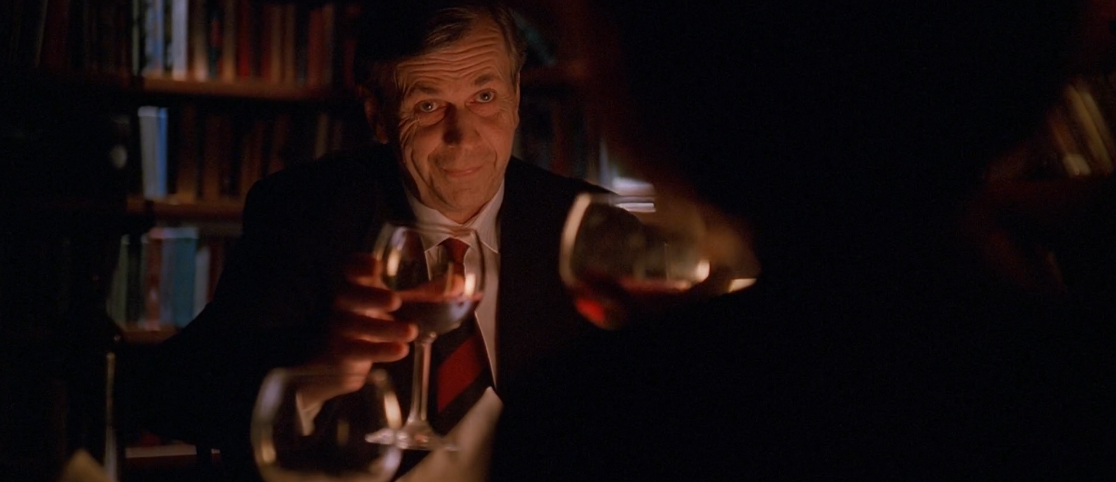
I'll drink to that...

I’ll drink to that…

At the same time, Two Fathers and One Son marked the end of the mythology as an on-going concern. The particulars of colonisation and the nature of the Cigarette-Smoking Man’s work were confined to limbo, some sort of bizarre twilight realm where they might exist or they might not; they simply drift around the show like ghosts. Whether or not Two Fathers and One Son actually resolved any aspect of the show’s overarching plot is open to debate; however, they very clearly suggested that the mythology was not the show’s central story going forward.

In the seventh season, it frequently feels like the mythology is a hazy backdrop against which character-driven stories might unfold. In The Sixth Extinction, an alien ship becomes a gateway to meditations on the nature of human existence while Krycek blackmails Skinner and Fowley still works with the Cigarette-Smoking Man. In The Sixth Extinction II: Amor Fati, the Cigarette-Smoking Man is making hybrids and murders Fowley, but the heart of the story is Mulder’s flirtation with temptation. Sein und Ziet and Closure have nothing to do with colonisation.

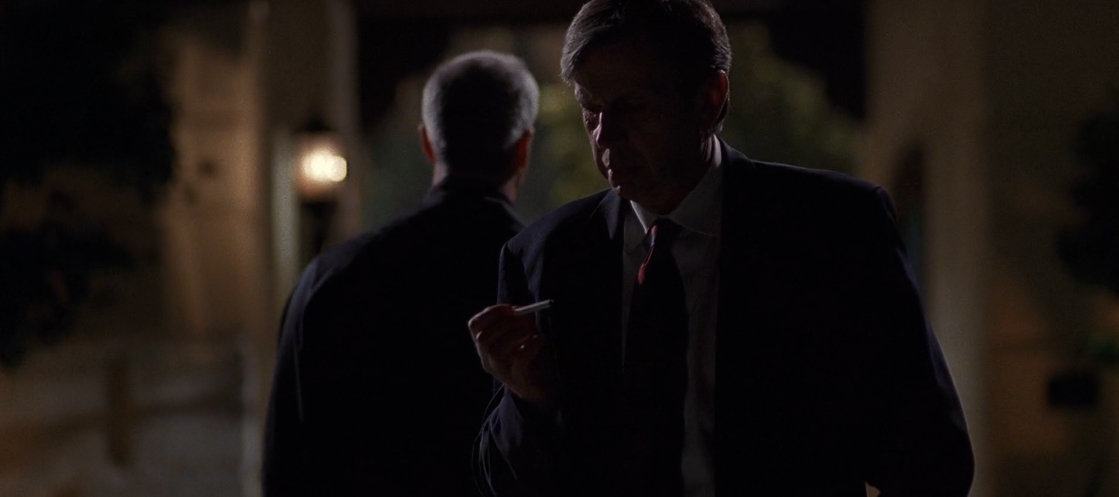
Smokey and the bandit...

Smokey and the bandit…

To be fair, this was arguably always the case with mythology episodes. In hindsight, it can seem like the mythology episodes were less part of an on-going story and more meditations on common themes tied into a shared continuity. Colony and End Game are spectacular pieces of television, but they are hard to reconcile with later revelations. The End arguably has more in common with Biogenesis than it does with the feature film into which it is supposed to tie. However, the mythology always held the promise of revelations and twists to propel it forward.

The principal effect of Two Fathers and One Son seems to have been to take away that sense of purpose and destination. The mythology is no longer building towards something or racing forward. Instead, the mythology stories seem to take place in the wasteland; a world in ruins, with only the fractured semblance of internal logic. En Ami continues the trend of setting character-driven stories amid the hazily defined unreality. Scully and the Cigarette-Smoking Man take a road-trip together through whatever is still standing.

Peering through an open door...

Peering through an open door…

Continue reading

The X-Files – Closure (Review)

This November, we’re taking a trip back in time to review the seventh season of The X-Files and the first (and only) season of Harsh Realm.

Sein und Zeit and Closure don’t fit together at all.

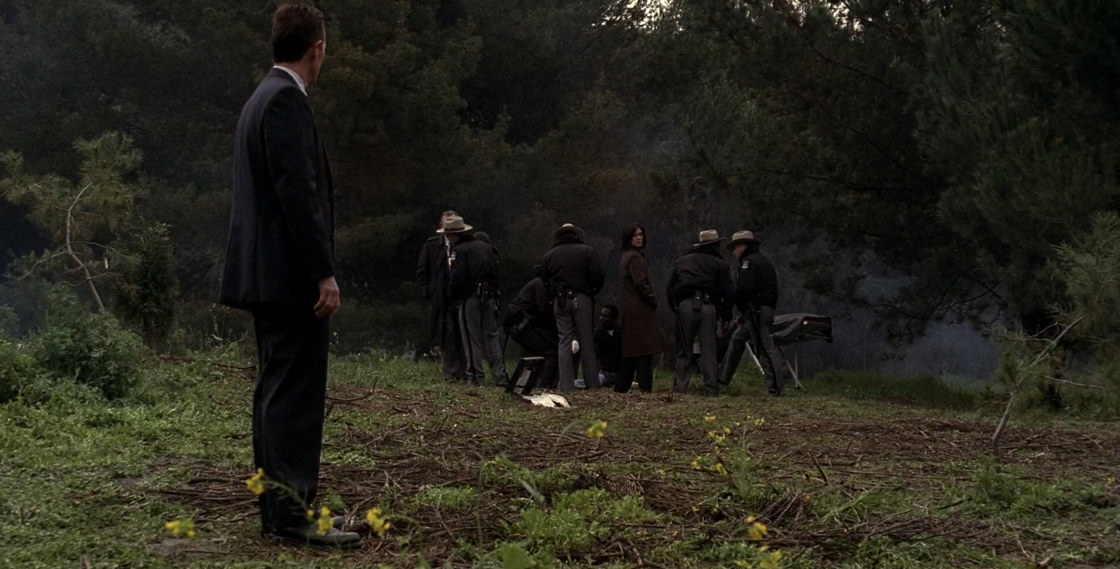
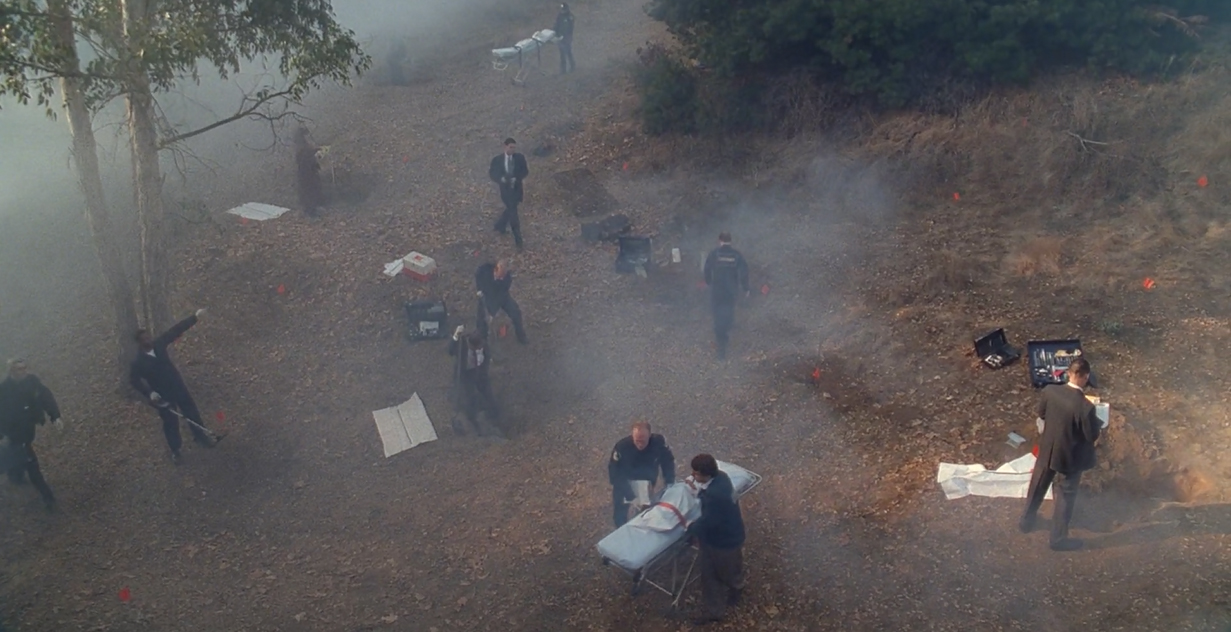
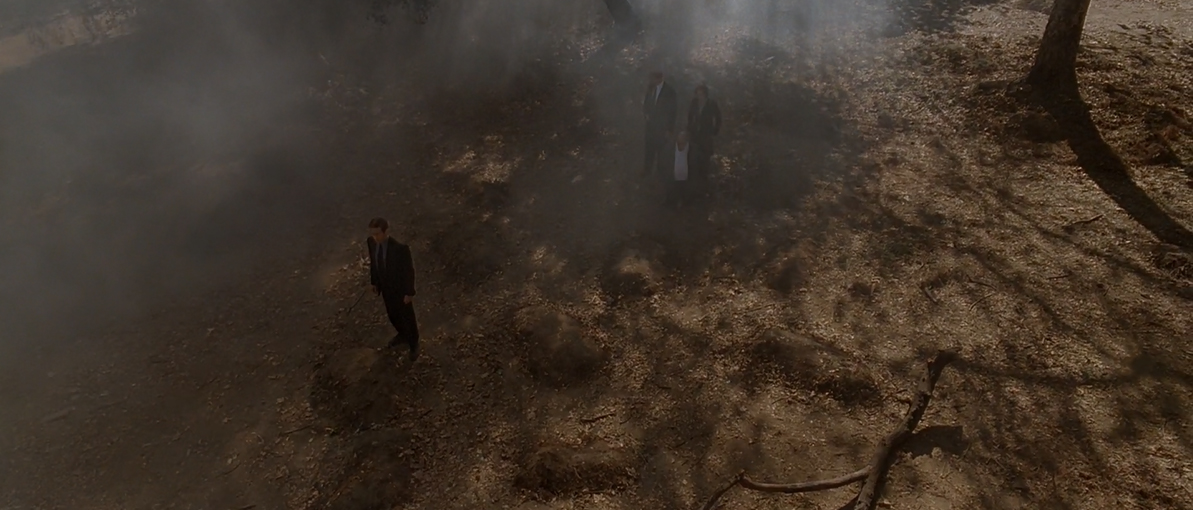
There is a nice symmetry to the stories, with Sein und Zeit closing with Mulder standing amid a mass grave and Closure opening with the excavation of the same mass grave. The contrast between the two shots of the same space says a lot about the differences between Sein und Zeit and Closure. Sein und Zeit is an episode that isolates Mulder, demonstrating how alone he truly is in the world and how all his beliefs might be empty; Closure responds by cluttering up the narrative and revealing an absurdly convoluted explanation of what happened to Samantha.

A grave subject...

A grave subject…

Even the themes of the two episodes are almost unique. Both Sein und Zeit and Closure are driven by Mulder’s desire to make sense of what happened to his sister, but both adopt diametrically different approaches towards the question. Sein und Zeit proposes that the world is a random and cruel place where bad things happen to children for no reason beyond the sadistic whims of strangers, while Closure embraces the idea that there is a larger scheme in which these horrible events occur.

There is a yin-and-yang structure to Sein und Zeit and Closure, a sense that the two episodes are almost at odds with one another when it comes to the fate of Samantha Mulder. Closure offers something approaching hope. It is too much to describe Closure as a happy-ending to the character arc that ran through the first seven seasons of the series, but it does offer Samantha an ending that is not soul-destroyingly bleak. It offers Mulder resolution and understanding. In his own words, it offers him freedom.

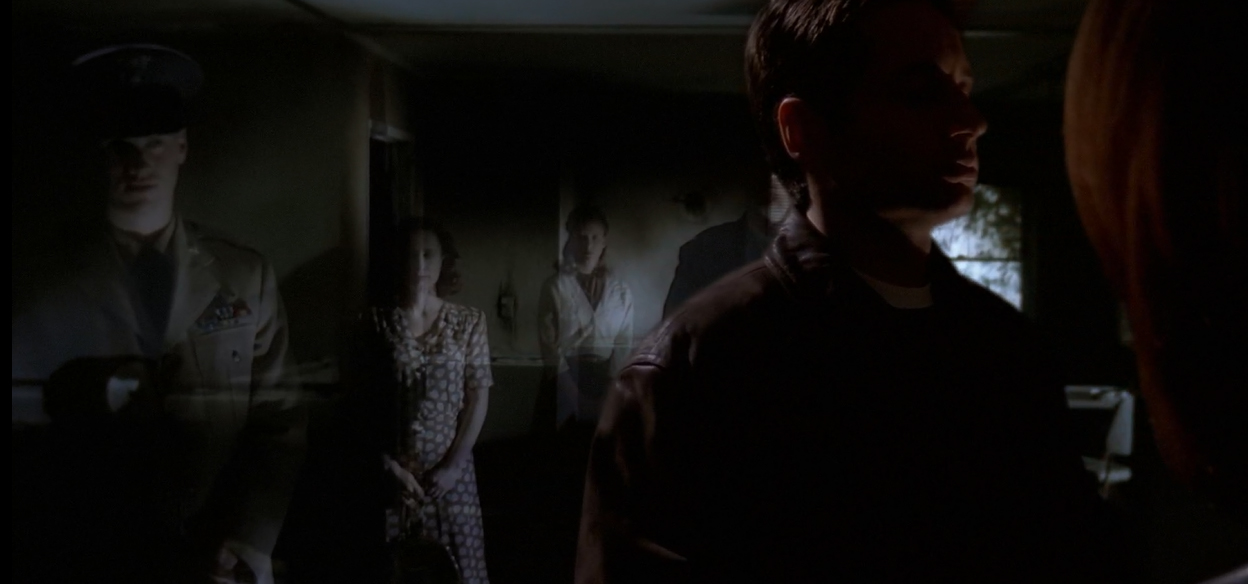
"Conscience... it's just the voices of the dead... trying to save us from our own damnation."

“Conscience… it’s just the voices of the dead… trying to save us from our own damnation.”

It is a very hopeful suggestion. It is a particularly hopeful suggestion coming at the middle of the show’s seventh season, as the resolution to Mulder’s character arc. The audience has spent seven years watching Mulder deal with the trauma of the loss of his sister, wrestling with the fear that he might never find an answer; or that he might find an answer that fails to make sense of it all. What if he found an answer that made sense of everything? What if Samantha’s disappearance wasn’t just part of a government conspiracy? What if it was part of something bigger?

What if the disappearance of Samantha Mulder meant everything?

A man alone.

A man alone.

Continue reading

The X-Files – Sein und Zeit (Review)

This November, we’re taking a trip back in time to review the seventh season of The X-Files and the first (and only) season of Harsh Realm.

Sein und Zeit and Closure don’t fit together at all.

There is a clear demarcation that exists between the two episodes, to the point where they cannot really be described as a single two-part story. Following the disappearance of Amber Lynn LaPierre from her home, Sein und Zeit closes with the arrest of a serial child-murderer and the discovery of a mass grave. There is not a whiff of the show’s central mythology to be found, despite Mulder’s insistence and anxiety. Although Closure picks up where Sein und Zeit left off, it embarks on its own separate story that does draw heavily from the show’s established mythology.

A grave subject...

A grave subject…

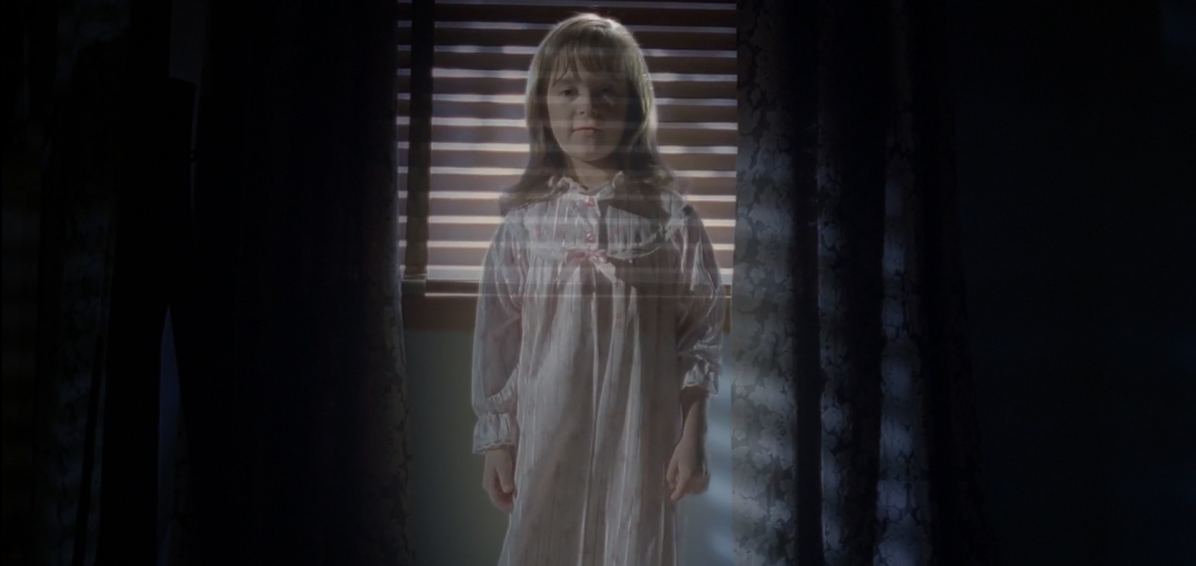
Even the guest casts of the two episodes are almost unique. Outside of David Duchovny and Gillian Anderson, only two guest stars appear in both episodes. Rebecca Toolan and Megan Corletto both play characters who die in Sein und Zeit, but appear as ghosts in Closure. The featured guest stars in Sein und Zeit do not reappear in Closure, and vice versa. Even the series’ recurring cast is firmly divided between the two halves; Walter Skinner appears in Sein und Zeit, while the Cigarette-Smoking Man plays an important role in Closure.

There is a yin-and-yang structure to Sein und Zeit and Closure, a sense that the two episodes are almost at odds with one another when it comes to the fate of Samantha Mulder. Sein und Zeit dares to ask what might happen if there was no rhyme or reason to her abduction; what if it was just a tragedy, like the tragedies that happen to happy families all the time? Mulder has invested so much of himself in the quest to explain what happened on that night in late November 1973; what would happen if there were no meaningful explanation?

"Conscience... it's just the voices of the dead... trying to save us from our own damnation."

“Conscience… it’s just the voices of the dead… trying to save us from our own damnation.”

It is a very bleak suggestion. It is a particularly bleak suggestion coming at the middle of the show’s seventh season, as the resolution to Mulder’s character arc. The audience has spent seven years watching Mulder dig deeper and deeper into a sinister conspiracy against mankind, largely motivated by the fact that his sister’s disappearance is a part of some larger puzzle. What if it wasn’t? What if Mulder’s whole quest were simply a lie that he had told himself? What if Mulder wanted to believe so badly that he convinced himself that this made sense?

What if the disappearance of Samantha Mulder meant nothing?

A man alone.

A man alone.

Continue reading