• Following Us

  • Categories

  • Check out the Archives


  • Awards & Nominations

New Podcast! The X-Cast – Season 2, Episode 17 (“End Game”)

Just a quick link to a recent (unscheduled) guest appearance over on The X-Cast, a great X-Files podcast run by the prolific Tony Black.

Following on from last week, I had the pleasure of an extended conversation with Tony about End Game. It was a joy, given the my own fondness for the episode and its place in the large X-Files canon. It was a fun to talk through the episode, from what Mulder really wants to whether the show’s popularity drove the mythology or the mythology’s popularity drove the show to Mister X’s appreciation for the fine arts. Check it out the episode here, or click the link below.

Continue reading

Star Trek: Voyager – Distant Origin (Review)

Like Remember before it, Distant Origin is a really great example of how Star Trek: Voyager‘s efforts to build a “generic Star Trek series can produce memorable and satisfying episodes of television.

There is very little about Distant Origin that demands to be set in the Delta Quadrant. In fact, Distant Origin arguably makes less sense as an episode set in the Delta Quadrant than it would as an episode set in the Alpha or Beta Quadrants. Episodes like The 37’s and Distant Origin (and the lies at the heart of Favourite Son) seem to suggest a lot of traffic between Earth and the Delta Quadrant beyond the Caretaker. It seems strange the Voth would migrate so far in search of a place to call home.

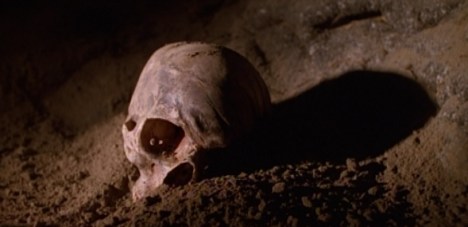
Skullduggery.

Skullduggery.

However, for all that Distant Origin feels like a strange fit for the series’ Delta Quadrant setting, it feels very much like quintessential Star Trek. Like Remember earlier in the season, Distant Origin is very much an old-fashioned Star Trek allegory that uses characters in cheesy make-up to comment upon contemporary issues. In Remember, it was the reality of holocaust denial. In Distant Origin, it is the age-old conflict of science-against-political-expedience. There is an endearing timelessness to the metaphor at the centre of the story.

With its dinosaur characters, its fixation upon evolution, and its doctrine of “origin”, Distant Origin seems very specifically tailored to the heated debates around science and creationism in American culture. However, the allegory is powerful enough that it maintains a potency even beyond that. Distant Origin has aged remarkably well, working effectively as a metaphor for climate change denial or even for historical revisionism in favour of the national myth. Distant Origin is both a season and a series highlight.

The bones of a theory.

The bare bones of a theory.

Continue reading

The X-Files – My Struggle I (Review)

This June, we’re going to be taking a look at the current run of The X-Files, beginning with the IDW comic book revival and perhaps taking some detours along the way. Check back daily for the latest review.

This is journey that began for me – I’m sorry if I get emotional – twenty-three years ago. Things just don’t last in culture, these days. They… culture gobbles them up and they go away. It’s… it’s rare when something sticks around. Thanks for being part of the journey. The idea is that this is not the end. This is maybe a new beginning. And maybe we’ll do more of these if we do a really good job.

– Chris Carter’s opening remarks at the first production meeting on My Struggle I

The truth is still out there...

The truth is still out there…

Continue reading

The X-Files: Season 10 (IDW) #21-25 – Elders (Review)

This June, we’re going to be taking a look at the current run of The X-Files, beginning with the IDW comic book revival and perhaps taking some detours along the way. Check back daily for the latest review.

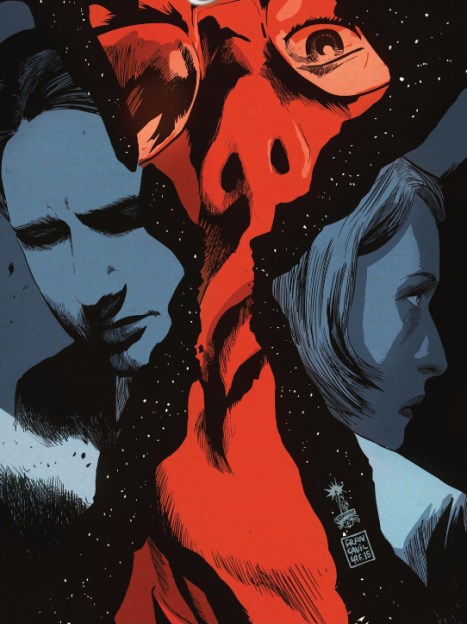
One of the more disappointing aspects of The X-Files: Season 10 and The X-Files: Season 11 is that it does very little to adapt the mythology to the twenty-first century.

The X-Files is very much a show rooted in the political and cultural context of the nineties. Everything about the show’s first seven seasons reflects the Clinton era, with the series perfectly capturing the zeitgeist in the weird lacuna between the fall of the Berlin Wall and the destruction of the World Trade Centre. At its peak, the show touched on underlying anxieties that are social, political and existential; it asked tough questions about identity in the final days of the twentieth century. As much as Friends or The Simpsons, The X-Files embodied the nineties.

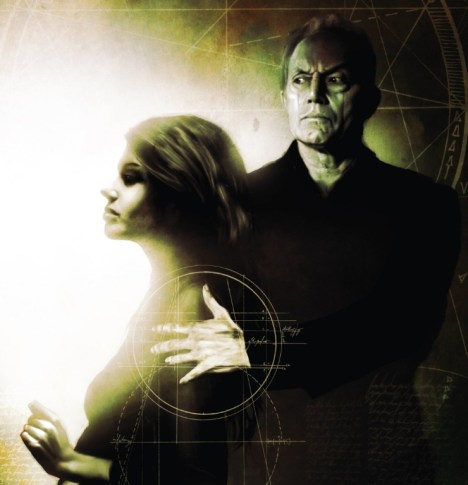
The son becomes the father... And the pseudo-son...

The son becomes the father…
And the pseudo-son…

As such, any revival of The X-Files must face questions of relevance. The X-Files so perfectly captured the spirit of the nineties that removing the series from that context runs the risk of severely damaging it. What makes now such a perfect time for The X-Files? What does The X-Files have to say about contemporary culture? How will the show be tweaked for modern audiences and sensibilities? These are not trivial questions. Any X-Files revival should be more than just a nostalgic “victory lap.”

This question of relevance faced the revival miniseries, but it also faced The X-Files: Season 10. What does The X-Files mean in the modern world? Harris had broached the question in a number of different ways, perhaps most skilfully in his approach to the classic “small town horror stories” that populated the show’s nine-season run. Whereas those stories tended to touch upon themes of globalisation and the erosion of so-called eccentric spaces, Harris used stories like Chitter and Immaculate to explore a growing cultural divide in twenty-first century America.

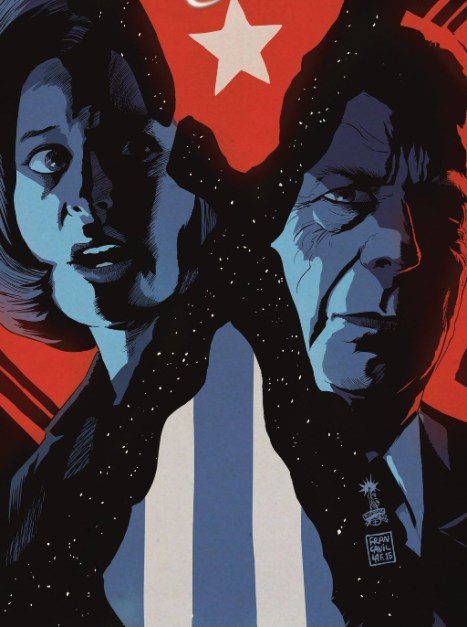
Cuba libre...

Cuba libre…

However, The X-Files: Season 10 does not work quite as well when it comes to updating the mythology for the twenty-first century. A lot of this is down to the strong nostalgic pull of the nineties mythology. Harris employs a lot of the same elements that were in play while the show was on the air; the same characters, the same dynamics, the same story beats. There were occasional nods towards the changing geopolitical realities, such as the use of black-oil-as-oil in Pilgrims. However, the revived mythology never engaged with the twenty-first century as well as it might.

Effectively serving as the season “finale”, Elders makes the strongest play for relevance yet. It consciously references and evokes the imagery of the War on Terror in its exploration of Gibson Praise’s revived conspiracy. Unfortunately, it doesn’t quite work.

Cross to bear...

Cross to bear…

Continue reading

Millennium (IDW) #1-5 (Review)

This June, we’re going to be taking a look at the current run of The X-Files, beginning with the IDW comic book revival and perhaps taking some detours along the way. Check back daily for the latest review.

One of the more interesting aspects of IDW holding the X-Files license has been watching the company try to franchise the brand.

During the production of the show, Chris Carter was notably wary of stretching the show’s brand. He turned down lucrative branding opportunities because he didn’t want to see his show attached to “doo-dads” and “gee-haws.” It was an understandable impulse. When Fox approached Carter to launch a new show during the third season of The X-Files, he did not build a spin-off in the conventional sense. He did not launch The X-Files: Miami or The X-Files: New Orleans, although Fox might have wanted something like that.

Time goes by so slowly... And time can do so much...

Time goes by so slowly…
And time can do so much…

When Carter launched Millennium, he was adamant that it should stand on its own two feet. Carter wanted the show “to succeed on its own terms, rather than on some kind of gimmick.” There were a few sly nods in episodes like Lamentation, but it mostly stood on its own two feet. Glen Morgan and James Wong got a little bit more adventurous in the second season, with Jose Chung’s “Doomsday Defense” and The Time is Now offering clear crossover of supporting cast. However, Frank Black would not meet Mulder and Scully until Millennium, after his show was cancelled.

To be fair to Carter, there is a sense that the later mellowed when it came to the concept of a broader shared universe. During the third season of Millennium, Carter acknowledged that he had been throwing around ideas for a crossover between The X-Files and Millennium. Although his short-lived Harsh Realm never directly crossed over with any of his other work, it is possible that the series was cancelled before Carter had the opportunity; he has talked about having plans to bring Mulder and Scully into Harsh Realm.

Father of the year...

Father of the year…

Carter’s fourth television series, The Lone Gunmen, was by all accounts a fairly conventional spin-off of The X-Files. It focused on three characters who originated (and continued to guest star) on The X-Files. It featured a major guest appearance from Mitch Pileggi as Walter Skinner in The Lying Game. It featured a cameo from David Duchovny in All About Yves. It was perhaps the most conventional piece of franchise-building in the history of Ten Thirteen, with characters and concepts moving freely between shows.

However, it should also be noted that Carter was a lot less involved in the day-to-day running of The Lone Gunmen as compared to Millennium or Harsh Realm. Carter created the show, but the management of the series was left to the trio of Frank Spotnitz, Vince Gilligan and John Shiban. Carter was only credited as writer on two of the show’s thirteen episodes, The Pilot and Three Men and a Smoking Diaper. It seems fair to say that Carter was an executive producer not particularly interested in building a shared universe as modern audiences understand it.

By Jordan!

By Jordan!

This is part of what is so intriguing about watching IDW trying to build a brand around their X-Files license. The company is very interested in turning the show into a much more tightly interwoven shared universe. Millennium is proof of that, a five-issue miniseries focusing on Frank Black that consciously builds off The X-Files to relaunch the cult nineties television series. In many ways, it represents a truer crossover between The X-Files and Millennium than that infamous seventh season episode.

Millennium is very much integrated into a shared Ten Thirteen universe.

We all have our demons.

We all have our demons.

Continue reading

The X-Files: Season 10 (IDW) #11-15 – Pilgrims (Review)

This June, we’re going to be taking a look at the current run of The X-Files, beginning with the IDW comic book revival and perhaps taking some detours along the way. Check back daily for the latest review.

Pilgrims is essentially an attempt to do a mid-season mythology episode in the style of Colony and End Game or Tunguska and Terma, a big sprawling epic populated by familiar faces and impossible scale that is driven more by questions and mysteries than by answers or revelations. It is in many ways a testament to writer Joe Harris’ desire to emulate the basic structure and framework of The X-Files, right down to the manner in which he structures The X-Files: Season 10.

There are a lot of obvious markers and touches that help Pilgrims to feel like a classic mid-season mythology episode. There is an international scope, as seen in the trip to the Arctic in End Game or to Hong Kong in Piper Maru or to Russia in Terma. The first half of Pilgrims unfolds in Saudi Arabia, with Mulder and Scully dispatched to investigate what initially appears to be a terrorist attack on an oil operation but is promptly revealed to be something far more sinister.

The red and the black.

The red and the black.

Similarly, in keeping with the style and tone of many of the best mythology two-parters, the basic plot is relatively straightforward even as complications appear at the edge of the frame. In End Game, Mulder is racing to recover his lost sister as details about secret cloning experiments spill out around him. In Nisei, Mulder is trapped in a traincar with a ticking time bomb and a dangerous assassin as he digs away at the conspiracy. In Apocrypha, the black oil just wants to go home. The same is true in Pilgrims, which follows an alien trying to escape.

Even the structure of the five-issue arc recalls that of many X-Files two-parters, with a massive pivot coming between the third and fourth issues in the same way that many two-parters would switch premises at the half-way point. The Saudi Arabia plot wraps up at the end of the third issue, while Gibson Praise is introduced at the start of the fourth. The first three issues focus on the mystery of the Saudi attack, while the final two put a much greater emphasis on the traditional trappings of the X-Files mythology including the conspirators and Skyland Mountain.

Lone survivors.

Lone survivors.

It is remarkable how faithful Joe Harris is to the format of those classic X-Files mythology episodes. Of course, this is something of a double-edged sword. As with a lot of The X-Files: Season 10, the biggest weakness of Pilgrims is the fact that it all feels a little overly familiar and a little too indulgent. Krycek was one of the most popular supporting characters from the nine-season run of The X-Files, but bringing him back at the centre of a five-part epic mythology story feels like pandering and fan service. Harris is not inventing his own mythology, but resurrecting an old one.

Then again, that might seem to be the point. The black oil discovered in Pilgrims is compared to the oil resting beneath Saudia Arabia. In that respect, it is the remains of long-dead organisms compressed and decayed and converted into fuel. There is something more than a little appropriate about that.

Eye see.

Eye see.

Continue reading

The X-Files: Season 10 (IDW) #8 – Being for the Benefit of Mr. X (Review)

This June, we’re going to be taking a look at the current run of The X-Files, beginning with the IDW comic book revival and perhaps taking some detours along the way. Check back daily for the latest review.

Being for the Benefit of Mr. X is effectively another origin story, following on from Hosts.

While Hosts explained exactly how the Fluke Man came to be, and even gave the character tangible motivation, Being for the Benefit of Mr. X is largely driven by flashbacks that proceed to explain and elaborate upon Mulder’s second informant. Mister X has long been one of the franchise’s most interesting and underdeveloped character, in part owing to the fact that the show fleshed out very little about him and in part due to Steven Williams’ performance. While the show revealed a lot about Deep Throat or the Cigarette-Smoking Man, Mister X remains a mystery.

Marking the spot.

Marking the spot.

The question, of course, is what this actually adds to the story being told. It is fun to revisit the origin of Mister X, but he is very much an outdated concern at this point in the show’s life. In fact, the character’s last appearance was in flashback in Unusual Suspects at the start of the fifth season, following his death in Herrenvolk at the start of the fourth season. Unlike the Cigarette-Smoking Man, Mister X was never literally resurrected. Unlike Deep Throat, he never turned up to haunt Mulder in episodes like The Blessing Way or The Sixth Extinction II: Amor Fati.

It is not as if writer Joe Harris has constructed a particularly compelling origin story for Mister X. The story told in Being for the Benefit of Mr. X is solid and sturdy, integrating quite smoothly with the continuity of the show and the character as we understand it. However, there are no real surprises or tangents, no twists or surprises. Being for the Benefit of Mr. X is a solid “done in one” story. It just feels a tad unnecessary.

In too Deep (Throat)...

In too Deep (Throat)…

Continue reading

The X-Files: Season 10 (IDW) #1-5 – Believers (Review)

This June, we’re going to be taking a look at the current run of The X-Files, beginning with the IDW comic book revival and perhaps taking some detours along the way. Check back daily for the latest review.

Five years can be a long time.

To be fair, there was a six-year gap between the broadcast of The Truth and the release of The X-Files: I Want to Believe, so the gap was not unprecedented. Nevertheless, the fact is that Mulder and Scully had been retired for five years since their last film and eleven years since their last television episodes. Even the most hardcore fans of The X-Files had begun to doubt that the show would ever return in any tangible form. However, the show was entering its twentieth anniversary year, and forces were stirring in the background.

X-appeal.

X-appeal.

Occasionally interviews would surface with David Duchovny or Gillian Anderson mooting the possibility of doing a third feature film. After all, despite the promise made in the opening of The Truth, 2012 had come and gone without an alien invasion or a global apocalypse. The franchise had set its own alarm clock and slept through it. There were still fitful stirrings, suggestions of possible future developments. As the franchise passed what many regarded as its “best before” date, Frank Spotnitz even speculated that fans might be treated to a reboot.

In many ways, the revival of The X-Files began somewhat innocuously. In January 2013, comics publisher IDW announced that they would be publishing a monthly series focusing on the continuing adventures of Mulder and Scully. This was not necessarily news of itself. IDW had a long history of managing licensed properties, such as the JJ Abrams Star Trek reboot and the Russell T. Davies Doctor Who relaunch. That was very much their market niche in the comic book industry, especially with nostalgic titles like Ghostbusters or Teenage Mutant Ninja Turtles.

How the years 'shroom by...

How the years ‘shroom by…

While the launch of the title did suggest that there was an audience for stories featuring Mulder and Scully, it did not necessarily lead to the promise of greater things. Indeed, the announcement that IDW would be publishing The X-Files: Season 10 consciously and clearly evoked the approach that the publisher Dark Horse had adopted towards Buffy: The Vampire Slayer and Angel, running entire seasons of comic book stories that served as the new “canon” for the characters. But nobody was expecting Sarah Michelle Gellar to reprise the role of Buffy Summers.

However, the IDW comic book launch served to bring Chris Carter out of semi-retirement and back into the media spotlight. Joss Whedon had consulted with Dark Horse on Buffy: Season Eight, the prolific television writer and producer was also working on his own concurrent projects that included directing episodes of The Office and preparing Doctor Horrible’s Sing-Along Blog. In contrast, Chris Carter had been largely silent since the release of I Want to Believe. The launch of the comic book brought him back.

Where there's smoke...

Where there’s smoke…

Continue reading

Non-Review Review: The X-Files – I Want to Believe

This January, to prepare for the release of the new six-part season of The X-Files, we’re wrapping up our coverage of the show, particularly handling the various odds and ends between the show’s last episode and the launch of the revival.

The plan was always to transition The X-Files from television to film, but fans change.

Following the success of The X-Files: Fight the Future, there had been some mumblings about the possibility of releasing a film in the summer of 2000. Given that The X-Files was a cultural property rooted in the nineties, it seemed like a big screen adventure would have been the perfect way to bring Mulder and Scully into the twenty-first century. After all, the original plan was that the show would retire in its seventh season. (The network even had a bespoke successor selected in Chris Carter’s Harsh Realm.)

Gotta have faith...

Gotta have faith…

However, this was not to be. It turned out that Fight the Future represented the cultural peak of The X-Files, the moment of maximum pop culture saturation. Almost immediately upon the production team’s move to California at the start of the sixth season, the show’s rating began their slow (and then not so slow) decline. The seventh season was itself hampered by behind-the-scenes drama, with David Duchovny suing Chris Carter and Fox over syndication. At the same time, Fox’s “worst season ever” meant that the broadcast could not afford to cancel The X-Files.

So, understandably, the sequel to Fight the Future was postponed and put on the long-finger. As the show came to an end in its ninth season, the subject of a second X-Files feature film arose again. Still, there was a debate to be had about whether the world really wanted a second X-Files film. While the sixth and seventh seasons had slowly eroded the show’s popularity and appeal, the ninth completely collapsed it; through the combination of bad storytelling decisions and the broader shift in the political mood, The X-Files felt like a spent cultural force.

"Platonic", eh?

“Platonic”, eh?

Ultimately, that was not to be either. The production history of The X-Files: I Want to Believe often recalls the mythology at the heart of The X-Files, with the project constantly shifting and changing as outside forces intervene. I Want to Believe arrived in cinemas in July 2008, a full decade after Fight the Future and more than six years after the broadcast of The Truth. The finished product is radically different from what anybody might have imagined in the immediate aftermath of Fight the Future, its design often surreal and awkward.

If I Want to Believe would have been a strange choice for an X-Files film release in July 2000, it seemed downright perverse in July 2008.

The truth is out there. Way out there.

The truth is out there. Way out there.

Continue reading

The X-Files – The Truth (Review)

This December, we’re taking a trip back in time to review the ninth season of The X-Files.

It is interesting how the popular memory of a thing can differ from the actual thing itself.

Memory was always a key theme of The X-Files, particularly in the early years of the show. Although the aliens and the conspirators were plucked from the demented imaginations of the most paranoid tinfoil hat enthusiasts, a surprising amount of the show was rooted in real history that had been allowed to slip by under the radar: the genocide of the Native Americans; the resettlement of German and Japanese war criminals after the Second World War; radiation experiments upon prisoners; the Tuskegee syphilis experiment.

Daddy's home.

Daddy’s home.

The truth is contained in the gap between memory and history. In a way, then, it feels entirely appropriate that the popular memory of The X-Files should remain quite distinct from the show itself. The popular memory of The X-Files tends to suggest that the mythology makes no sense, that it does not fit together in any tangible form. This is an opinion repeated so often that it has become a critical shorthand when discussing the end of the show; much like the assertion “they were dead all along” tends to come when discussing Lost.

The truth is that the mythology of The X-Files largely made sense. Sure, there were lacunas and contradictions, inconsistencies and illogicalities, but the vast majority of the mythology was fairly linear and straightforward. It had been fairly straightforward for quite some time. The show had been decidedly ambiguous in its first few seasons, only confirming that colonisation was the conspiracy’s end game in Talitha Cumi at the end of the third season. Elements like the black oil and the bees tended to cloud matters, but the internal logic was clear.
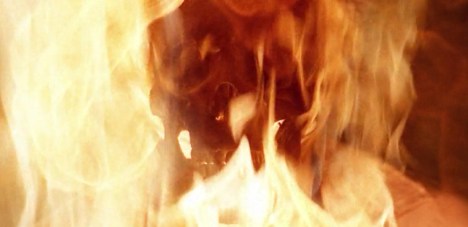
Everything burns...

Everything burns…

Significant portions of both The X-Files: Fight the Future and Two Fathers and One Son had been dedicated to spelling out the finer details of the mythology in great detail. Mankind were not the original inhabitants of Earth; the former occupants had returned and were making a rightful claim; the conspirators had agreed to help them, selling out mankind for a chance to extend their own lives. Everything else was window dressing. The production team had laid everything out during the fifth and sixth seasons.

Still, the general consensus of The X-Files was that it was a show driven by mysteries that was always more interested in questions than answers. This was certainly true, but it was somewhat exaggerated. When the cancellation was announced, the media immediately demanded answers. A month before The Truth was broadcast, Tim Goodman complained about how the show offered “precious few answers to Carter’s riddles.” Two days before the broadcast, Aaron Kinney wondered of the conspirators, “Who are these people and what is their agenda?”
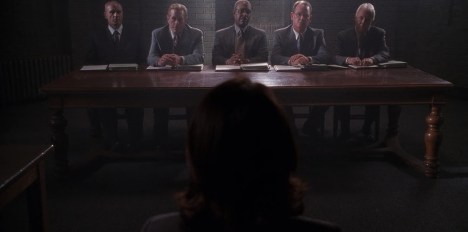
The Truth on trial...

The Truth on trial…

It does not matter that these answers have mostly been provided and that the truth is mostly know. This was the context of the conversation unfolding around The Truth, and it likely explains a number of the creative decisions taken during the production of the episode. The Truth plays as an extended video essay dedicated to providing answers that were offered three or four seasons earlier in relation to mysteries that are no longer part of the show. The Truth is a passionate and intense argument that the mythology of The X-Files does make sense.

For viewers tuning back into the show for the first time in years, this means long expository monologues and skilfully edited montages that do not tie into the plot of the episode in any significant way. For those who stuck with the show for these past few seasons, it means rehashing everything that the show has taken for granted since the fifth or sixth season. While it feels like The Truth is desperately longing for vindication, to the extent where the show puts itself on trial in the person of Fox Mulder, this does not make for compelling viewing.

Happy ending.

Happy ending.

Continue reading