• Following Us

  • Categories

  • Check out the Archives


  • Awards & Nominations

Non-Review Review: The Girl in the Spider’s Web

The Girl in the Spider’s Web is essentially a high concept shorn of any sense of authorship.

Lisbeth Salander is one of the very few breakout fictional characters of the twenty-first century, a concept that immediately latched on to the public imagination following the publication of Stieg Larsson’s Män som hatar kvinnor in 2005. Salander was a character who seemed to speak to the turbulent new century, a digitally native avenging angel who unleashed her wrath against a violent and misogynist establishment. Salander seemed to speak immediately and viscerally to her moment.

Phoning it in.

A Swedish language film was released four years later, featuring a career-defining performance from Noomi Rapace, which seemed to be enough to singlehandedly assure the young actor an English-language career. Hollywood quickly noticed and immediately commissioned a remake that would be directed by David Fincher, and which would go on to be nominated for five awards. Rooney Mara would effectively launch her career with a Best Actress nomination for her performance of Salander.

All of these are incredible accomplishments for a character and concept that in someways seemed clichéd and nineties. Män som hatar kvinnor was the kind of serial killer narrative that has been ubiquitous in the nineties, but largely supplanted by terrorist stories in the new millennium. As an archetype, Salander was very much of a piece with cyberpunk hackers with which Hollywood had clumsily flirted in movies like Hackers or The Matrix or Johnny Mnemonic.
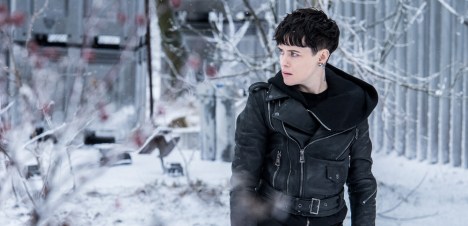
Snow escape.

Salander was elevated by two things. The first was a prescient understanding of the appeal of a feminine avenging angel dismantling systems of misogynist oppression. If anything, Salander seemed ahead of her time, and should be perfectly pitched for the #metoo moment. However, the other important aspect of Salander was a strong sense of authorship and craft. Noomi Rapace embodied the character in the Swedish-language original, and David Fincher helped to elevate pulpy material to top-tier filmmaking in the American reimagining.

All of this makes The Girl in the Spider’s Web an interesting , if deeply unsatisfying case study of what happens when anything resembling a distinct creative voice is ripped away from Salander and she is stuck in a much more bland and conventional film. The results are deeply frustrating, but affirm the level of talent involved in the character’s earlier adventures on page and screen.
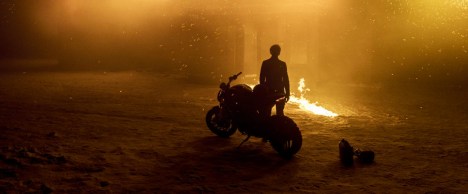
Everything burns.

Continue reading

Non-Review Review: Colette

The story at the heart of Colette is familiar, even to those with little knowledge of its inspiration.

Colette is a story about the eponymous French writer, who rose to fame on the back of a series of novels that fictionalised her own life through the lens of a character named Claudine. Keira Knightley stars in the title role, a young woman from the country who finds herself swept into Paris by her older and more established husband. Publishing under the pen name “Willy”, Henry Gauthier-Villars is something of a cad. He is quick to capitalise on his wife’s artistic voice and to claim her successes for his own. Meanwhile, Colette struggles for her creative freedom and to find a way to express herself.

Go, West!

The broad strokes of Colette are fairly routine, the film following the rhythms and structures of the modern historical biography. Reflecting the modern creative and political climate, there is a great deal of emphasis placed on Colette as a feminist narrative, the story of a young woman trying to assert control over her own voice and come to terms with her own identity. It is certainly a timely story, even if Colette follows the standard biographical film playbook beat-for-beat. Very few developments in Colette come as a surprise, and many of the film’s twists and reversals are helpfully signposted from the get-go.

However, Colette works much better than that assessment might suggest. A lot of this is down to a clever and nimble screenplay from Richard Glatzer, Wash Westmoreland and Rebecca Lenkiewicz. Colette is aware of all the marks that it needs to hit, and that frees the screenplay up to be a little playful in how it develops its beats and what it does when it hits each mark. Colette is a fascinating hall of mirrors, a movie packed with twisted reflections and symmetries, luxuriating in the blurred boundaries between reality and fiction. Coupled with a pair of charming lead performances, this elevates Colette very well.

A picture-perfect marriage.

Continue reading

Non-Review Review: Fantastic Beasts – The Crimes of Grindelwald

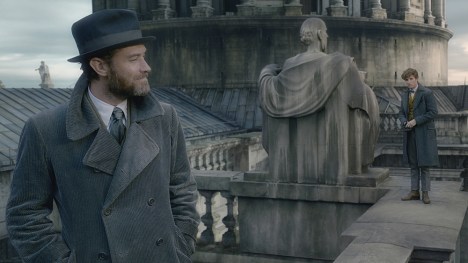
Fantastic Beasts: The Crimes of Grindelwald knows its audience.

The Crimes of Grindelwald is a film consciously aimed at the audience member who has charted and navigated the family trees of the Harry Potter franchise, who knows the finer details of families that were never explicitly featured in the original series and who can recognise names that were never spoken aloud. This is a film that is geared towards the kinds of fans who devour supporting material, who pour enthusiastically and endlessly over the appendices to The Lord of the Rings.

Law student.

This is not to mock or belittle those sorts of fans. Indeed, there is something infectious and exciting in that enthusiasm, in standing outside a cinema and hear enthusiastic six-year-olds with a much better grasp of the dynamics at play than the adults who accompanied them. The eagerness with which these fans pour over the finer details is genuinely heartening, and some of it might even be absorbed by osmosis as they boast about “when” they “got” some twist or other. This a movie aimed at those who devour scenes of exposition and love a good flashback or six.

The only issue is that The Crimes of Grindelwald has precious little for the more casual audience member, whether the casual cinema-goer who just wants a night full of wizards and witches or the more relaxed fan who has only watched the films or read the books once a few years ago. For those audience members, The Crimes of Grindelwald does not offer nearly enough. Or it offers too much.

Partially wanted for crimes against fashion.

Continue reading

Non-Review Review: Disobedience

Disobedience is the statistical mean derived from its premise, filtered through the lens of modern awards fare.

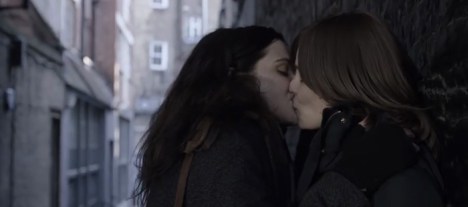
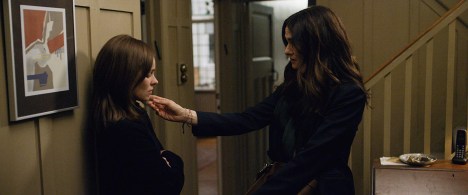
Disobedience is the story of two women trapped within the Orthodox Jewish community in contemporary (or close to contemporary) London. Ronit Krushka returns home upon receiving word of her father’s death. Her return shocks the community, which is still recovering from the scandal of her departure years earlier. Ronit arrives to discover that her old friend Esti and her cousin Dovid have married in her absence, Ronit’s return serving to stoke old tensions and poke at still-healing wounds within the community.

Rachels’ Vice.

Disobedience is an adaptation of Naomi Alderman’s novel, and is very much an archetypal example of contemporary prestigious drama. Disobedience is effectively a delivery method for a set of striking performances from its leading triptych, but is also largely anemic; this is a movie that confuses inertia for profundity and lethargy for restraint. Disobedience is populated by characters who seem more comfortable talking around things rather than about them. There is undoubtedly an argument to be made about such an approach seeming naturalistic, but here is largely dull.

Disobedience seems afraid of its central tensions, wary of navigate a minefield that it has chosen for itself. The result is a movie that feels largely ornate. It has a great cast and some big ideas, but never seems to know quite what to do with either.

Touching reunion.

Continue reading

Non-Review Review: Cam

The most horrific aspects of Cam have little to do with the literal monster lurking at its core.

It is almost half an hour before the central plot of Cam kicks into gear. It is a credit to both director Daniel Goldhaber and writer Isa Mazzei that Cam sustains itself as a horror even through this (relatively) long establishing stretch. There is something inherently skin-crawling about that extended introductory sequence, which is essentially a depiction of “business as usual” for central character Alice. The opening scenes of Cam very skilfully and very creepily capture the commodification and performativity of both cam-girl-ing in particular and social media in general.

Time for reflection.

Watching the opening stretch of Cam, the audience might read social media itself as the monster, a horrific force capable of warping and bending individuals to its will. Even before Alice realises that something is wrong, there is a sense that the audience has taken a trip through the looking glass. The pink neon glow, the way the camera snakes down hallways, the casualness with which Alice picks up her dinner from a delivery man while covered in corn syrup (and little else), the repeated framing of shots to emphasise mirrors and screens as images trapped and projected.

Indeed, the obligatory bridge between the second and third acts of the film might be the biggest issue with Cam, the clumsy in-universe explanation of the strange entity lurking at the centre of the story and function that it performs. However, this is a testament to the quality and imagination of the rest of the film around that exposition. The monster in Cam is so familiar and so relevant to contemporary society that it almost needs no explanation at all. Cam is so effective a horror story that it arguably doesn’t even need its monster.

“Feed me.”

Continue reading

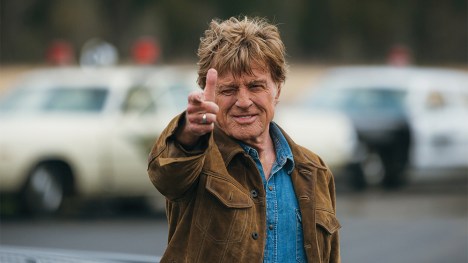
Non-Review Review: The Old Man and the Gun

There’s a charming gentleness to The Old Man and the Gun, an old-fashioned charisma that reflects its octogenarian leading man.

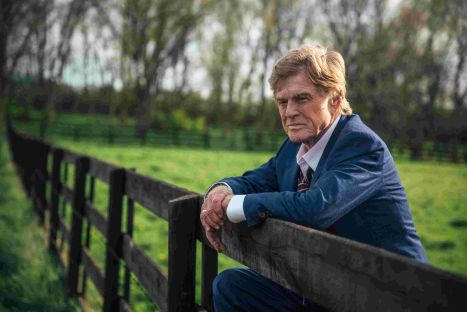
The Old Man and the Gun has been largely branded as the last feature film to star Robert Redford. Of course, show business retirements are notoriously fickle, as Clint Eastwood has repeatedly demonstrated and will likely continue to demonstrate with The Mule. It isn’t too hard to imagine Robert Redford returning to the screen (or behind the camera) in a couple of years, his roguish grin enough to forgive the broken promise that audiences probably never wanted him to keep anyway. However, it is still impossible to escape the sense of The Old Man and the Gun as a farewell piece, a tribute sculpted in the image of its lead.

Every good thief should know a solid fence.

The Old Man and the Gun is gentle, sweet and has charm to spare. As a performer, Redford is defined by a star quality that feels increasingly old-fashioned in an era where blockbuster cinema is driven by established intellectual property and awards-season fare seems to be shaped by recognisable directors. Redford was always an actors whose central appeal lay in how hard it was to dislike him. Redford had a roguish charm that offset a more fundamental decency, a movie star who seemed like he’d have stories to tell over a nice drink, but never at anybody else’s expense.

If The Old Man and the Gun is to be Redford’s cinematic swansong, there are certainly worse ways to go.

The Old Man and the Gun infamously blew its casting budget on Robert Redford, who insisted that he could play both title characters.

Continue reading

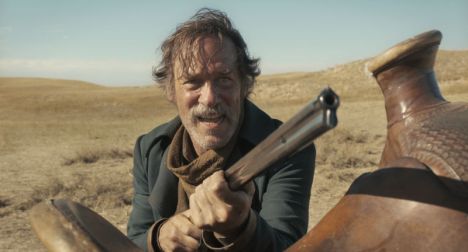
Non-Review Review: The Ballad of Buster Scruggs

The Ballad of Buster Scruggs is not so much a set of stories about the Old West, more a set of stories about the stories that are told about the Old West.

To be fair, the anthology film wears this premise on its sleeve. The Ballad of Buster Scruggs is by its nature an omnibus of short stories, drawing its audience’s attention to the format through the framing device of an anonymous hand leafing gently through an old hardcover book of short stories. Even within the individual stories, the Coen Brothers frequently nest smaller and more intricate narratives; whether stories shared at dinner, great works recited for an enchanted audience, or even just strangers in a stage coach making awkward conversation with one another.

The rifle man.

In the film’s final segment, The Mortal Remains, the self-described “distractor” Thigpen explains that he distracts his quarry through stories. “People can’t get enough of them,” he assures his audience. “Because people connect the stories to themselves, I suppose. And we all love hearing about ourselves. So long as the people in the stories are us… but not us.” In its own weird way, positioned at the tail end of the narrative, Thigpen seems to offer something of a thesis statement for The Ballad of Buster Scruggs, a story about stories. In particular, a story about certain types of stories.

The Ballad of Buster Scruggs is decidedly uneven, as anthology films tend to be. That said, the quality is high enough (and the stories disparate enough) that it’s easy to imagine that each story of the six might be someone‘s favourite. The Coen Brothers very cannily and very astutely ensure a great variety in tone across the six installments, which range from gleefully nihilistic, to sombre and withdrawn, to eerie and uncanny. However, they are connected by a series of recurring preoccupations about life of the frontier and man’s awkward relationship to both that wilderness and his fellow man.

No need to make a song and dance about it.

The Ballad of Buster Scruggs is not consistent enough to rank among the Coens’ best work. While the movie maintains a consistent perspective and philosophical vantage point across its two-hour-and-ten-minute runtime, the individual stories vary so wildly in terms of aesthetic and rhythm that the film never quite coheres as well as it might. At the same time, The Ballad of Buster Scruggs contains enough delightful details in its smaller moments that linger, suggesting that the film might best be remembered as a collection of inspired moments rather than as a satisfying whole.

The Ballad of Buster Scruggs is not so much a ballad as a concept album.

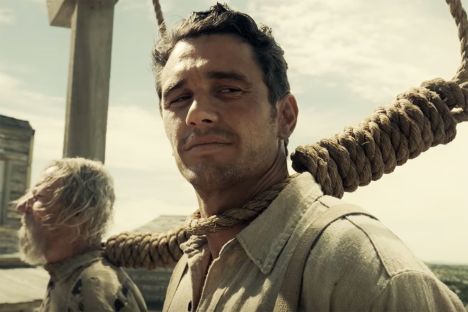
Don’t leave him hanging.

Continue reading

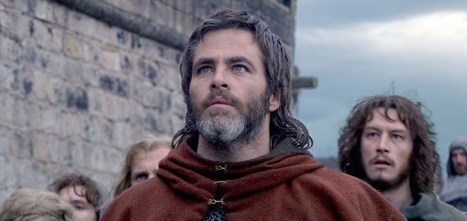
Non-Review Review: Outlaw King

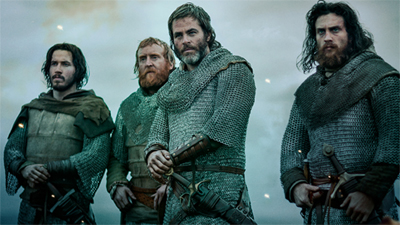
Outlaw King opens with a very impressive tracking shot, or what at least appears to be a very impressive tracking shot. The sequence lasts more than eight minutes, wherein the audience follows the action at the Scottish surrender to King Edward I. The camera follows various actors at they move through the scene, from inside the tent with King Edward I to the congress outside in the mud. The scene features an impressive sword fight, before heading back into the tent and out the other side, to the point where Kind Edward I has a massive trebuchet waiting.

The Scottish have surrendered. The revolution has failed. The lords of the region have bowed before the British Crown and sworn fealty to the throne. This gigantic instrument of war seems redundant, pointless. It has no purpose in this particular situation. Nevertheless, King Edward insists that the trebuchet be loaded, and discharged towards a prominent Scottish castle on the nearby hill. Edward explains that this is a gesture of authority, making it clear that the surrender is “final.” He adds, “Also, it took three months to build. So I don’t want to waste it.”

Great Scot!

It is an interesting introductory scene for a number of reasons. Most obviously, it is incredibly technically impressive. Director David Mackenzie is really just showing off here, demonstrating how much control he has over the film, how carefully managed the choreography is, how perfectly he can time the rhythms of the action to the movement of his camera. The introductory scene very skillfully introduces most of the major players and key dynamics that will inform the action that follows, in manner that is graceful and never overwhelming. It’s technically impressive.

At the same time, the entire sequence feels just a little bit like Edward’s gigantic trebuchet and perhaps even a little bit like the film as a whole. It is a wonderfully constructed piece of work that feels over-elaborate and over-complicated for what it is doing. Outlaw is a beautiful film underpinned by some intriguing ideas about power and violence, much like Mackenzie’s work on Hell or High Water. Unfortunately, Outlaw King lacks the warmth and humanity of Hell or High Water. Like that absurd trebuchet, it feels a little overly ornate and never entirely sure of its purpose.

A Brucie Bonus.

Continue reading

Non-Review Review: Bohemian Rhapsody

Bohemian Rhapsody is more invested in being a fairly standard music biopic than with being a slightly more specific Queen biopic.

There’s a weird sense of familiarity that runs through Bohemian Rhapsody, which has nothing at all to do with its central characters and everything to do with the kind of story that it is telling. If anything, Bohemian Rhapsody will appear completely foreign and alien to dedicated fans of Queen, or anybody with even a passing knowledge of the bad’s history and discography. Instead, it will feel most comforting and familiar to the aficionados of the old tried-and-true biographical feature film formula memorably lampooned by Walk Hard.

Spotlighting its subject.

Bohemian Rhapsody repeatedly brushes up against conflicts between history as it occurred and the rhythms of that standard narrative template. In every single case, Bohemian Rhapsody chooses to side with the narrative template rather than the historical record. It is debatable whether there is anything inherently wrong with this, to be fair. This sort of film-making is an act of adaptation. It is often necessary to conflate, distort of fabricate events in order to convey an essential truth about some real-life person or character, because real life is not a narrative, despite best efforts to impose one upon it.

However, it is one thing to manipulate or distort the finer details of a narrative to hint at a deeper truth. It is another thing entirely to warp reality to fit an assembly blueprint that reveals next to nothing about any of its subjects.

A pale reflection of the man himself.

Continue reading

Non-Review Review: They’ll Love Me When I’m Dead

They’ll Love Me When I’m Dead serves as a convincing argument that The Other Side of the Wind works better as a story than as an actual object that exists.

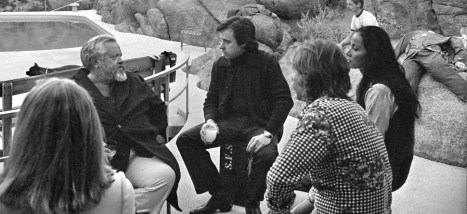
They’ll Love Me When I’m Dead is a feature-length documentary that is only a few minutes shorter than its subject, providing an exploration of The Other Side of the Wind, from its conception through it development and into its long and storied afterlife. It is a very exciting and engaging tale, one that sweeps across Hollywood history, delving into a variety of nooks and crannies. It is a story that is intertwined with dissolving marriages and international politics, of bad luck and tremendous arrogance. All of this existing in the shadow of Orson Welles.

They’ll Love Me When I’m Dead offers an account of the production of Orson Welles’ ill-fated experimental piece of metafiction. It is perhaps a testament to The Other Side of the Wind that it occasionally feels like They’ll Love Me When I’m Dead can perhaps be folded into the wild ambitions of an ageing filmmaker working on a project that would not materialise during his life-time. Towards the end of They’ll Love Me When I’m Dead, archive footage of Orson Welles finds the auteur musing on his next project.

“Maybe it isn’t even the picture,” he confesses to the press. “Maybe it’s just talking about the picture.” Maybe The Other Side of the Wind is not the real headline. Maybe They’ll Love Me When I’m Dead is the real headline.

Continue reading