• Following Us

  • Categories

  • Check out the Archives


  • Awards & Nominations

Doctor Who: The Name of the Doctor (Review)

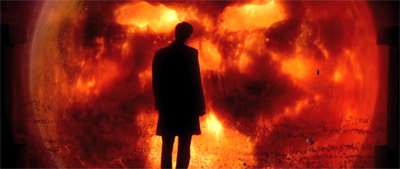
How do we get down there? Jump?

Don’t be silly. We fall.

– Clara and the Doctor set things straight

Like The Wedding of the River Song, The Name of the Doctor suggests that Moffat might be better served by reverting to the Davies-era model of two-part season finalés. The strongest season ender of the Moffat era (and probably the best season finalé of the revived show) was The Big Bang, because it felt like Moffat had enough space to allow his ideas to breathe. The Name of the Doctor is a lot sharper and a lot more deftly constructed than any of the closing episodes from Russell T. Davies’ seasons, but it feels a little too compact, a little too tight for its own good.

To be fair, Moffat is has very cleverly structured his season. The mystery of Clara was seeded as early as Asylum of the Daleks and hints have been scattered throughout the past year of Doctor Who. Even the build-up to the final line of the episode feels like an idea that Moffat has been toying with since The Beast Below. Despite all this, it still feels like The Name of the Doctor could do with a little more room to elaborate and develop the concepts at the core of the story.

Journey to the centre of the Doctor?

Journey to the centre of the Doctor?

Continue reading

Doctor Who: Nightmare in Silver (Review)

I trust the Doctor.

You sure he knows what he’s doing?

I’m not sure I’d go that far.

– Clara and the Captain make sure they’re on the same page

Nightmare in Silver might not be as breathtakingly ambitious as The Doctor’s Wife, but Neil Gaiman’s sophomoric Doctor Who script retains the writer’s charm and wit. A collection of wonderful high concepts thrown together into a blender, distilled to their essence and gleefully sprinkled across forty-five minutes of television, it’s a beautiful reinvention of the Cybermen. After all, the show’s golden anniversary probably wouldn’t be complete without a visit from the Doctor’s silver nemesis.

Face-off!

Face-off!

Continue reading

Doctor Who: Journey to the Centre of the TARDIS (Review)

“Good guys do not have zombie creatures. Rule one, basic storytelling.”

– Clara understands the way the universe works

And here our big theory that this anniversary season is a “greatest hits” collection runs into a bit of bother. Okay, Cold War was definitely a Troughton-era throwback. And Hide had a definite Hinchcliffe-and-Holmes feeling to it. (“The Baker Street irregulars” in 1974.) Maybe you could stretch it a little bit and argue that The Bells of St. John is a tribute to the Pertwee era by way of Russell T. Davies; and The Rings of Akhaten definitely feels a little like a classic bit of Hartnell-era world-building.

Making the case for The Journey to the Centre of the TARDIS is just a little bit harder. After all, The Crimson Horror is another throwback to Hinchcliffe and Holmes, while Nightmare in Silver is another “base under siege by classic monster” tribute to Troughton. So there’s only one missing piece here. If that “greatest hits” argument holds, then Journey to the Centre of the TARDIS must be one gigantic shout out to the John Nathan Turner era.

Hear me out.

A shining beacon of light...

A shining beacon of light…

Continue reading

Doctor Who: Hide (Review)

Say we actually find her. What do we say to her?

We ask her what she is, how she came to be.

Why?

Because I don’t know and ignorance is… what’s the opposite of bliss?

Carlisle.

Yes, Carlyle. Ignorance is Carlyle.

– the Doctor and Clara

Hide is the best episode of Doctor Who to air since The God Complex, almost two years ago. Writing an affectionate tribute to gothic horror Doctor Who, Hide allows even the most skeptical member of the audience to forgive writer Neil Cross for his somewhat clunky script for The Rings of Akhaten. It’s a nostalgic and atmospheric trip back in time, and a reminder of just exactly what this show is capable of, offering a creepy haunted house horror that manages to morph into an epic love story by the time the credits have rolled.

What lies beyond?

What lies beyond?

Continue reading

Doctor Who: The Last of the Time Lords (Review)

To celebrate the fiftieth anniversary of the longest-running science-fiction show in the world, I’ll be taking weekly looks at some of my own personal favourite stories and arcs, from the old and new series, with a view to encapsulating the sublime, the clever and the fiendishly odd of the BBC’s Doctor Who.

The Last of the Time Lords originally aired in 2007.

I just need you to listen.

No, it’s my turn. Revenge!

– the Doctor and the Master

I like quite a lot of The Last of the Time Lords. I think, for example, that Russell T. Davies does an exceptional job creating a version of the Master that manages to remain true to the character’s pantomime roots, while also seeming a credible threat and dark mirror to the Doctor. I also think that Martha’s character arc has a fairly logic and fluid conclusion. On the other hand, there’s a great deal about the resolution to The Last of the Time Lords that feels a bit rushed, a bit convenient, a bit tidy.

I’m quite fond of Davies’ writing style, but I’ll concede that he tends to favour theme and character over plot and structure. The Last of the Time Lords does an excellent job illustrating this, providing a bunch of fascinating thematic and character-based moments, but positioning them in a plot that doesn’t really work.

You know, for once I actually feel sorry for the Master...

You know, for once I actually feel sorry for the Master…

Continue reading

Doctor Who: Cold War (Review)

Hair. Shoulderpads. Nukes. It’s the eighties. Everything’s bigger!

– the Doctor

The theory that this fiftieth anniversary half-season is intended as an homage to Doctor Who‘s rich and varied past holds up with Cold War. If The Bells of St. John was a Pertwee-era invasion tale, and The Rings of Akhaten was a shout-out to classic Hartnell world-building, then Cold War wears its influences even more brazenly. It’s the archetypal “base under siege” story popularised in the Troughton era, to the point where it even brings back one of the era’s most iconic monsters.

Indeed, the “Troughton base under siege by classic monsters” story is the only classic Doctor Who formulation that this half-season visits twice. While Cold War is easily weaker (and less ambitious) than Nightmare in Silver, it still fills that niche remarkably well. After all, if any Doctor Who writer can channel nostalgia, it’s Mark Gatiss.

Going green...

Going green…

Continue reading

Doctor Who: The Rings Of Akhaten (Review)

The Rings of Akhaten is a visual feast. Both the Mill and Millennium FX deserve a tremendous amount for realising the eponymous environment, which stands out as the perhaps the most impressively alien landscape to appear on Doctor Who since the show began broadcasting in high definition. It’s a solid demonstration that Doctor Who has come a long way since the eighties, and that the show is well able to keep pace with its American competitors. However, it also makes the news that the Mill has been forced to shut down all the more depressing – especially since that shut-down was partially due to the reduced number of Doctor Who episodes being produced each year.

In fact, a lot of the bigger problems with The Rings of Akhaten can be traced back to the decision to structure this seventh season of the revived show, split over two different years instead of across a single year. Most obviously, there’s the fact that we are half-way through this season of Doctor Who, and The Rings of Akhaten feels like the second or third episode of a given season. So much time is taken up with matters and concerns associated with the first half of a given season that The Rings of Akhaten ultimately feels quite light and almost insubstantial.

Burn with me...

Burn with me…

Continue reading

Doctor Who: The Bells of St. John (Review)

There’s something in the wifi.

– the Doctor does his best Jaws impression

The Bells of St. John is an intriguing piece of Doctor Who. This is the first time that the show has had to manage a companion swap in the middle of a season. That said, it doesn’t really work to think of the seventh season as a single cohesive entity.

The first five episodes are something of an abridged season, akin to the 2009 season of specials starring David Tennant. They are dedicated to tidying away lingering plot threads from the last two years of the show, and resolving Moffat’s lingering plot threads. The Power of Three and The Angels Take Manhattan are very much about tidying up the Doctor’s lingering connection to Rory and Amy.

In contrast, the second half of the season has a much more celebratory feeling to it, tied together by the over-arching mystery around Clara. While Clara pops up in Asylum of the Daleks, she’s very much a teaser of a mystery to come rather than a character in her own right. Instead, the themes of the season start in The Snowmen, introducing (or reintroducing) the Great Intelligence and Clara, and outlining the mystery of “the twice-dead girl.”

As a result, The Bells of St. John feels very much like a season opener to an unfortunately brief season of celebration.

Maybe that should be "thrice dead"?

Maybe that should be “thrice dead”?

Continue reading

Doctor Who: The Infinite Quest (Review)

To celebrate the fiftieth anniversary of the longest-running science-fiction show in the world, I’ll be taking weekly looks at some of my own personal favourite stories and arcs, from the old and new series, with a view to encapsulating the sublime, the clever and the fiendishly odd of the BBC’s Doctor Who.

The Infinite Quest was originally broadcast in weekly instalments on Totally Doctor Who in 2007.

… And then I’ll have my revenge! Revenge! REVENGE!

– just in case you didn’t get that Baltazar was evil

The Infinite Quest is a 45-minute animated episode of Doctor Who that was broadcast as part of Totally Doctor Who in 2007, during the third season of the revived show. It was written by Alan Barnes, who has written a number of Big Finish audio plays for Doctor Who, and was directed by Gary Russell. The animation was produced by Cosgrave Hall, who animated the missing episodes of The Invasion for its 2006 DVD release. So there’s a fairly considerable amount of talent involved in this project, which is notable as not only the first full-length animated Doctor Who episode to be broadcast on television, but is the first fully serialised story to be told since the show was revived. It was originally broadcast in chunks of three-and-a-half minutes.

Flight of fancy...

Flight of fancy…

Continue reading

Doctor Who: The Snowmen (Review)

Snowmen are rubbish in July. You’ll have to be better than that.

– the Doctor points out that the Great Intelligent doesn’t seem especially… intelligent

The Snowmen is a return to the sort of plot-driven Christmas Special that we occasionally saw during the Davies era. Much like The Christmas Invasion was concerned with introducing David Tennant and The End of Time, Part I was focused on wrapping up the Davies era, The Snowmen feels like it’s more concerned with setting up the fiftieth anniversary half-season ahead than it is with being a Christmas Special in its own right.

Sure, The Snowmen has all the festive trappings you might expect. There are killer snowmen, as the title implies. There’s a rich lonely old miser, as we’ve come to expect in these sorts of tales. There’s a nice Victorian setting for all the action as well. However, The Snowmen devotes a considerable amount of time to developing the mystery surrounding the Doctor’s new companion, and setting up a recurring foe for this fiftieth anniversary half-season.

The result is somewhat unsatisfying, as if The Snowmen is working harder to check the requisite boxes than it is to provide seasonal Doctor Who viewing.

What white teeth they have...

What white teeth they have…

Continue reading