• Following Us

  • Categories

  • Check out the Archives


  • Awards & Nominations

Star Trek: Deep Space Nine – Meridian (Review)

The September and October, we’re taking a look at the jam-packed 1994 to 1995 season of Star Trek, including Star Trek: Deep Space Nine and Star Trek: Voyager. Check back daily for the latest review.

Meridian is, to be frank, an absolutely abominable episode of Star Trek: Deep Space Nine. As a series, Deep Space Nine never really had a concentrated run of bad episodes, like the first and second seasons of Star Trek: The Next Generation or the second season of Star Trek: Enterprise or the third season of the original Star Trek. The first two seasons of Deep Space Nine might not be spectacular, but they are competently produced television – while there are a few scattered stinkers to be found, the bulk of the show comprises of mediocre and solid stories.

Instead, Deep Space Nine tended to pepper its weakest episodes throughout its run, perhaps a firm reminder that the show was never an entirely serialised experience. This wasn’t one story pushing forward, despite the presence of arcs and character development; Deep Space Nine was still prone to the pratfalls of episodic television. In this case, the pratfall was the necessity of churning out filler on a tight schedule and hoping to meet a deadline while pumping out two dozen episodes a year.

So we get unforgivably shoddy episodes like The Emperor’s New Cloak or Profit and Loss or Let He Who Is Without Sin mixed in with Deep Space Nine at the height of its form. The third season of Deep Space Nine lacks the highs of the later seasons, but that doesn’t mean it lacks the lows. Meridian stands out as the weakest episode of the season, and a serious competitor for one of the worst episodes of the show.

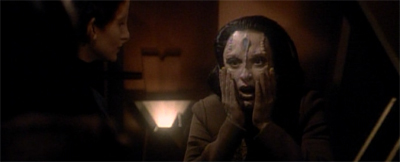
It appears that the toxic smell of the script is suffocating Terry Farrell...

It appears that the toxic smell of the script is suffocating Terry Farrell…

Continue reading

Star Trek: Deep Space Nine – Second Skin (Review)

The September and October, we’re taking a look at the jam-packed 1994 to 1995 season of Star Trek, including Star Trek: Deep Space Nine and Star Trek: Voyager. Check back daily for the latest review.

Second Skin continues the identity and reality themes running through the third season of Star Trek: Deep Space Nine. The Search revealed that the Dominion is led by shape-changing aliens who can impersonate anybody, after our heroes spend an episode in a virtual reality. House of Quark stemmed from lies Quark told about himself, only to discover that Klingon culture is not what it claims to be. Equilibrium revealed that Dax held secrets even from herself, having a whole other life. Second Skin confronts Kira with the idea that she may be everything she hates.

The theme will continue in the episodes ahead. The Abandoned is a rather cynical meditation on the nature-against-nurture debate. Civil Defense involves the Deep Space Nine crew discovering that the station itself is not as safe as they like to think. Meridian involves a subplot about Kira’s right to control her own body. Defiant is built around a crisis of identity for a doppelganger. Past Tense features Sisko stepping into the identity of a historical figure. And so it continues. Things are not what they appear to be; the truths we take for granted are not true.

Rewatching this first block of Deep Space Nine‘s third season, it’s amazing how cynical the show could be.

Face of the enemy...

Face of the enemy…

Continue reading

Star Trek: Deep Space Nine – Fearful Symmetry by Olivia Woods (Review)

The September and October, we’re taking a look at the jam-packed 1994 to 1995 season of Star Trek, including Star Trek: Deep Space Nine and Star Trek: Voyager. Check back daily for the latest review.

Fearful Symmetry had a long and painful history. The novel was originally scheduled for release April 2007. This would have seen the novel published about a year after the release of the previous Star Trek: Deep Space Nine relaunch novel, Warpath. The plan had been for new author Leanna Morrow to write the novel. When that proved impossible, Olivia Wood stepped in to rescue the assignment. Fearful Symmetry was eventually published in June 2008, over a year behind the initial schedule.

It’s interesting to speculate how that delay affected the Deep Space Nine relaunch. The next novel in the series, The Soul Key, would be the last published before the print Star Trek universe realigned as part of the Typhon Pact and The Fall, very much “event” books that served to relaunch the fictional universe. It is interesting to speculate whether the year between Warpath and Fearful Symmetry contributed to the decision to discontinue that particular iteration of the Deep Space Nine relaunch.

Still, whatever the reason, Fearful Symmetry is more interesting than successful. It is a book written with a number of great ideas, but some very flawed execution. It adopts a very “comic book” approach towards the Star Trek universe – featuring high concepts and crossovers and character who have been exaggerated slightly and distorted so as to fit the general perception of them rather than any consistent internal characterisation.

Fearful Symmetry is a bold and ambitious piece of work, particularly from a first time novelist. Unfortunately, it doesn’t work quite as well as it needs to.

ds9-fearfulsymmetry

Continue reading

Star Trek: Deep Space Nine – Crossover (Review)

Star Trek: Deep Space Nine is twenty years old this year. To celebrate, I’m taking a look at the first and second seasons. Check back daily for the latest review or retrospective.

At the time, Crossover must have seemed like a very odd choice for a late-second-season episode of Star Trek: Deep Space Nine. Of course, the mirror universe episodes would become a quasi-annual occurrence on the show, similar to the “O’Brien must suffer” adventures. However, in May 1994, it must have seemed like a really strange choice to do an entire episode as a sequel to a much-loved second-season installment of the original Star Trek.

Still, Crossover remains the strongest of Deep Space Nine‘s mirror universe episodes, most notably because it treats the rather absurd premise with a certain amount of weight and integrity, but also because it feels so delightfully weird.

Half the cast has been waiting two years to do that...

Half the cast has been waiting two years to do that…

Continue reading

Star Trek: Deep Space Nine – Necessary Evil (Review)

Star Trek: Deep Space Nine is twenty years old this year. To celebrate, I’m taking a look at the first season. Check back daily for the latest review or retrospective.

Commence Station Security log. Stardate 47282.5. At the request of Commander Sisko, I will hereafter be recording a daily log of law enforcement affairs. The reason for this exercise is beyond my comprehension, except perhaps that humans have a compulsion to keep records and lists and files. So many, in fact, that they have to invent new ways to store them microscopically, otherwise their records would overrun all known civilisation. My own very adequate memory not being good enough for Starfleet, I am pleased to put my voice to this official record of this day. Everything’s under control. End log.

Necessary Evil continues to deliver on the promise of “things you can’t do anywhere but Star Trek: Deep Space Nine that Michael Piller made at the start of the show’s second season. It’s a genuinely ambitious piece of Star Trek, all the stronger for the fact that it’s idea that could go horribly and spectacularly wrong. Movies like Blade Runner demonstrated that it is possible to blend the aesthetics of science-fiction and film noir, but it seems like a mix that would sit rather uncomfortably in the bright utopian future of Star Trek.

However, Deep Space Nine was never afraid to experiment with its format. This wasn’t always successful, but it did give the show a unique flavour. And when it did work, as it does here, it offered something new and exciting to the franchise’s playbook.

Time for a Changeling...

Time for a Changeling…

Continue reading

Star Trek: Deep Space Nine – The Circle (Review)

Star Trek: Deep Space Nine is twenty years old this year. To celebrate, I’m taking a look at the first and second seasons. Check back daily for the latest review or retrospective.

Drama naturally lends itself to a neat three-act structure. At the most basic level, it’s as simple as beginning, middle and end. However, it’s also a format taught in just about every screenwriting course, and it’s even used as the conventional model for those with more innovative approaches. With that in mind, it’s interest that Star Trek has done relatively few three-part stories. The Circle sits in the middle of the first such attempt, in the second season of the second spin-off. The format would not see use again for over a decade, when it would become a feature of the final season of Star Trek to air on television.

Given the franchise is relatively fond of two-parters, it seems strange that there haven’t been more attempts to extend that out an episode. Perhaps the reason is obvious. Of the three acts, the beginning and the end are the most essential. Both come with a certain in-built amount of energy. The first part introduces the problem, while the conclusion deals with it. However, it’s the middle which proves problematic. It’s the point in the story after you’ve set up the conflict, but before you resolve it. Given how much difficulty Star Trek: The Next Generation had with conclusions, imagine how difficult the second part of a three-parter would be.

Even when Star Trek: Enterprise adopted the three-parter format it ran into basic structural difficulties, with a couple feeling like a two-part episode with an additional prologue or epilogue added on. The Circle isn’t a terribly flawed piece of television, but it suffers from the fact that Star Trek has never really tried storytelling in this mode before.

The writing's on the wall...

The writing’s on the wall…

Continue reading

Star Trek: Deep Space Nine – The Homecoming (Review)

Star Trek: Deep Space Nine is twenty years old this year. To celebrate, I’m taking a look at the first and second seasons. Check back daily for the latest review or retrospective.

The Homecoming is notable for a number of reasons. It kicks off the franchise’s first three parter. Sure, Family provided a nice epilogue to The Best of the Both Worlds, but The Homecoming, The Circle and The Siege represents the first explicit three-part story in the history of the franchise. Star Trek: Enterprise would develop a fondness for the format in its final season and one of those three-parters (The Forge, The Awakening and Kir’Shara) would owe a conscious debt to this opening trilogy.

It also pretty much sets the tone of season premieres on Star Trek: Deep Space Nine. Star Trek: The Next Generation and Star Trek: Voyager would both display a fondness for bridging their seasons with two-part adventures. The opening episode would air as a season finalé, with the resolution airing as the opening episode of the following season. Deep Space Nine was not so literal minded. While each season premiere was informed by the themes and events of the last season’s closing episode, Deep Space Nine tended to favour opening with multi-part episodes rather than conclusions to narrative hooks.

Rather than wrapping up the threads hinted at in In the Hands of the Prophets, The Homecoming only builds on them. It suggests that the problems and the difficulties facing Bajor won’t magically disappear because ninety minutes of screen time have elapsed.

Dynamic Kira action pose!

Dynamic Kira action pose!

Continue reading

Star Trek: Deep Space Nine – Dramatis Personae (Review)

Star Trek: Deep Space Nine is twenty years old this year. To celebrate, I’m taking a look at the first season. Check back daily for the latest review or retrospective.

Dramatis Personae tends to get lost in the shuffle at the end of Star Trek: Deep Space Nine‘s first season. Sitting between two of the season’s most generic Star Trek stories (If Wishes Were Horses… and The Forsaken) and two distinctly Deep Space Nine classics (Duet and In the Hands of the Prophets), it’s easy to see why Joe Menosky’s tale of repeated history tends to get overlooked. It manages to sit quite neatly in both camps, as a generic Star Trek tale and as something more specific to Deep Space Nine.

After all, possession stories are scattered throughout the Star Trek mythos. Star Trek: The Next Generation was quite fond of have various members of the crew impersonated or doubled or controlled by a variety of alien influences. Dramatis Personae also feels like a very Joe Menosky script, linked by various thematic connections to the writer’s work on both The Next Generation and later on Star Trek: Voyager.

And yet, despite all those links, Dramatis Personae feels quite anchored to Deep Space Nine. It’s hard to imagine the dynamic working with any other Star Trek cast, even Voyager‘s Maquis and Starfleet ensemble. There’s also the sense that the episode’s pattern of repeated history feels more in keeping with Deep Space Nine‘s perception of history than any other Star Trek show’s.

The man with the plan...

The man with the plan…

Continue reading

Star Trek: Deep Space Nine – Progress (Review)

Star Trek: Deep Space Nine is twenty years old this year. To celebrate, I’m taking a look at the first season. Check back daily for the latest review or retrospective.

Progress is the best episode of Star Trek: Deep Space Nine‘s first season to date. Of course, there are better episodes ahead – two of them clustered at the end of the show’s truncated first year – but Progress still represents a considerable improvement over anything that has come before. It isn’t quite perfect, but it does have a nice character focus and takes advantage of the show’s unique perspective and position. It’s evidence that the writing staff were at least engaging with the show’s status quo and trying to work with it to tell interesting stories, with Progress offering an early pure example of what Deep Space Nine story should probably look like.

While the first season has been quite bumpy (although notably less bumpy than any of the opening seasons of the other three Star Trek spin-offs), Progress offers a demonstration that we are getting somewhere. The title might apply as much to the status of the show itself as to the themes of the episode.

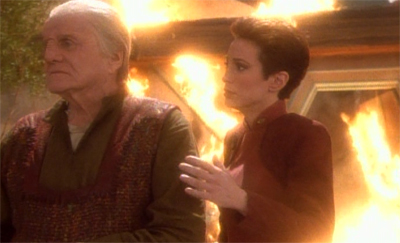
Burning down the house...

Burning down the house…

Continue reading

Star Trek: Deep Space Nine – Battle Lines (Review)

Star Trek: Deep Space Nine is twenty years old this year. To celebrate, I’m taking a look at the first season. Check back daily for the latest review or retrospective.

Battle Lines is, quite frankly, not a very good piece of television. Like a few of the episodes scattered throughout the first season of Star Trek: Deep Space Nine, it feels like it was pulled from a list of rejected scripts for Star Trek: The Next Generation. Ironically, it feels more like a reheated left-over than the next episode, The Storyteller, which was actually a recycled script from the first season of The Next Generation. Were it not for the involvement of Kai Opaka and a few hints about Bajoran spirituality, Battle Lines would feel almost as generic as The Passenger.

The concept is fascinating, and it represents another long-term shift in Deep Space Nine, but the script from Hilary J. Bader feels too functional and broad to do the episode justice. Instead, it feels fairly bland, which is a bit disappointing for an episode where Sisko accidentally gets the pope caught up in the universe’s most deadly game of laser tag.

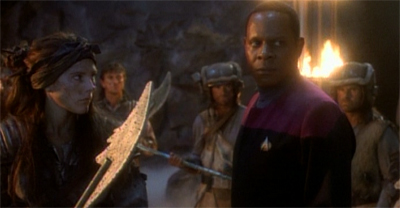
Taking a stab at bringing peace...

Taking a stab at bringing peace…

Continue reading