• Following Us

  • Categories

  • Check out the Archives


  • Awards & Nominations

The X-Files – Patient X (Review)

This May and June, we’re taking a trip back in time to review the fifth season of The X-Files and the second season of Millennium.

This should not work.

There are lots of reasons why Patient X and The Red and the Black should simply implode under their own weight. Most obviously, they are scripts that are rather blatantly just piling more and more back story and convolution onto a framework that is already overloaded and over-stretched. They are introducing new characters at a late stage of the game. They rely on contrivance and sketchy character development. They seem to exist at odds with the script for The X-Files: Fight the Future, which had been written and shot, but was awaiting release.
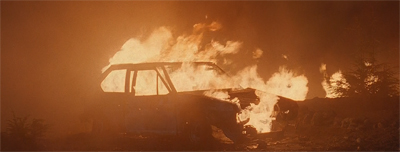
Everything burns...

Everything burns…

However, despite all this, Patient X and The Red and the Black work very well together. They are the strongest story-driven mythology two-parter since Nisei and 731 at the start of the third season. There is an energy and drive to Patient X and The Red and the Black that has been largely absent from the show’s big blockbuster two-parters since Herrenvolk at the start of the fourth season. After a year-and-a-half treading water as the release date of the movie draws ever closer, it is nice to see Chris Carter cut completely loose.

Patient X and The Red and the Black form a story which doesn’t seem at all worried about what any of this means for the summer realise of Fight the Future. Parts of it become quite difficult to reconcile with the film as released. However, the two-parter is all the stronger for it.
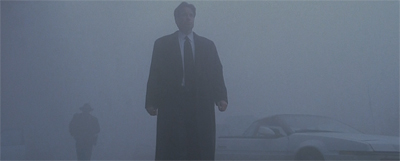
Fog of war...

Fog of war…

Continue reading

The X-Files – Kaddish (Review)

This February and March, we’re taking a trip back in time to review the fourth season of The X-Files and the first season of Millennium.

Kaddish is the last solo script that Howard Gordon wrote for The X-Files.

The writer would remain part of the writing staff until the end of the fourth season, contributing to scripts like Unrequited or Zero Sum. However, Kaddish would be the last script credited to Howard Gordon alone. So Gordon does not quite get the clean farewell that Darin Morgan got with Jose Chung’s “From Outer Space” or that Glen Morgan and Howard Wong received with Never Again. Instead, Howard Gordon remains a pretty significant presence on the show even after writing his final solo script.

The word made flesh...

The word made flesh…

Nevertheless, Kaddish is packed with a lot of the images and themes associated with Gordon’s work. As with Fresh Bones or Teliko, it is a horror story set within a distinct ethnic community. As with Firewalker or Død Kälm or Grotesque, there is an element of body horror at play. As with Lazarus or Born Again, this is essentially a supernatural revenge story. Kaddish offers a distilled collection of the tropes and signifiers that Gordon helped to define for The X-Files, making it an appropriate final script for the writer.

It helps that Kaddish is a surprisingly sweet and thoughtful little horror story.

The outside looking in...

The outside looking in…

Continue reading

The X-Files – Leonard Betts (Review)

This February and March, we’re taking a trip back in time to review the fourth season of The X-Files and the first season of Millennium.

Leonard Betts is a big one. In fact, it may just be the biggest one.

Leonard Betts attracted the largest audience in the history of The X-Files, with almost thirty million people tuning in to watch the episode. This audience was largely carried over from Superbowl XXXI, but it arrived at a fortuitous moment for the series. The X-Files was exploding into the mainstream. Chris Carter and Frank Spotnitz had spent Christmas 1996 in Hawaii plotting The X-Files: Fight the Future, a blockbuster movie based on the series. The week before, Mulder and Scully had paid a visit to Springfield in The Springfield Files.

What a waste...

What a waste…

The show’s moment had arrived. Leonard Betts makes for quite the moment. It might not be the best episode in the history of the show; it might not even be the best episode of the season. However, it ranks with Pusher as one of the great archetypal episodes of The X-Files. The show captures so much of what makes The X-Files great, almost perfectly distilling the appeal of the show into a tight forty-odd minute package. It is a beautifully-crafted piece of television that checks all of the right boxes. This is a pretty fantastic introduction to the show and its world.

Leonard Betts is an episode that has been put together with incredible skill, one that demonstrates why The X-Files had such an impact on the popular consciousness.

Comfortable in his skin...

Comfortable in his skin…

Continue reading

The X-Files – Sanguinarium (Review)

This February and March, we’re taking a trip back in time to review the fourth season of The X-Files and the first season of Millennium.

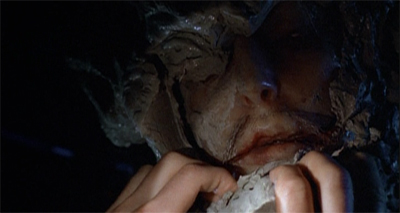
Appropriately enough, Sanguinarium is a bloody mess of an episode.

To be fair, it’s not a total write-off. There are some interesting ideas here, and the episode’s willingness to indulge in trashy horror is almost endearing… to a point. However, Sanguinarium often serves to illustrate just how much care and consideration is necessary to make an episode of The X-Files work. It is a very effective counter-example, an episode that demonstrates it takes more than just pulpy horror to make an episode work. Sanguinarium is almost as revolting and as graphic as Home, but it lack all the little elements that made the earlier episode work.

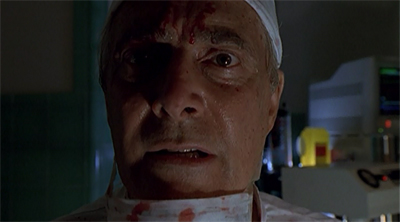
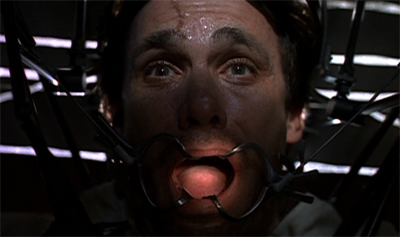
The doctor will see you now...

The doctor will see you now…

It’s cheesy instead of wry. It’s gratuitous instead of simply hyperactive. It’s blunt instead of subversive. Sanguinarium is not a misfire to the same extent as – say – Teso Dos Bichos or Excelsis Dei. It has a few ill-judged elements, but it’s more clumsy than offensive. It might be a bit much to suggest that there’s a classic episode buried just beneath the surface of Sanguinarium, but it seems fair to say that there is a much better episode somewhere in here. One suspects that pressure behind the scenes simply made it tougher to bring that episode to the fore.

Nevertheless, Sanguinarium is an interesting failure, if not quite a satisfying episode.

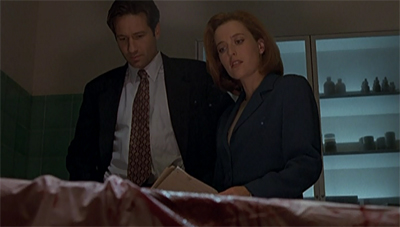
Blood work...

Blood work…

Continue reading

The X-Files – Home (Review)

This February and March, we’re taking a trip back in time to review the fourth season of The X-Files and the first season of Millennium.

Home is a big one.

It is an episode that is frequently ranked among the best that the show ever produced. It is an episode that many viewers remember quite clearly, even if they only saw it once years earlier. It was the first episode of the show to receive a viewer discretion warning on initial broadcast and was famously never repeated on the Fox Network. “It had one airing and then it was banned,” writer Glen Morgan quipped. “Jim and I don’t get rerun money for that.” It is also one of the rare episodes of The X-Files that is not explicitly paranormal in its subject matter, instead wandering into the macabre and the taboo.

Here there be monsters...

Here there be monsters…

Home also marks the return of writers Glen Morgan and James Wong to the series, following the cancellation of Space: Above and Beyond. With the debut of Millennium looming, the production team on The X-Files was under pressure. Fox had convinced Morgan and Wong to return to Ten Thirteen in return for producing a pilot for The Notorious Seven, one the duo’s long-gestating ideas. Morgan and Wong would produce four episodes of the fourth season of The X-Files and three episodes of the first season of Millennium.

Home is the first of their four scripts for the fourth season of The X-Files, and it sets the mood quite well. Returning from Space: Above and Beyond, the two seemed to be bristling with an electric energy and a palpable frustration. While not all four scripts are unqualified masterpieces, they each serve to push The X-Files further than it has gone before. Perhaps the most surprising thing about Home is that it is the most conventional of these four explosive scripts.

The mother of all problems...

The mother of all problems…

Continue reading

The X-Files – Teso Dos Bichos (Review)

This November (and a little of December), we’re taking a trip back in time to review the third season of The X-Files and the first (and only) season of Space: Above and Beyond.

It happens.

Every once in a while, there is a misfire. This is especially true when producing a genre television series churning out over twenty episodes a year. Inevitably, some of those episodes will fail; a few will fail spectacularly. Such is the way of things. It is hard to think of a twenty-odd episode season of anything that managed to maintain consistent levels of brilliance for a full season. All you can really hope is that the eventual and inevitable misfire is mostly technical.

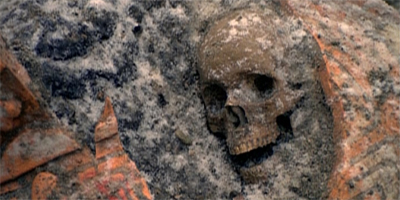
No bones about it...

No bones about it…

Teso Dos Bichos is a terrible episode of The X-Files. It is a terrible episode of television in general. However, it is terrible in ways that are mostly banal. This isn’t a failure of overreaching ambition, like Fearful Symmetry. It isn’t a missed opportunity, like 3. It isn’t even a racist and sexist nightmare, like Excelsis Dei. Instead, Teso Dos Bichos is just bad television. It is an episode that probably didn’t work on paper, containing elements that were unlikely to work on film either.

Given how strong the third season has been, there’s a desire to brush past Teso Dos Bichos, and pretend it simply did not happen.

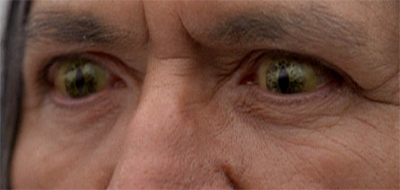
Cat people!

Cat people!

Continue reading

The X-Files – Grotesque (Review)

This November (and a little of December), we’re taking a trip back in time to review the third season of The X-Files and the first (and only) season of Space: Above and Beyond.

Grotesque is probably Howard Gordon’s strongest script for The X-Files.

F. Emasculata had demonstrated that Howard Gordon and Chris Carter worked very well together as a writing team. Carter was very good at big philosophical concepts, while Gordon was very adept at structuring a plot. Gordon knows how to build momentum and suspense, and his best scripts benefit from that particular talent. It helps that Gordon and Carter are probably the writers with the best understanding of Mulder as a character at this point in the show’s run.

Here there be monsters...

Here there be monsters…

Grotesque is an intriguing episode, particularly when examined in the context of the third season. The first and second season of The X-Files had been rather experimental in nature – the show tried to figure out what worked and what didn’t. The third season built off the successes of those earlier seasons. The idea seemed to be that the show would do more of what had worked, only better. So there were more two-part mythology episodes, more grounded stories, more comedy.

Grotesque is fascinating because it draws as much from earlier stories that didn’t work, using the lessons that the show had learned in the years since in order to make them work this time around.

Face-off...

Face-off…

Continue reading

The X-Files – War of the Coprophages (Review)

This November (and a little of December), we’re taking a trip back in time to review the third season of The X-Files and the first (and only) season of Space: Above and Beyond.

It is very odd to describe any Darin Morgan episode as “underrated.” And yet, despite that, War of the Coprophages feels like the underrated Darin Morgan teleplay.

Clyde Bruckman’s Final Repose had appeared towards the start of the season, featuring a powerhouse guest performance from Peter Boyle. Both Boyle and Morgan would win Emmys for their work on that episode, and Clyde Bruckman’s Final Repose is perhaps Morgan’s most conventional script for The X-Files or Millennium. In contrast, Jose Chung’s “From Outer Space” is perhaps the most adventurous and gonzo episode of The X-Files ever produced, coming at the end of the season and relentlessly (but affectionately) mocking the show’s core iconic mythology.

Down the drain...

Down the drain…

In contrast, War of the Coprophages sits in the middle, literally and figuratively. It is positioned almost precisely in the middle of the third season, with Morgan writing the screenplay in an exceptionally short period of time. It isn’t a truly exceptional example of a monster-of-the-week episode in the way that Clyde Bruckman’s Final Repose was, but it also isn’t as off-the-walls and bizarre as Jose Chung’s “From Outer Space.” It doesn’t feel like it has as much to say about death as Clyde Bruckman’s Final Repose, nor as much about life as Jose Chung’s “From Outer Space.”

And yet, in its own way, War of the Coprophages as an incisive and well-constructed commentary on The X-Files as a television show while allowing Morgan to tackle his recurring themes about society and humanity, and whether the world is what we would like to think that it is.

Bug hunt...

Bug hunt…

Continue reading

The X-Files – D.P.O. (Review)

This November (and a little of December), we’re taking a trip back in time to review the third season of The X-Files and the first (and only) season of Space: Above and Beyond.

What is interesting about the third season of The X-Files is the way that everything seemed to click into place. After two years of figuring out how various parts of the show worked, the series was in a place where it worked like a finely-honed machine. The conspiracy episodes hit all the right boxes. The second season had demonstrated the show could do experimental or even humourous episodes. Even the standard “monster of the week” shows were delivered with more confidence and style.

While D.P.O. may not be the strongest episode of the third season, it is an example of how comfortable the show has become. It is an episode that move incredibly well, where the vast majority of the pieces click, and one which is fondly remembered by the fan base. There’s a very serious argument to be made that writer Howard Gordon was the best author of “monster of the week” scripts working on the show at this point, and D.P.O. demonstrates how well he crafts these sorts of stories.

Cooking up a storm...

Cooking up a storm…

D.P.O. also benefits from any number of elements that make it seem memorable, even if it is “business as usual” after a massive three-part conspiracy epic. The opening sequence – featuring Ring the Bells by James – is one of the first times the show has so successfully integrated music into its action, something that would become a memorable part of later shows and even Millennium. The guest cast features Giovanni Ribisi and Jack Black. The episode also perfectly captures teen angst in an insightful manner.

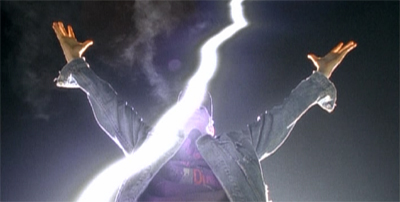
The show was apparently drawn from an index card labelled “lightning boy”, which had been on Chris Carter’s white board since the first season. It’s very hard to imagine the show pulling off something like D.P.O. during its first season. While it might have worked towards the end of the second season, the start of the third season seems the perfect place for it.

Cloudy with a chance of angst...

Cloudy with a chance of angst…

Continue reading

The X-Files – Season 2 (Review)

This August (and a little of September), we’re taking a trip back in time to review the second season of The X-Files. In November, we’ll be looking at the third season. And maybe more.

The first few seasons of a television show are very much about defining the show – figuring out what works and what doesn’t, and what form the show will take. After all, a lot of discussion and planning takes place during development, but all of that is on paper. It’s only once you’ve worked with the cast and had a chance to gauge audience response that it is possible to truly understand a television show.

The first two seasons of The X-Files seem like an attempt to map out the show, to mark the boundaries and do some fine calibration. The show had been a sleeper hit in its first season, popular enough to secure a second season on Fox. However, the second season had seen the series become a breakout hit. It climbed rather dramatically in the ratings, and the show would continue that ascent through to the fifth season in the lead-in to the feature film. However, the second season still feels like it’s a learning curve.

xfiles-onebreath6

There are exceptional episodes in the second season. The season provides a wealth of classic stories. Fresh Bones and Our Town stand out as two of the best monster-of-the-week stories that the show had done by this point in its life-cycle. Even outside of that, there are classics like One Breath or Humbug or The Host or F. Emasculata. However, there are also quite a few misfires like Fearful Symmetry or Excelsis Dei or 3.

There are a lot of points in the second season where it feels like The X-Files is experimenting, trying new things that would ultimately become part of the show’s unique identity. Not all of these elements worked, but that is the luxury of a second season. It allows the production team to do that sort of experimentation so they might find their groove.

xfiles-duanebarry16 Continue reading