• Following Us

  • Categories

  • Check out the Archives


  • Awards & Nominations

Star Trek – The Wounded Sky by Diane Duane (Review)

This January and February, we’ll be finishing up our look at the second season of Star Trek: The Next Generation and moving on to the third year of the show, both recently and lovingly remastered for high definition. Check back daily for the latest review.

We’ll be supplementing our coverage of the episodes with some additional materials – mainly novels and comics and films. This is one such entry. This is actually supplementary to the first season of the Next Generation, specifically the episode Where No One Has Gone Before.

Diane Duane remains one of the most influential Star Trek tie-in writers ever to work on the franchise. She has been involved in publishing tie-in books pretty consistently since the early days of the publishing line. The Wounded Sky, her first tie-in novel, was lucky number thirteen in the “Pocket TOS” range, published in 1983. Her most recent tie-in novel, The Empty Chair, was published in 2006. As well as a distinguished career outside of Star Trek, she has written novels and comics for the franchise. She even has a television credit, for her work on the teleplay for Where No One Has Gone Before.

There’s a reason that Duane’s contributions to Star Trek fiction are held in such a high regard, and those reasons are quite clear on reading The Wounded Sky. It’s a beautiful and thoughtful piece of prose set within the Star Trek universe, one more concerned with continuing and advancing the spirit of exploration established in the television show than meddling in continuity minutiae or offering generic adventures starring James Tiberius Kirk.

It’s a whole-hearted recommendation for any fan of the original series.
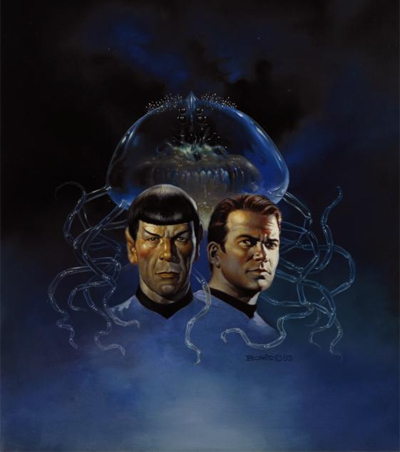
tos-thewoundedsky

Continue reading

Star Trek: The Next Generation (DC) Annual #2 – Thin Ice (Review)

This January and February, we’ll be finishing up our look at the second season of Star Trek: The Next Generation and moving on to the third year of the show, both recently and lovingly remastered for high definition. Check back daily for the latest review.

We’ll be supplementing our coverage of the episodes with some additional materials – mainly novels and comics and films. This is one such entry.

Riker is a character caught between a rock and a hard place. According to the series bible, Riker was imagined as one of the “dual lead characters” for the show and clearly envisioned as an impulsive and brilliant Kirk to Picard’s more rational and stoic Spock. However, it didn’t quite work out that way, for a number of reasons. For one thing, the writing on the early years of Star Trek: The Next Generation tended to be a bit more sterile and bland, so Riker was never really allowed to step too far out of Picard’s shadow.

Instead, we got lots of characters talking about how ambitious Riker was, without seeing it for ourselves. It’s implied that Riker’s career led him to separate from Troi, something Peter David ran with in Imzadi. Everybody is constantly telling everybody else how Riker desperately wants to be a starship commander. And yet, when it come to the actual characterisation of Riker on the show, none of this shines through.

Due to the constraints imposed on the early years, interpersonal conflict was impossible in early Next Generation scripts, putting Riker in a paradoxical position as a character. We’re repeatedly told how ambitious and career-orientated he is, but none of that shines through.

Dead space...

Dead space…

Continue reading

Star Trek: The Lost Era – Deny Thy Father by Jeff Mariotte (Review)

This January and February, we’ll be finishing up our look at the second season of Star Trek: The Next Generation and moving on to the third year of the show, both recently and lovingly remastered for high definition. Check back daily for the latest review.

We’ll be supplementing our coverage of the episodes with some additional materials – mainly novels and comics and films. This is one such entry.

In theory, you can probably tell a good story about just about anything. There’s a knack to constructing a narrative and in making particular characters fascinating or compelling. In the right hands, even the most tired and boring premise can generate some measure of excitement and over a glimpse of depth that we never thought was there. For example, I didn’t come out of Star Trek: Generations thinking that I’d ever read a classic story about John Harriman, and then I read the superb Serpents Among the Ruins.

However, some ideas strike you as a little less exciting than others. Some concepts seem a bit riskier to pull off, a bit more daunting in scope. Constructing a compelling narrative around the youth of Commander William T. Riker, probably one of the blandest members of the Star Trek: The Next Generation ensemble, seems like an uphill struggle.

Unfortunately, Jeff Mariote’s Deny Thy Father isn’t up to the task of making the boring father-son relationship glimpsed in The Icarus Factor seem any more exciting.

tng-denythyfather

Continue reading

Star Trek: Myriad Universes – Echoes and Refractions: Brave New World by Chris Roberson (Review)

This January and February, we’ll be finishing up our look at the second season of Star Trek: The Next Generation and moving on to the third year of the show, both recently and lovingly remastered for high definition. Check back daily for the latest review.

We’ll be supplementing our coverage of the episodes with some additional materials – mainly novels and comics and films. This is one such entry.

Quite a few of the Myriad Universe stories feel like “for want of a nail” stories. Changing one little detail of Star Trek history and the entire universe comes apart at the seams. In the Echoes and Refractions collection alone, The Chimes at Midnight offers a nightmare glimpse of a universe where Spock died in childhood, while A Gutted World explores what might have happened if the Cardassians had never left Bajor. Neither alternate universe represented a sustainable alternative to the Star Trek we know and love. The subtitles might as well have been “… and then things got worse.”

With the final story in the collection, Chris Roberson takes another tack. Brave New World isn’t a story about how removing one vital thread of the Star Trek tapestry causes the whole thing to unravel. Instead, it’s something quite a bit bolder. It’s a genuine alternate universe, one boldly different – not inherently better or worse, but just an example how things might have unfolded if just one little thing had been different.

st-myriaduniverses

Continue reading

Star Trek: Deep Space Nine – Blood Oath (Review)

Star Trek: Deep Space Nine is twenty years old this year. To celebrate, I’m taking a look at the first season. Check back daily for the latest review or retrospective.

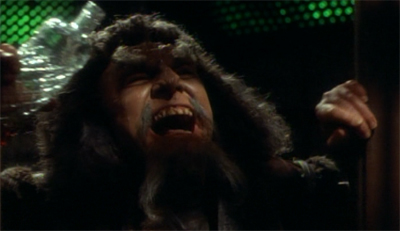
Blood Oath is a pretty fantastic piece of Star Trek: Deep Space Nine, and kicks the second season back into gear after a few mediocre (although not embarrassing) episodes. While it’s hardly the best episode of the year, and comes with its share of problems and baggage, it’s a tight and well-constructed piece of space opera. It’s a pulpy Klingon adventure, with the show’s best exploration to date of the existential problems of being Dax and a relatively simple (but potent) moral dilemma. It’s also just great fun.

Here's Kor!

Here’s Kor!

Continue reading

Star Trek: Mirror Universe – Shards & Shadows: The Greater Good by Margaret Wander Bonanno

This August, to celebrate the upcoming release of Star Trek: Into Darkness on DVD and blu ray, we’re taking a look at the Star Trek movies featuring the original cast. Movie reviews are every Tuesday and Thursday.

We’ll be supplementing our coverage of the movies with tie-ins around (and related to) the films. We’ll be doing one of these every week day. This is one such article.

If Star Trek and Star Trek: Into Darkness proved one thing, it’s that it sucks to be Christopher Pike, in any universe. The first captain of the USS Enterprise not only had to wait until 1988 to see his pilot (The Cage) finally broadcast on television, he also got shuffled off-screen unceremoniously in the franchise’s first two-parter (The Menagerie) and was never really mentioned again. When JJ Abrams’ Star Trek introduced us to a rebooted Christopher Pike played wonderfully by Bruce Greenwood, he observed of George Kirk was captain of a starship for eight minutes. It seemed like Pike ended up in command of the Enterprise for only slightly longer than that.

It seems that even mirror!Pike can’t catch a break, as Margaret Wander Bonanno demonstrates in her short little glimpse into how exactly mirror!James Tiberius Kirk took control of the ISS Enterprise.

st-shardsandshadows

Continue reading

Non-Review Review: Star Trek – Generations

This August, to celebrate the upcoming release of Star Trek: Into Darkness on DVD and blu ray, we’re taking a look at the Star Trek movies featuring the original cast. Movie reviews are every Tuesday and Thursday.

There are lots of problems with Star Trek: Generations. It feels too much like a two-parter from the television show. It tries to fit in a laundry list of demands from the studio. It wastes Malcolm McDowell. It decides that the only part of the original series deserving a send-off is James T. Kirk, and then pushes him off-screen for an hour before dragging him back into the movie to kill him off in the most ironic and anti-climactic manner possible.

Yet, despite these considerable flaws, Generations also has a lot to recommend it. Although the script occasionally feels a little overcooked, the themes concerning mortality lend it a serious amount of weight. Director David Carson demonstrates that he can work wonders on a tiny budget. Cinematographer John A. Alonzo finds a way to shoot familiar sets in a way that makes them look incredibly beautiful. None of these strengths can fully compensate for the very fundamental flaws with the seventh Star Trek cinematic outing, but they do mitigate them somewhat.

Generations isn’t a great Star Trek film, and it isn’t even the best odd-numbered Star Trek film, but it is far from an unmitigated disaster. Well, except for the way it treats Kirk.

Riding the wave...

Riding the wave…

Continue reading

Star Trek Special #2 (DC Comics, 1994) – A Question of Loyalty (Review)

This August, to celebrate the upcoming release of Star Trek: Into Darkness on DVD and blu ray, we’re taking a look at the Star Trek movies featuring the original cast. Movie reviews are every Tuesday and Thursday.

We’ll be supplementing our coverage of the movies with tie-ins around (and related to) the films. We’ll be doing one of these every week day. This is one such article.

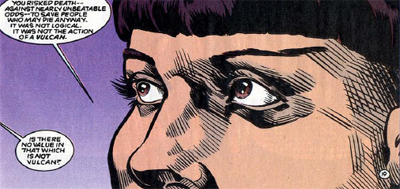
A Question of Loyalty is essentially a Star Trek character study, comparing and contrasting the two young Vulcan female characters to appear in the film franchise, providing a meeting between Valeris and Saavik, Spock’s two young protegés. The production history of Star Trek VI: The Undiscovered Country is interesting, as there were early plans to include Saavik. For a variety of reasons, this didn’t work out and director Nicholas Meyer and his writers decided to cast a new role, Valeris. A Question of Loyalty allows the two characters to come face-to-face, and offers both some character motivation for the under-developed Valeris and a fond farewell for Saavik.

Her ears are tingling...

Her ears are tingling…

Continue reading

Star Trek – The Ashes of Eden by William Shatner et al (DC Comics) (Review)

This August, to celebrate the upcoming release of Star Trek: Into Darkness on DVD and blu ray, we’re taking a look at the Star Trek movies featuring the original cast. Movie reviews are every Tuesday and Thursday.

We’ll be supplementing our coverage of the movies with tie-ins around (and related to) the films. We’ll be doing one of these every week day. This is one such article.

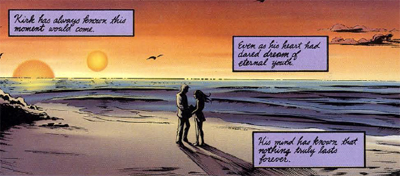
The Ashes of Eden is effectively professionally published Star Trek fan fiction, written by William Shatner. The actor gets some assistance from veteran Star Trek writers Judith and Garfield Reeves-Stevens, but it’s clear that Shatner is the driving force behind The Ashes of Eden. Indeed, an astute reader will spot quite a few thematic overlaps with Shatner’s much-maligned directorial effort, only without the rest of the cast around to temper his efforts to make this a story about Kirk and Kirk alone.

Still, The Ashes of Eden isn’t as bad as it might be. After all, just because something is fan fiction – professionally published or otherwise – says nothing of its quality. The story is probably best read as an exploration between Shatner and his alter ego, but it holds together quite well, providing a much more solid (if still far from perfect) exploration of the themes hinted at in Shatner’s Star Trek V: The Final Frontier.

The dusk of an era...

The dusk of an era…

Continue reading

Non-Review Review: Star Trek V – The Final Frontier

This August, to celebrate the upcoming release of Star Trek: Into Darkness on DVD and blu ray, we’re taking a look at the Star Trek movies featuring the original cast. Movie reviews are every Tuesday and Thursday.

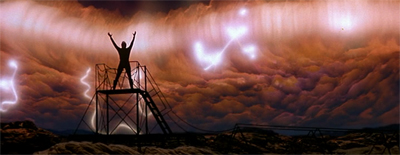
Star Trek V: The Final Frontier is not a good movie. There’s really nothing that can be excavated from the film that might redeem it. It isn’t a misunderstood masterpiece. It isn’t an insightful diamond in the rough. It’s just a bad film, the one which forms the cornerstone of the “odd-numbered Star Trek films” curse. It’s indulgent, pretentious and narrow-minded. It tries to blend a world-weary cynicism with an ill-judged and mean-spirited sense of humour.

Despite being shorter than Star Trek IV: The Voyage Home, it feels remarkably longer. It feels like a rather halfhearted attempt to recapture the spirit of the television show – oblivious to the fact that the franchise has spent the past decade moving onwards. It confuses ponderous pretension for intelligent insight.

Feeling blue...

Feeling blue…

Continue reading