• Following Us

  • Categories

  • Check out the Archives


  • Awards & Nominations

Star Trek: Deep Space Nine – Rules of Acquisition (Review)

Star Trek: Deep Space Nine is twenty years old this year. To celebrate, I’m taking a look at the first season. Check back daily for the latest review or retrospective.

The Nagus was a surprising high-point of the first season of Star Trek: Deep Space Nine. It represented a conscious effort to rehabilitate and reappraise the Ferengi, the aliens introduced as potentially major adversaries in the first season of Star Trek: The Next Generation, only to wind up as mostly unfunny comic relief. The Nagus dared to suggest that the Ferengi might not be the monsters the Federation considers them to be, suggesting that their culture – while different – was no less worthy of respect or consideration than that of the Klingons.

Rules of Acquisition is a clear follow-up, right down to the way that it includes Grand Nagus Zek. However, it’s nowhere near as charming and successful as The Nagus, because it feels like it’s just treading water. It teases potential developments down the line, but the story seems locked in a familiar holding pattern – right down to the rather convenient ending that inevitably sees Quark snatching defeat from the jaws of victory.

It’s not quite a bad episode, certainly not on the scale of the colossal misfire that was Melora, but it’s also not a particularly good one.

Nothing to see here...

Nothing to see here…

Continue reading

Star Trek: Deep Space Nine – Season 1 (Review)

Star Trek: Deep Space Nine is twenty years old this year. To celebrate, I’m taking a look at the first season. Check back daily for the latest review or retrospective.

Well, that was actually pretty satisfying. Star Trek: Deep Space Nine has probably the most satisfying debut season of any of the Star Trek spin-offs. While the show’s first year can’t quite measure up to the very first season of Star Trek ever produced, it can hold its head high among the spin-offs. Although I will concede that the bar isn’t exactly high when it comes to measuring the first year of the tie-in television shows.

When I began a recent re-watch of Star Trek: The Next Generation, I was glad to finish the show’s rocky first season. It was a slog, like the work one has to put in before delving into “the good stuff.” I recently picked up the blu ray of the first season of Star Trek: Enterprise. While there are a couple of nice episodes, there are quite  a few I’d forgotten entirely because they were so bland. There are more I would like to forget. Star Trek: Voyager‘s first season is the single largest missed opportunity in the history of the franchise.

So Deep Space Nine‘s first year doesn’t have to do that much beyond “not sucking” in order to earn the coveted title of “best pilot season of a Star Trek spin-off.” However, as I watched the season, I was continually impressed with the quality of work done. There are a few duds (and a few classics), but the first year demonstrates remarkable insight into what is unique about the show’s premise. It doesn’t always have the courage to follow through on that promise, but it at least acknowledges it.

ds9-season1a

Continue reading

Star Trek: Deep Space Nine – The Forsaken (Review)

Star Trek: Deep Space Nine is twenty years old this year. To celebrate, I’m taking a look at the first season. Check back daily for the latest review or retrospective.

Following on directly from If Wishes Were Horses…, The Foresaken combines another bunch of familiar Star Trek clichés into a plot that fells like it has been elsewhere. To be fair, the “malfunctioning computer” plot is a plot that lends itself to a Star Trek setting, and the key is the execution of that most familiar set up. The franchise has done it quite well in the past. I’m fond of Star Trek: The Next Generation‘s foray into the subgenre with Disaster. Even Star Trek: Deep Space Nine would do a number of later episodes working quite well from this starting point – Civil Defense and Starship Down ranking quite highly.

The problem with The Foresaken, then, isn’t the fact that it falls back on a bunch of familiar Star Trek clichés, but it fails to use them to tell an especially compelling story.

Oh, what a world!

Oh, what a world!

Continue reading

Star Trek: Deep Space Nine – The Storyteller (Review)

Star Trek: Deep Space Nine is twenty years old this year. To celebrate, I’m taking a look at the first season. Check back daily for the latest review or retrospective.

The Storyteller should not work half as well as it does. While some episodes this season (notably The Passenger and Battle Lines) feel like they were simply lifted directly from the “reject” pile within the writers’ room on Star Trek: The Next Generation, The Storyteller is actually a rejected pitch from that show’s first season. Written by Kurt Michael Bensmiller, the writer responsible for Time Squared, one of the stronger installments of the show’s first two years, it was also written late in 1992, about a month before Star Trek: Deep Space Nine would actually air.

And yet, despite that, The Storyteller really feels like a show that wouldn’t work on any of the other Star Trek spin-offs. A lot of that seems to be down to the work by Ira Steven Behr to polish up Bensmillers’ draft and to add a lot of character work and development to what is a decidedly high concept. As producer Michael Piller confessed in Captains’ Logs Supplemental – The Unauthorized Guide to the New Trek Voyages, “Ira did a lot of work on that script.”

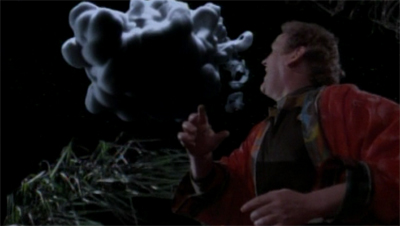
O'Brien's mind is a bit clouded right now...

O’Brien’s mind is a bit clouded right now…

Continue reading

Star Trek: Deep Space Nine – Vortex (Review)

Star Trek: Deep Space Nine is twenty years old this year. To celebrate, I’m taking a look at the first season. Check back daily for the latest review or retrospective.

Something very interesting happens in the second half of Star Trek: Deep Space Nine‘s first season. It seems like the writers and producers are making a conscious effort to develop the show’s characters, themes and the world that these inhabit. Plot threads are hinted at, only to be left dangling. Ideas are broached, and tucked away for another day. Given that Star Trek: The Next Generation waited until the third season to broach serialisation in Sins of the Father, the approach taken here is quite striking.

These three episodes are more notable for what they set up rather than what they actually accomplish on their own terms. These adventures lay groundwork, or at least hint at laying groundwork, that will pay off throughout the show’s extended seven-year run. Okay, not exactly. There are some redundant elements here that never actually pay off, but Vortex, Battle Lines and The Storyteller all play into the show’s bigger story arc, even if it seems the writers aren’t entirely sure what those story arcs are.

It's murky out there...

It’s murky out there…

Continue reading

Star Trek: Deep Space Nine – The Nagus (Review)

Star Trek: Deep Space Nine is twenty years old this year. To celebrate, I’m taking a look at the first season. Check back daily for the latest review or retrospective.

The Nagus starts what turns out to be an annual tradition for Star Trek: Deep Space Nine. It introduces the concept of a “Ferengi” episode, where once (or twice) a year, the show would take time out from other on-going concerns to focus on the state of affairs in the Ferengi Alliance. In a way, it’s quite like what Star Trek: The Next Generation did for the Klingons, taking an episode every once in a while to delve into the alien culture and offer a bit of exploration of a species originally created as a two-dimensional cardboard stand-in for a philosophy the franchise found unappealing.

Starting with Heart of Glory, The Next Generation developed Klingons from “those bad guys with the ridges” into a fully functioning and multi-faceted culture, largely driven by writer Ronald D. Moore from the third season. Deep Space Nine did largely the same thing with the Ferengi, largely spearheaded by producer Ira Steven Behr. Although, given the fact that the episodes concerned amoral capitalists instead of imposing warriors, Deep Space Nine opted for comedy as the genre of choice when developing the Ferengi.

He's got the lobes for business...

He’s got the lobes for business…

Continue reading

Star Trek: Deep Space Nine – The Passenger (Review)

Star Trek: Deep Space Nine is twenty years old this year. To celebrate, I’m taking a look at the first season. Check back daily for the latest review or retrospective.

And here we hit what amounts to the rock bottom of Star Trek: Deep Space Nine‘s first season. The Passenger and Move Along Home exist as the two weakest stories in this first season, and the point from which Deep Space Nine begins to map a path towards recovery, climaxing in the best final two episodes of any first season in the history of Star Trek. We’re a long way from that, and we seem furthest from it here.

While Move Along Home is a legitimately bad episode, one with flaws that probably should have been spotted in any of the episode’s troubled development history, The Passenger suffers because it is the most bland and generic of the first season Deep Space Nine episodes. It accomplishes nothing, but it feels worse because its ambitions were so low. It’s the kind of story that could easily have been told on any Star Trek show, or any science-fiction series, but with no sense of local colour to give it distinctive flavour.

The Passenger is just as bland as the title makes it sound.

The not-so-good Doctor...

The not-so-good Doctor…

Continue reading

Star Trek: Deep Space Nine – Captive Pursuit (Review)

Star Trek: Deep Space Nine is twenty years old this year. To celebrate, I’m taking a look at the first season. Check back daily for the latest review or retrospective.

Much like Babel, it’s not too difficult to reimagine Captive Pursuit as an episode of Star Trek: The Next Generation. It’s notable for being one of the few episodes of Deep Space Nine to really feature the famous “Prime Directive”, something of a staple of the original Star Trek, The Next Generation and even Voyager. Like a lot of episodes from the middle of Deep Space Nine‘s first season, this seems almost like an attempt to port on episode concept directly over from The Next Generation. In particular, the notion of the crew dealing with a fugitive while wrestling with the Prime Directive feels like a retread of The Hunted.

That said, Captive Pursuit does work quite well, taking a familiar concept and putting a twist on it unique to the show. Despite the fact the episode’s premise feels like it has been carried over, the execution is careful enough to distinguish Deep Space Nine from its older sibling.

The hunted...

The hunted…

Continue reading