• Following Us

  • Categories

  • Check out the Archives


  • Awards & Nominations

Doctor Who: The Hand of Fear (Review)

To celebrate the fiftieth anniversary of the longest-running science-fiction show in the world, I’ll be taking weekly looks at some of my own personal favourite stories and arcs, from the old and new series, with a view to encapsulating the sublime, the clever and the fiendishly odd of the BBC’s Doctor Who.

The Hand of Fear originally aired in 1976.

Come on, where are we?

We’re in a quarry.

Yes, I know we’re in a quarry, but where?

Well, how do I know? I don’t know all the quarries that–

– the Doctor and Sarah Jane get a bit meta

The Hand of Fear is odd, because it’s the end of an era – but it’s not the end of the era for the rather obvious reason that it bids farewell to one of the franchise’s best-loved companion character. The Hand of Fear is best known as the final story to feature Sarah Jane Smith. Indeed, the DVD comes with a helpful sticker informing any potential purchasers of the story’s significance.

However, watching The Hand of Fear with the benefit of hindsight, it isn’t Sarah Jane’s departure that is the most striking part of the show.
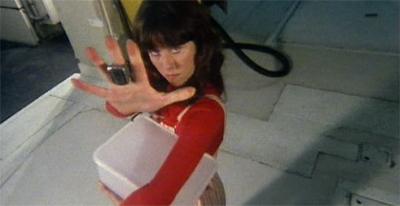
Keep it handy...

Keep it handy…

Continue reading

Doctor Who: Arc of Infinity (Review)

To celebrate the fiftieth anniversary of the longest-running science-fiction show in the world, I’ll be taking weekly looks at some of my own personal favourite stories and arcs, from the old and new series, with a view to encapsulating the sublime, the clever and the fiendishly odd of the BBC’s Doctor Who.

Arc of Infinity originally aired in 1983.

We know who you are.

That changes nothing.

– the Doctor and Omega set one thing straight

There really should be a bare minimum threshold of enjoyment for a Doctor Who story set on Gallifrey. I mean, these are beings who claim to control the whole of time and space. Their guards look like they modelled themselves on Adam Strange, replacing his jetpack with a cape, and there’s always an excuse for some good old-fashioned science-fiction ray-gun-related fun. How hard can it be to entertain an audience for four episodes in that particular setting?

Unfortunately, Arc of Infinity answers that question. Quite boring indeed, it seems.

Going around in circuits...

Going around in circuits…

Continue reading

Doctor Who: The Keeper of Traken (Review)

To celebrate the fiftieth anniversary of the longest-running science-fiction show in the world, I’ll be taking weekly looks at some of my own personal favourite stories and arcs, from the old and new series, with a view to encapsulating the sublime, the clever and the fiendishly odd of the BBC’s Doctor Who.

The Keeper of Traken originally aired in 1981. It was the first instalment in the “Master” trilogy.

He dies, Doctor. The Keeper dies!

– Tremas heralds the end of an era

Of course, the entire season has been less than subtle about the point, but The Keeper of Traken is the point at which Tom Baker’s final season builds to critical mass, and reaches the point of no return. Entropy, decay and death have all been crucial ingredients in the year’s collection of adventures, but The Keeper of Traken is the point at which it seems like our character has set himself on an incontrovertible course, a path from which he cannot diverge. Baker’s approaching departure gives The Keeper of Traken a great deal of weight, and helps balance a story that might otherwise seem excessive or overblown. There’s melodrama here, but it feels strangely appropriate.

Lawrence Miles has argued that Logopolis was the funeral for the Fourth Doctor. If so, The Keeper of Traken is his wake – and it’s fitting that Irish poet and writer Johnny Byrne should provide this strangely lively (if morbid) celebration.

Hell of a wake...

Hell of a wake…

Continue reading

Doctor Who: Meglos (Review)

To celebrate the fiftieth anniversary of the longest-running science-fiction show in the world, I’ll be taking weekly looks at some of my own personal favourite stories and arcs, from the old and new series, with a view to encapsulating the sublime, the clever and the fiendishly odd of the BBC’s Doctor Who.

Meglos originally aired in 1980.

To control the output, it will be necessary to increase the violence of the emissions.

Then you’ll be in danger yourself.

Well, hardly. I’m a Time Lord. Having lived in the future I can hardly die in the present.

That can’t be true. That’s a philosophical paradox.

No, it’s merely beyond your comprehension.

– Meglos and Deedrix get their “parody” on

Meglos is one of those stories that has undergone something of an alternative interpretation among Doctor Who fans. Much like The Web Planet went from “a brave attempt to realise a truly alien world” to a “complete and utter embarrassment”, Meglos has gone from “that episode where a talking cactus tries to take over the universe” to “that parody where a talking cactus tries to take over the universe.” In fairness, looking at the serial, it is very hard not to see Meglos as an intentional and subversive parody of a bad Doctor Who story, but I have to concede that it doesn’t stop the adventure from being a bad Doctor Who story itself.

Okay, not every review this week is going to open with a close-up of Tom Baker in distress...

Continue reading

Doctor Who: The Deadly Assassin (Review)

To celebrate the fiftieth anniversary of the longest-running science-fiction show in the world, I’ll be taking weekly looks at some of my own personal favourite stories and arcs, from the old and new series, with a view to encapsulating the sublime, the clever and the fiendishly odd of the BBC’s Doctor Who.

The Deadly Assassin originally aired in 1976.

I deny this reality.

– the Doctor

The Deadly Assassin is a rather boldly experimental episode of Doctor Who. It’s the first story told without a companion character, and it also ventures quite forcefully into the realm of surrealism. It offers a rather bold deconstruction of the Time Lords, a rather cynical depiction of the aliens who had seemed all-powerful in stories like The War Games or The Three Doctors. More than that, though, The Deadly Assassin feels – appropriately enough – like a treatise on the inevitable death of Doctor Who.

Located in the middle of the fourteenth of twenty-six seasons, and broadcast thirteen years from both the start and the end of the show’s initial run, The Deadly Assassin seems to be positioned at the very heart of Doctor Who.

A rough outline of what's going on...

A rough outline of what’s going on…

Continue reading

Doctor Who: The Sound of Drums (Review)

To celebrate the fiftieth anniversary of the longest-running science-fiction show in the world, I’ll be taking weekly looks at some of my own personal favourite stories and arcs, from the old and new series, with a view to encapsulating the sublime, the clever and the fiendishly odd of the BBC’s Doctor Who.

The Sound of Drums originally aired in 2007.

Doctor.

Master.

I like it when you use my name.

You chose it. Psychiatrist’s field day.

As you chose yours. The man who makes people better. How sanctimonious is that?

– the Doctor and the Master

The Sound of Drums is really more interesting than it is successful. Building off Utopia as the second part of a three-part finalé, building the longest single story in the revived Doctor Who, The Sound of Drums does an excellent job moving the characters along and getting everything where it needs to be for the requisite cliffhanger. Unfortunately, Davies’ weaknesses when it comes to plotting are at play here. While Utopia took advantage of a leisurely pace and conventional plot in order to do some nice set-up, The Sound of Drums doesn’t have that luxury. Utopia came out of left-field, with the last ten minutes taking the audience by surprise. Now the audience knows the game is afoot, so the rules have changed.

The Sound of Drums kicks off with everything in full swing, and Davies has to ratchet up the tension from there. The result is that Davies does solid character work, but that the plot points and set-ups occasionally feel a bit forced. That’s especially true when it comes to the ideas that will be important to the resolution of The Last of the Time Lords.

The End of the World... oh, wait, we already did that one...

The End of the World… oh, wait, we already did that one…

Continue reading

Doctor Who: Shada (2003) (Review)

To celebrate the fiftieth anniversary of the longest-running science-fiction show in the world, I’ll be taking weekly looks at some of my own personal favourite stories and arcs, from the old and new series, with a view to encapsulating the sublime, the clever and the fiendishly odd of the BBC’s Doctor Who.

Shada originally broadcast on the BBC website in 2003.

Doctor, a fool would realise that it was written in code!

Skagra, this thing is written in code!

– Skagra and the Doctor have some communication difficulties

Has a failed Doctor Who story every haunted the collective consciousness in the way that Shada does? There’s a wealth of adventures that were proposed and never produced, from the last Master story that never happened in The Final Game, through to the laundry list of unproduced adventures that would have made up Colin Baker’s second season if the show hadn’t been parked by the BBC. However, Shada is something different. So different, in fact, that it has been told quite a few times. In fact, it might be the only Doctor Who story I end up covering twice.

This was a webcast version, a very simply animated version of the tale produced for the BBC website, using an audio play adapted from Douglas Adams’ original script by Big Finish, the fan collective who produce a range of celebrated audio plays for the classic series. Starring Paul McGann, the Eighth Doctor who never really got a chance to develop the role in live action, it’s an interesting glimpse at what might have been.

Lost in time...

Lost in time…

Continue reading