• Following Us

  • Categories

  • Check out the Archives


  • Awards & Nominations

Doctor Who: The Keys of Marinus (Review)

To celebrate the fiftieth anniversary of the longest-running science-fiction show in the world, I’ll be taking weekly looks at some of my own personal favourite stories and arcs, from the old and new series, with a view to encapsulating the sublime, the clever and the fiendishly odd of the BBC’s Doctor Who.

The Keys of Marinus originally aired in 1964.

While the initial thirteen-episode block helped established Doctor Who, it was the follow-up stories that built on those initial blue-prints. Marco Polo was a historical adventure in the style of An Unearthly Child, paying homage to the original educational aim of the series, designed to teach kids about history and science. However, the real breakout of the initial run had been The Daleks, with those adorable psychotic pepper pots. Keen to capitalise on the success of the futuristic adventure, another adventure serial was commissioned to take place on an alien world, with Terry Nation’s The Keys of Marinus helping to establish science fantasy as a concrete part of the show’s identity.

All a-Voord!

Continue reading

Doctor Who: The Edge of Destruction (Review)

To celebrate the fiftieth anniversary of the longest-running science-fiction show in the world, I’ll be taking weekly looks at some of my own personal favourite stories and arcs, from the old and new series, with a view to encapsulating the sublime, the clever and the fiendishly odd of the BBC’s Doctor Who.

The Edge of Destruction originally aired in 1964.

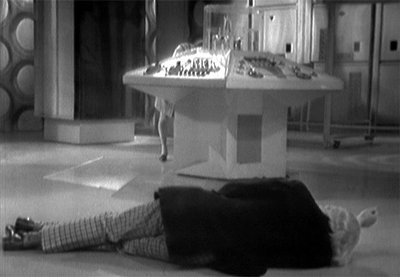
The Edge of Destruction is an interesting little two-parter. Basically created to fill out a two-episode gap in the end of the initial run of episodes following the four-part An Unearthly Child and the seven-part The Daleks. It wasn’t possible to bring Marco Polo forward into this production block, as it was too long, and there wasn’t any budget provided for a guest cast or for new sets. So, as seemed to happen quite a lot on the show, the production team’s ingenuity forced their creativity. The Edge of Destruction (or Inside the Spaceship) ended up being a two-part “bottle” episode, featuring only the four members of the lead cast.

After seven episodes of The Daleks, I can’t blame the Doctor for wanting a nap…

Continue reading

Doctor Who: The Daleks (Review)

To celebrate the fiftieth anniversary of the longest-running science-fiction show in the world, I’ll be taking weekly looks at some of my own personal favourite stories and arcs, from the old and new series, with a view to encapsulating the sublime, the clever and the fiendishly odd of the BBC’s Doctor Who.

The Daleks originally aired in 1963-4.

Make! no! attempt! to! capture! them! they! are! to! be! exterminated! you! understand! exterminated!

– four episodes in, the Daleks have a catchphrase

Because of the somewhat confusing naming conventions for the Hartnell era, where each individual episode had its own title, this one goes by a variety of names: The Mutants, The Dead Planet, or The Daleks. Still, if you’re reading this, you probably know the serial I’m talking about. It’s the one that introduced everyone’s favourite psychotic little pepper pots.

Taking the plunger…

Continue reading

Doctor Who: An Unearthly Child (Review)

To celebrate the fiftieth anniversary of the longest-running science-fiction show in the world, I’ll be taking weekly looks at some of my own personal favourite stories and arcs, from the old and new series, with a view to encapsulating the sublime, the clever and the fiendishly odd of the BBC’s Doctor Who.

An Unearthly Child originally aired in 1963.

“Just open the doors, Doctor Foreman.”

“Eh? Doctor who? What’s he talking about?”

– Ian and the Doctor drop the title

And so, it begins…

There from the beginning…

Continue reading

Doctor Who: The Angels Take Manhattan (Review)

The decision to build Steven Moffat’s third season of Doctor Who around a series of done-in-one stories has been a bit of a mixed blessing. Asylum of the Daleks was suitably madcap Saturday tea-time telly, and A Town Called Mercy was an affectionate homage to Americana, but Dinosaurs on a Spaceship barely had room to breath, overloaded on cool moments with little room left for plotting.

The Angels Take Manhattan suffers the most from this sense that it is being compacted. Watching the episode, it feels like Moffat is trying to cram too much story into a single forty-five minute episode. It makes the viewer long for the days when Russell T. Davies would gleefully run his episodes over the allocated forty-five minute slot. Here, Moffat’s big high-concept “timey wimey” ideas and his farewell to his two companions eating up so much of the run-time that the plot itself still feels like an afterthought, running on contrivance and coincidence rather than anything more substantial.

That doesn’t mean it isn’t an affective farewell to Rory and Amy, or that it doesn’t draw fantastic performances from its central quartet, but it does mean that The Angels Take Manhattan is never quite as sturdy as it should have been.

A walk in the park…

Continue reading

Doctor Who: The Doctor, The Widow & The Wardrobe (Review)

Where are we?

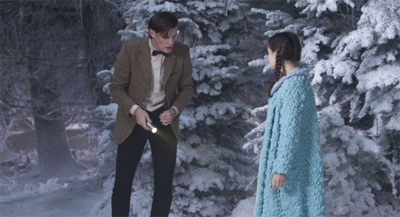
In a forest. In a box. In the sitting room. Try to keep up.

– Lily and the Doctor sum things up

I could get used to this “coopting a holiday classic” thing that Steven Moffat has going. After all, last year riffed on A Christmas Carol (right down to the name), and this one leans pretty heavily on The Lion, The Witch & The Wardrobe. I imagine a Doctor Who episode themed around It’s a Wonderful Life can’t be too far away. Still, strangely enough, the episode worked best as an illustration of the show’s wonderful heart and its charming understanding of childhood psychology – even if the actual science-fiction plot was a little disappointing and the ending felt like a bit of a copout. Certainly not quite as good as last year’s entry into the Doctor Who Christmas canon, but not a waste of time either.

It left me a bit cold...

Continue reading

The Doctor Is In? Is Doctor Who “Too British” For American Audiences?

Well, it’s been about a week since the news broke that David Yates would be directing the new Doctor Who movie, being produced by the BBC, aimed at American audiences. Perhaps Steven Moffat’s rumoured commentary was perfectly apt: it seems that neither the director nor the studio have any idea what exactly they are planning, and the announcement might have been more than a little preemptive. There’s a lot of chatter out there about what this means for the television show, which is rumoured to be running severely over-budget and under pressure from the BBC executives. Because, you know, it’s not like the show makes enough to justify its costs.

I don’t know if this means potential cancellation or a reboot after the fiftieth anniversary, or even if the show and the movie will run alongside in two distinct continuities (and people said Moffat’s “timey-wimey” plots were too complicated!). Being entirely honest, I’m not sure if Yates knows either. However, something does fascinate me about this. Bringing Yates on-board represents a vote of confidence, suggesting that Doctor Who could be somewhere in the region of “Harry Potter” success stateside.

I can’t help but wonder if Doctor Who is simply “too British” for mainstream American audiences, and if launching a movie franchise to appeal to the demographics will be able to keep the core of the character and the show, while courting North American movie-goers.

States of play?

Continue reading

Doctor Who: The Wedding of River Song (Review)

To celebrate the fiftieth anniversary of the longest-running science-fiction show in the world, I’ll be taking weekly looks at some of my own personal favourite stories and arcs, from the old and new series, with a view to encapsulating the sublime, the clever and the fiendishly odd of the BBC’s Doctor Who.

The Wedding of River Song originally aired in 2011.

“I had to die. I didn’t have to die alone.”

– The Doctor

That was a really crammed 45 minutes. If I’m ever looking for an example of how much plotting Steven Moffat can fit into a single regular-sized episode of Doctor Who, I think I only need to look back at The Wedding of River Song. It’s a piece of very smart science-fiction writing, bristling with ideas and tying up quite a lot of the questions that Moffat raised over the course of the last two years, while raising even more.

It’s something that Moffat’s Doctor Who seems to struggle with, balancing the show’s appeal and accessibility with long-term arc-based story telling. It’s a conflict that’s playing out across a variety of television shows, building off the massive success of Lost, and demonstrating that television shows with serialised plot elements can draw (and, for the most part, keep) large audiences.

It’s still a risky gambit for any television show, particularly one like Moffat’s Doctor Who, where the episodes are so few and so far spaced across the television season. Arcs like this run the risk of extending some of the problems with the season as a whole, rather than playing up the individual strengths of the episodes.

Death of the Doctor…

Continue reading

Doctor Who: Closing Time (Review)

Look! They gave me a badge with my name on it, in case I forget it… Which is very thoughtful, because that does happen.

– The Doctor shows off his name badge

I have to admit, I liked Closing Time. It wasn’t quite as good as The Lodger, but it was an entertaining diversion at the end of what has been a pretty gloomy run of episodes for Doctor Who. And based on the previews for The Wedding of River Song, it isn’t going to get any lighter next week. I do have to admit, I kinda like the idea of Craig as an almost “stationary” companion – one whose life is constantly interrupted by the return of the Doctor to his relatively quiet existence, something that works quite well in contrast to the relationship between Amy and the Doctor.

It's all under (remote) control...

Continue reading

Doctor Who: The God Complex (Review)

To celebrate the fiftieth anniversary of the longest-running science-fiction show in the world, I’ll be taking weekly looks at some of my own personal favourite stories and arcs, from the old and new series, with a view to encapsulating the sublime, the clever and the fiendishly odd of the BBC’s Doctor Who.

The God Complex originally aired in 2011.

It’s time we saw each other as we really are.

– The Doctor

It really is like the McCoy era all over again, isn’t it? The Impossible Astronaut gave us a scheming and manipulative Doctor. Night Terrors felt like it was drawn from the same cloth as Survival, with the faintest trace of Paradise Towers. Here, we get to revisit the ideas at the heart of The Curse of Fenric. Moffat’s second season has really been about the writer defining his own way of making Doctor Who, following a debut season that followed the same structure as the four years overseen by Russell T. Davies.

Here, Moffat is deconstructing the myth of the Doctor, in a way that draws on and contrasts with Davies’ “the Lonely God”, without going to the excess of “the Time Lord Victorious.” Indeed, with the whole dynamic between the Doctor and Amy drawing on one careless miscalculation the character made, changing a young girl’s life forever, one can’t help but wonder if there was more than a hint of truth in what the Doctor confessed to Amy to break her faith in him. “I took you with me because I was vain,” he tells her, “because I wanted to be adored.”

More than ever, it seems there’s a bit of truth in the Doctor’s admission that, “I’m not a hero.” Russell T. Davies has the Doctor follow a similar trajectory, albeit on a larger scale – episodes like Midnight and The Waters of Mars represented massive failings on the part of the Doctor. Moffat draws on the same sort of idea, but renders the Doctor’s failures much more intimate. It isn’t so much that the Eleventh Doctor fails to save the world or defeat the monster, it’s that he fails the people close to him so frequently and thoroughly.

You can check out any time you like, but you may never leave…

Continue reading