• Following Us

  • Categories

  • Check out the Archives


  • Awards & Nominations

Doctor Who: Pyramids of Mars (Review)

To celebrate the fiftieth anniversary of the longest-running science-fiction show in the world, I’ll be taking weekly looks at some of my own personal favourite stories and arcs, from the old and new series, with a view to encapsulating the sublime, the clever and the fiendishly odd of the BBC’s Doctor Who.

Pyramids of Mars originally aired in 1975.

Yes, that’s resonating tuner. Part of an anti-gravity drive. Oh! They must be building a rocket.

Egyptian mummies building rockets? That’s crazy.

– the Doctor and Sarah Jane demonstrate how arbitrary “crazy” is on this show

Pyramids of Mars is a classic slice of Doctor Who. It’s a piece of television that I dearly love, even if it is quite clear watching it that Robert Holmes was re-writing it by the seat of his pants. It’s got all the right ingredients for the Philip Hinchcliffe era of the show. Tom Baker is on phenomenal form. Sarah Jane has full adapted to being the only companion again. There’s one of those nice period settings that the BBC does so well. There’s an ancient evil arising to destroy the planet, and maybe the universe. Said evil is deliciously hammy, yet somehow quite intimidating.

Pyramids of Mars is the perfect storm, a carefully mixed cocktail of Doctor Who in the Hinchcliffe era. Given that the Hinchcliffe era is generally regarded as one of the best periods in the show’s history, that should give an idea of just how impressive it is.
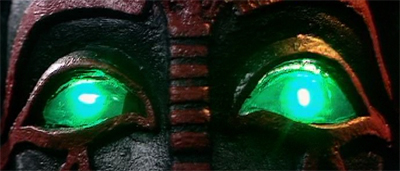
Because "Sutekh the Benign" doesn't sound quite so threatening...

Because “Sutekh the Benign” doesn’t sound quite so threatening…

Continue reading

Doctor Who: Planet of Evil (Review)

To celebrate the fiftieth anniversary of the longest-running science-fiction show in the world, I’ll be taking weekly looks at some of my own personal favourite stories and arcs, from the old and new series, with a view to encapsulating the sublime, the clever and the fiendishly odd of the BBC’s Doctor Who.

Planet of Evil originally aired in 1975.

He used the neutron accelerator. If he hit Sorenson, it could be disastrous.

You mean things can get worse? I don’t believe it.

– the Doctor and Sarah Jane make sure we understand the stakes

I feel a bit sorry for Planet of Evil. I mean, it sits near the start of one of the best seasons of Doctor Who, and yet it’s generally overlooked. It’s not that Planet of Evil is bad – The Android Invasion from the same season is actually bad, and is remembered as such. It’s more that Planet of Evil doesn’t really feel as exceptional as it could be. The Hinchcliffe and Holmes era of Doctor Who was cranking out classic adventures and iconic images to beat the band, but Planet of Evil just wound up feeling relatively generic. That’s not necessarily entirely fair. The opening two episodes of Planet of Evil are superb, but it is let down by a fairly average conclusion and undermined by a fairly weak supporting cast.

It is nowhere near the best story of the season, but it’s hardly a spectacular failure. there are times in the history of Doctor Who where Planet of Evil would be a welcome relief. However, it suffers from being a reasonably mediocre adventure in a fantastic season.

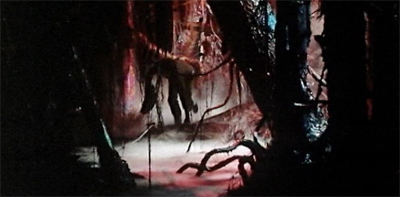
In the jungle, the peaceful jungle...

In the jungle, the peaceful jungle…

Continue reading

Doctor Who: The Bells of St. John (Review)

There’s something in the wifi.

– the Doctor does his best Jaws impression

The Bells of St. John is an intriguing piece of Doctor Who. This is the first time that the show has had to manage a companion swap in the middle of a season. That said, it doesn’t really work to think of the seventh season as a single cohesive entity.

The first five episodes are something of an abridged season, akin to the 2009 season of specials starring David Tennant. They are dedicated to tidying away lingering plot threads from the last two years of the show, and resolving Moffat’s lingering plot threads. The Power of Three and The Angels Take Manhattan are very much about tidying up the Doctor’s lingering connection to Rory and Amy.

In contrast, the second half of the season has a much more celebratory feeling to it, tied together by the over-arching mystery around Clara. While Clara pops up in Asylum of the Daleks, she’s very much a teaser of a mystery to come rather than a character in her own right. Instead, the themes of the season start in The Snowmen, introducing (or reintroducing) the Great Intelligence and Clara, and outlining the mystery of “the twice-dead girl.”

As a result, The Bells of St. John feels very much like a season opener to an unfortunately brief season of celebration.

Maybe that should be "thrice dead"?

Maybe that should be “thrice dead”?

Continue reading

Doctor Who: Planet of the Spiders (Review)

To celebrate the fiftieth anniversary of the longest-running science-fiction show in the world, I’ll be taking weekly looks at some of my own personal favourite stories and arcs, from the old and new series, with a view to encapsulating the sublime, the clever and the fiendishly odd of the BBC’s Doctor Who.

Planet of the Spiders originally aired in 1974.

Oh dear, this is getting monotonous.

– the Doctor sums it up

Jon Pertwee’s final season is a real shame. The actor was, at the time, the actor who had served the longest period of time in the lead role. Starring as the Doctor for five years, and appearing as the face of the show during an era of renewal and reinvention, the actor deserved a much strong swansong. The year had started relatively strong with The Time Warrior, which I would rank among the best stories of the Pertwee era. However, every story after that just felt like it was treading water, revisiting old triumphs while biding time until the finalé. We had a Dalek episode in Death to the Daleks. We had a Malcolm Hulke lizard story with Invasion of the Dinosaurs. We had an off-world social commentary story in The Monster of Peladon. All felt like the cast and crew were just worn out, just going through the motions.

Sadly, Planet of the Spiders continues this trend, rather than bucking it.

Kiss of the spider-queen...

Kiss of the spider-queen…

Continue reading

Doctor Who: The Monster of Peladon (Review)

To celebrate the fiftieth anniversary of the longest-running science-fiction show in the world, I’ll be taking weekly looks at some of my own personal favourite stories and arcs, from the old and new series, with a view to encapsulating the sublime, the clever and the fiendishly odd of the BBC’s Doctor Who.

The Monster of Peladon originally aired in 1974.

Oh, have a heart, Sarah. I’ve been meaning to pay a return visit to Peladon for ages.

I can’t think why.

– the Doctor and Sarah Jane

What made The Curse of Peladon so fantastic was the fact that it felt so unique and different, as compared to all the Third Doctor adventures that had appeared before. Sure, the Doctor had travelled in time and space in Colony in Space, but The Curse of Peladon was really the first time that the colour television series had indulged in designing a truly alien world populated with truly alien creatures. Since the series had begun transmission in colour with Spearhead from Space, there had been nothing quite like it, and that was what made The Curse of Peladon so refreshing.

As such, the idea of doing The Monster of Peladon seems a bit questionable, especially when it’s going to feature the same world, the same aliens and be two episodes longer than the original adventure.

Not an underrated gem, I'm afraid...

Not an underrated gem, I’m afraid…

Continue reading

Doctor Who: Death to the Daleks (Review)

To celebrate the fiftieth anniversary of the longest-running science-fiction show in the world, I’ll be taking weekly looks at some of my own personal favourite stories and arcs, from the old and new series, with a view to encapsulating the sublime, the clever and the fiendishly odd of the BBC’s Doctor Who.

Death to the Daleks originally aired in 1974.

Keep away! Keep away!

– the Daleks have an understandable reaction to appearing in another Terry Nation script

I’ve remarked a bit that Pertwee’s final year feels a little like a victory lap, a clear attempt to revisit familiar, sometimes to provide a sense of closer. For example, Invasion of the Dinosaurs feels like the last true U.N.I.T. story, with betrayal and disillusionment closing that narrative strand. Similarly, Planet of the Spiders closes out the recurring New Age Buddhist iconography that the Barry Letts has been injecting into the show. However, some of these decisions to return to familiar concepts feel a little superfluous. Did we need an extended sequel to Curse of Peladon, for example?

And did we really need another throwback Terry Nation Dalek story, only a year after the last throwback Terry Nation Dalek story?

The clue is in the title...

The clue is in the title…

Continue reading

Doctor Who: Invasion of the Dinosaurs (Review)

To celebrate the fiftieth anniversary of the longest-running science-fiction show in the world, I’ll be taking weekly looks at some of my own personal favourite stories and arcs, from the old and new series, with a view to encapsulating the sublime, the clever and the fiendishly odd of the BBC’s Doctor Who.

Invasion of the Dinosaurs originally aired in 1974.

How are you feeling now?

Hungry, tired and I’ve got a headache.

– Mark asks Sarah Jane how her viewing went. I can empathise.

Ah, ambition. It’s hard to fault it… although there is a point where you simply have to. Invasion of the Dinosaurs crosses that line in the first episode. I know that Doctor Who is a BBC television serial. I understand that the classic series hardly had a huge amount of money to hand when it needed special effects. I am well aware that the special effects for the following season’s The Ark in Space amount to some bubblewrap and green paint. There is an art to watching many of these classic stories, and that art involves being wilfully blind to the fact that the special effects aren’t up to scratch. Beyond that, it’s arbitrary. There’ll always be one silly special effect that undermines an otherwise impressive episode – which special effect and which episode will vary from person to person.

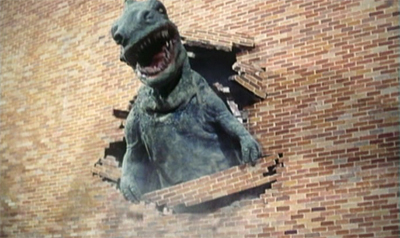
However, Invasion of the Dinosaurs makes the special effects the whole point of the exercise. The title tells you that you should be watching the dinosaurs. Malcolm Hulke was given the brief to write a story about dinosaurs in contemporary London. There might be a plot underneath it all, but the serial expects that you are here for the dinosaurs. And, if you are…

I’m sorry. I’m so sorry.

A smashing time...

A smashing time…

Continue reading

Doctor Who: The Time Warrior (Review)

To celebrate the fiftieth anniversary of the longest-running science-fiction show in the world, I’ll be taking weekly looks at some of my own personal favourite stories and arcs, from the old and new series, with a view to encapsulating the sublime, the clever and the fiendishly odd of the BBC’s Doctor Who.

The Time Warrior originally aired in 1974.

Look, will you excuse me? I’ve got to go and find a young girl. I’ll see you later, I hope.

Young girl? I should have thought he was a bit old for that sort of thing. Oh well.

– the Doctor and Rubeish discover that Jo’s departure isn’t affecting him too much

The end of an era is fast approaching. Jon Pertwee departed Doctor Who after spending five years in the title role. The end of his fourth year saw the departure of his longest-serving companion, Jo Grant. The start of his final year would see the introduction of Sarah Jane Smith, perhaps the most iconic companion of all time. However, watching the first serial of his last year – The Time Warrior – there is a sense of pending change in the air, a sense that show in the cusp of a very significant shift. The Time Warrior isn’t necessarily explicit about this, but you can almost feel it.

Time is running out...

Time is running out…

Continue reading

Doctor Who: Utopia (Review)

To celebrate the fiftieth anniversary of the longest-running science-fiction show in the world, I’ll be taking weekly looks at some of my own personal favourite stories and arcs, from the old and new series, with a view to encapsulating the sublime, the clever and the fiendishly odd of the BBC’s Doctor Who.

Utopia originally aired in 2007.

Ooo, new voice. Hello, hello. Hello. Anyway, why don’t we stop and have a nice little chat while I tell you all my plans and you can work out a way to stop me, I don’t think.

Hold on. I know that voice.

I’m asking you really properly. Just stop. Just think!

Use my name.

Master. I’m sorry.

Tough!

– the Master, Martha and the Doctor welcome a new old face back

It’s very hard to talk about Utopia without seguing into talking about The Sound of Drums or The Last of the Time Lords. Certainly the third season finalé is the most ambitious of Russell T. Davies’ end-of-season adventures. It’s a three-part adventure, the equivalent to one of those classic gigantic six-part serials. If you accept that logic, it breaks down neatly into the old two-parter-and-four-parter format that the writers used to use to prevent an extended story from dragging too much.

Utopia, of course, serves the function of the two-parter in this classic structure – the smaller chunk of the episode with its own plot points and characters and settings, but with very definite connections to the rest of the adventure. However, I’d argue that Utopia is a lot more successful than either of the two episodes following, and a lot of that stems from the fact that it devotes a considerable amount of time to quietly setting up plot points and characters that will pay off down the line.

It’s also a powerful subversion of the fundamental ethos of Doctor Who, which makes it particularly effective as we head into two episodes where the Master hijacks not only the TARDIS but the show itself.

No time like the end of the universe...

No time like the end of the universe…

Continue reading

Doctor Who: Frontios (Review)

To celebrate the fiftieth anniversary of the longest-running science-fiction show in the world, I’ll be taking weekly looks at some of my own personal favourite stories and arcs, from the old and new series, with a view to encapsulating the sublime, the clever and the fiendishly odd of the BBC’s Doctor Who.

Frontios originally aired in 1984.

“You know, we can sort this all out in no time at all, if everyone just stays calm.”

– The Doctor sums up the tragedy of Peter Davison’s time as the Timelord

Towards the end of Peter Davison’s time in the title role, Doctor Who was becoming gradually darker. While Colin Baker’s brightly-coloured take on the character would convert this grim fare into a surreal and grotesque pantomime, there was something tragic about Davison’s iteration confronting a quickly darkening universe. Steven Moffat once explained, “this Doctor takes the emphasis off the eccentricities and turns it into a pained heroism of a man who is so much better than the universe he is trying to save but cannot bear to let it stand”, and that’s very much the case here. While the cynicism and pointless darkness would reach their zenith during Resurrection of the Daleks and pay off spectacularly in The Caves of Androzani, Frontios feels like the perfect illustration of these ideas.

The Doctor's surgery...

Continue reading