• Following Us

  • Categories

  • Check out the Archives


  • Awards & Nominations

Doctor Who: Survival (Review)

To celebrate the fiftieth anniversary of the longest-running science-fiction show in the world, I’ll be taking weekly looks at some of my own personal favourite stories and arcs, from the old and new series, with a view to encapsulating the sublime, the clever and the fiendishly odd of the BBC’s Doctor Who.

Survival originally aired in 1989.

Where to now, Ace?

Home.

Home?

The TARDIS.

Yes, the TARDIS. There are worlds out there where the sky is burning, where the sea’s asleep, and the rivers dream. People made of smoke, and cities made of song. Somewhere there’s danger, somewhere there’s injustice, and somewhere else the tea’s getting cold. Come on, Ace, we’ve got work to do!

– the Doctor and Ace turn off the lights on their way out

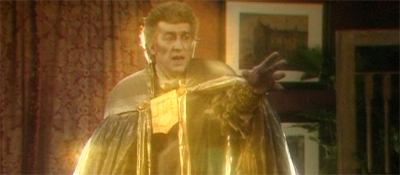
There was a long gap between Survival and Rose. It was filled with stuff. It was filled with lost of interesting and different Doctor Who stuff. There were books and audio plays and even a television movie to help fill the decade and a half when Doctor Who was not a regular feature of British television. A lot of that stuff was important, and a lot of it helped determine and shape what Doctor Who would become when it did return. It’s telling that the many members of the writing staff on the revived Doctor Who cut their teeth on novels and short stories and audio plays and specials in the wilderness years, while no writers returned from the classic show.

At the same time, however, the gap between Survival and Rose doesn’t feel as profound as it might. It’s misleading to suggest that Survival was a clear bridge towards the Russell T. Davies era, or even to hint that the revival could have emerged fully formed from this three-part closing serial. At the same time, Survival is really the closest that the classic series ever came to the spirit of the Davies era, hitting on quite a few familiar themes and ideas and settings, as if Cartmel’s vision of the future of Doctor Who was not too far from the version proposed by Davies.

Survival was the end of an era, but it also motioned towards the start of another.
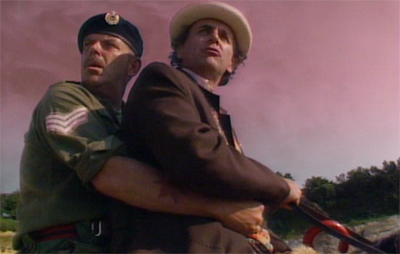
Riding into the sunset...

Riding into the sunset…

Continue reading

Doctor Who: Ghost Light (Review)

To celebrate the fiftieth anniversary of the longest-running science-fiction show in the world, I’ll be taking weekly looks at some of my own personal favourite stories and arcs, from the old and new series, with a view to encapsulating the sublime, the clever and the fiendishly odd of the BBC’s Doctor Who.

Ghost Light originally aired in 1989.

Sir, I think Mister Matthews is confused.

Never mind, I’ll have him completely bewildered by the time I’m finished.

– Gwendoline and the Doctor may as well be talking about the audience

Ghost Light is rather infamous as the “impossible to follow” story from the final year of Doctor Who, the episode that doesn’t quite make sense or fit together as well as it should. Although there’s an element of exaggeration here, there’s also a grain of truth. As with Silver Nemesis, there’s a sense that Andrew Cartmel’s approach to three-part adventures is simply to structure a four-part story and start whittling it down.

Of course, there’s one massive difference between Ghost Light and Silver Nemesis. While Silver Nemesis was a retread of ground that had been covered with more skill and thought in the season premiere, Ghost Light is something altogether different. As difficult as the episode is to piece together – and it’s far from impossible, even if it requires an increased level of engagement from its audience – it is quite brilliant.

Shine on, you crazy survey dude...

Shine on, you crazy survey dude…

Continue reading

Doctor Who: Battlefield – Special Edition (Review)

To celebrate the fiftieth anniversary of the longest-running science-fiction show in the world, I’ll be taking weekly looks at some of my own personal favourite stories and arcs, from the old and new series, with a view to encapsulating the sublime, the clever and the fiendishly odd of the BBC’s Doctor Who.

Battlefield originally aired in 1989.

Pitiful. Can this world do no better than you as their champion?

Probably. I just do the best I can.

– the Destroyer gets to know the Brigadier

Battlefield gets a bit of a bum rap as the weakest story in the final season of the classic Doctor Who. This isn’t entirely fair. Battlefield is a well-produced and thoughtful piece of Doctor Who, it just happens to be inferior to The Curse of Fenric, Ghost Light and Survival; it’s hardly the most damning indictment possible. After all, Battlefield would arguably be treated as an unsung gem had it aired during Colin Baker’s time on the show.

In keeping with Ben Aaronovitch’s last season opener, Remembrance of the Daleks, Battlefield is preoccupied with the history of the show – of its legacy and the artifacts that it carries with it. Archeology is a key theme here, but juxtaposed against a near future setting and the clever conceit of the Doctor manipulating his own history. There’s a wealth of great material here, even if the production never quite lives up to the potential teased.

A beacon of light...

A beacon of light…

Continue reading

Doctor Who: The Twin Dilemma (Review)

To celebrate the fiftieth anniversary of the longest-running science-fiction show in the world, I’ll be taking weekly looks at some of my own personal favourite stories and arcs, from the old and new series, with a view to encapsulating the sublime, the clever and the fiendishly odd of the BBC’s Doctor Who.

The Twin Dilemma originally aired in 1984.

Whatever else happens, I am the Doctor, whether you like it or not. 

– the perfect sentiment on which to enter a nine-month gap

Some mistakes only seem obvious in hindsight. Some errors are easy to judge with the weight of experience and history behind you. Some calls are easy to dismiss and ridicule retroactively, completely divorced from the context in which they were made.

Of course, some mistakes should have been blindingly obvious when they were made in the first place.

Go on, guess which one The Twin Dilemma was.

Hardly a moment of triumph...

Hardly a moment of triumph…

Continue reading

Doctor Who: The End of Time, Part II (Review)

To celebrate the fiftieth anniversary of the longest-running science-fiction show in the world, I’ll be taking weekly looks at some of my own personal favourite stories and arcs, from the old and new series, with a view to encapsulating the sublime, the clever and the fiendishly odd of the BBC’s Doctor Who.

The End of Time, Part II originally aired in 2010.

I don’t want to go.

– the Doctor channels David Tennant and Russell T. Davies

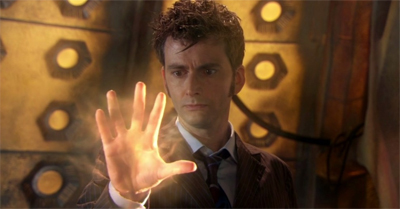
The End of Time, Part II is an incredibly confident piece of science-fiction. It’s also fiendishly self-indulgent. “Where are you going?” Wilf asks the Doctor after the Doctor takes a fatal dose of radiation. “To get my reward,” the Doctor responds, as if he has earned enough credit and kudos that he can cash it in for one last victory lap around the cosmos. Cue an exceptionally sentimental sequence in which the Tenth Doctor visits most of his major companions (and a few minor ones) before he departs.

It’s a nice excuse to trot out the familiar characters from the Davies era one last time. Martha is there; Jack shows up; even Jackie Tyler gets a look-in. It’s not just the Tenth Doctor’s farewell tour of the universe, it’s a reminder of how skilfully Davies has built a world around his lead character. And this was really the last chance for the show to say goodbye to all of that. It makes a great deal of sense, and it’s well earned. Davies resurrected a television show that died a joke and turned it into a success story that was strong enough to anchor the Christmas and New Year schedules. He’s earned the right to be this self-indulgent.

Worlds apart...

Worlds apart…

The problem is that the show seems more than a little entitled, more than a little brash about what is owed to it. The universe owes the Tenth Doctor one last go around; the audience owes Tennant and Davies enough to put up with this sort of ham-fisted sentimentality. There’s a moment when the Doctor seems to honestly consider leaving Wilf to die from radiation poisoning, and rants against the cruelty of the universe. How dare the universe put him in a position where he has to make this sort of moral choice!

The problem is that the episode tries to present this a sympathetic moment. We’re supposed to emphasise with the Doctor as he considers walking away from a poor old man who has been nothing but helpful and trustworthy and friendly to him. The End of Time, Part II is clearly intended as a celebratory romp in the style of Journey’s End, a reminder of how Doctor Who conquered television. The problem is that The End of Time, Part II overplays its hand a bit, and over-estimates how much the audience loves the Tenth Doctor.

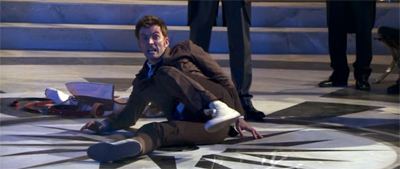
Not quite a blaze of glory...

Not quite a blaze of glory…

Continue reading

Doctor Who: The End of Time, Part I (Review)

To celebrate the fiftieth anniversary of the longest-running science-fiction show in the world, I’ll be taking weekly looks at some of my own personal favourite stories and arcs, from the old and new series, with a view to encapsulating the sublime, the clever and the fiendishly odd of the BBC’s Doctor Who.

The End of Time, Part I originally aired in 2009.

The human race was always your favourite, Doctor. But now, there is no human race. There is only the Master race.

– the Master always did like a good pun

The problem with The End of Time isn’t a lack of good ideas. Indeed, there are far too many good ideas here. There are enough large concepts here to sustain an entire season of Davies’ Doctor Who, from the resurrection of the Master to the return of Gallifrey to the resurrection gate to Naismith to the Tenth Doctor’s impending mortality and quite a few more. The End of Time is bristling with so many ideas and concepts that only the truly outrageous examples really stick. Is that really the Tenth Doctor’s mother?

The End of Time is fundamentally flawed, but it remains intriguing. There’s a wealth of good ideas here that tend to get drowned out in the spectacle and fury of it all, a sense that Davies had a wealth of clever ideas but was unable to tie them into anything fully satisfying.

Ten cedes the floor...

Ten cedes the floor…

Continue reading

Doctor Who: The Waters of Mars (Review)

To celebrate the fiftieth anniversary of the longest-running science-fiction show in the world, I’ll be taking weekly looks at some of my own personal favourite stories and arcs, from the old and new series, with a view to encapsulating the sublime, the clever and the fiendishly odd of the BBC’s Doctor Who.

The Waters of Mars originally aired in 2009.

Adelaide, I’ve done this sort of thing before. In small ways, saved some little people, but never someone as important as you. Oh, I’m good.

Little people? What, like Mia and Yuri? Who decides they’re so unimportant? You?

For a long time now, I thought I was just a survivor, but I’m not. I’m the winner. That’s who I am. The Time Lord Victorious.

– the Doctor does a pretty poor job of comforting Adelaide

The Waters of Mars is the strongest of the specials that ran from the end of the fourth season of Doctor Who through to David Tennant’s regeneration into Matt Smith on New Year’s Day 2010. Despite teasing the issue in The Next Doctor and Planet of the Dead, The Waters of Mars is the first time that the show really engages with the mortality of the Tenth Doctor – exploring the idea that it might be time for the Tenth Doctor to leave. As much as the Tenth Doctor might be reluctant to leave, The Waters of Mars suggests that the character’s flaws are gaining critical mass and that his ego runs the risk of collapsing in on itself.

It’s a very bold and daring piece of Doctor Who, which is quite striking given the audience-pleasing “comfort food” nature of the other specials. Reinforcing ideas that Davies has been hinting at since the very start of the relaunch, The Waters of Mars is about how the Doctor can sometimes be absolutely terrifying.

This is what happens when the Doctor goes wrong.

This is what happens when the Doctor goes wrong.

Continue reading

Doctor Who: Planet of the Dead (Review)

To celebrate the fiftieth anniversary of the longest-running science-fiction show in the world, I’ll be taking weekly looks at some of my own personal favourite stories and arcs, from the old and new series, with a view to encapsulating the sublime, the clever and the fiendishly odd of the BBC’s Doctor Who.

Planet of the Dead originally aired in 2009.

Hello, I’m the Doctor. Happy Easter!

– the Doctor sets the mood

Planet of the Dead is light-weight Doctor Who. That wouldn’t normally be a problem. In fact, there’s a significant portion of each season devoted to light-weight run-around adventures. The problem is that it didn’t air as part of a season. It aired as the first piece of Doctor Who since Christmas and the next aired around Halloween. This was something of an attempt to tide fans over, to remind everybody that Doctor Who was still on the air while Steven Moffat and Matt Smith prepared to take over the TARDIS, the BBC got used to filming in HD and David Tennant pursued his career beyond the show.

As a result, the special feel a little funny. In a way, they seem like an attempt to truncate a standard season of Davies’ Doctor Who. The Next Doctor fits the mould of Christmas special quite well. It even snows! The Waters of Mars is the darker second two-parter of the season, dealing with bigger ideas and adult fears. The End of Time is very much a spiritual successor to Journey’s End. All of this is a way of pointing out that Planet of the Dead is clearly designed to serve as the bombastic family-friendly adventure two-parter that typically aired after the first two episodes of a given season.

As such, the logical point of comparison is Rise of the Cybermen, The Sontaran Stratagem or Daleks in Manhattan. Indeed, Planet of the Dead is conspicuous for its gratuitous location shooting; the last time the production team went abroad to film a story was Daleks of Manhattan, even if the cast stayed at home that time. The problem is that those light two-parters are tolerable in the context of a longer series. On its own, Planet of the Dead is far from satisfying.

Egging him on...

Egging him on…

Continue reading

Doctor Who: The Beast Below (Review)

To celebrate the fiftieth anniversary of the longest-running science-fiction show in the world, I’ll be taking weekly looks at some of my own personal favourite stories and arcs, from the old and new series, with a view to encapsulating the sublime, the clever and the fiendishly odd of the BBC’s Doctor Who.

The Beast Below originally aired in 2010.

What are you going to do?

What I always do. Stay out of trouble. Badly.

So is this how it works, Doctor? You never interfere in the affairs of other peoples or planets, unless there’s children crying?

Yes.

– Amy and the Doctor reiterate the way things work

Steven Moffat’s first season producing Doctor Who owes a conscious debt to the rigid structure of the seasons produced by Russell T. Davies. There’s an opening episode in contemporary Britain, followed by one episode visiting the past, one visiting the future. There are three two-parters – the season finalé, a “monster”-driven two-parter and a more atmospheric and moody piece. There’s even a brief spell in the middle of the season where Moffat spices up the TARDIS dynamic by adding in a temporary companion.

This approach worked quite well. It’s worth noting that Moffat’s first season was the only point following the departure of Russell T. Davies that Doctor Who was able to deliver thirteen episodes of the show on thirteen consecutive weeks. It struck something of a happy middle between Davies’ more episodic approach to the show that the more arc-driven storytelling favoured by Moffat. Still, there are moments when it seems like this approach isn’t quite the perfect fit, with Moffat’s voice struggling to fit into the structure established by Davies.

Essentially Steven Moffat’s impression of Russell T. Davies’ update of Andrew Cartmel’s social allegory stories, The Beast Below is an interesting – if slightly unsuccessful – experiment. Moffat’s second season would feature much more effective attempts to evoke the Cartmel era of the classic show, without the sense that Moffat was trying a little too hard to emulate his predecessor.

The space in-between...

The space in-between…

Continue reading

Doctor Who: Gridlock (Review)

To celebrate the fiftieth anniversary of the longest-running science-fiction show in the world, I’ll be taking weekly looks at some of my own personal favourite stories and arcs, from the old and new series, with a view to encapsulating the sublime, the clever and the fiendishly odd of the BBC’s Doctor Who.

Gridlock originally aired in 2007.

The sky’s a burnt orange, with the Citadel enclosed in a mighty glass dome, shining under the twin suns. Beyond that, the mountains go on forever. Slopes of deep red grass, capped with snow.

– the Doctor takes us to Gallifrey, for the first time in ages

Gridlock is the final (and best) of Davies’ “New Earth” trilogy, encompassing The End of the World and New Earth. The decision to focus the opening futuristic stories of the first three seasons around the same strand of “future history” is a very clever move, and perhaps an indication of how acutely aware Davies is of the way the modern television differs from television when the classic show aired. In short, it creates a pleasing sense of continuity between episodes that are very disconnected from the show’s main continuity.

This is far from the Powell Estate as you can get, and yet – three years in – it also feels strangely familiar.

The skyline's the limit...

The skyline’s the limit…

Continue reading