• Following Us

  • Categories

  • Check out the Archives


  • Awards & Nominations

Star Trek: The Next Generation – The Royale (Review)

This January and February, we’ll be finishing up our look at the second season of Star Trek: The Next Generation and moving on to the third year of the show, both recently and lovingly remastered for high definition. Check back daily for the latest review.

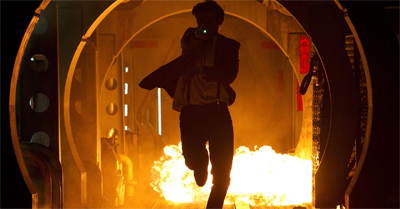
“None of it makes any sense, sir,” Riker succinctly states before the credits role on The Royale. The Royale is a decidedly nonsensical episode of Star Trek: The Next Generation, where an away team find themselves trapped inside an atrocious casino melodrama and have to figure out how to return to the ship. The episode is packed with interesting visuals and a bizarre situations, but it never quite comes together in the end.

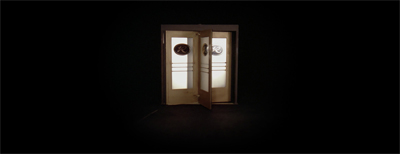
And, yet, despite the obvious problems, The Royale is intriguing. Visually, it’s one of the most striking and memorable episodes of the show’s first two season. The rotating door to nowhere is a beautifully strange image, and the sight of the Enterprise away team wandering around a twentieth century casino is enough to prevent the episode from ever becoming boring. The Royale isn’t the best constructed episode of the show’s first two years, and it has more than its fair share of problems.

However, it’s also a wonderfully bizarre and adventurous piece of science-fiction, as if Riker has beamed into a cheap imitation of The Twilight Zone. That’s enough to make it well worth a watch.
The whole plot revolves around absurdities...

The whole plot revolves around absurdities…

Continue reading

Doctor Who: The Time of the Doctor (Review)

It’s okay, Barnable, don’t worry. I have got a plan. Off you pop.

[beat]

I haven’t got a plan, but people love it when I say that.

Doctor, what are you going to do?

I don’t know. Talk very fast. Hope something good happens. Take the credit. That’s generally how it works.

– the Doctor and Clara discuss standard operating procedure

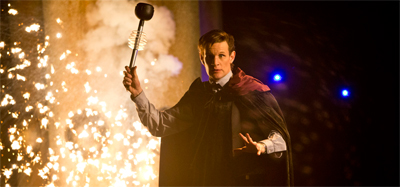
An epic struggle for universal peace lasting centuries on a back water world; a conflict spanning generations; the potential to re-spark the Time War; the possibility of burning the turkey. The epic and intimate co-mingle in The Time of the Doctor.

In many respects, The Time of the Doctor serves as an effective counterpoint to The End of Time. Even the title seems to allude towards the Tenth Doctor’s final episode, as if to suggest that “time” is a thing that passes naturally rather than ending brutally. “I don’t want to go,” the Tenth Doctor pleaded in his final moments, a line that Moffat gently tried to re-write at the end of The Day of the Doctor. The Eleventh Doctor is more even-handed. “But you, you are the Doctor,” Clara assures him. “Yep, and I always will be,” he replies. “But times change, and so must I.”

This is when the magic happens...

This is when the magic happens…

(In fact, Moffat has a bit of gentle fun at the expense of The End of Time. Whereas the Tenth Doctor reluctantly sacrificed himself to save Wilf, the Eleventh Doctor quite selfless spends his entire life defending the town of Christmas on the planet of Trenzalore. Discussing the fake regeneration at the climax of The Stolen Earth, the Eleventh Doctor quips, I had vanity issues at the time.” He could easily be hinting at the hubris that built up towards the Tennant and Davies era’s swansong.)

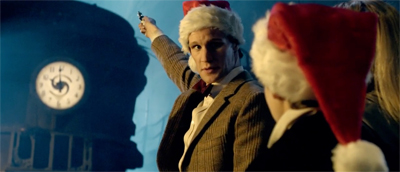
In contrast, The Time of the Doctor was relatively low key. Well, as low key as an episode featuring all of the Doctor’s classic adversaries laying siege to one planet across hundreds of years as the threat of a reignited Time War looms large in the horizon. Still, as wonderful as that epic scale might be, The Time of the Doctor feels like a spiritual companion to Moffat’s other Christmas episodes – the story of the loneliest man in the universe saving Christmas (the town and the holiday), on an intimate scale that just happens to be epic; “the man who stayed for Christmas.”

What's cooking?

What’s cooking?

Continue reading

Doctor Who: The Doctor, The Widow & The Wardrobe (Review)

To celebrate the fiftieth anniversary of the longest-running science-fiction show in the world, I’ll be taking weekly looks at some of my own personal favourite stories and arcs, from the old and new series, with a view to encapsulating the sublime, the clever and the fiendishly odd of the BBC’s Doctor Who.

The Doctor, The Widow & The Wardrobe originally aired in 2011.

I don’t understand. Is this place real, or is it fairyland?

Fairyland? Oh, grow up, Lily.

Fairyland looks completely different.

– Lilly and the Doctor get their geography straightened out

The Doctor, The Widow and the Wardrobe is, like A Christmas Carol before it, a rather wonderful idea. A Christmas Carol mashed up Doctor Who with one of the best-loved Christmas narratives of all time. The Doctor, The Widow and the Wardrobe does something similar, substituting CS Lewis for Charles Dickens. It’s a fantastic idea, given that Doctor Who is the spiritual successor of that peculiarly British thread of childhood fantasy.

The only real problem with The Doctor, The Widow and The Wardrobe is that it can’t quite stretch that good idea across an hour of television.

On the run again...

On the run again…

Continue reading

Doctor Who: A Christmas Carol (Review)

To celebrate the fiftieth anniversary of the longest-running science-fiction show in the world, I’ll be taking weekly looks at some of my own personal favourite stories and arcs, from the old and new series, with a view to encapsulating the sublime, the clever and the fiendishly odd of the BBC’s Doctor Who.

A Christmas Carol originally aired in 2010.

If you’re my babysitter, why are you climbing in the window?

Because if I was climbing out of the window, I’d be going in the wrong direction. Pay attention.

– Kazran and the Doctor get things straight

A Christmas Carol might just be the best Doctor Who Christmas Special ever produced, if only because it’s such a brilliantly obvious idea, executed with the show’s traditional wit and charm. Russell T. Davies tended to write the Christmas Special in the style of a gigantic blockbuster episode of Doctor Who, but Moffat adopts a slightly different approach to what has quickly become the annual tradition of the Doctor Who Christmas Special.

Davies traditionally had the Doctor collide with genres of Christmas television viewing. The Christmas Invasion was American blockbuster sci-fi, The Runaway Bride was fun odd-couple comedy action film, Voyage of the Damned was a disaster flick in space and The Next Doctor was a celebration of quaint Victoriana. In contrast, Moffat has Doctor Who collide with beloved children’s stories in his first two Christmas Specials. His second two are burdened with dealing with left-over plot threads.

A Christmas Carol is perhaps the most effective distillation of “Doctor Who as a story” that the show has ever managed, on top of being a wonderfully moving piece of Christmas television and hitting on the major themes of the Moffat era as a whole.

Turning back the clock...

Turning back the clock…

Continue reading

Doctor Who: The Specials (Review/Retrospective)

In theory, the specials were a great idea. The BBC is in the middle of converting to high-definition broadcast. One of their best-loved and most respected dramas isn’t quite ready to make that leap, and will require extensive re-working in order to be sustainable for high-definition broadcast, which seems to be the future of home entertainment. It’ll be a year before the show can get back to churning out thirteen episodes and a Christmas Special.

However, the show runner who brought the show back from the dead and turned it into a highlight of your broadcast schedule, and the beloved lead actor who has become deeply associated with the lead role are willing to do a series of five specials that you can broadcast to fill the gap year. Producing a series of Doctor Who specials to tide over the viewing public and keep the show fresh in the public’s mind was a great idea. After all, you don’t want fans to forget about the show.

doctorwho-theendoftimepart2o

The plan has the added benefit of allowing Russell T. Davies and David Tennant a bit more freedom to stretch their wings. Davies can work on Torchwood in a way that he was never able to find time before, producing the superb Children of Earth. Tennant can work with Royal Shakespearean Company, playing the lead in Hamlet. All this, and fans get their prescription dose of Doctor Who and the BBC has the time to upgrade the show so it can broadcast in high definition. Everybody wins! Everybody stays happy!

Unfortunately, there’s a bit of a catch. It turns out that these five episodes have to do more than merely “tide” fans over. These five specials are also the last episodes that will be written by Davies and that will star Tennant. So these five specials become more than just a way to stop the public forgetting about Doctor Who. They also have to close out what has been a phenomenal era for the show, and wrap up everything in a nice big bow. And this is where the specials don’t really work.

doctorwho-thewatersofmars19

Continue reading

Doctor Who: The Next Doctor (Review)

To celebrate the fiftieth anniversary of the longest-running science-fiction show in the world, I’ll be taking weekly looks at some of my own personal favourite stories and arcs, from the old and new series, with a view to encapsulating the sublime, the clever and the fiendishly odd of the BBC’s Doctor Who.

The Next Doctor originally aired in 2008.

Oh, goodness me. Well. But this is… but this is nonsense.

Well, that’s one word for it.

Complete and utter, wonderful nonsense. How very, very silly.

– Jackson Lake and the Doctor

The Next Doctor actually has a pretty audacious concept. It’s one gigantic tease that plays off the audience’s media savvy. Airing after David Tennant’s departure from the role had been announced, but before Matt Smith had been named as Tennant’s successor, The Next Doctor is one gigantic tease. Like the surprise “regeneration” at the climax of The Stolen Earth, it’s a shrewd attempt to turn the audience’s expectations against themselves.

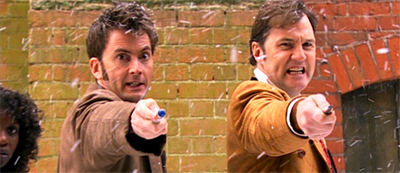
After all, the gap between an announced departure of an existing lead and the point where he actually leaves is rife for experimentation – particularly in a show about time travel. Up until The Next Doctor actually aired, it was quite possible that David Morrissey was Tennant’s successor, and The Next Doctor was a rather clever twist on the classic “multi-Doctor” story by having the Doctor team up with his future self.

Of course, as with The Doctor’s Daughter, Davies was just teasing. It’s to Davies’ credit that The Next Doctor remains interesting even after the illusion begins to slip. The first half is actually a wonderfully solid mystery and character study, albeit one that descends into confusion and chaos in the second half of the episode.

The Next Doctor...?

The Next Doctor…?

Continue reading

Doctor Who: Voyage of the Damned (Review)

To celebrate the fiftieth anniversary of the longest-running science-fiction show in the world, I’ll be taking weekly looks at some of my own personal favourite stories and arcs, from the old and new series, with a view to encapsulating the sublime, the clever and the fiendishly odd of the BBC’s Doctor Who.

Voyage of the Damned originally aired in 2007.

I’m the Doctor. I’m a Time Lord. I’m from the planet Gallifrey in the constellation of Kasterborous. I’m nine hundred and three years old and I’m the man who’s going to save your lives and all six billion people on the planet below. You got a problem with that?

No.

In that case, allons-y!

– of course, the Doctor’s boasting would be much more effective if most of the cast didn’t die

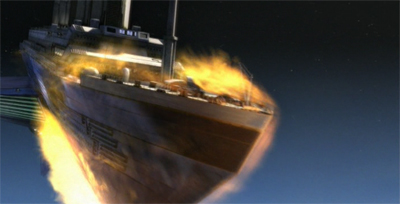
Voyage of the Damned is an ambitious piece of Doctor Who, at least in terms of scope. It’s very clearly an attempt to do The Poseidon Adventure in space, on a television budget, with a sinister corporate conspiracy layered on top. It’s all this and a big Christmas Special guest starring Kylie Minogue to boot. That’s a lot to pile into a single episode, and Voyage of the Damned strains under the pressure.

There are various flaws that chip away at Voyage of the Damned. It’s very hard to do a disaster movie with about six sets and only one big set piece. The fact that this was all planned ahead of time gives the Doctor a convenient adversary to face, but it does over-crowd the script somewhat; Max Capricorn feels like a cardboard cut-out of a baddie. And Astrid feels less like a fully-formed companion in the style of Donna and more like a generic secondary character.

And yet, despite that, Davies’ ambition is infectious. Even if Voyage of the Damned struggles to carry off everything that it attempts, it’s still a remarkable accomplishment of tea-team Christmas viewing.

Ship-shape...

Ship-shape…

Continue reading

Doctor Who: The Runaway Bride (Review)

To celebrate the fiftieth anniversary of the longest-running science-fiction show in the world, I’ll be taking weekly looks at some of my own personal favourite stories and arcs, from the old and new series, with a view to encapsulating the sublime, the clever and the fiendishly odd of the BBC’s Doctor Who.

The Runaway Bride originally aired in 2006.

What, there’s like a secret base hidden underneath a major London landmark?

Oh, I know. Unheard of.

– Donna and the Doctor present Doctor Who 101

The Runaway Bride is really more indicative of a Davies-era Christmas Special than The Christmas Invasion was. The Christmas Invasion came with so much narrative baggage to unpack that it even spilt over into the Born Again scene that aired as part of Children in Need. While The Runaway Bride does have to deal with some of the fallout from Billie Piper’s departure in Doomsday, it’s a much more stand-alone piece of Doctor Who.

It’s a very light piece of television, but that’s really the ideal kind of Doctor Who to air as part of the BBC’s Christmas line-up.

He's fire and ice and rage...

He’s fire and ice and rage…

Continue reading

Doctor Who: The Christmas Invasion (Review)

To celebrate the fiftieth anniversary of the longest-running science-fiction show in the world, I’ll be taking weekly looks at some of my own personal favourite stories and arcs, from the old and new series, with a view to encapsulating the sublime, the clever and the fiendishly odd of the BBC’s Doctor Who.

The Christmas Invasion originally aired in 2005.

Oh, that’s rude. That’s the sort of man I am now, am I? Rude. Rude and not ginger.

– the Doctor

Part of what’s remarkable about The Christmas Invasion is that it’s a great big important episode. Not only is it the first Doctor Who Christmas Special, the beginning of a BBC institution, it’s also the first full-length adventure to feature David Tennant in the title role, and so it comes with a lot of expectations. Whereas most of Davies’ Christmas Specials tended to be relatively light fare – enjoyable run-arounds aimed rather squarely at the kind of people who didn’t tune into the show week-in and week-out – The Christmas Invasion is a pretty big deal.

It’s a vitally important part of Davies’ Doctor Who, and one that really lays out a general blue print for where he wants to take the series over the next few years. The fact that so much of this winds up tying back into the final story of the Davies era – The End of Time – is quite striking on re-watch.

Song for Ten(nant)...

Song for Ten(nant)…

Continue reading

Doctor Who: Born Again (Review)

To celebrate the fiftieth anniversary of the longest-running science-fiction show in the world, I’ll be taking weekly looks at some of my own personal favourite stories and arcs, from the old and new series, with a view to encapsulating the sublime, the clever and the fiendishly odd of the BBC’s Doctor Who.

Born Again originally aired in 2005.

Can you change back?

Do you want me to?

Yeah.

Oh.

Can you?

No.

– Rose and Doctor

Davies revived Doctor Who devoted considerable time to reintroducing the core concepts of the series. Unlike The TV Movie, Davies saw no need to over-complicate Rose by featuring the regeneration from the previous Doctor to the current lead. The Ninth Doctor was introduced as-is to an entire generation of new viewers. Only a quick examination of his features in Rose seemed to hint that he was getting used to his new face.

The prospect of “regeneration” hadn’t been flagged too heavily by the time The Parting of the Ways aired. This makes sense. For one thing, there’s a sense that Eccleston’s departure was not something that the production team had accounted for – which makes it even stranger that the whole first season seems to be building towards his redemption in death. For another thing, it’s very hard to drop “by the way, I change into somebody else when I die” casually into conversation.

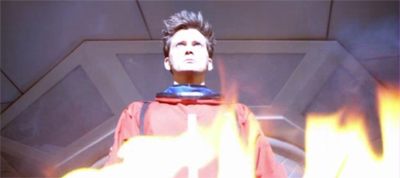
So the regeneration at the end of The Parting of the Ways was kind of a big deal, and a huge moment for the series. After all, the classic Doctor Who had enjoyed more than three seasons with its lead character before having to swap him out – Hartnell being the last member of the original ensemble to depart. And, given the rules of television narratives in 2005, there was no way that the show’s first regeneration wasn’t going to be a pretty significant event.

Somebody needs a Doctor...

Somebody needs a Doctor…

Continue reading