• Following Us

  • Categories

  • Check out the Archives


  • Awards & Nominations

The Flash (1987-2009) #7-8 – Red Trinity/Purple Haze (Review)

So, I’m considering reviewing this season of The Flash, because the pilot looks interesting and I’ve always had a soft spot for the Scarlet Speedster. I’m also considering taking a storyline-by-storyline trek through the 1987-2009 Flash on-going series as a companion piece. If you are interested in reading either of these, please let me know in the comments.

Red Trinity and Purple Haze are at least plotted a bit more tightly than Mike Baron’s earlier issues of The Flash.

Baron’s first two two-part stories on The Flash had seen Wally West literally running into trouble – encountering both Vandal Savage and the Kilg%re by chance while running across the country. Speed McGee was only slightly more subtle, revealing that Wally was now dating a woman whose husband just happened to be working on attempts to generate super-speed. Wally seemed to spend the first six months of The Flash randomly bumping into trouble that seemed tailor-made for him.
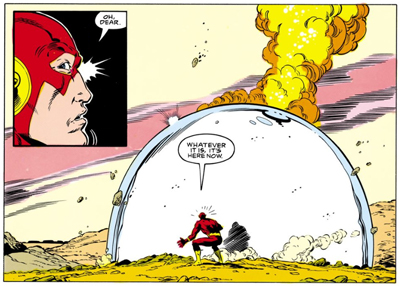
... And we're off!

… And we’re off!

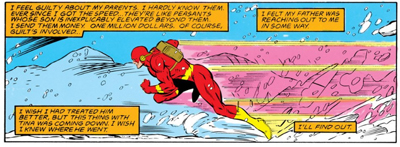
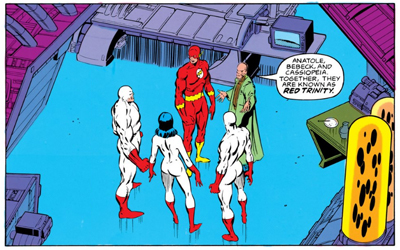
While the plotting of Red Trinity is hardly elegant, it at least makes a bit more sense. Baron builds off the events of Speed McGee to present a story that flows relatively logically – well, according to comic book logic. Instead of conveniently crossing paths with a problem tailored to his abilities, Wally instead sets out specifically to find the problem at the heart of this issue. His encounter with the eponymous trio is as part of his attempts to help find a cure for the self-titled “Speed Demon”, Jerry McGee.

Inevitably, this brings him into conflict with more new opponents perfectly suited to do battle with The Flash.
Trio of terror?

Trio of terror?

Continue reading

The Flash – Fastest Man Alive (Review)

So, I’m considering reviewing this season of The Flash, because the pilot looks interesting and I’ve always had a soft spot for the Scarlet Speedster. I’m also considering taking a storyline-by-storyline trek through the 1987-2009 Flash on-going series as a companion piece. If you are interested in reading either of these, please let me know in the comments.

In many ways, Fastest Man Alive plays like the second part of a pilot for The Flash. Like City of Heroes before it, Fastest Man Alive is written by Andrew Kreisberg and Geoff Johns, with Greg Berlanti credited on the story. It is also directed by David Nutter, one of television’s most respected pilot directors – even if his famous “hot streak” of pilots going straight to show was interrupted when CBS did not pick up The Doctor in 2011.

Fastest Man Alive is still about building the world around Barry Allen. City of Heroes established the basics, the ground rules of the world in which Barry operates. Fastest Man Alive exists to delineate them a bit further. It defines the ensemble better, clarifying the roles of Joe West and Iris West in the grand scheme of things; it gives Barry the confidence he needs to do what he does; it imposes limits on Barry’s ability; it clarifies that Harrison Wells is not entirely heroic.

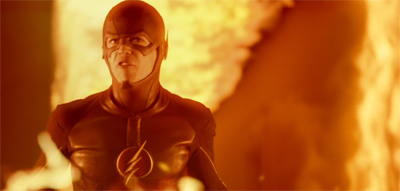
CGI flames! My fatal weakness!

CGI flames! My fatal weakness!

Given the amount of attention and effort that Fastest Man Alive devotes to cementing the foundations of The Flash, it’s understandable that there really isn’t too much room for anything else. Fastest Man Alive is about settling the cast and the writers into a sustainable status quo for the next stretch of episodes – maybe even the entire first season. It makes sure that everybody knows where everything lies and that there’s a solid base upon which to build.

So, while Fastest Man Alive might not be an especially brilliant episode of television, it does a very good job of setting up what it needs to set up.

Born to run...

Born to run…

Continue reading

The Flash (1987-2009) #3-4 – The Killg%re/Kill the Kilg%re! (Review)

So, I’m considering reviewing this season of The Flash, because the pilot looks interesting and I’ve always had a soft spot for the Scarlet Speedster. I’m also considering taking a storyline-by-storyline trek through the 1987-2009 Flash on-going series as a companion piece. If you are interested in reading either of these, please let me know in the comments.

In many respects, The Kilg%re and Kill the Kilg%re are indicative of Mike Baron’s approach to plotting The Flash. There’s never really a sense of an over-arching plot. It often feels like the comic is not being written with a structured story in mind. As the reader follows the story, it seems to develop and grow and move in odd directions. It’s hard to figure out exactly where any of these stories are going, because Baron himself never seems entirely certain from one moment to the next.

In a way, this style of storytelling suits The Flash as a character and as a comic. The Scarlet Speedster is all about forward momentum, a sense of urgency and dynamism. The sense that Baron is making all this up on the spot is energetic at points, because it feels like the comic is being written by the seat of his pants. However, it also means that the character and plot beats can feel arbitrary and illogical, as if to demonstrate that what works in a particular moment is not guaranteed to work in a larger context.

Hate to burst his bubble...

Hate to burst his bubble…

Continue reading

Scott Snyder and Greg Capullo’s Run on Batman – Zero Year: Secret City & Dark City (Review/Retrospective)

23rd July is Batman Day, celebrating the character’s 75th anniversary. To celebrate, this July we’re taking a look at some new and classic Batman (and Batman related) stories. Check back daily for the latest review.

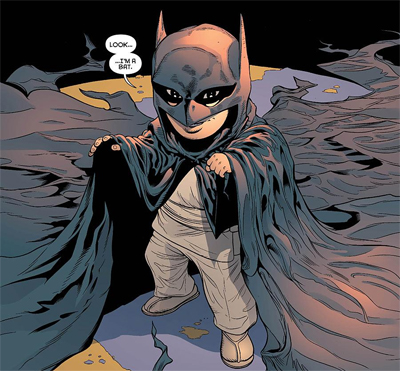
It takes considerable bravery to craft an origin story for Batman in the wake of Frank Miller and David Mazzucchelli’s Year One.

Superhero origins are constantly being tweaked and re-written and re-worked. Superman has had a half-dozen comic book origins (in- and out-of-continuity) since Crisis on Infinite Earths rebooted the DC universe. There’s John Byrne’s Man of Steel, Kurt Busiek’s Secret Identity, Mark Waid’s Birthright, Geoff Johns’ Secret Origin, J. Michael Straczynski’s Superman: Earth One and even Grant Morrison’s Action Comics run.

It's only a pale moon...

It’s only a pale moon…

In contrast, Batman has been relatively undisturbed, with only Geoff Johns’ Batman: Earth One positing an alternate origin story for the Caped Crusader. A large part of that is down to how sacred Year One is. Written by Frank Miller and David Mazzucchelli, Year One is considered to be one of the best Batman comics ever published. It recently topped Comic Book Resources’ high-profile fan poll for the character’s seventy-fifth anniversary.

In many cases, an “if it ain’t broke…” mentality applies. Having a universally-beloved comic book story that is easily accessible as the origin story for a particular character is not a bad thing at all. You can hand Year One to anybody and they can read and enjoy it. Although undoubtedly a product of the late eighties, the comic remains relevant and compelling to this day. Indeed, we have not moved so far from the eighties that it’s hard to reconcile a Batman origin grounded in that social context.

Talk about falling so far...

Talk about falling so far…

However, Scott Snyder and Greg Capullo are the creative team working on the Batman book for the character’s seventy-fifth anniversary. The duo have enjoyed a tremendous run – managing that rare intersection of critical and commercial success in mainstream comics. There are legitimate criticisms to be made, but Snyder and Capullo’s Batman work does hold up as some of the best Batman comics produced in quite some time, and one of true success stories of DC’s “new 52.”

So, if there was ever a time to go back to Batman’s origin, this was it. A well-loved creative team, a significant anniversary, a clear distance between this time and Year One. The risk associated with Zero Year is phenomenal. It is an incredible gambit. Even though the story is not in competition with Year One, comparisons are inevitable. The result is a very satisfying and exciting tribute to an iconic comic book character that doesn’t quite surpass Year One, but is clever enough to be clear that it isn’t trying to.

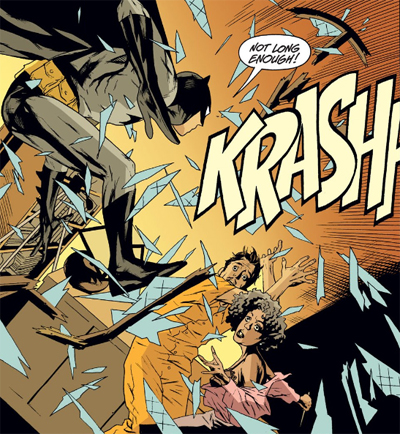
Getting into the swing of things...

Getting into the swing of things…

Continue reading

Batman – Arkham Asylum: Living Hell (Review/Retrospective)

23rd July is Batman Day, celebrating the character’s 75th anniversary. To celebrate, this July we’re taking a look at some new and classic Batman (and Batman related) stories. Check back daily for the latest review.

There is something absolutely compelling about witnessing the surreal and the impossible through the eyes of ordinary people. In the middle of the first decade of the twentieth century, DC seemed to take a novel approach to the larger Batman mythos. Acknowledging the absurdity of the world inhabited by the Caped Crusader, comic book fans were asked to look at that strange world from the perspective of the ordinary people inhabiting it.

Greg Rucka, Ed Brubaker and Michael Lark all collaborated on Gotham Central, the wonderful police procedural that offered a new way of examining the streets of Gotham. As observed by the members of the Gotham Police Department’s Major Crimes Unit, Gotham’s population of heroes and villains seemed particularly unsettling and ethereal. It is one thing to imagine the weird and wonderful world inhabited by the Batman and the Joker and the Mad Hatter. It is another to imagine sharing that world.

He knows how to make an entrance...

He knows how to make an entrance…

Launched a few months after the first issue of Gotham Central, Dan Slott and Ryan Sook’s wonderful Arkham Asylum: Living Hell is a six-issue miniseries that invites the reader inside the eponymous institution. As glimpsed through the eyes of white-collar criminal Warren White, Arkham Asylum is a place that defies explanation – a macabre and horrific environment that is home to all sorts of depravity and brutality.

Batman himself barely appears in Arkham Asylum: Living Hell, existing at the fringes of the book as he does with Gotham Central. However, despite these limited appearances, it remains clear that Warren White has found his way to the other side of the looking glass.

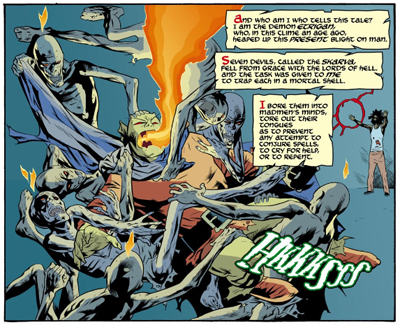
We all face our demons...

We all face our demons…

Continue reading

Peter Tomasi & Patrick Gleason’s Run on Batman & Robin – Pearl & Death of the Family (Review)

23rd July is Batman Day, celebrating the character’s 75th anniversary. To celebrate, this July we’re taking a look at some new and classic Batman (and Batman related) stories. Check back daily for the latest review.

Peter Tomasi is one of the best supporting writers in comics. Writing a supporting title in a shared superhero universe is a very daunting task. It requires a unique ability to weave into (and out of) events and storylines dictated by more high-profile writers on more popular books. Due to the structuring of superhero publishing, the direction for an entirely line is typically dictated by one (or maybe two) books, with the rest of the line alternating between supporting those books and trying not to make waves.

Tomasi is very good at this. His Green Lantern Corps book provided a suitably solid support for Geoff Johns’ more high-profile Green Lantern comic. He was the logical choice to take over Batman & Robin after Grant Morrison departed, even if the book did cycle through a variety of creators including Paul Cornell and Judd Winick. Tomasi is a writer with a lot of experience as an editor, and – as such – has a knack for picking up on themes and core values of particular writers.

He shall become a bat...

He shall become a bat…

Following the “new 52” relaunch, Batman & Robin was very much a satellite book in DC’s Batman line. It was a holding pattern, a book designed to feature Damian Wayne while Grant Morrison prepared to launch into Batman Incorporated. It was part of a line that was largely being driven by Scott Snyder and Greg Capullo’s work on Batman. There was no sense writer Peter Tomasi and Patrick Gleason would be doing anything particularly bold or daunting with the book at this moment in time.

Dutifully, following an eight-issue introductory arc, Born to Kill, Batman & Robin found itself bouncing around between various high-profile crossovers in the Batman line and in the wider context of DC’s publishing schedule. In the spate of issues between Born to Kill and the end of Grant Morrison’s Batman Incorporated run, Tomasi and Gleason find themselves navigating a veritable minefield of DC continuity and crossovers.

Everything burns...

Everything burns…

Continue reading

Batman: Shadow of the Bat – The Last Arkham (Review)

23rd July is Batman Day, celebrating the character’s 75th anniversary. To celebrate, this July we’re taking a look at some new and classic Batman (and Batman related) stories. Check back daily for the latest review.

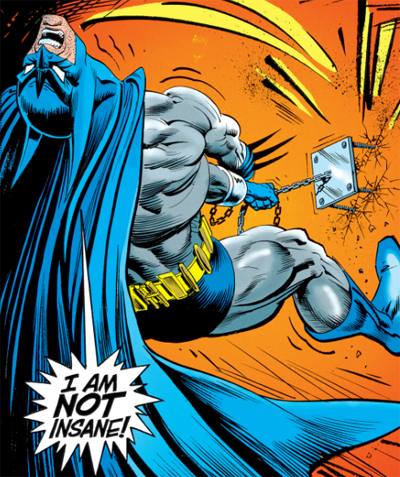
In 1992, DC comics launched Shadow of the Bat. It ran for eight years and ninety-two issues. Alan Grant wrote most of those issues, before his creative relationship with the publisher eventually broke down. (Grant is still upset about the manner of his dismissal.) As the driving force behind the book, Grant was able to give Shadow of the Bat its own unique flavour, focusing on the madness of Gotham, and the strangeness of its inhabitants.

The opening four-part story, The Last Arkham, remains perhaps the most definitive of Grant’s contributions to the Batman mythos, teaming up with artist Norm Breyfogle to offer a rather creepy and unnerving exploration of the city’s ever-slipping sanity.

Me thinks the Batman doth protest too much...

Me thinks the Batman doth protest too much…

Continue reading

Scott Snyder & Greg Capullo’s Run on Batman – The Court of Owls, Night of the Owls & The City of Owls (Review/Retrospective)

23rd July is Batman Day, celebrating the character’s 75th anniversary. To celebrate, this July we’re taking a look at some new and classic Batman (and Batman related) stories. Check back daily for the latest review.

The “new 52” was a rather polarising experiment.

Claiming to restart their entire universe from scratch after the events of Flashpoint, DC comics claimed the initiative would make comic books more accessible to the masses. Without decades of continuity to block access, new readers would be more likely to try to get into these sorts of comics. The decision to effectively start from scratch has been controversial – arguably compounded by the fact that writers like Geoff Johns or Grant Morrison were allowed to carry their work across the continuity reboot.

Swinging into action...

Swinging into action…

The team of Scott Snyder and Greg Capullo are among the longest serving of the “new 52” creators. The pair have remained on the flagship Batman book for three years, longer than the vast majority of creators recruited to help relaunch the DC universe back in September 2011. There’s a wonderful consistency and enthusiasm to their work, and it seems like the two have a very clear vision of where they want to take Batman, one of the characters with the most complex relationship to the re-launch.

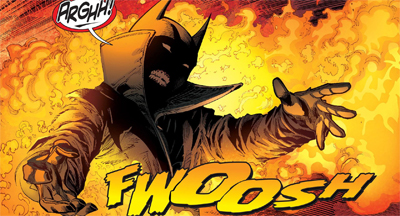
In many ways, The Court of Owls can be read as a meta-commentary on Batman’s position in the wake of Flashpoint, reflecting on the awkward relationship between the potential for novelty and the demand for familiarity.

Everything burns...

Everything burns…

Continue reading

Star Trek – Debt of Honour (Review)

This June, we’re taking a look at some classic Star Trek movie tie-ins and other interesting objects. Check back daily for the latest reviews and retrospectives.

By all accounts, Debt of Honour should be an unqualified success.

It’s a prestige graphic novel from DC comics, produced around the twenty-fifth anniversary of Star Trek and the release of Star Trek VI: The Undiscovered Country. It is written by celebrated comic book scribe Chris Claremont, fresh off his career-defining stint on Uncanny X-Men. An avowed Star Trek fan and comic book veteran, this should be in his wheel house. The art is provided by Adam Hughes, one of the most celebrated and respected artists of his time.

Talk about kicking off a comic...

Talk about kicking off a comic…

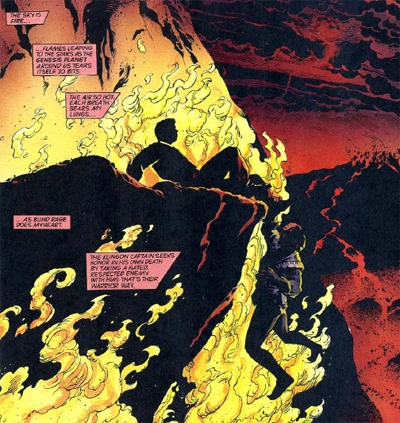
By any measure, Debt of Honour should count as some sort of hallmark for DC Comics’ Star Trek tie-ins. Unfortunately, that isn’t quite the case. A rather muddled storyline that is hopelessly devoted to Star Trek continuity while awkward interfacing with it,  Debt of Honour is just packed a little too tight. Charting a story from the earliest days of Kirk’s career to the aftermath of Star Trek IV: The Voyage Home, Claremont bites off more than he can chew.

Over the course of Debt of Honour, Claremont introduces a vague alien threat that has apparently been haunting Kirk for his entire career, a new arch-foe or love interest for Kirk, and even a supporting role for Kor. Along the way, he packs in cameos and shout-outs to various parts of Star Trek lore. He even explains why Klingons suddenly had ridges around the time of Star Trek: The Motion Picture. Ultimately, Debt of Honour is ambitious, but a little over-stuffed and quite over-cooked.

Warp speed ahead!

Warp speed ahead!

Continue reading

Star Trek (DC Comics, 1989) #35-40 – Tests of Courage/The Tabukan Syndrome (Review)

This June, we’re taking a look at some classic Star Trek movie tie-ins and other interesting objects. Check back daily for the latest reviews and retrospectives.

Captain Hikaru Sulu occupies a very special place in Star Trek lore. Given the amount of spin-off material that Sulu’s command of the Excelsior has generated, Sulu often seems like the Star Trek spin-off that never quite materialised. The idea of Sulu commanding the Excelsior has inspired novels and comics and audio books, and was even featured in Flashback, one of the episodes produced to celebrate the thirtieth anniversary of the franchise.

While Sulu’s command of the Excelsior is open-ended, it is interesting to consider the various origin stories that might apply. As with Khan Noonien Singh, there are multiple tie-in stories that cover the same ground. Published in late 2007, the novel Forged in Fire, for example, offers one account of Sulu taking command of the Excelsior – assuming command from Captain Styles during a high-pressure diplomatic crisis. However, this was not the first time that the story had been told.

Crossing swords...

Crossing swords…

A year following the release of Star Trek VI: The Undiscovered Country, author Howard Weinstein wrote Tests of Courage. A six-issue arc set during the earliest days of Sulu’s command, Weinstein had originally hoped to collaborate with George Takei on the comic. Unfortunately, the two could not work out their schedules, forcing Weinstein to write the comic without Takei’s input. However, Takei did provide a glowing and enthusiastic foreword for the collected edition of the comic published two years later.

Tests of Courage is a fantastic piece of work, a suitably epic Star Trek comic that tells a suitably epic story – one with breadth and scope and drama and conflict that demonstrates just what a wonderful storyteller Howard Weinstein is.

Ships of the line...

Ships of the line…

Continue reading