












This month, we’re doing daily reviews of the second season of Daredevil. Check back daily for the latest review.
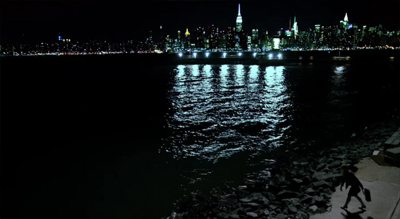
The Marvel Universe has a strong attachment to New York City.
There are any number of examples that might be cited, from the lighting of the Empire State Building in blue and red to celebrate the release of The Amazing Spider-Man to J. Michael Straczynski’s cringe-inducing issue of The Amazing Spider-Man where megalomaniac (and occasionally mass murdering) supervillain Doctor Doom cries in the rubble of the World Trade Centre. The company and its characters have a long and rich history that is intertwined with the city itself.

Church Devil.
At the same time, certain titles and characters have stronger attachments to particular areas and eras of the city. Spider-Man will always be rooted in Manhattan. The X-Men are symbolically tied to Westchester. Daredevil might be connected with Hell’s Kitchen, but he is anchored in a very particular version of Hell’s Kitchen; the gritty version of Daredevil pioneered by Frank Miller is tied to the dangerous neighbourhood as it existed against the backdrop of the seventies and eighties. (The Punisher is similarly rooted in seventies and eighties New York.)
Of course, Hell’s Kitchen has changed in the intervening years. It is no long as run down as it once was, subject to the forces of gentrification and modernisation. The first season of Daredevil touched on this idea, using the Chitauri attack from The Avengers to explain why the neighbourhood had been set back a few decades and turned into an urban hellhole. Wilson Fisk was suggested to be plotting a gentrification that had already taken place in the real world, casting out working-class inhabitants in order to remodel the area.

In with a shot…
The second season of Daredevil adopts something of a different approach, which makes sense given the transition from producer Steven DeKnight to Doug Petrie and Marco Ramirez. Although there are fleeting references to “the Incident” later in the season, the invasion is no longer used to explain the urban nightmare of Hell’s Kitchen. Instead, the season adopts an approach akin to a stylistic period piece. Although Daredevil is still unfolding in the present day, the series is populated with markers that place it in an earlier context.
Bang seems to suggest that Daredevil is unfolding a version of New York anchored in the summer of 1977.

Don’t leave us hanging…
Filed under: Television | Tagged: daredevil, new york, seventies, the punisher | 4 Comments »






 the m0vie blog