• Following Us

  • Categories

  • Check out the Archives


  • Awards & Nominations

Doctor Who: The Caves of Androzani (Review)

To celebrate the fiftieth anniversary of the longest-running science-fiction show in the world, I’ll be taking weekly looks at some of my own personal favourite stories and arcs, from the old and new series, with a view to encapsulating the sublime, the clever and the fiendishly odd of the BBC’s Doctor Who.

The Caves of Androzani originally aired in 1984.

Androzani Major was becoming quite developed the last time I passed this way.

When was that?

I don’t remember. I’m pretty sure it wasn’t the future.

You’re a very confusing person to be with, Doctor, you know that?

I tried keeping a diary once. Not chronological, of course, but the trouble with time travel is one never seems to find the time.

– The Doctor and Peri reflect on travel in the TARDIS

At the risk of succumbing to cliché, The Caves of Androzani is my favourite Doctor Who serial from the classic series. A perfect encapsulation of Peter Davison’s tenure, a fitting farewell story that incarnation of the Doctor, and arguably the perfect regeneration adventure, The Caves of Androzani is one of the very few DVDs that I happen to own twice. And that’s quite a ringing endorsement.

Five outta five?

Continue reading

Doctor Who: The Sensorites (Review)

To celebrate the fiftieth anniversary of the longest-running science-fiction show in the world, I’ll be taking weekly looks at some of my own personal favourite stories and arcs, from the old and new series, with a view to encapsulating the sublime, the clever and the fiendishly odd of the BBC’s Doctor Who.

The Sensorites originally aired in 1964.

There’s one thing about it, Doctor. We’re certainly different from when we started out with you.

That’s funny. Grandfather and I were talking about that just before you came in. How you’ve both changed.

Well we’ve all changed.

Have I?

Yes.

Yes, it all started out as a mild curiosity in a junkyard, and now it’s turned out to be quite a, quite a great spirit of adventure, don’t you think?

Yes. We’ve had some pretty rough times and even that doesn’t stop us. It’s a wonderful thing, this ship of yours, Doctor. Taken us back to prehistoric times, the Daleks.

Marco Polo, Marinus.

And the Aztecs.

Yes, and that extraordinary quarrel I had with that English king, Henry the Eighth. You know, he threw a parson’s nose at me.

What did you do?

Threw it back, of course.

– Ian, Susan, Barbara and the Doctor discuss character development

The Sensorites feels like a bit of a mess of an episode. It’s a six-part adventure, but one that feels quite a bit longer than it should be. The trip to Skaro in The Daleks ran for seven episodes, but it never felt quite as padded as this. There are some decent ideas and some nice character moments to be found in The Sensorites, if you’re willing to look hard enough, but there’s also quite a lot of padding, quite a lot of nonsense, and some plot developments that feel just a little bit convenient or contrived. This isn’t Doctor Who at anything approaching its best, but there’s still some measure of potential here.

Using your head...

Using your head…

Continue reading

Doctor Who: The Keys of Marinus (Review)

To celebrate the fiftieth anniversary of the longest-running science-fiction show in the world, I’ll be taking weekly looks at some of my own personal favourite stories and arcs, from the old and new series, with a view to encapsulating the sublime, the clever and the fiendishly odd of the BBC’s Doctor Who.

The Keys of Marinus originally aired in 1964.

While the initial thirteen-episode block helped established Doctor Who, it was the follow-up stories that built on those initial blue-prints. Marco Polo was a historical adventure in the style of An Unearthly Child, paying homage to the original educational aim of the series, designed to teach kids about history and science. However, the real breakout of the initial run had been The Daleks, with those adorable psychotic pepper pots. Keen to capitalise on the success of the futuristic adventure, another adventure serial was commissioned to take place on an alien world, with Terry Nation’s The Keys of Marinus helping to establish science fantasy as a concrete part of the show’s identity.

All a-Voord!

Continue reading

Doctor Who: The Daleks (Review)

To celebrate the fiftieth anniversary of the longest-running science-fiction show in the world, I’ll be taking weekly looks at some of my own personal favourite stories and arcs, from the old and new series, with a view to encapsulating the sublime, the clever and the fiendishly odd of the BBC’s Doctor Who.

The Daleks originally aired in 1963-4.

Make! no! attempt! to! capture! them! they! are! to! be! exterminated! you! understand! exterminated!

– four episodes in, the Daleks have a catchphrase

Because of the somewhat confusing naming conventions for the Hartnell era, where each individual episode had its own title, this one goes by a variety of names: The Mutants, The Dead Planet, or The Daleks. Still, if you’re reading this, you probably know the serial I’m talking about. It’s the one that introduced everyone’s favourite psychotic little pepper pots.

Taking the plunger…

Continue reading

Doctor Who: Dinosaurs on a Spaceship (Review)

You know when Amy and I first got married and we went travelling…

To Thailand?

More the entirety of space and time… in that Police Box.

– Rory and Brian Williams share some truths

There is a strange listlessness to the seventh season, despite its position on the cusp of the big anniversary year. In many ways, the seventh season feels awkwardly positioned between the “timey wimey” ambitiousness of the sixth season and the “new beginning” aesthetic of the eighth season. The fact that the seventh season is split in half doesn’t help matters; it feels like an epilogue to the story of Amy and Rory, and a prologue to the story of Clara. It feels very much like a “light” year, which is a strange way to head into a big anniversary celebration.

There is a curious sense of idleness to all this. There is, for example, no clear story that links both halves of the season – Jenna-Louise Coleman’s role in Asylum of the Daleks notwithstanding. The seventh season has no real purpose beyond clearing out the ensemble and building towards the anniversary. As a result, it can feel more than a little rudderless and indulgent. Steven Moffat has described the “blockbuster” aesthetic of the year, and long stretches of the season feel like the show is just doing stuff because it can.

Gone to the birds?

Give Amy and Rory a five-episode coda? Sure, why not! Actually shoot a western in a country that could pass for the United States? Go for it! It’s been a while since we’ve seen the Ice Warriors, hasn’t it? Throw them in there! Neil Gaiman wants to write a Cyberman episode? Ah, go on! Develop those quirky supporting characters from A Good Man Goes to War into a part of the show’s ensemble in Victorian London? It just makes sense! Richard E. Grant as a villain from two Second Doctor stories? We’d be crazy not to!

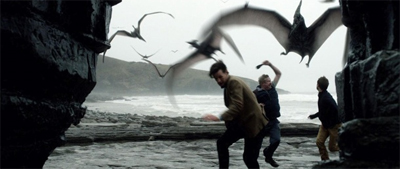
There is a sense that the seventh season is a victory lap for the show and many involved in the production. Deservedly so. What is the point of an anniversary year if you can’t go a little wild? That is the kind of thinking that leads to Dinosaurs on a Spaceship, a simple “because we can!” story. After all, one of the stock cringe-inducing Doctor Who images is the dinosaur special effects from Invasion of the Dinosaurs. What’s the point in turning the show into a hit if you can’t take an episode to prove how far your dinosaur effects have come in four decades?

Locking horns…

Continue reading

Doctor Who: Asylum of the Daleks (Review)

You’re going to fire me at a planet? That’s your plan? I get fired at a planet and expected to fix it?

In fairness, that is slightly your M.O.

Don’t be fair to the Daleks when they’re firing me at a planet.

And more wacky structural hijinks ensue.

The sixth and seventh seasons of the revived Doctor Who are strange beasts, for a number of reasons. The decision to split the seasons stands out, but there is also a sense that they are structured in a counter-intuitive manner. The Impossible Astronaut and Day of the Moon served as a two-part season finalé, despite opening the sixth season. In contrast, Let’s Kill Hitler played like a frothy season premiere. (The Wedding of River Song is perhaps the most difficult to place; while certainly not a light run-around season opener, it was nevertheless a bit light for a finalé.)

Things are looking up...

Things are looking up…

The seventh season arguably streamlines the structure a bit. The Name of the Doctor plays almost like a season premiere, revealing the origin story for “the Impossible Girl” and teasing ideas like the War Doctor and Trenzalore relentlessly. In contrast, Asylum of the Daleks feels like a season finalé, teasing a new companion as the existing companions struggle to get on with their real lives, featuring fleets of Dalek ships destroying planets and massive amounts of continuity.

Indeed, the biggest problem with Asylum of the Daleks is that it has not enough time to establish all its core elements. Plot points come out of nowhere. Character beats are established in the same scenes that resolve them. Asylum of the Daleks is a big episode in keeping with the “blockbuster” aesthetic of the anniversary season, but it also establishes the limitations of that approach.

Moffat’s crack at writing a Dalek episode…

Continue reading