• Following Us

  • Categories

  • Check out the Archives


  • Awards & Nominations

Star Trek: Enterprise – Season 1 (Review)

Next year, Star Trek is fifty years old. We have some special stuff planned for that, but – in the meantime – we’re reviewing all of Star Trek: Enterprise this year as something of a prequel to that anniversary. This January, we’re doing the first season. Check back daily for the latest review.

The first season of Star Trek: Enterprise is caught at a crossroads.

On the hand, it needs to be something new and exciting. The first Star Trek show of the new millennium, Enterprise has to find a way of updating the franchise and pushing forward. It has to find a way to challenge audience expectations and demonstrate that – after fourteen consecutive years and twenty-one overlapping seasons – Star Trek still has something fresh and exciting to offer fans. After all, the television landscape had changed significantly since the late eighties. It was time for Star Trek to change with it.
ent-brokenbow3

On the other hand, there’s a clear desire to seek familiar comforts. Star Trek has been on the air consistently for over a decade now. That wouldn’t be the case if the franchise didn’t have its own merits. There’s a sense that the first season of Enterprise is drawn to the idea that it can keep doing what worked before, offering generic Star Trek stories with a new cast and a new theme tune. This is still Star Trek, after all. There’s nothing gained by changing it to the point where it is unrecognisable.

Throughout the first season, these two impulses seem to be at odds with one another, leading to a surreal sense of whiplash. Episodes that feel as unique as Breaking the Ice, Dear Doctor or Shuttlepod One sit alongside generic shows like Civilisation, Sleeping Dogs or Rogue Planet. The show frequently pushes itself in interesting directions, only to pull relent as it approaches the point of committal. The result is a first season that is uneven, but intriguing, one that has great potential – if not necessarily the will to fulfill it.
ent-shockwavepart1m Continue reading

Star Trek: Enterprise – Two Days and Two Nights (Review)

Next year, Star Trek is fifty years old. We have some special stuff planned for that, but – in the meantime – we’re reviewing all of Star Trek: Enterprise this year as something of a prequel to that anniversary. This January, we’re doing the first season. Check back daily for the latest review.

To be fair to Two Days and Two Nights, the episode itself isn’t a bad idea.

The stronger episodes of the first season have been those willing to allow the cast a bit of room to define their characters, luxuriating in the human side of mankind’s first real adventure to the stars. Episodes like Breaking the IceCold Front and Shuttlepod One were all built around character moments and interactions, featuring relaxed plotting that left room for the cast to develop their roles.

"So I'm coolin' at a bar, and I'm lookin' for some action.  But like Mike Jagger said, I can't get no satisfaction."

“So I’m coolin’ at a bar, and I’m lookin’ for some action.
But like Mike Jagger said, I can’t get no satisfaction.”

In theory, Two Days and Two Nights does the same thing. Essentially a “holiday episode”, the show features the senior staff of the Enterprise taking two days of vacation time on the surface of Risa. A series of loosely-connected adventures ensue, following members of the main cast as they try to take a break from it all. No points for guessing that very few members of the crew actually get the relaxing vacation they had hoped for.

The problem is that the plot threads all feel a little tired and awkward, coalescing into a Star Trek comedy episode that simply isn’t funny.

It all falls down...

It all falls down…

Continue reading

Star Trek: Enterprise – Fallen Hero (Review)

Next year, Star Trek is fifty years old. We have some special stuff planned for that, but – in the meantime – we’re reviewing all of Star Trek: Enterprise this year as something of a prequel to that anniversary. This January, we’re doing the first season. Check back daily for the latest review.

Fallen Hero works quite well. While it isn’t sturdy or tight enough to stand with the very best of this first season, it is an engaging diplomatic thriller elevated by a fantastic guest performance, a nice focus on T’Pol and a surprisingly warm approach to the Vulcans. Easily the strongest episode between Shuttlepod One and Shockwave, Fallen Hero is a solid adventure that offers a glimpse of a more promising future.

I'll drink to that...

I’ll drink to that…

Continue reading

Star Trek: Enterprise – Acquisition (Review)

Next year, Star Trek is fifty years old. We have some special stuff planned for that, but – in the meantime – we’re reviewing all of Star Trek: Enterprise this year as something of a prequel to that anniversary. This January, we’re doing the first season. Check back daily for the latest review.

Acquisition feels like a misstep for the first season of Star Trek: Enterprise.

It’s not the worst episode of the season. In fact, it falls rather comfortably into the show’s “big middle” – the random and generic episodes that take Star Trek clichés and execute them in a competent manner while overlooking the opportunity to do something a bit more novel and exciting. Acquisition ranks with failures like Civilisation or Sleeping Dogs or Rogue Planet. It is competently executed and contains a few moments of merit, but there’s a feeling that this has all been seen before.

"Take us to your leader."

“Take us to your leader.”

Of course, Acquisition serves to foreground a number of pressing concerns about the production of Enterprise. It’s something of a lightening rod to certain aggressive elements of fandom. Bringing back the Ferengi for a guest appearance proves that the show is more of a prequel to Star Trek: The Next Generation than to the original Star Trek. Glossing over continuity issues by refusing to name these marauding aliens demonstrates that the show clearly doesn’t care about continuity at all. Trying to do a comedy episode featuring the Ferengi demonstrates the producers have no idea what does and doesn’t work in Star Trek production.

All of this is, of course, nonsense. Acquisition isn’t a bad episode because it plays with continuity, or because it features the Ferengi. It’s a bad episode because it’s a comedy adventure that isn’t particularly funny or exciting.

"Hey, at least we got here before the Borg..."

“Hey, at least we got here before the Borg…”

Continue reading

Star Trek: Enterprise – Silent Enemy (Review)

Next year, Star Trek is fifty years old. We have some special stuff planned for that, but – in the meantime – we’re reviewing all of Star Trek: Enterprise this year as something of a prequel to that anniversary. This January, we’re doing the first season. Check back daily for the latest review.

Silent Enemy is very much a game of two halves.

It’s an episode that suffers from the decision to incorporate two radically different plots into a single episode. In many respects, it’s a show that suffers from Star Trek: Enterprise‘s decidedly old-fashioned storytelling aesthetic: the sense that most hours of Star Trek need to have two plots running through them for pacing and structural reasons. This storytelling technique is a decidedly outdated approach to television, reflecting the narrative conservatism at play in the first season of the show.

We come in peace...

We come in peace…

Silent Enemy is built around two plots. The primary plot sees the ship coming into conflict with a bunch of strange predatory aliens who do not respond to attempts for contact, and who grow increasingly belligerent over the course of the episode. Archer and his crew find themselves facing an opponent far stronger and more aggressive than they are. It’s a pretty bleak, pretty heavy plotline. Inevitably, the show decided to pair it with something a bit more light-hearted, so we get Hoshi trying to figure out what Reed’s favourite food is that Chef can bake him a super-special birthday cake.

While the combination of plotlines isn’t the worst in the history of the franchise – the episode doesn’t feel like Frankenstein’s monster in the same way that Life Support does, for example – it’s still rather incongruous. Silent Enemy is an episode weakened by the decision to combine these two into a single story; the desire to offset the doom of the “Enterprise under siege” story with something a bit more easy-going and comedic.

Alien aliens...

Alien aliens…

Continue reading

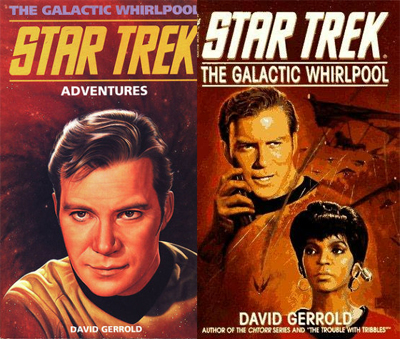
Star Trek – The Galactic Whirlpool by David Gerrold (Review)

The first Star Trek pilot, The Cage, was produced in 1964. To celebrate its fiftieth anniversary, this December we are reviewing the second season of the original Star Trek show. You can check out our first season reviews here. Check back daily for the latest review.

David Gerrold is one of the very few Star Trek writers to become an established science-fiction writer after his work on the television show.

Sure, writers like Ronald D. Moore and Brannon Braga have continued to work in genre television and film, but Gerrold is unique in that he has built up a reputation as a formidable science-fiction novelist. “By any reasonable definition David Gerrold is a major figure in science fiction,” the New York Times has argued. It seems hard to disagree. If Roddenberry had produced Star Trek a decade or so later, he may have been approaching David Gerrold the same way he approached Ray Bradbury or Theodore Sturgeon.

Gerrold joined the writing staff in the second season of Star Trek, following a number of failed pitches. The writer managed to sell The Trouble With Tribbles, which became one of the most iconic and memorable Star Trek episodes ever written. He was such a success that he was drafted in to punch up I, Mudd – the script going into production before The Trouble With Tribbles. Gerrold would hang around for the third season of the show and would become one of the defining voices on Star Trek: The Animated Series with D.C. Fontana.

galacticwhirlpool

Gerrold remained busy in the long gap before Star Trek: The Next Generation, writing a string of well-regarded one-off science fiction novels in the seventies; however, perhaps his best-known work in the interregnum was The War With the Chtorr, his series of novels documenting an alien invasion of Earth. When he fell out with Gene Roddenberry over the production of The Next Generation, Gerrold would launch his popular Star Wolf series – a bunch of novels adapted from a television pitch that feel very much like his vision of The Next Generation.

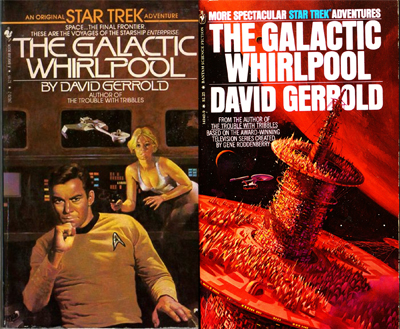
However, despite this success outside Star Trek, Gerrold remains quite attached to that massive shared universe. Indeed, he recently adapted his own infamously lost Next Generation script – Blood and Fire – for Star Trek: Phase II. However, this was not Gerrold’s first “non-televised” piece of Star Trek. The author was responsible for The Galactic Whirlpool, the fourteenth Bantam Star Trek novel published in 1980. The novel was published shortly before the license was handed over to Pocket Books, and is a remarkable accomplishment.

galacticwhirlpool2 Continue reading

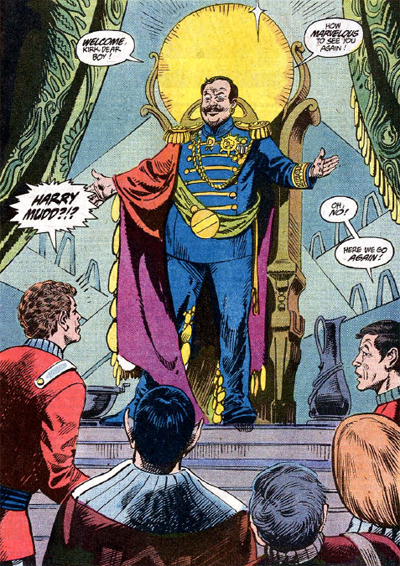
Star Trek (DC Comics, 1984) #39-40 – The Return of Mudd (Review)

The first Star Trek pilot, The Cage, was produced in 1964. To celebrate its fiftieth anniversary, this December we are reviewing the second season of the original Star Trek show. You can check out our first season reviews here. Check back daily for the latest review.

By its nature, Star Trek had very few recurring guest stars – outside of recurring extras and the supporting senior staff.

Star Trek was a prime-time science-fiction show in the sixties. As such, it was strongly episodic. More than that, it was a show that included its stated goal – “to explore strange new worlds” – in a narration over the opening credits. As such, the show did not tend to bring back too many recurring characters. Gene L. Coon had tried to introduce a recurring foil for Kirk in the second season, but Robert Justman had vetoed the reappearance of Kor in A Private Little War and Coon would depart before he could follow through on plans to make Koloth a recurring adversary.

Our man Mudd...

Our man Mudd…

Of course, this has not stopped Star Trek fans from seizing on various one-shot characters from the three seasons of the original Star Trek. Despite only appearing in Errand of Mercy, Kor has become a frequently recurring character in the Star Trek mythos. Gary Seven has spun off from Assignment: Earth into a string of novels and comics. Christopher Pike only appeared with Kirk in one single story, but there is a huge amount of literature dedicated to him. Still, this means that the elements which do recur are given a bit more weight.

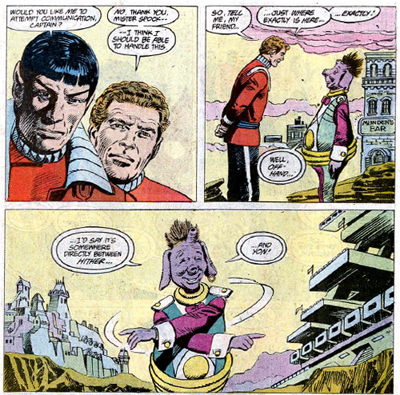
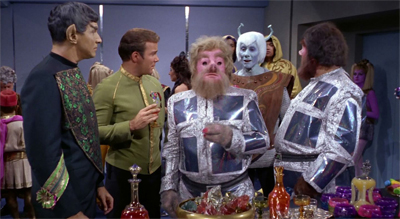
Klingons, Romulans and Vulcans are a vital part of the Star Trek mythos. Khan Noonien Singh only appeared in Space Seed and Star Trek II: The Wrath of Khan, but his memory haunts the franchise to the point where he was revived for Star Trek Into Darkness. Harry Mudd has the distinction of being the only non-crewmember to recur within the original run of eighty episodes. So it is no surprise that Harry Mudd has become one of the most frequently recurring guest stars in the history of the franchise.

Kirk meets quirky...

Kirk meets quirky…

Continue reading

Star Trek – Journey to Babel (Review)

The first Star Trek pilot, The Cage, was produced in 1964. To celebrate its fiftieth anniversary, this December we are reviewing the second season of the original Star Trek show. You can check out our first season reviews here. Check back daily for the latest review.

Journey to Babel is pretty influential, as episodes of Star Trek go. It is an episode that really cements idea of the Federation that came to be at the heart of the franchise, suggesting that the organisation really is a diverse intergalactic alliance of diverse alien species, rather than a union between Earth and Vulcan. More than that, the episode suggests that the individual members of the Federation might not exist in perfect harmony with one another, but may each operate with their own agenda and motivations.

However, what is really remarkable about Journey to Babel is how much of this unfolds in the background. All this world-building and -embellishing is very much a secondary concern for writer D.C. Fontana. Despite its scale and its scope, Journey to Babel is a decidedly personal story about a family in crisis. It works remarkably well, offering viewers a bit more insight into Spock as a character and where he came from.

Party on, Gav...

Party on, Gav…

Continue reading

Star Trek (IDW, 2009) #15-16 – Mirrored (Review)

The first Star Trek pilot, The Cage, was produced in 1964. To celebrate its fiftieth anniversary, this December we are reviewing the second season of the original Star Trek show. You can check out our first season reviews here. Check back daily for the latest review.

The mirror universe is a fun concept.

Over the run of the franchise, quite divorced from the context of Mirror, Mirror, the mirror universe itself is an excuse to go big; to indulge in hammy and silly behaviour. There’s no need to worry about putting the toys back in the box, or even the general philosophy of the franchise as a whole. Appropriately enough, it becomes a place where you can do almost anything you might imagine with no real consequences. Writers get to do big space opera stuff, actors get to munch on the scenery.

All hail the empire...

All hail the empire…

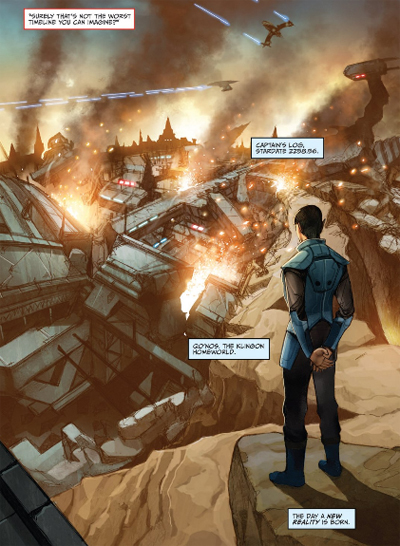
There is a reason that the most giddy and indulgent fan service from the already giddy and fan-service-filled fourth season of Star Trek: Enterprise was the two-parter set in the mirror universe. Indeed, Mirrored arguably borrows more from In a Mirror, Darkly than it does from Mirror, Mirror. The entire two-part story is launched from a casual conjectural conversation between Scotty and McCoy – suggesting that this might just be some flight of fancy. Indeed, the story cuts to the mirror universe as Scotty asks McCoy about “the worst timeline [he] can imagine.”

Mirrored is a very silly, very disposable story. It combines the weird fascination with alternate universes that runs through IDW’s monthly Star Trek series with the fixation on the events of JJ Abrams’ franchise-launching reboot. The result does not rank with the best mirror universe stories ever told, feeling too indulgent for its own good.

A cutting retort...

A cutting retort…

Continue reading

Star Trek: Mirror Universe – The Sorrows of Empire by David Mack (Review)

The first Star Trek pilot, The Cage, was produced in 1964. To celebrate its fiftieth anniversary, this December we are reviewing the second season of the original Star Trek show. You can check out our first season reviews here. Check back daily for the latest review.

There is a fairly significant lacuna in the internal chronology of the Star Trek universe, between the opening scene of Star Trek: Generations and Encounter at Farpoint. It is a fairly significant void that has only fleetingly been explored in various novels and comic books – most notably in Pocket Books’ intriguing Lost Era series. However, the lack of interest in this period is understandable. Not too much had changed between the end of Star Trek VI: The Undiscovered Country and the start of Star Trek: The Next Generation. Starfleet was still Starfleet, the Enterprise was still a ship of exploration.

In contrast, much more happened between the last act of Mirror, Mirror and the teaser of Crossover. The Terran Empire had collapsed in on itself, replaced by a hostile alliance of Klingons and Cardassians. Humans were no longer masters of their domain, instead forced to exist as slaves or mercenaries or rebels. The universe of Mirror, Mirror had been brutal, but ordered; the world of Crossover was brutal and chaotic. Everything had changed in a rather fundamental way. An empire had died, the enemy had stormed the gates. Everything was wrong.

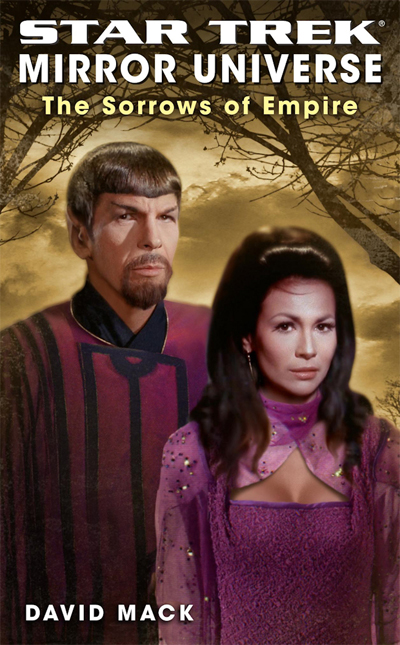
With The Sorrows of Empire, author David Mack begins a project to impose a clear structure on the mirror universe. Mack’s objective is essentially to stitch together a host of divergent (and perhaps even contradictory) continuity into a singular unifying narrative. The Sorrows of Empire was first published as a novella in the Glass Empires collection. However, his attempt to knit together the mirror universe as featured on the original show, Star Trek: Deep Space Nine and Star Trek: Enterprise was quickly expanded into its own full-length novel.

Indeed, having tied those various threads together, Mack would then try to resolve them all, writing Rise Like Lions to help stitch The Soul Key into his tapestry while resolving a long-dangling piece of Star Trek continuity. The Sorrows of Empire is a fascinating read, and Herculean effort. Mack shares the same knack for blending continuity with narrative as writers like Keith R.A. DeCandido or Christopher L. Bennett. However, The Sorrow of Empires struggles to get around the fact that it is trying desperately to put together a jigsaw from mismatched pieces that were never meant to be combined.

tos-thesorrowsofempire

Continue reading