• Following Us

  • Categories

  • Check out the Archives


  • Awards & Nominations

Millennium – Sense and Antisense (Review)

This May and June, we’re taking a trip back in time to review the fifth season of The X-Files and the second season of Millennium.

Sense and Antisense is a misfire.

It is an episode with far too much going on, and no time to unpack it all. Sense and Antisense moves like a rocket ship, jumping from one crazy idea to the next crazy idea. It opens with the threat of a viral contagion, but quickly escalates into the realm of conspiracy theories and mind control. It is an episode that is almost impossible to summarise without sounding as crazy as some of the characters populating the narrative. It is unsatisfying and disjointed, but not in a way that makes those sentiments seem part of the plan.
The pupil has become the master...

The pupil has become the master…

At the same time, it is an incredibly ambitious misfire. The biggest problem with Sense and Antisense is that it tries to cram too much in there. It is constructed almost writer Chip Johannessen tried to condense down contemporary conspiracy theory into a single forty-five minute story that winds up connecting the Department of Energy to the Rwandan Genocide. There is a breathless enthusiasm to all this that would make Fox Mulder blush. As much as Sense and Antisense doesn’t work, it is hard not to admire it’s sheer gumption.

The second season of Millennium might not be the most consistent season in the history of the medium, but even its failures are bold and energetic. Sense and Antisense is not The Curse of Frank Black, Jose Chung’s “Doomsday Defense” or Luminary, but it is a far cry from something like Unrequited, Synchrony or Schizogeny.
A stain on the record...

A stain on the record…

Continue reading

Star Trek: Enterprise – The Crossing (Review)

Next year, Star Trek is fifty years old. We have some special stuff planned for that, but – in the meantime – we’re reviewing all of Star Trek: Enterprise this year as something of a prequel to that anniversary. This April, we’re doing the second season. Check back daily for the latest review.

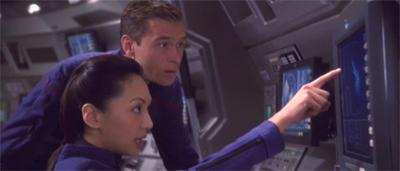
The Crossing represents a troubling return to form for the second season of Star Trek: Enterprise in a number of ways.

In terms of basic storytelling, the show is back at the point where it is simply throwing Star Trek plots into a blender and serving up a rather unappetising smoothy. The Crossing is packed with familiar Star Trek tropes – it is Return to Tomorrow by the way of Power Play through Cathexis. The idea of non-corporeal entities hijacking living bodies is not particularly novel, and The Crossing really has nothing new to offer in terms of that sort of story. There is no element of The Crossing as fun as Leonard Nimoy’s performance in Return to Tomorrow or the hostage crisis stakes of Power Play.

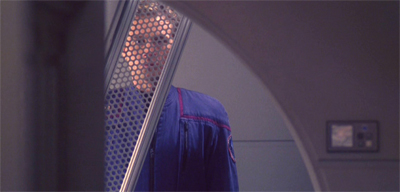
Here's Trip!

Here’s Trip!

However, even without the feeling of reheated leftovers, The Crossing is a very ugly little story. It reflects the reactionary post-9/11 politics of the show, the sense of isolationism and xenophobia that have become part of the fabric of Enterprise. The Crossing is essentially a fifties horror film repurposed as a post-9/11 cautionary tale about the dangers of trusting people who are not like you. It feels like a pretty solid indication of just how thoroughly Star Trek has lost its way. The decision to just externalise these anxieties in The Expanse is long overdue.

The fact that The Crossing is credited to the two showrunners driving Enterprise is quite worrying, particularly given that it serves to express an uncomfortable subtext running through the season.

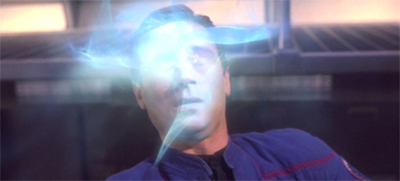
Having a gas time...

Having a gas time…

Continue reading

Star Trek: Enterprise – Future Tense (Review)

Next year, Star Trek is fifty years old. We have some special stuff planned for that, but – in the meantime – we’re reviewing all of Star Trek: Enterprise this year as something of a prequel to that anniversary. This April, we’re doing the second season. Check back daily for the latest review.

The Temporal Cold War arguably works better as a metaphor than a plot.

There is something quite compelling about the imagery of Star Trek‘s past and future doing battle within the confines of a troubled prequel, of outside forces meddling in a narrative, of the characters caught in the grip of forces they cannot understand. To expect the Temporal Cold War to make sense is to miss the point; to expect clear resolution is foolhardy. Instead of serving as a strong narrative thread running through Star Trek: Enterprise, it serves as a visual manifestation of the troubles haunting the show. It also serves as a very effective story backdrop.

Let's do the time warp again...

Let’s do the time warp again…

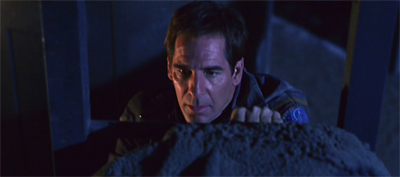
Future Tense has a pretty straightforward story. Archer and his crew discover a piece of floating space debris. They bring it aboard, discovering it is not what it appears to be. The Suliban show up, claiming salvage rights. The Tholians arrive, demanding the same. A chase ensues, as Archer tries to outrun the two alien species desperate to get their hands on the technology. Future Tense is a classic chase narrative, as multiple parties fight over what Hitchcock described as a “macguffin.” Little is revealed, nothing is proven, everything is resolved so neatly that it seems divine intervention is at work. Maybe it is.

And yest, despite – or perhaps because – of this narrative simplicity, Future Tense stands as a highlight of the troubled second season. Future Tense leaves almost every question about the Temporal Cold War unanswered, but it is a tight and efficient action adventure. Like Cold Front before it, it recognises that the Temporal Cold War is a story as much as a backdrop. The fact that it is mysterious and nonsensical and arbitrary make it all the more compelling. After all, that is how it must appear to Archer.

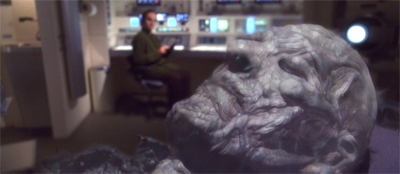
Alien bodies...

Alien bodies…

Continue reading

Star Trek: Enterprise – Cease Fire (Review)

Next year, Star Trek is fifty years old. We have some special stuff planned for that, but – in the meantime – we’re reviewing all of Star Trek: Enterprise this year as something of a prequel to that anniversary. This April, we’re doing the second season. Check back daily for the latest review.

It is weird to think that Star Trek was dying in early years of the twenty-first century.

After all, the original series had greatly increased its cultural cachet at the height of the Cold War. The adventures of James Tiberius Kirk offered an optimistic alternative to total nuclear annihilation and a doomsday clock that was rapidly approaching midnight. Logic would suggest that utopian fantasy was all the more essential when contrasted against harsh reality. In fact, it seemed like cynicism and pessimism thrived in the (relatively) peaceful and prosperous decade following the collapse of the Cold War. The X-Files and Star Trek: Deep Space Nine were inescapably products of the nineties.

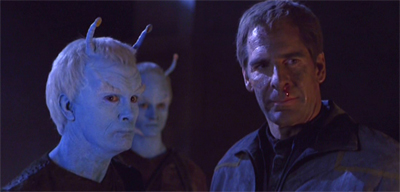
I'm blue dabba dee dabba dii...

I’m blue dabba dee dabba dii…

So one imagines that the dread and fear that took root in the wake of 9/11 might somehow make the optimism and hope of Star Trek all the more essential. After all, pundits and commentators wasted no time in suggesting that irony and cynicism were passé. Stephen Thompson, editor of The Onion, suggested that the age of irony had ended only a week after the attacks.  Graydon Carter, editor of Variety, observed, “I think it’s the end of the age of irony. Things that were considered fringe and frivolous are going to disappear.” In a highly publicised Time article, Roger Rosenblatt rejoiced.

Of course, irony was far from dead, as films like Team America: World Police demonstrated. The Colbert Report became a cultural phenomenon. The Onion is still in business. However, the speed with which these commentators latched on to the idea of the death of irony suggested that the mood had changed perceptibly. Maybe not definitively, maybe not completely, but there was a change in the air. If ever there was a time for the optimism and the utopianism of Star Trek, it would be this particular moment.

"This is the point where everything changed..."

“This is the point where everything changed…”

However, it seemed like 9/11 eroded the franchise’s faith in utopia. Understandably – and perhaps inevitably – Star Trek: Enterprise found itself warped by images and iconography associated with the attacks. The tradition idyllic alien worlds associated with the franchise – visible in early episodes like Strange New World and Civilisation were quickly replaced by landscapes evoking the popular mood – apocalyptic cityscapes of Shadows of P’Jem and Shockwave, Part II, the deserts of Desert Crossing, the militaristic settings of Detained and The Communicator, or even the darkness of Rogue Planet.

It was as if 9/11 had warped the psychological landscape of the Star Trek universe, throwing everything into doubt. Far from responding to that real-world tragedy with optimism and hope, it seemed that Enterprise only lost certainty in itself. Cease Fire is an episode that feels plagued by self-doubt and insecurity, even as it tries to find its way back to the franchise’s trademark idealism. It may not quite find its way back to the path, but it makes a reasonable effort.

It's all in ruins...

It’s all in ruins…

Continue reading

The X-Files: Season One (Topps) #2 – Deep Throat (Review)

This February and March, we’re taking a trip back in time to review the fourth season of The X-Files and the first season of Millennium.

Season One feels like a very odd way to franchise The X-Files.

Topps had enjoyed tremendous success with their licensed tie-in comic book, so it made a certain amount of sense to try to milk the franchise as much as possible. After all, they had already tried a number of other promotions, like releasing “digests” to supplement that monthly series and releasing tie-in comics to appear with magazines like Wizard. So offering another series that would publish on a regular basis starring Mulder and Scully made perfectly logical sense.

The truth is up there...

The truth is up there…

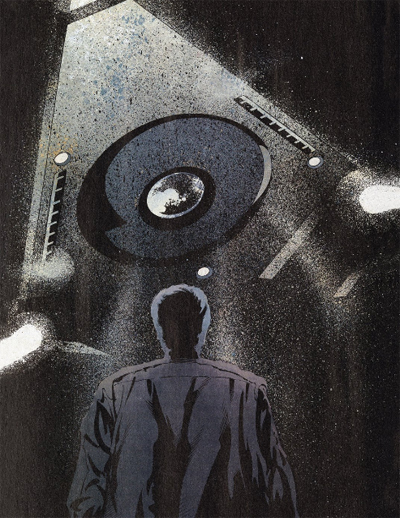
About a year after the release of their adaptation of The Pilot, Topps decided to push ahead with a series of regular adaptations of first season episodes of The X-Files. They reissued their adaptation of The Pilot as the first comic in the series, and then began publishing new adaptations of those early episodes written by Roy Thomas and illustrated by a rotating team of artists. The comics would be about twice as long as the issues of the monthly series, but would only publish once every two months. The monthly series was priced a $2.50, with Season One priced at $4.95.

It is hard not to feel quite cynical about Season One, particularly in an era where these classic episodes of The X-Files stream of Netflix and entire seasons are available to purchase at very low prices.

The shape of things to come...

The shape of things to come…

Continue reading

The X-Files – Zero Sum (Review)

This February and March, we’re taking a trip back in time to review the fourth season of The X-Files and the first season of Millennium.

For all that The X-Files exists in a murky shadow world populated by ambiguous figures and a government conspiracy dating back generations, the show has a pretty straightforward sense of morality. No good can stem from evil, the show seems to suggest; the show’s central mythology repeatedly has Mulder and Scully confront the legacy of sins committed by their forefathers. Even the title of Zero Sum alludes to the hollowness of Walter Skinner’s deal with the devil, his moral compromise that has no demonstrable benefit and severe demonstrable harm.

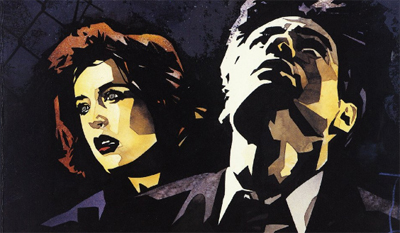
In Memento Mori, Walter Skinner compromised himself. He made a deal with the Cigarette-Smoking Man, in return for Agent Scully’s continued well-being. “What’ll it take?” Skinner asked, desperate for a chance to save Dana Scully. Ever ambiguous, the Cigarette-Smoking Man offered, “Well, I’ll have to get back to you on that.” Unfolding a few months later, Zero Sum is essentially about paying the piper. It is Walter Skinner settling up with the Cigarette-Smoking Man. He rolls up his sleeves and jumps into the dirty work.

Fire and brimstone...

Fire and brimstone…

Zero Sum is a story that you could not tell with Mulder. Although Mulder never faces the same choice as Skinner, the show has been quite consistent in its portrayal of Mulder’s morality. Mulder does not compromise; Mulder does not subscribe to the theory that a deal with the devil could ever pay dividends. In contrast, Skinner is a more ambiguous and pragmatic figure. Skinner spent significant sections of the second season caught between Mulder and the Cigarette-Smoking Man. The show only firmly committed him to Mulder and Scully in Paper Clip.

Zero Sum is a fantastic example of how the world of The X-Files has really grown and expanded around the lead characters. While the show will never quite develop into an ensemble, it is a series with a broad cast. It makes sense that it should begin to use them in a productive manner.

"Walter Skinner, F.B.I."

“Walter Skinner, F.B.I.”

Continue reading

The X-Files – Max (Review)

This February and March, we’re taking a trip back in time to review the fourth season of The X-Files and the first season of Millennium.

Reportedly, Tempus Fugit and Max took twenty-eight days to shoot. Assistant director Tom Braidwood described the two-parter as a “pretty challenging” effort for the show. The series built an air plane cabin specifically so that it could film those fantastic abduction sequences. There are fields and hangars strewn with dead bodies and the wreckage of a passenger air plane. By just about any definition, Tempus Fugit and Max comprise the most ambitious and large-scale two-part episode that the show has produced to date.

Paradoxically, this is also the smallest two-part episode that the show has produced to date. It brings back a minor guest star from a first season episode, only to kill him off casually in the teaser for the first episode. None of the big players show up for the drama. The most significant consequence of Tempus Fugit and Max is the death of Agent Pendrell. In many ways, Tempus Fugit and Max is the post-mortem story of a little guy who was crushed by the weight of something much larger than himself – caught between forces of immeasurable power.

In-flight serve will now resume...

In-flight service will now resume…

Tempus Fugit and Max do very little to advance the central mythology arc, which has stalled somewhat in the fourth season. However, they manage to encapsulate so many of the core themes of that central storyline. This is a story about the victimisation of the weak by the powerful; this is a tale about the sacrifices that are made in pursuit of the truth; this is a reflection on the appeal of conspiracy theory; this is a morality play about balancing lives against “the greater good.”

In many ways, Tempus Fugit and Max are the quintessential mythology episodes, despite not being that closely related at all.

Things are looking up...

Things are looking up…

Continue reading

The X-Files – Unrequited (Review)

This February and March, we’re taking a trip back in time to review the fourth season of The X-Files and the first season of Millennium.

Unrequited opens with Mulder and Scully’s attempts to stop an assassination attempt by an invisible man, before jumping back twelve hours to explain how our heroes got into this situation. With that set-up, Unrequited falls into a lot of the narrative traps associated with an in media res teaser. After all, there’s not really anything special about the teaser. There is no mystery to be solved, no strange behaviour to explain. What questions are we meant to ask, based on that opening scene? How are we meant to look at the rest of the episode differently, knowing what we know?

Sure, Mulder and Scully are protecting Major General Benjamin Bloch. That would seem to be a little bit outside the remit of “the FBI’s most unwanted”, but that is not too strange a situation for the duo. They are FBI agents, so there is a certain flexibility in their job description. The Field Where I Died – an episode with a much more effective non-linear teaser – featured Mulder and Scully collaborating with the ATF. So it isn’t as if the set-up should be striking or compelling.

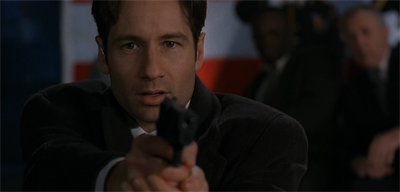
Stop, or my Mulder will shoot!

Stop, or my Mulder will shoot!

It seems like we are meant to focus on the monster of the week – Vietnam veteran Nathaniel Teager. Teager has the ability to turn himself invisible, which is quite something. Sure enough, the teaser to Unrequited offers a glimpse of that ability in action. But why is it important to have show us that ability in a scene from the climax of the episode? With a few adjustments, Teager’s first murder in the back of the limousine would serve the same purpose; introducing the audience to his powers without the need to recycle several minutes of footage from the climax.

After all, the most dissatisfying aspect of the in media res teaser is not the fact that it is completely inessential. Instead, the decision to use footage from the climax means that the audience has to sit through the same sequence twice. The teaser for Unrequited works well enough the first time around, but the sequence is not clever or inventive enough to merit a live-action replay towards the end of the hour. It just saps momentum from episode, rendering the final sequences somewhat tedious. That is the biggest problem with the opening of Unrequited, even beyond laziness.

Flags of our father figures...

Flags of our father figures…

Continue reading

The X-Files – Kaddish (Review)

This February and March, we’re taking a trip back in time to review the fourth season of The X-Files and the first season of Millennium.

Kaddish is the last solo script that Howard Gordon wrote for The X-Files.

The writer would remain part of the writing staff until the end of the fourth season, contributing to scripts like Unrequited or Zero Sum. However, Kaddish would be the last script credited to Howard Gordon alone. So Gordon does not quite get the clean farewell that Darin Morgan got with Jose Chung’s “From Outer Space” or that Glen Morgan and Howard Wong received with Never Again. Instead, Howard Gordon remains a pretty significant presence on the show even after writing his final solo script.

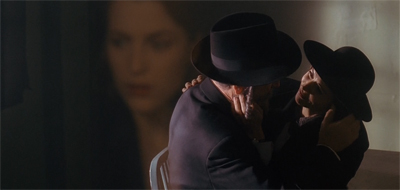
The word made flesh...

The word made flesh…

Nevertheless, Kaddish is packed with a lot of the images and themes associated with Gordon’s work. As with Fresh Bones or Teliko, it is a horror story set within a distinct ethnic community. As with Firewalker or Død Kälm or Grotesque, there is an element of body horror at play. As with Lazarus or Born Again, this is essentially a supernatural revenge story. Kaddish offers a distilled collection of the tropes and signifiers that Gordon helped to define for The X-Files, making it an appropriate final script for the writer.

It helps that Kaddish is a surprisingly sweet and thoughtful little horror story.

The outside looking in...

The outside looking in…

Continue reading

The X-Files – Terma (Review)

This February and March, we’re taking a trip back in time to review the fourth season of The X-Files and the first season of Millennium.

Tunguska and Terma borrows the structure that made the show’s early mythology episodes so effective. Tunguska is full of intriguing and compelling questions, implications that would seem to broaden or deepen the mythology. However, instead of resolving any of the major threads, Terma simply turns itself into a roller-coaster thrill ride. A cynical observer might compare the weaker mythology episodes to a shell-game: the potential of an interesting premise, lost in a shuffle designed to disorientate and catch the viewer off-guard.

It is an approach that has served the show well. Ascension avoided answering too many of the questions posed by Duane Barry, barrelling along with the momentum of a runaway freight train. Similarly, End Game did not dwell too heavily on the questions posed by Colony, instead serving as a series of high-momentum chase sequences with Mulder following the Alien Bounty Hunter to the ends of the Earth. Paper Clip moved so quickly that the viewers never wondered why the documents recovered in Anasazi were no longer earth-shattering, but merely macguffins.

Things are really heating up...

Things are really heating up…

The X-Files is very good at this sort of dynamic mile-a-minute plotting. The production team are very good at what they do. There is a sleek professionalism to these episodes that makes them easy to watch. Although filmed in Vancouver, there were few shows in the nineties ambitious enough to send their character to a Russian gulag for human experimentation. However, the cracks are starting to show. Herrenvolk demonstrated how frustrating a lack of answers could become. Terma struggles to balance a number of potentially interesting plot threads.

There are a lot of elements of Terma that might have worked well, if they had been given more room to breath. Sadly, the episode spends most of its run time trying to build up momentum towards the inevitable scene where proof narrow slips through Mulder’s fingers one more time.

Evil oil...

Evil oil…

Continue reading